semi合集-English.pdf - 第2417页
SEMI E86-0200 © SEMI 1999 , 2000 17 # Curre nt State Trigger New State Action Comment 3 NOT AT WORK STATION makeAtWorkStation ( ); sent to instan ce of Person. AT WORK STATION Person StateChanged event po sted by instan …
SEMI E86-0200 © SEMI 1999, 2000 16
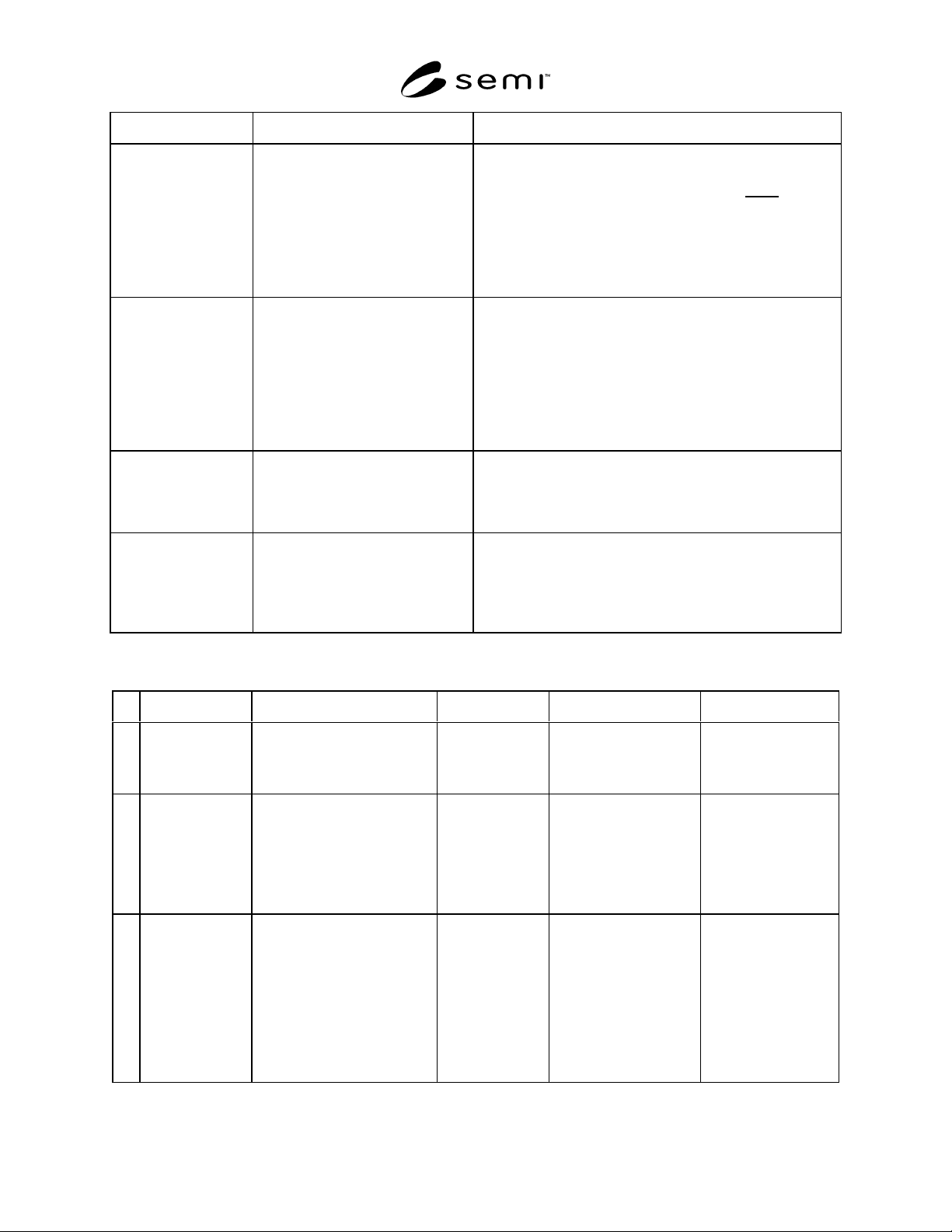
State Definition Query for State via
UNASSIGNED TO
JOBS
In this state a Person has not
been assigned to any jobs. A
Person may or may not be
assigned to job(s).
boolean isAssignedToJobs ( ) or boolean
isAssignedToJob (in Job aJob) [for all Jobs] sent to
instance of Person returns FALSE. Person NOT
included in set returned by PersonManager services
PersonSequence allPersonsAssignedToJob (in Job aJob)
[for all Jobs] or PersonSequence
allAssignedToJobsPersons ( ). Empty set returned by
Person service JobSequence assignedJobs( );
ASSIGNED TO
JOBS
In this parent state, a Person has
been assigned to one or more
job(s).
boolean isAssignedToJobs ( ) or boolean
isAssignedToJob (in Job aJob) sent to instance of Person
returns TRUE. Person included in set returned by
PersonManager services PersonSequence
allPersonsAssignedToJob (in Job aJob) or
PersonSequence allAssignedToJobsPersons ( ). Non-
empty set returned by Person service JobSequence
assignedJobs ( );
AVAILABLE FOR
MORE
ASSIGNMENTS
In this substate, a Person is
available for assignments to
more jobs.
boolean isAvailableForMoreJobAssignments ( ) sent to
instance of Person returns TRUE. Person included in set
returned by PersonManager service PersonSequence
allPersonsAvailableForJob (in Job aJob).
ASSIGNMENT AT
CAPACITY
EXCEEDED
In this substate, a Person can no
longer be assigned to another
job; that is, they are AT
CAPACITY with regard to job
assignment.
boolean isAvailableForMoreJobAssignments ( ) sent to
instance of Person returns FALSE. Person not included
in set returned by PersonManager service
PersonSequence allPersonsAvailableForJob (in Job
aJob).
Table 2 Person State Transitions
#
Current State Trigger New State Action Comment
non-existent createPersonWithIdentifier (in
string identificationNumber);
sent to an instance of
PersonManager.
NOT
AVAILABLE
1 NOT
AVAILABLE
makeOnShift( ); sent to
instance of Person.
AVAILABLE PersonShiftChanged
event posted by instance
of Person.
PersonStateChanged
event posted by instance
of Person.
Person logged on to
shift. Person is
assumed to be
initially available for
work (at work station)
and not assigned to
machines or jobs.
2
AT WORK
STATION
makeNotAtWorkStation ( );
sent to instance of Person.
NOT AT WORK
STATION
PersonStateChanged
event posted by instance
of Person.
Typically used for
situation where
Person is not
physically present at
work site (e.g., on a
break). Person is still
assigned to
machine(s) and/or
job(s). Person may be
busy with a job.

SEMI E86-0200 © SEMI 1999, 200017
#
Current State Trigger New State Action Comment
3 NOT AT WORK
STATION
makeAtWorkStation ( ); sent
to instance of Person.
AT WORK
STATION
PersonStateChanged
event posted by instance
of Person.
Person is physically
present at work site.
4
UNASSIGNED
TO MACHINES
assignToMachine (...); sent to
instance of Person.
ASSIGNED TO
MACHINES
PersonCapacityChanged
event posted by instance
of Person.
Person assigned to a
machine. For
example, a
Scheduling
Component might
assign an operator to
a machine.
5AVAILABLE
FOR MORE
ASSIGNMENTS
Sending assignToMachine
(...); to instance of Person
increments number of
machine assignments to AT
CAPACITY level.
ASSIGNMENT
AT CAPACITY
EXCEEDED
PersonStateChanged
event posted by instance
of Person.
6
ASSIGNMENT
AT CAPACITY
EXCEEDED
Sending
deassignFromMachine (...); to
instance of Person decrements
number of machine
assignments below AT
CAPACITY level.
AVAILABLE
FOR MORE
ASSIGNMENTS
PersonStateChanged
event posted by instance
of Person.
7
ASSIGNED TO
MACHINES
Sending
deassignFromMachine (...);
decrements number of
machine assignments to nil.
UNASSIGNED
TO MACHINES
PersonCapacityChanged
event posted by instance
of Person.
Person not assigned
to any machines.
8 UNASSIGNED
TO JOBS
assignToJob (...); sent to
instance of Person.
ASSIGNED TO
JOBS
PersonCapacityChanged
event posted by instance
of Person.
Person assigned to
job. Allocates a
Person to a
manufacturing task.
A Person may be
allocated to more than
one task at a time.
9
AVAILABLE
FOR MORE
ASSIGNMENTS
Sending assignToJob (...); to
instance of Person increments
number of job assignments to
AT CAPACITY level.
ASSIGNMENT
AT CAPACITY
EXCEEDED
PersonStateChanged
event posted by instance
of Person.
10 ASSIGNMENT
AT CAPACITY
EXCEEDED
Sending deassignFromJob
(...); to instance of Person
decrements number of job
assignments below AT
CAPACITY level.
AVAILABLE
FOR MORE
ASSIGNMENTS
PersonStateChanged
event posted by instance
of Person.
11 ASSIGNED TO
JOBS
Sending deassignFromJob (...)
decrements number of job
assignments to nil.
UNASSIGNED
TO JOBS
PersonCapacityChanged
event posted by instance
of Person.
Person not assigned
to any jobs.
12 AVAILABLE makeOffShift ( ); sent to
instance of Person.
NOT
AVAILABLE
PersonShiftChanged
event posted by instance
of Person.
PersonStateChanged
event posted by instance
of Person.
Person logged off of
shift.

SEMI E86-0200 © SEMI 1999, 2000 18
6.3.5 QualificationData Interface
Interface: QualificationData
Inherited Interface: NamedEntity
Description: This interface represents the record of training and medical examinations taken by factory
personnel. Successful completion of training and medical examinations qualifies
personnel for a factory operation (a skill).
It is anticipated that a Factory Labor application will specialize and instantiate this
interface to maintain the training and medical examination histories of factory personnel.
For example, CourseQualificationData and MedicalQualificationData sub-interfaces
could be defined. These sub-interfaces would exhibit most of the interesting behavior for
this interface. For instance, each sub-interface could be compared with a corresponding
sub-interface of the Skill Management Component interface SkillRequirement to
determine certification (qualification for a skill).
The attribute QualificationHistory indicates that either a specific course or a medical
examination was taken; information regarding the date and time the Person tested for the
qualification (when testing for a course or a medical examination occurred); and the
results of that test or examination.
Exceptions: None.
Published Events: None.
Provided Services:
/* Set and get the qualification descriptor (an abbreviated string which serves as a “short-hand” notation for
identifying the course or examination; e.g., a course number.) */
void setQualificationDesignator (in string designator)
raises (FrameworkErrorSignal);
string getQualificationDesignator ( ) raises (FrameworkErrorSignal);
/* Set and get the history for a qualification event. Historical information indicates that either a specific course or a
medical examination was taken; information regarding the date and time the Person tested for the qualification
(when testing for a course or a medical examination occurred); and the results of that test or examination. */
void setQualificationHistory (in History qualificationHistory)
raises (FrameworkErrorSignal);
History getQualificationHistory ( ) raises (FrameworkErrorSignal);
/* Return the date and time of qualification (when certification was made.) */
TimeStamp certificationDate ( ) raises (FrameworkErrorSignal);
Contracted Services: None.
Dynamic Model: None.
6.4 Skill Management Component
6.4.1 This component supports the management of the skill or skill set required to qualify personnel for a factory
operation. Specifically, the skills required in order that personnel can assist a process resource or job in the
performance of a process capability. Support is provided through association of skill requirements (training and
medical examinations which must be completed) with a specific skill or skill set. Some personnel management
aspect of the factory (e.g., training department) will interface with this component to define the training interface
and medical examination roadmaps to achieve certification for factory operations.
6.4.2 The Skill Management Component Information Model is shown in Figure 4.