semi合集-English.pdf - 第233页
SEMI E35-0305 © SEMI 1995, 2005 2 Figure 1 Relationship of Factors to Difficulty of Collection and Validation 4 Referenced Standards 4.1 SEM I Standards SEMI E10 — Specification for Definition and Measu r ement of Equipm…

SEMI E35-0305 © SEMI 1995, 2005 1
SEMI E35-0305
GUIDE TO CALCULATE COST OF OWNERSHIP (COO) METRICS FOR
SEMICONDUCTOR MANUFACTURING EQUIPMENT
This guide was technically approved by the Global Metrics Committee and is the direct responsibility of the
North American Metrics Committee. Current edition approved by the North American Regional Standards
Committee on December 10, 2004. Initially available at www.semi.org February 2005; to be published
March 2005. Originally published in 1995; previously published March 2004.
NOTICE: This document was completely rewritten in 2005.
1 Purpose
1.1 The purpose of this guide is to provide standard metrics for evaluating unit production cost effectiveness of
manufacturing equipment in the semiconductor industry.
1.2 This guide establishes a well-defined procedure to facilitate an understanding of equipment-related costs by
providing definitions, classifications, algorithms, methods, and default values necessary to build a full or constrained
cost of ownership (COO) calculator.
NOTE 1: Related Information 1 provides a graphical representation of calculating COO to expand upon the guide text.
2 Scope
2.1 This guide is applicable to any type of equipment for processing semiconductor units, which may be wafers,
devices, flat panels or other material. Some terms are specialized to integrated circuit wafer and device production.
2.2 Effective use of the metric to build a COO model requires identification of constraints and data values. Where
possible, use direct values for inputs rather than deriving them from secondary models or using example values.
NOTE 2: Related Information 2 provides some example data.
2.3 Full calculation of COO often requires data held proprietary and is coupled to the overall factory yield and the
related cost of yield loss. It is envisioned that this guide will be used for internal factory and equipment
optimization, investment evaluation, and equipment design improvements.
NOTICE: This standard does not purport to address safety issues, if any, associated with its use. It is the
responsibility of the users of this standard to establish appropriate safety and health practices and determine the
applicability of regulatory or other limitations prior to use.
3 Limitations
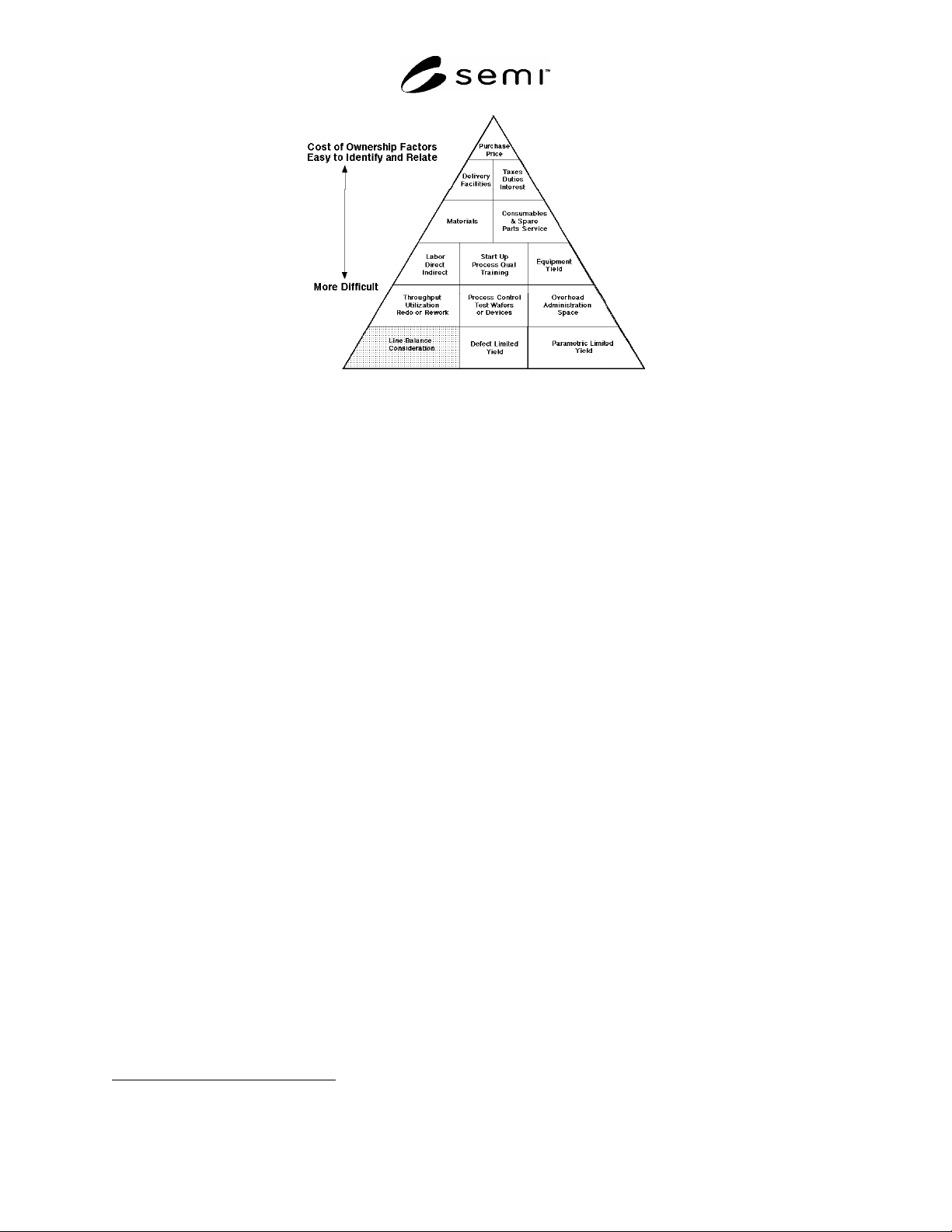
3.1 Certain cost factors are more difficult than others to accurately determine. Figure 1 depicts the relationship of
some of the COO model input factors to ability to collect and validate them. The accuracy of a COO calculation
may be prone to a variety of errors or omissions.
3.2 Line balance considerations are not included in the COO calculation. Line balance considerations are not
included because it is difficult, in an individual COO model, to show the impact of equipment being modeled on the
complete manufacturing facility. A factory-level cost model should be used for this purpose.
3.3 A COO calculation may have more detail than presented explicitly in this guide. The structure of the guide,
however, allows for these situations.
SEMI E35-0305 © SEMI 1995, 2005 2
Figure 1
Relationship of Factors to Difficulty of Collection and Validation
4 Referenced Standards
4.1 SEMI Standards
SEMI E10 — Specification for Definition and Measurement of Equipment Reliability, Availability, and
Maintainability (RAM)
SEMI E81 — Provisional Specification for CIM Framework Domain Architecture
SEMI E89 — Guide for Measurement System Capability Analysis
4.2 ISO Document
1
International Vocabulary of Basic and General Terms in Metrology, Second Edition [VIM]
NOTICE: Unless otherwise indicated, all documents cited shall be the latest published versions.
5 Terminology
5.1 Abbreviations and Acronyms
5.1.1 CEO — Cost of equipment ownership
5.1.2 COO — Cost of ownership
5.1.3 CYL — Cost of yield loss
5.1.4 DLY — Defect limited yield
5.1.5 ER — Equipment required (integer number)
5.1.6 EY — Equipment yield
5.1.7 GUE — Good unit equivalents
5.1.8 P/T — Precision-to-tolerance (ratio)
5.1.9 PLY — Parametric limited yield
5.1.10 PRY — Product yield
5.1.11 PU — Production utilization (total)
1 International Organization for Standardization, ISO Central Secretariat, 1, rue de Varembé, Case postale 56, CH-1211 Geneva 20, Switzerland.
Telephone: 41.22.749.01.11; Fax: 41.22.733.34.30, Website: /www.iso.ch

SEMI E35-0305 © SEMI 1995, 2005 3
5.1.12 TP — Throughput
5.2 Definitions
5.2.1 alpha error — the error that occurs when a conforming item is incorrectly reported as nonconforming. This is
also called Type I error.
5.2.2 alpha probability,
— the probability of an alpha error, also called the alpha error rate.
5.2.3 baseline cost of ownership — a constrained version of cost of ownership (COO) that only includes equipment
yield [i.e., defect limited yield and parametric limited yield are not included].
5.2.4 beta error — the error that occurs when a nonconforming item is incorrectly reported as conforming. This is
also called Type II error.
5.2.5 beta probability,
— the probability of a beta error, also called the beta error rate.
5.2.6 bias,
— the difference between the mean value of measurements made on the same object and a true value.
NOTE 3: In many cases the true value of bias is unknown. A value established by reference gauges or a consensus value may be
used as a substitute.
5.2.7 comprehensive cost of ownership — cost of ownership (COO) calculated with no constraints.
5.2.8 constrained cost of ownership — cost of ownership (COO) version with a set of defined restrictions to
facilitate comparisons or to remove ambiguity.
5.2.9 consumable — part of the piece of equipment that is worn out by the process operation of the piece of
equipment and requires replacement after less than one year of operation.
5.2.10 cost footprint — the area (A) of the smallest horizontal rectangle that contains all of the shadow footprint
and half of the easement space around the piece of equipment. This is calculated as:
DeDsDeWeWsWtA
2/12/1 (1)
DsDeWsWe
4/1
where:
De = Depth of the piece of equipment
Ds = Combined depth of the piece of equipment and easement space
We = Width of the piece of equipment
Ws = Combined width of the piece of equipment and easement space
5.2.11 cost of equipment ownership (CEO) — a factor in cost of ownership that includes all costs not associated
with yield loss.
5.2.11.1 Discussion — See ¶ 6.4 and ¶8.3 for more details.
5.2.12 cost of ownership (COO) — full cost of embedding, operating, and decommissioning in a factory
environment equipment needed to accommodate the required volume of production units.
5.2.13 cost of yield loss (CYL) — a unit lost at the end of a given step represents the loss of the cost of the starting
unit and the manufacturing to that point. In addition, units leaving a step may be lost at some later step. Calculating
CYL therefore requires knowing the starting unit cost and the accumulated cost of manufacturing before the unit is
lost. Therefore, CYL should be tracked as a separate cost for factory optimization.
5.2.14 cumulative distribution function (CDF) — a mathematical formula that describes the probability a
measurable event occurs at or below a specific value.
5.2.15 default or default value — a value to be used if actual data are not available. Also called example value.
Where possible, actual data should be used in COO calculations.
5.2.16 defect limited yield (DLY) — the fraction of units that are not lost from defects added by the equipment. For
wafer processing, defect yield is usually derived from a model.