semi合集-English.pdf - 第1321页
SEMI E5-1104 © SEMI 1982, 2004 263 R1-4.3 Equipment Process Capa bilities Data R1-4.3.1 The underl ying assum ption of SECS-II formatted pr ocess programs is that processi ng instructions for e quipment can be expressed …

SEMI E5-1104 © SEMI 1982, 2004 262
equipment. Because special programming would be
required at the host to understand the equipment’s
unique data format, the process program is most likely
generated at the machine and the host is only used as a
data repository, saving the foreign data for later
retransmission to the equipment. S7,F3 and S7,F6 are
the SECS-II messages used to move unformatted
process programs between host and equipment.
R1-4.1.2 Unformatted process programs were the
original accepted means for moving processing
instructions between host and equipment under SECS-
II. However, the inability of a host to generate process
programs for its subordinate machines was quickly
recognized as a severe problem. As a result, the
formatted process program and its associated
transactions were added. Five transactions are provided
under SECS-II for handling formatted process
programs: S7,F23-24, S7,F25-26 allow movement of
process programs between host and equipment; S7,F21-
22 originates at a machine and provides a host with the
information it needs to generate a process program for
that machine; S7,F27-28 allows the equipment to tell
the host whether or not the contents of the formatted
process program received from the host are valid; and
S7,F31-32 provides the host with the ability to ask the
equipment to check the validity of a process program
without actually downloading the program into the
machine for production use.
R1-4.2 Normal Sequence of Operations
R1-4.2.1 Formatted process programs may be
generated at a host or machine. The actions taken to
generate one in a machine are left to the equipment
manufacturer. If the process program is created at a
host, a sequence of operations is assumed.
R1-4.2.1.1 Once the host’s process program generator
has been invoked and has been told for which machine
a process program is to be created, the host editor must
obtain a copy of the process capabilities data for that
machine. The information may already be available on
the host or it may be obtained directly from the
machine. In either case, the information originates at
the equipment and is obtained using S7,F21-22. (See
Section R1-4.4 for additional information.)
R1-4.2.1.2 With the machine’s process capabilities in
its possession, the process program editor may proceed
with creating the desired process program. At the
conclusion of the editing session, the new machine
process program will either be saved at the host or sent
directly to the machine for storage and/or use.At this
point, the process program is known to satisfy a number
of constraints, but it is not necessarily completely
acceptable to the machine due to interrelationships of
the process program data which are too complex to be
described in the machine process capabilities data. The
host at any time may verify that a process program is
truly valid by sending the process program to the
machine and asking it to check the process program and
tell the host whether or not the process program is, in
fact, correct. If not correct, the equipment is expected
to provide information on what data in the process
program is unacceptable. This action is accomplished
through S7,F31-32. This transaction is equivalent to
S7,F23-24, with one important exception, the machine
is not to do anything with the process program received
under S7,F31 except acknowledge that it got the
message (S7,F32) and, as soon as it is able, respond
with S7,F27, which provides the host with information
on the validity of the process program. In this way, a
new version of a process program already held by a
machine may be checked for validity without affecting
the operation of the machine (i.e., a newer version of a
particular process program may be checked while an
older version is simultaneously being used by the
equipment for material processing).
R1-4.2.1.3
At some point, a host resident process
program will be required by the equipment for material
processing. Transfer of a program may be
accomplished in either of two ways. First, the host may
initiate transfer by transmitting S7,F23. In this case,
immediately upon reception of the message, the
equipment is required to respond with S7,F24, which
tells the host that the process program arrived and
whether or not the process program is accepted for
further processing by the equipment. The second
means is for the equipment to initiate the transfer by
asking for a process program using S7,F25. In this
case, the host will send the process program to the
equipment or tell the equipment it is unable to satisfy
the request. S7,F23 may also be used by a piece of
equipment to transfer a process program to its host for
archiving. In this case, the host will respond with
S7,F24 and an appropriate completion code. Likewise,
a host may request a process program transfer from its
machine using S7,F25. The machine will respond with
S7,F26, which will contain the process program or an
error indication.
R1-4.2.1.4 Following reception by the equipment of
the process program, it is the machine’s responsibility
to check the contents of the process program for
validity and respond to the host with a S7,F27 message
formatted with the appropriate information about the
just received process program. To complete the process
program exchange transaction, the host will
acknowledge the S7,F27 message with S7,F28. What is
done with the process program once accepted and
checked for validity is dependent on the state of the
process equipment.

SEMI E5-1104 © SEMI 1982, 2004 263
R1-4.3 Equipment Process Capabilities Data
R1-4.3.1 The underlying assumption of SECS-II
formatted process programs is that processing
instructions for equipment can be expressed as
sequences of commands with parameters. Commands
are integer codes which tell the machine what to do.
The parameters of each command are numeric (integer
or floating point) values, Boolean values, or text strings
which specify how to carry out the particular command.
This provides a very flexible structure for building
process programs but does not provide the specific
information (code values, types and number of
parameters, legal parameter values, etc.) required by a
host system to generate a process program for a
particular piece of equipment. Under SECS-II, this
information is provided to a host via the machine’s
Equipment Process Capabilities Data or PCD.
R1-4.3.2 A PCD provides three levels of information
global data pertaining to the entire process program;
definition of each possible command understood by the
machine; and definition of each command parameter.
Global process program definition data consist of
MDLN, SOFTREV, CMDMAX, BYTMAX, and the
list of command descriptors.
R1-4.3.3 MDLN and SOFTREV provide the same data
to the host as the equipment’s response to the S1,F1
host interrogative, “Are you there?” They are included
in the PCD to provide a means of distinguishing
between PCDs for different machines and revisions of
PCDs for the same piece of equipment. Also, when a
process program is generated, the MDLN/SOFTREV
values of the PCD are provided in the process program
to allow the machine an unambiguous method of
determining if the process program was generated from
a PCD it understands.
R1-4.3.4 BYTMAX and CMDMAX are two integer
values which allow the equipment to limit the size of
the process program which will be generated.
BYTMAX specifies the maximum number of bytes a
process program may occupy. CMDMAX specifies the
maximum number of commands which may appear in
the process program. Either value may be zero, which
indicates that no maximum limit is being imposed by
the equipment.
R1-4.3.5 The PCD command list identifies (in no
particular order) each of the unique operations its
associated machine is capable of performing. These
operations may correspond to processing operations of
the equipment (bake, spin), initialization of equipment
components (set beamline controls), definition of data
values referenced by later commands (define bond
coordinates or inspection points), or even “pseudo-
operations,” which allow conditional execution of the
process program (go to X; if temperature out of range,
then go to y; repeat ramping until speed 200; etc.).
R1-4.3.6 Each command in the PCDlist has a number
of data values associated with it which provide the host
with the command’s personality. These are CCODE,
CNAME, RQCMD, BLKDEF, BCDS, IBCDS,
NBCDS, ACDS, IACDS, NACDS, and the commands
parameter list.
R1-4.3.7 CCODE defines the unique numeric code
which the equipment recognizes as representing the
command being defined. CNAME is a text string
which hopefully describes the function of the
command. The string must be unique for each
command since humans generating process programs at
the host will use them, and the host process program
generator will translate the CNAME to the
corresponding CCODE.
R1-4.3.8 RQCMD. This Boolean value allows
equipment to specify whether or not a command must
appear at least once within their process program. If
true, the command must be used. If RQCMD is set
false, the command may or may not be used in the
process program at the discretion of the person creating
the process program.
R1-4.3.9 In addition to the information the PCD
provides on allowed data content within a process
program, it also can provide information to the host on
possible interdependencies between the commands.
Specifically, through the PCD the host can know such
things as: command code A must appear before
command code B; command code A must come after
command code D; command code A must immediately
precede command code X; command code A must not
come before command code E; command code A must
not come after command code F; and/or command code
A must immediately come after command code T.
Each of the PCD entries, BCDS (before codes), ACDS
(after codes), IBCDS (immediately before codes),
IACDS (immediately after codes), NBCDS (not before
codes), and NACDS (not after codes), is a SECS item
which may contain one or more command codes. Each
particular item defines the relation to be satisfied. The
elements of the item identify the command codes which
are to satisfy the relation with the command being
defined. A zero length item indicates that no
restrictions apply for that type of checking. For
example, if the values of the various fields take on the
values shown in Figure R1-1, the host process program
editor will assure that the TEST command (code 10)
will occur before commands with codes 5, 6, and 8; that
it will come after commands with codes 100 and 2; that
TEST will not appear after the command with code 20;
and that each occurrence of command code 3 will have
SEMI E5-1104 © SEMI 1982, 2004 264
a TEST command immediately before it, subject to the
block checking limitations described elsewhere.
CNAME = TEST
CCODE = 10
BCDS = 5,6,8
IBCDS = 3
N
BCDS = none
ACDS = 100.2
IACDS = none
N
ACDS = 20
Figure R1-1
R1-4.3.10 Associated with before/after checking is the
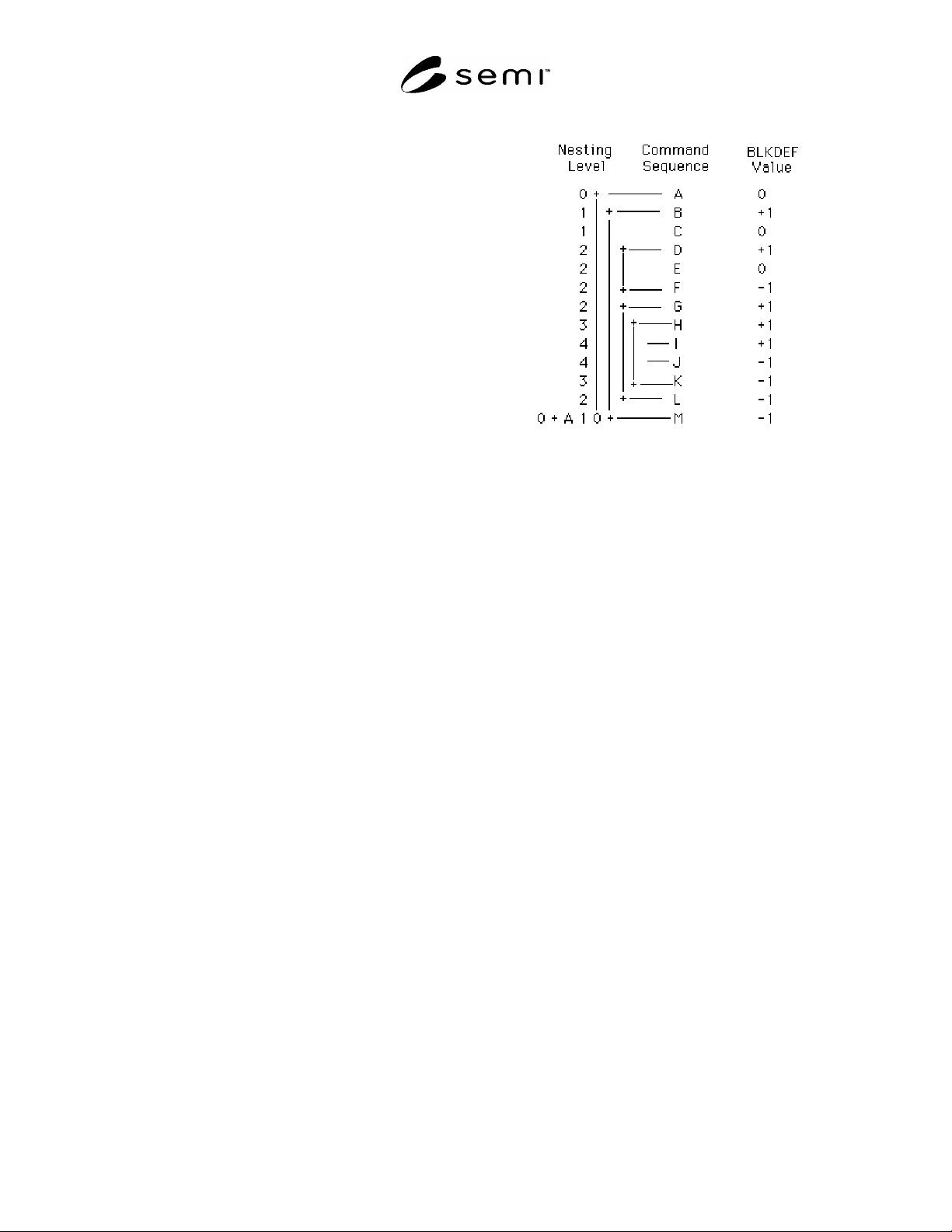
concept of a block which allows setting of limits on
before/after checking. A block consists of a start block
command, a block terminator command and possibly
body commands, commands which are included
between the start and terminator commands. There are
no specific command codes for start, or terminator
commands in SECS-II formatted process programs.
Instead, being a start block, terminator block, or body
command is merely an attribute of each command
defined in the PCD. The field BLKDEF defines this
attribute for each command. A positive one indicates
the command starts a new block. Zero indicates that
the command is a body command and neither starts nor
terminates a block. A value of negative one indicates
that the command is a terminator command.
R1-4.3.11 Before/after checking for a particular
command is performed only with other commands
within the same block. To be within the same block, a
command must have the same nesting level as the
command of interest or the command must be a
contained block.
R1-4.3.11.1 The example data in Figure R1-2 shows
six grouping of commands for before/after checking:
(A,B',N), (B,C,D',G',M), (D,E,F), (G,H',L), (H,I',K),
(I,J). A letter followed by an apostrophe (') indicates a
block which has been collapsed to a command and has
the before/after attributes of its start block command.
Note that body and terminator commands occur in only
one grouping, while block start commands occur in
two. Also, note that the outermost block is assumed to
begin with the first command of the process program
and to end with the last command.
Figure R1-2
R1-4.3.12 Each command’s parameter list defines the
parameters required by the equipment to carry out each
particular command. The order in which each
parameter descriptor appears in the PCD parameter list
also defines the order in which parameters will appear
in a process program command parameter list. Each
parameter is one of three possible types: numeric, text,
or Boolean.
R1-4.3.13 Regardless of parameter type, the first four
elements of any parameter descriptor list are the same.
The first field, PNAME, specifies the text string which
names the parameter. This data will be displayed by a
host when prompting a human for the parameter data.
The second field, RQPAR, specifies if the value must
be specified at the time the process program is
generated (true) or if specifying the data is optional
(false). The third field, PDFLT, identifies the type of
data to be accepted for this parameter as well as
providing default values to include in the process
program if the RQPAR is false and no data is input for
the parameter when the process program is generated.
PDFLT will have zero length if no default value is
provided.
R1-4.3.14 The final field, PMAX, specifies the
maximum length of the parameter data placed in a
process program. For numeric and Boolean data, it
specifies the maximum number of data entries in the
SECS-II item. For a string parameter, it specifies the
maximum number of characters acceptable to the
machine. In either case, negative values are invalid and
a value of zero indicates there is no length restriction.
R1-4.3.15 For numeric and Boolean parameters which
are multi-valued items, usage of PDFLT becomes a bit
more complex. In these cases, PDFLT may also be a