semi合集-English.pdf - 第7460页
SEMI MF1569-0705 © SEMI 2003, 2005 2 ISO 8402 — Quality—Vocabulary 2 ISO 10012-1 — Quality Assurance Requ irements for Measuring Equipment—Part 1: Management of Measuring Equipment 2 NOTICE: Unless otherwise indicated, a…

SEMI MF1569-0705 © SEMI 2003, 2005 1
SEMI MF1569-0705
GUIDE FOR GENERATION OF CONSENSUS REFERENCE MATERIALS
FOR SEMICONDUCTOR TECHNOLOGY
This guide was technically approved by the global Silicon Wafer Committee. This edition was approved for
publication by the global Audits and Reviews Subcommittee on April 7, 2005. It was available at
www.semi.org in June 2005 and on CD-ROM in July 2005. Original edition published by ASTM
International as ASTM F 1569-94. Last previous edition SEMI MF1569-94 (Reapproved 1999).
1 Purpose
1.1 This guide covers the procedures for producing a single set of consensus reference materials (ConRefs) in the
absence of suitable certified reference materials from an established source.
1.2 Such reference materials are frequently required for calibration of measurement systems to reduce bias
differences between different organizations.
1.3 The generated ConRefs can be used by a single laboratory for internal use or for interlaboratory comparison of
related equipment and materials.
1.4 Most often, however, they are used for replicating multiple sets of reference materials. In such a case, the
property values of these reference materials are traceable to the values of the property value of the ConRefs.
Depending on the nature of the preparing organization, these multiple sets may be certified reference materials or
working reference materials. For this purpose, a guide for generation of reference materials specific to the materials
and property may be required; Appendix 1 outlines the requirements for preparing a guide for generation of multiple
sets of reference materials.
2 Scope
2.1 This guide covers the steps to be taken to generate a set of ConRefs for a specific property or family of related
properties required in semiconductor technology.
2.2 The procedure for generating the set of ConRefs is based on interlaboratory testing in accordance with ASTM
Practice E 691. It is assumed for the purposes of this guide that the test method evaluated by the interlaboratory
study (ILS) is appropriate for determining the property values of the ConRef.
2.3 This guide does not cover the selection of one of several possible test methods nor does it cover the case for
which other reference materials must be used in the measurement of the properties of the ConRef.
2.4 This guide also describes procedures that may be used to generate consensus property values that may form the
basis for the generation of multiple sets of CRMs or reference materials (RMs).
NOTICE: This standard does not purport to address safety issues, if any, associated with its use. It is the
responsibility of the user of this standard to establish appropriate safety and health guides and determine the
applicability of regulatory or other limitations prior to use.
3 Referenced Standards and Documents
3.1 ASTM Standards
E 456 — Terminology Relating to Quality and Statistics
1
E 691 — Practice for Conducting an Interlaboratory Study to Determine the Precision of a Test Method
1
3.2 ISO Standards
ISO Guide 30:1981 — Terms and Definitions Used in Connection with Reference Materials
2
1 Annual Book of ASTM Standards, Vol 14.02, ASTM International, 100 Barr Harbor Drive, West Conshohocken, PA 19428. Telephone: 610-
832-9500, Fax: 610-832-9555, Website:
www.astm.org
.
SEMI MF1569-0705 © SEMI 2003, 2005 2
ISO 8402 — Quality—Vocabulary
2
ISO 10012-1 — Quality Assurance Requirements for Measuring Equipment—Part 1: Management of Measuring
Equipment
2
NOTICE: Unless otherwise indicated, all documents cited shall be the latest published versions.
4 Terminology
4.1 Definitions
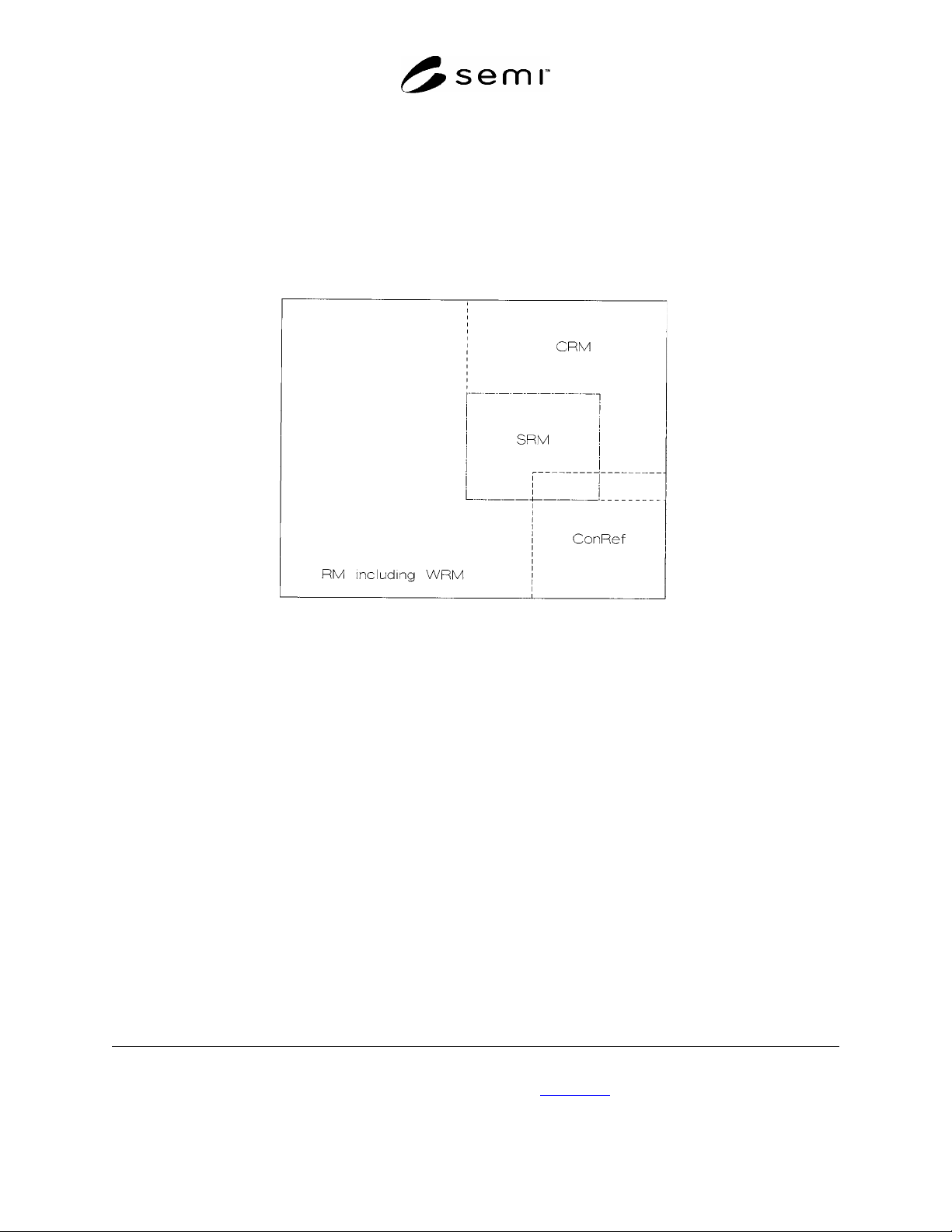
NOTE 1: See Figure 1 for a schematic presentation of the hierarchy of reference materials.
Figure 1
Reference Material Hierarchy
4.1.1 certified reference material (CRM) — a reference material one or more of whose property values are certified
by a technically valid procedure, accompanied by or traceable to a certificate or other documentation that is issued
by a certifying body (ISO Guide 30:1981).
4.1.2 consensus reference material (ConRef) — a reference material one or more of whose property values have
been established by a documented ILS that is based on a technically valid test method.
4.1.3 reference material (RM) — a material or substance one or more properties of which are sufficiently well
established to be used for the calibration of an apparatus, (for) the assessment of a measurement method, or for
assigning values to materials (ISO Guide 30:1981; ISO 10012-1).
4.1.3.1 Discussion — A reference material made by a laboratory for its own use is referred to as a working
reference material (WRM). This term is gradually replacing the term, secondary reference material, which has been
used widely in the past.
4.1.4 Standard Reference Material (SRM
3
) — a certified reference material issued by the U.S. National Institute of
Standards and Technology.
4.1.5 traceability — the ability to trace the history, application, or location of an item or activity, or similar items or
activities, by means of recorded identification (ISO 8402).
4.1.5.1 Discussion — ISO 8402 states that in a calibration sense, traceability relates measuring equipment to
national or international standards, primary standards, or basic physical constants or properties. In this guide, as in
2 International Organization for Standardization, ISO Central Secretariat, 1, rue de Varembé, Case postale 56, CH-1211 Geneva 20, Switzerland.
Telephone: 41.22.749.01.11; Fax: 41.22.733.34.30, Website: /www.iso.ch; available in the U.S. from American National Standards Institute,
New York, NY 10036, USA. Telephone: 212.642.4900, Fax: 212.398.0023, Website:
www.ansi.org
.
3 SRM
®
is a registered trademark of the U.S. National Institute of Standards and Technology and the U.S. Government.
SEMI MF1569-0705 © SEMI 2003, 2005 3
ISO 10012-1, the term “measuring equipment” is extended to include both measuring instruments and measurement
standards (including reference wafers).
4.2 Terminology related to the conduct and analysis of the ILS may be found in ASTM Terminology E 456 and
ASTM Practice E 691.
5 Summary of Guide
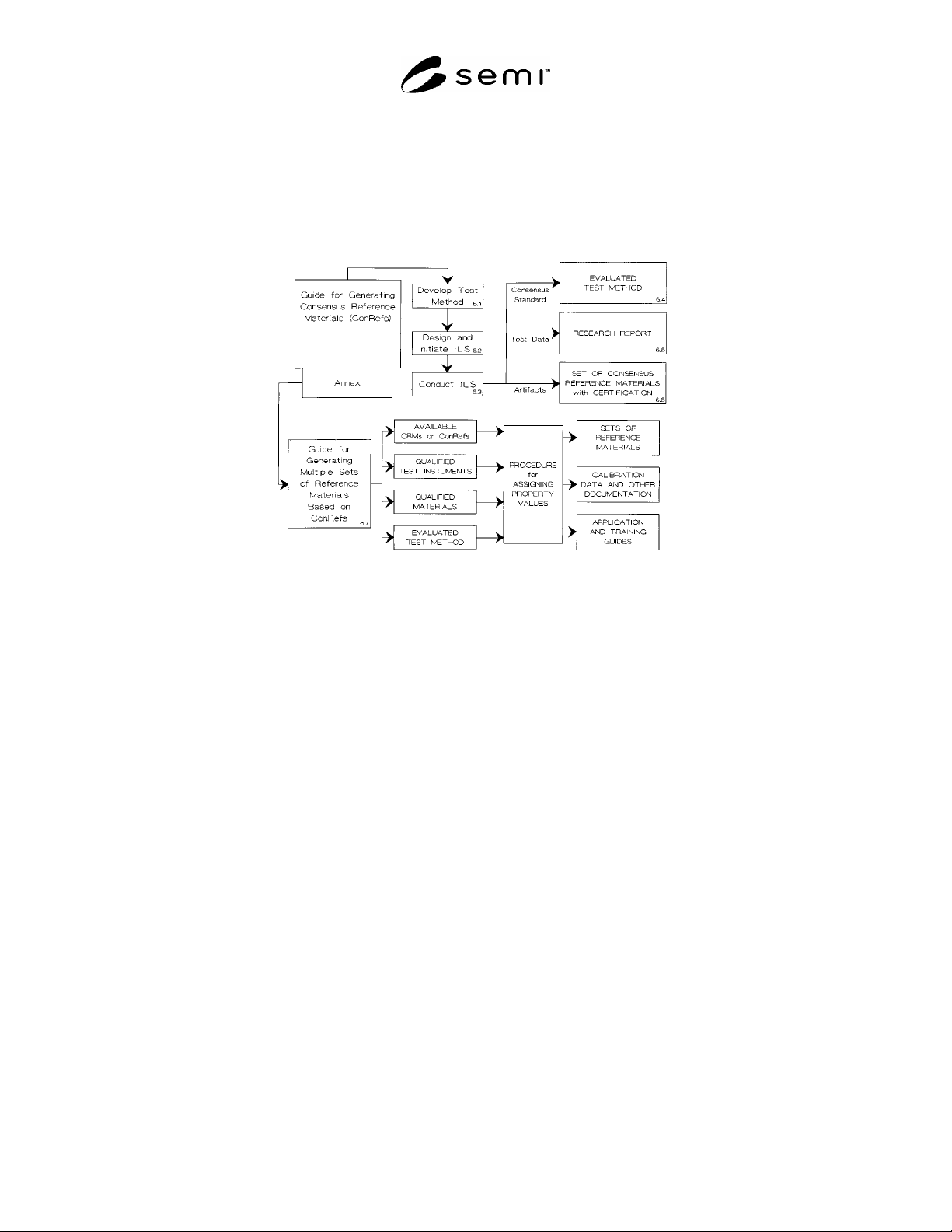
NOTE 2: See Figure 2 for a flow chart of the steps covered.
Figure 2
Flow Chart for Generation of Consensus Reference Materials and Derived Sets of Reference Materials
5.1 The test method to be used is selected or developed, and acceptable levels of repeatability and reproducibility
are defined.
5.2 An ILS test protocol for use with the selected consensus test method is developed in accordance with ASTM
Practice E 691 and the proper materials and instrumentation are assembled.
5.3 The ILS is executed and analyzed.
5.4 The results are evaluated against the criteria selected in ¶5.1. If the results are acceptable, a precision statement
is developed and balloted for inclusion in the test method. If the results are not acceptable, the test method validity
and the usefulness of the materials tested are assessed.
5.5 The results are incorporated into a research report.
5.6 If the results are acceptable, the materials used in the test are now qualified as ConRefs. They have values of
the desired property (or properties) that represent the consensus of the industry; the uncertainty in these values can
be estimated from the repeatability and reproducibility obtained in the test, as documented in the research report.
These materials are stored in a location accessible for future use in preparing replicate sets of reference materials.
6 Procedure
6.1 Select or establish the test method to be used and define acceptable levels of repeatability and reproducibility
for the proposed test method.
6.1.1 If the test method has already been evaluated by an interlaboratory study (ILS) and contains repeatability and
reproducibility results documented in a research report or in the method itself, proceed directly to ¶6.4. Otherwise
develop the test method as follows:
6.1.1.1 Determine feasibility of proposed test method.
6.1.1.2 Conduct screening experiments (ruggedness tests) of the proposed test method in a single laboratory.