semi合集-English.pdf - 第6267页
SEMI G52-90 © SEMI 1990, 2004 3 10.2.2 Place the bags in the water bath at T > 95°C for 30 ± 2 m inutes. 10.2.3 Remove the bags f rom the bath a nd allow to reach room temperature. 10.2.4 The lead frames, which are in…

SEMI G52-90 © SEMI 1990, 2004 2
6.8 Borosilicate Glass flasks and Pipettes for Anion
Standard Solutions — 100, 250, 500, and 100 ml
capacity (flasks); 1, 10, and 25 ml capacity (pipettes).
6.9 Chemical Balance, Weighing Chemicals
6.10 Scissors, Tweezers, Spatula
7 Reagents and Materials
7.1 Deionized water, resistivity 15 megohm
centimeters at 25°C per ASTM D 1193.
7.2 Eluents and regenerants for specific chromatograph
columns prepared per chromatograph equipment
manufacturer’s recommendations so that the water peak
can be separated from the ionic peaks.
7.3 Compounds for Cation Standard Solutions —
NaCl, NH
4
Cl, KC1.
7.3.1 Compounds for Anion Standard Solutions —
NaCl, Na
2
HPO
4
, 12H
2
O, NaBr, NaNO
3
, K
2
SO
4
.
NOTE 3: All compounds are to be reagent grade.
8 Sampling
8.1 The leadframes must not be touched, except with
previously cleaned tweezers or double-layered cotton
gloves with polyethylene outer gloves in order to avoid
additional contamination.
8.2 The sample size (i.e., the number of frames to be
tested in this destructive test) may be determined by
agreement between the customer and the vendor. The
recommended sample sizes are 10–50 cm
2
for testing
pads and 200–500 cm for the test of overall leadframes.
NOTE 4: The surface area of the frame is calculated from the
leadframe drawing, and includes the top, bottom and side
surfaces. It is important that user and supplier agree on the
surface area calculation for any given leadframe
configuration.
9 Preparation of Standard — Solutions and
Chromatograph Calibration
9.1 Standard Solutions
9.1.1 The single-ingredient standard solutions of each
ion (Na
+
, NH
4
+
, K
+
; C1
, No
3
-
, Br
-
, SO
4
2
, PO
4
3
) are
made by dissolving 1.000 g of each ion into 1.000 liter
of D.I. water, respectively. The stored multi-ingredient
standard solutions shown in Table 2 are then made form
these single-ingredient standard solutions by the
dilution method.
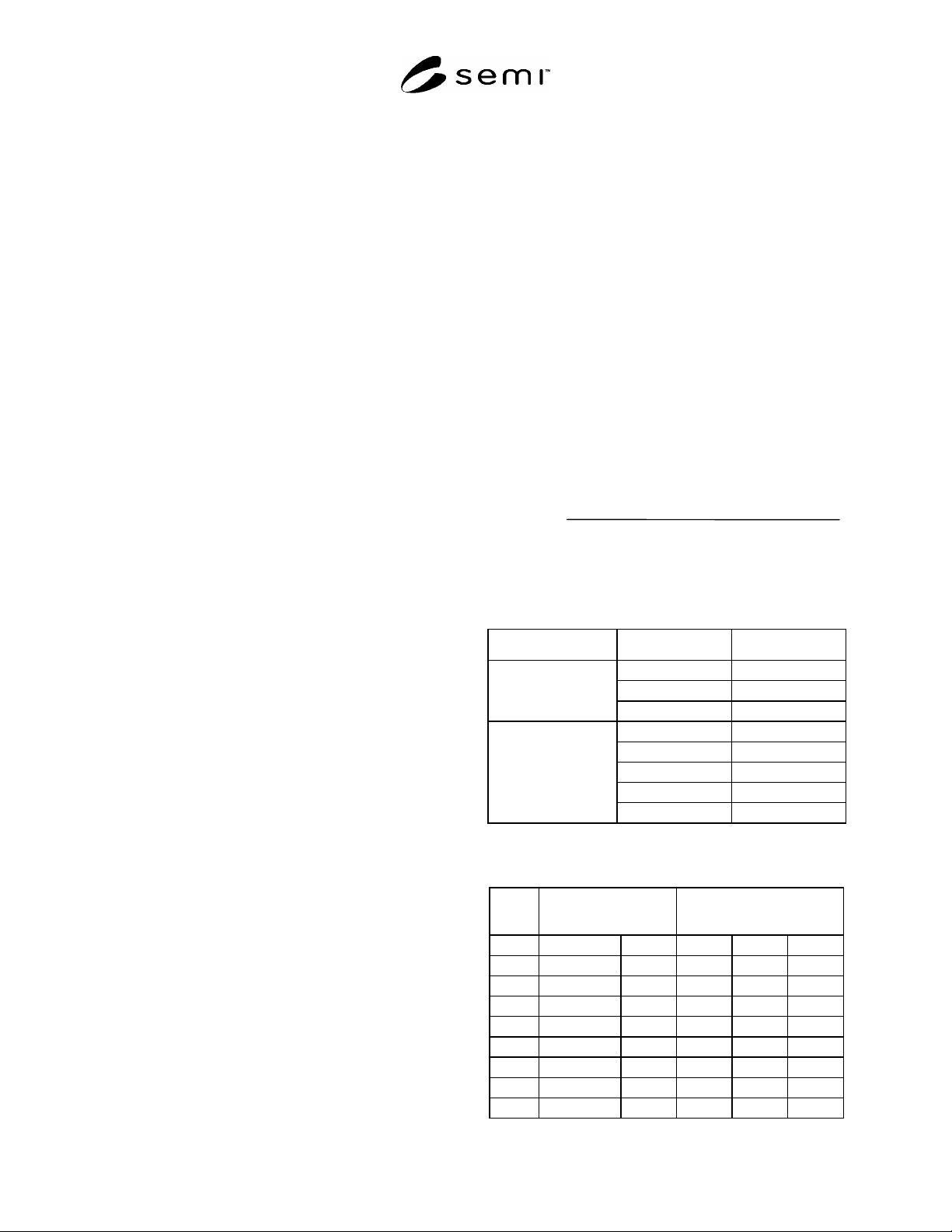
9.1.2 Cation and anion standard solutions for
calibration are made by diluting the stored multi-
ingredient standard solutions as shown in Table 2.
9.1.3 Store the multi-ingredient standard solution and
the calibration solutions in the correct flasks and label
with the ion type and concentration.
NOTE 5: New standard solutions for calibration are required
every 24 hours. Ensure that the flasks are cleaned with water
before refilling with a new solution.
9.2 Calibration
9.2.1 Set up the chromatograph and regenerate the
columns according to the manufacturer’s instructions
(ASTM D 4327 provides further details).
9.2.2 Run the eluent through the chromatograph until a
stable baseline chromatograph is obtained.
9.2.3 Select the infection volume recommended by the
manufacturer for each ion type and inject in to the
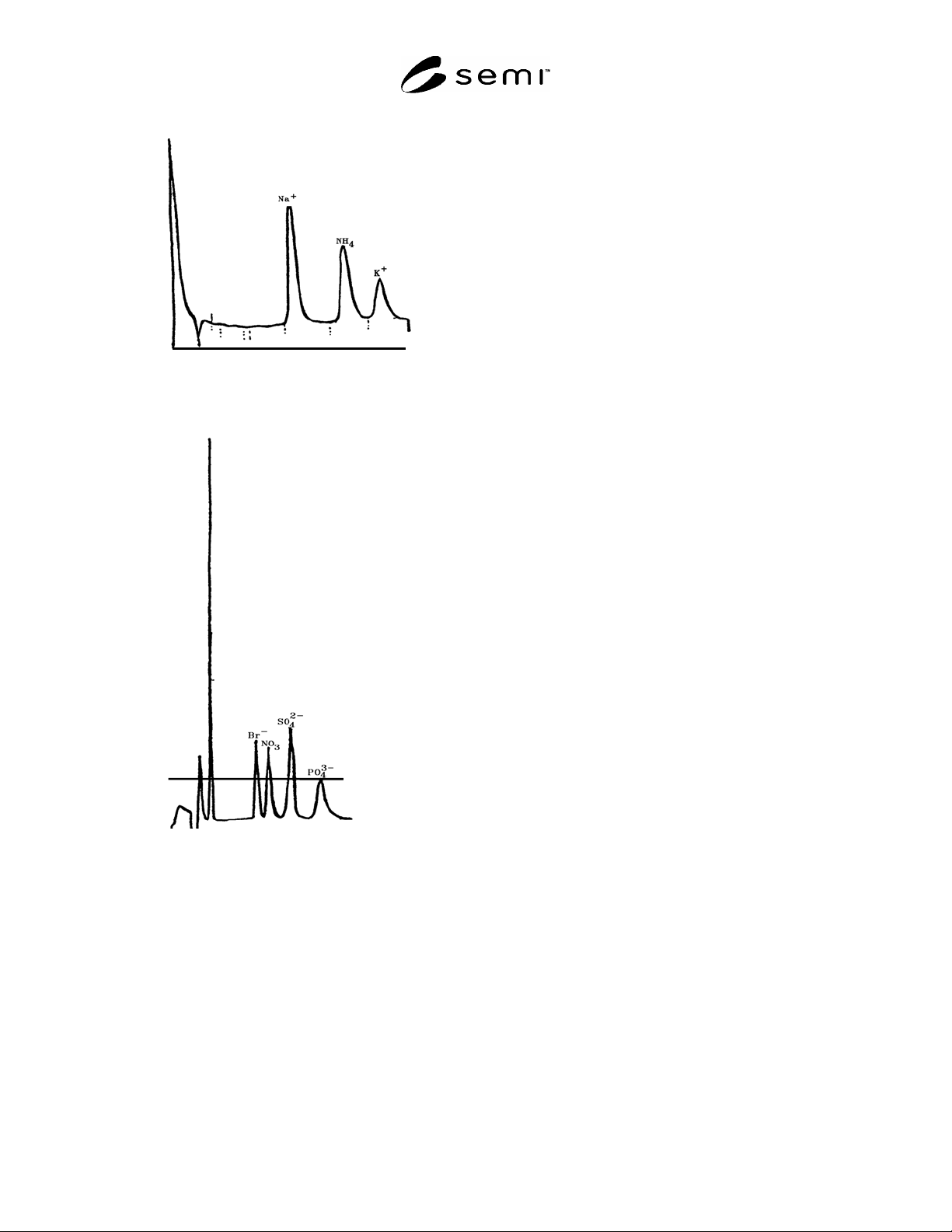
chromatograph. Record the chromatograph for each ion
type (see Figure 1), and make the calibration curve for
each ion (ion concentration versus peak height or area).
NOTE 6: Peak height or area under the ion’s characteristic
curve is proportional to the concentration.
10 Procedure — Bag Extraction Method
10.1 Preparation of Extraction Bags
10.1.1 Add 100 ml of DI water to the
polypropylene/polyethylene double layered bag and
seal them with the hot bar bag sealer. The amount of air
in the bags should be reduced as much as possible
before sealing.
NOTE 7: Two bags are required for each test and must come
from the same manufacturing lot.
10.1.2 Place the bags in the water bath at T > 95°C for
2 hours ± 5 minutes.
10.1.3 Allow the bags to reach room temperature but
leave sealed until ready for use at which time open the
bags (use clean scissors for the bags) and rinse out five
(5) times with DI water.
10.2 Extraction Process
10.2.1 Place the samples in the bags. Cover the frames
with a known volume of water (e.g., 100 ml and then
seal the bags). Also, place a similar amount of water in
an empty bag and seal.
NOTE 8: The amount of air in the bags should be reduced as
much as possible before sealing. The bags that only contain
water provide the background contamination of the bag. Do
not select the frames or remove them from their shipping
container until ready to test the surface contamination. The
recommended volume of water is 10–30 ml for the testing die
pads only and 100 ml for testing complete leadframes. Lead
frames should be bent after sealing so that the water is in
contact with all surfaces.
SEMI G52-90 © SEMI 1990, 2004 3
10.2.2 Place the bags in the water bath at T > 95°C for
30 ± 2 minutes.
10.2.3 Remove the bags from the bath and allow to
reach room temperature.
10.2.4 The lead frames, which are inside the sealed
bags, are moved to one side of the bags without
opening the bags. Then the solution is separated from
leadframes by sealing the mean portion of the bags
without opening.
11 Procedure — Container Extraction Method
NOTE 9: The size of the containers to be used depends on
the expected volume of water and the leadframes. The
container must be at least three-quarters filled with the water
and leadframes.
11.1 Preparation of Extraction Vessels
11.1.1 Fill the containers with DI water and attach the
caps. In order to reduce the amount of air in the vessel,
fill vessels to the amount of three-quarter.
NOTE 10: Two containers are required for each test and must
come from the same manufacturing batch.
11.1.2 Place the containers in the water bath at T >
95°C for 2 hours ± 5 minutes.
11.1.3 Remove the containers from the bath and rinse
out five (5) times with DI water.
11.2 Process
11.2.1 Place the samples in one of the containers
cleaned per Section 11.1.1.
NOTE 11: Leadframes may be cut or rolled in order to ease
loading to the container. Die pads may be tested separately, if
desired, by cutting from the leadframes.
11.2.1.1 Add the required volume of DI water and cap
the container. Place a similar amount of water into the
other cleaned container and attach the cap.
NOTE 12: Do not select the frames or remove them from
their shipping container until ready to test for the surface
contamination. Recommended volumes of water are 10–30 ml
for testing die pads only and 100 ml for the entire leadframe
— samples must be covered by water.
11.2.2 Place the containers in the water bath at T >
95°C for 30 ± 2 minutes.
11.2.3 Remove the containers from the bath and allow
to reach room temperature.
11.2.4 Remove the leadframes from the container and
cap it again.
12 Measurements
12.1 Prepare the chromatograph for operation by
regenerating the columns according to the
manufacturer’s recommendations.
12.2 Run the eluent through the chromatograph until a
stable baseline calibration is established.
12.3 Inject the recommended sample size of test
solution into the chromatograph and record the ion
chromatogram.
12.4 Repeat for all the samples and also run the
background sample.
NOTE 13: The time from extraction to insertion of sample is
to be within eight hours.
12.5 Sample concentrations are determined from the
calibration curves for each ion type.
12.6 The surface concentration of ionic contaminants
for each ion type (SCIC) is given by the following
equation:
SCIC (ng/cm
2
) =
(Sample conc. – Background conc.)
Extraction Volume (mL)
Leadframe Surface Area (cm
2
)
No. of Leadframes
NOTE 14: Allowable concentration levels are to be agreed
between the user and supplier.
Table 1 Sensitivity of Ion Chromatograph
Ion Sensitivity (ng/ml)
Na
+
0.2
NH
4
+
0.5
Cation
K
+
1.0
Cl
0.3
PO
4
3
2.0
Br
-
1.0
NO
3
-
1.0
Anion
SO
4
2-
1.0
Table 2 Concentration of Standard Solution for
Calibration
Mixed Standard
Solution (ug/ml)
Standard Solution for
Calibration(ng/ml)
Ion I II III
Cation Na
+
10 5 10 20
NH
4
+
10 5 10 20
K
+
10 5 10 20
Anion Cl
4 10 20 40
PO
4
3
10 25 50 100
Br
4 10 20 40
NO
3
4 10 20 40
SO
4
2
4 10 20 40
SEMI G52-90 © SEMI 1990, 2004 4
Retention Time (Min.)
0
5
10
Cation
10
0
5
Retention Time (Min.)
A
nion
+
2
–
Figure 1
Schematic of Ion Chromatograph
NOTICE: SEMI makes no warranties or
representations as to the suitability of the standards set
forth herein for any particular application. The
determination of the suitability of the standard is solely
the responsibility of the user. Users are cautioned to
refer to manufacturer’s instructions, product labels,
product data sheets, and other relevant literature
respecting any materials mentioned herein. These
standards are subject to change without notice.
The user’s attention is called to the possibility that
compliance with this standard may require use of
copyrighted material or of an invention covered by
patent rights. By publication of this standard, SEMI
takes no position respecting the validity of any patent
rights or copyrights asserted in connection with any
item mentioned in this standard. Users of this standard
are expressly advised that determination of any such
patent rights or copyrights, and the risk of infringement
of such rights, are entirely their own responsibility.
Copyright by SEMI® (Semiconductor Equipment and Materials
International), 3081 Zanker Road, San Jose, CA 95134. Reproduction of
the contents in whole or in part is forbidden without express written
consent of SEMI.