semi合集-English.pdf - 第4554页
SEMI D27-1000 © SEM I 2000 1 SEMI D27-1000 GUIDE FOR FLAT PANEL DISPLAY EQUIPMENT COM MUNICATION INTER F A CES This guide w as technically approved by the Globa l Flat Panel Display Comm itte e and is the direct responsi…
SEMI D26-1000 © SEMI 2000 12
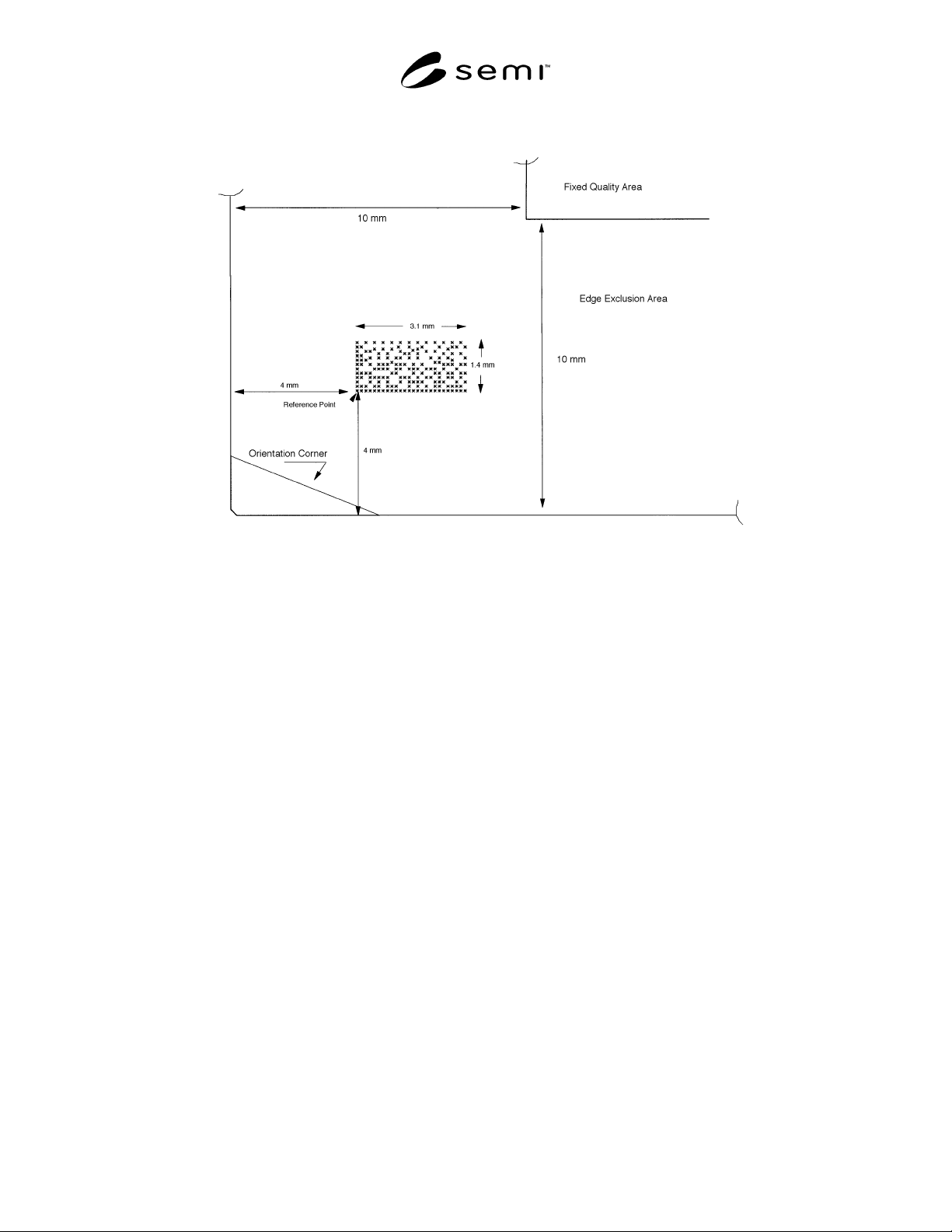
Figure 10
Data Matrix Code Field in Edge Exclusion Area
NOTICE: SEMI makes no warranties or representations as to the suitability of the standards set forth herein for any
particular application. The determination of the suitability of the standard is solely the responsibility of the user.
Users are cautioned to refer to manufacturer’s instructions, product labels, product data sheets, and other relevant
literature respecting any materials mentioned herein. These standards are subject to change without notice.
The user’s attention is called to the possibility that compliance with this standard may require use of copyrighted
material or of an invention covered by patent rights. By publication of this standard, SEMI takes no position
respecting the validity of any patent rights or copyrights asserted in connection with any item mentioned in this
standard. Users of this standard are expressly advised that determination of any such patent rights or copyrights, and
the risk of infringement of such rights, are entirely their own responsibility.
Copyright by SEMI® (Semiconductor Equipment and Materials
International), 3081 Zanker Road, San Jose, CA 95134. Reproduction o
f
the contents in whole or in part is forbidden without express written
consent of SEMI.

SEMI D27-1000 © SEMI 20001
SEMI D27-1000
GUIDE FOR FLAT PANEL DISPLAY EQUIPMENT COMMUNICATION
INTERFACES
This guide was technically approved by the Global Flat Panel Display Committee and is the direct
responsibility of the North American Flat Panel Display Committee. Current edition approved by the North
American Regional Standards Committee on August 28, 2000. Initially available at www.semi.org August
2000; to be published October 2000.
1 Purpose
1.1 This is a guide for implementing equipment
communication features for successful integration and
automation in a flat panel display manufacturing
facility.
2 Scope
2.1 This guide includes references to other SEMI
standards. It also includes definitions and explanations
specific to FPD equipment automation.
2.2 The scope of this guide is limited to equipment
communication features that interface with factory
automation systems.
2.3 This guide does not reference physical or electrical
interfaces, except to the extent necessary to implement
the features described. For example, a serial data cable
connector could be specified to have 9 pins or 25 pins.
2.4 This guide may not be applicable to all types of
FPD equipment. It only applies to those for which a
direct data communication interface will be
implemented between the equipment and the factory
automation systems.
2.5 This guide does not address all software standards
that may be applicable, but addresses a subset that is
necessary for effective integration and automation.
2.6 This standard does not purport to address safety
issues, if any, associated with its use. It is the
responsibility of the user of this standard to establish
appropriate safety and health practices and determine
the applicability of regulatory limitations prior to use.
3 Limitations
3.1 The other SEMI standards referred to in this
document have been carefully reviewed for
applicability to FPD manufacturing. However, when
referring to other SEMI standards used in this
specification, the reader should allow for some editorial
exceptions in order to apply the specification to FPD
equipment. For example, if another SEMI specification
referenced here uses the term “wafer”, the reader can
assume that this also applies to FPD substrates, and
likewise with “silicon” and glass or plastic. These
minor differences in no way impact the interpretation or
implementation of those standards in FPD
manufacturing equipment and factory systems.
3.2 This guide is not an all-inclusive list of applicable
standards, but is a starting point for defining
requirements of these equipment automation functions,
and a guideline for implementation.
4 Referenced Standards
NOTE 1: As listed or revised, all documents cited shall be the
latest publications of adopted standards.
4.1 SEMI Standards
SEMI E4 — SEMI Equipment Communications
Standard 1 Message Transfer (SECS-I)
SEMI E5 — SEMI Equipment Communications
Standard 2 Message Content (SECS-II)
SEMI E23 — Specification for Cassette Transfer
Parallel I/O Interface
SEMI E30 — Generic Model for Communications and
Control of SEMI Equipment (GEM)
SEMI E37 — High-Speed SECS Message Services
(HSMS), Generic Services
SEMI E37.1 — High-Speed SECS Message Services,
Single-Session Mode (HSMS-SS)
SEMI E84 — Specification for Enhanced Carrier
Handoff Parallel I/O
5 Terminology
5.1 The following define some descriptive terms that
can be used to refer to systems that meet the
requirements of the standards referenced herein.
5.1.1 SECS Compliant — This term is often used to
describe systems which comply completely with both
the SEMI E4 (SECS-I) and SEMI E5 (SECS-II)
standards. However, it is more appropriate to identify
the system as “SECS-I Compliant” and/or “SECS-II”
compliant. This distinction is important because SECS-
II can be implemented independently from SECS-I. The
term “SECS Compliant” is ambiguous, but commonly
used. It is suggested that the following terms be used

SEMI D27-1000 © SEMI 2000 2
instead to describe the equipment and host
communication interface.
5.1.2 SECS-I Compliant — This term is used to
identify a system that complies completely with SEMI
E4.
5.1.3 SECS-II Compliant — This term is used to
identify a system that complies completely with SEMI
E5.
5.1.4 HSMS Compliant — This term is used to
describe systems which comply with SEMI E37
(HSMS) and either SEMI E37.1 (HSMS-SS) or SEMI
E37.2 (HSMS-GS) or both. However, it is more
appropriate to identify the system as either “HSMS-SS
Compliant” or “HSMS-GS Compliant”, since they both
imply compliance with SEMI E37, and the user must
know exactly which of the two is supported. The term
“HSMS Compliant” is ambiguous, but commonly used.
5.1.5 HSMS-SS Compliant — This term is used to
identify a system that complies completely with SEMI
E37 and SEMI E37.1. This protocol has been adopted
for use in FPD.
5.1.6 HSMS-GS Compliant — This term is used to
identify a system that complies completely with SEMI
E37 and SEMI E37.2.
5.1.7 GEM — Generic Equipment Model as defined in
SEMI E30.
5.1.8 GEM Compliant — This term is defined in
SEMI E30.
5.1.9 Fully GEM Capable — This term is defined in
SEMI E30.
5.1.10 System — Either manufacturing equipment or
factory host.
6 Data Transfer
6.1 For optimum compatibility, systems supporting the
automation capabilities described herein should support
all requirements defined for at least one of the
following SEMI protocol standards:
6.1.1 SEMI E4 (SECS-I)
6.1.2 SEMI E37.1 (HSMS-SS). Note that this requires
implementation of SEMI E37.
6.1.2.1 HSMS-SS compliant interfaces are preferred
for FPD manufacturing because of its performance and
logistical advantages, and because it allows other
protocols to operate on the same connection
simultaneously.
6.1.2.2 However, SECS-I interfaces are acceptable in
systems where the performance of a serial interface is
sufficient. Since many off-the-shelf component
software implementations support both protocols, it is
relatively easy to design systems which can be
configured to support either.
7 Data Format
7.1 The system should support all minimum
requirements of SEMI E5 (SECS-II). Although more
modern data communication specifications are
available (e.g. HTML), SECS-II has unique aspects
which are valuable in microelectronics manufacturing.
Also, there are many available “off-the-shelf” software
packages which provide the SECS-II feature set.
7.2 Furthermore, for maximum co mpatibility and
reliability, the implementation of any optional SEMI E5
objects (data items, variable items, messages, etc.) on
the system should meet the requirements of SEMI E5.
For example, if an FPD system implements the S7,F3
message, it must do so in compliance with SEMI E5 to
be considered “SECS-II Compliant”. It is possible to
implement “user-defined” SECS-II messages, and it is
allowed by SEMI E5.
7.3 However, it is usually unnecessary to use such
custom SECS-II messages. Complicated scenarios such
as production sequence control, inline production,
consumable management, and material handling can all
be implemented using standard SECS-II messages.
Many SECS-II messages are designed to be very
generic and very flexible such as the Remote Command
message (S2F41 or S2F49) which can contain any
number of parameters of any type in any format. Many
of the basic SECS-II data items such as variables can
also take on any type of value in any format.
7.4 User-defined data items and messages are more
difficult to integrate into FPD factory automation
systems and should be avoided.
8 GEM and SEM
8.1 Generic Equipment Model (GEM)
8.1.1 Any reference to the term “GEM” (Generic
Equipment Model) with respect to FPD manufacturing
equipment will be construed as a reference to SEMI
E30. The system provider should ensure that this term
is used only for those systems which rigidly adhere to
SEMI E30. End-users will make certain assumptions
about the capabilities of “GEM” systems based on the
requirements of SEMI E30.
8.1.2 SEMI E30 is applicable to FPD manufacturing
equipment. FPD equipment suppliers may choose to
implement GEM. In order for FPD equipment to be
“GEM Compliant” or “Fully GEM Capable”, it must
meet the requirements of SEMI E30 without exception.
However, it may not be necessary to implement certain