semi合集-English.pdf - 第4390页
SEMI F96-0704 © SEMI 2004 2 5.5 The height difference between the tops of t he ports will be no more than 0.5 mm. 5.6 Additional ports m ay be provided so l ong as they do not interfere with the above specifications. NOT…
SEMI F96-0704 © SEMI 2004 1
SEMI F96-0704
SPECIFICATION FOR PORT CONFIGURATION OF CANISTERS TO
CONTAIN LIQUID CVD PRECURSORS
This specification was technically approved by the Global Gases Committee and is the direct responsibility of
the North American Gases Committee. Current edition approved by the North American Regional Standards
Committee on April 22, 2004. Initially available at www.semi.org June 2004; to be published July 2004.
1 Purpose
1.1 This document specifies the type, size and spacing
of connectors to be used on metal (e.g. stainless steel)
canisters for liquid chemical precursors, solutions and
solvents.
2 Scope
2.1 This document applies to metal (e.g. stainless steel)
canisters to be used for “liquid precursors” (see
definition) including solutions of precursors in solvents.
It also applies to containers for solvents used for in situ
cleaning of delivery system.
2.2 The liquid connection ports (inlet and outlet) are
included, as are pneumatic connections to valves.
2.3 Parameters such as overall canister dimensions are
expected to be specified by other standards.
NOTICE: This document does not purport to address
safety issues, if any, associated with its use. It is the
responsibility of the user of this standard to establish
appropriate safety and health practices and determine
the applicability of regulatory or other limitations prior
to use.
3 Referenced Standards
3.1 SEMI Standard
SEMI F66 — Specification for Port Marking and
Symbol of Stainless Steel Vessels for Liquid Chemicals
NOTICE: Unless otherwise indicated, all documents
cited shall be the latest published versions.
4 Terminology
4.1 Definitions
4.1.1 canister — a metal (usually stainless steel)
container in which a liquid precursor is supplied.
Canisters are also known as “ampoules”, “shuttle
drums”, “ tanks”, etc.
4.1.2 liquid precursor — a liquid precursor is a
chemical supplied as a liquid and used in Chemical
Vapor Deposition (CVD). Many liquid precursors are
toxic, reactive and air-sensitive.
5 Ports
5.1 A canister has a gas inlet port and a liquid outlet
port. The outlet port is equipped with a dip-tube,
marked according to SEMI F66. Note that a canister
may be used as a bubbler, by using the dip-tube port as
the gas inlet. In this standard however, liquid delivery
is assumed and the dip-tube port will be referred to as
the “outlet”.
5.2 Canisters up to 100 liters in volume:
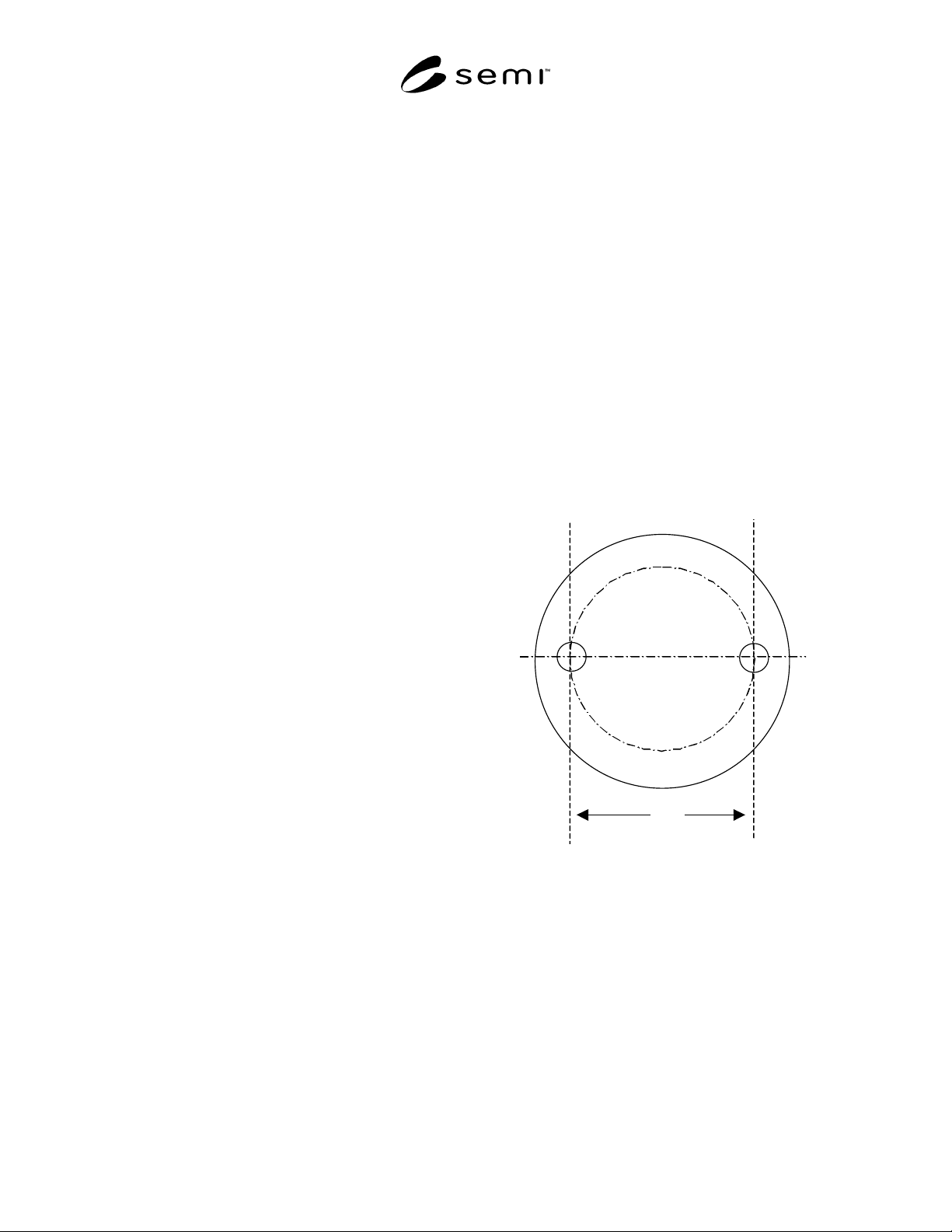
5.2.1 The ports will be located with the dip tube at the
3 o’clock position and the gas inlet at the 9 o’clock
position, as illustrated in Figure 1.
L
Figure 1
Port Configuration
5.2.2 Both ports shall be fitted with ¼” O.D. face-seal
connectors.
5.2.3 The port separation (L in the Figure) shall be
76 mm or 146 mm, + /- 4 mm, the value to be chosen
according to the diameter of the canister.
5.3 For canisters greater than 100 liters in volume, the
outlet port shall be in the center, the port separation 152
+ /- 4 mm, and the port connections ½” O.D. face-seal.
5.4 The connector shall be male on the gas inlet port
and female on the dip tube port.

SEMI F96-0704 © SEMI 2004 2
5.5 The height difference between the tops of the ports
will be no more than 0.5 mm.
5.6 Additional ports may be provided so long as they
do not interfere with the above specifications.
NOTE 1: The user of this standard should evaluate the
consequences of connecting a given precursor to a point
intended for other precursors. The nature of the precursor
itself and of the other precursors expected to be in use at the
same location should be taken into account. Consider
packaging precursors with a non-standard connector on the
canister outlet if necessary to avoid a dangerous situation.
6 Valves
6.1 The inlet and outlet port are each provided with a
valve but the details of those valves are not specified
here. If pneumatic valves are provided, the pneumatic
connection shall be a 1/8” quick-connect type.
NOTICE: SEMI makes no warranties or
representations as to the suitability of the standards set
forth herein for any particular application. The
determination of the suitability of the standard is solely
the responsibility of the user. Users are cautioned to
refer to manufacturer' s instructions, product labels,
product data sheets, and other relevant literature,
respecting any materials or equipment mentioned
herein. These standards are subject to change without
notice.
By publication of this standard, Semiconductor
Equipment and Materials International (SEMI) takes no
position respecting the validity of any patent rights or
copyrights asserted in connection with any items
mentioned in this standard. Users of this standard are
expressly advised that determination of any such patent
rights or copyrights, and the risk of infringement of
such rights are entirely their own responsibility.
Copyright by SEMI® (Semiconductor Equipment and Materials
International), 3081 Zanker Road, San Jose, CA 95134. Reproduction o
f
the contents in whole or in part is forbidden without express written
consent of SEMI.

SEMI F97-0305 © SEMI 2005 1
SEMI F97-0305
SPECIFICATION FOR FACILITY PACKAGE INTEGRATION,
MONITORING AND CONTROL
This specification was technically approved by the Global Facilities Committee and is the direct
responsibility of the European Global Facilities Committee. Current edition approved by the European
Regional Standards Committee on November 10, 2004. Initially available at www.semi.org January 2005; to
be published March 2005.
1 Purpose
1.1 The purpose of this specification is to provide the requirements for the architecture, functionality and interfaces
for Facility Monitoring and Control Systems and the various Facility Package Units to enable a standardized and
integrated communication between them. This specification is appended with related information to provide
application examples.
1.2 Background and Motivation
1.2.1 Today, the suppliers of Facility Package Units (e.g., chemicals, power supply, gases, HVAC) are often using
individual communication concepts. This leads to high efforts to specify the communication structures between
Facility Package Units (FPU) and the Facility Monitoring and Control Systems (FMCS), to evaluate the quoted
solutions and to eventually integrate these units. These individual, not standardized concepts today are not reusable,
bear risks in execution and lead to high maintenance costs.
1.2.2 This specification is a first step to standardize the communication between facility and monitoring
components. Therefore, it focuses in its scope to a small set of requirements which are common to all FPUs. As
this communication concept is adopted by the various FPU suppliers and their customers, more specific standards
describing particular FPUs and their services may evolve.
1.3 Who and what is addressed by this standard.
1.3.1 A standardization of the communication concept between FMCS and FPUs will support Facility Package Unit
manufacturers, general contractors, system integrators, purchasers, and control system manufacturers. It will lead to
substantially reduced costs, more reliable execution times, and optimized maintenance concepts.
2 Scope
2.1 This standard specifies the requirements for the architecture, common services, data, and its semantic meaning
to integrate the FPUs into the FMCS. For this purpose, a basic set of common services (operations) between the
FMCS and the FPUs are specified to exchange FPU status information and data. In addition, the state models for
FPUs are described.
2.2 Out of scope for this standard are:
Services of FMCS provided to interface to Manufacturing Execution Systems or Enterprise Resource Planning
Systems,
Specification of functionality of particular FMCS functions (graphical user interface (GUI), data archives,
reporting archives, alarm handling, etc.), and
The specification of the interface between FPU control level and FPU field level.
2.3 Applicability — This standard applies to the field of facility management and is targeted for FPU suppliers and
FMCS suppliers for systems integration, engineering and commissioning as well as the operation of such systems by
the purchasers.
NOTICE: This standard does not purport to address safety issues, if any, associated with its use. It is the
responsibility of the users of this standard to establish appropriate safety and health practices and determine the
applicability of regulatory or other limitations prior to use.