semi合集-English.pdf - 第3392页
SEMI E132.1-0305 © SEMI 2005 19 Figure 11 GetDefinedPrivilegesRequest X ML Schema Element 8.2.9.1. 3 GetDefinedPrivileges Response 8.2.9.1. 3.1 The service response is mapped to the XML Schem a ele ment GetDefinedPrivile…
SEMI E132.1-0305 © SEMI 2005 18
8.2.7.1 The session identifier is required to be present in all requests to the equipment over an SEMI E132
authenticated session. The session identifier is generated by the equipment during the Establish Session operation,
and must be a UUID that is guaranteed unique across space and time, see documentation referenced in ¶4.4 for
specific details on syntax and format of a UUID.
8.2.7.2 In this specification, a header type is defined in the XML Schema file to carry the SEMI E132 session
identifier within the SOAP header for SOAP messages defined for this interface. This provides the most transparent
way of sending the session identifier without affecting the input/output parameters of the individual operations.
Since SEMI E132 requires all requests to the equipment to be sent over SSL, the session identifier need not be
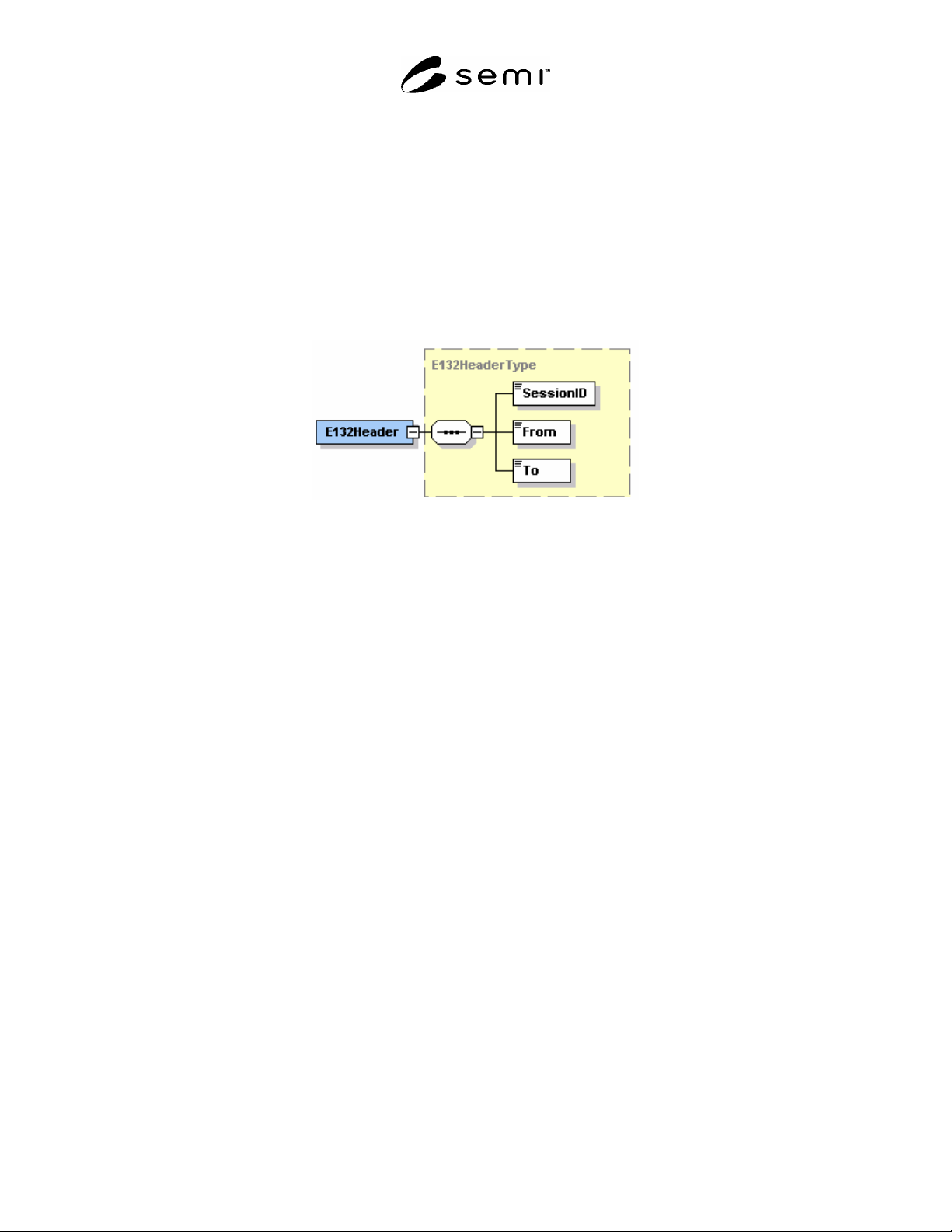
encrypted and shall be included in the header unmodified. Figure 10 shows the XML schema diagram for the
E132Header schema element. The session identifier is modeled as the SessionID of XML type xsd:string in the
E132Header.
Figure 10
E132Header XML Schema Element
8.2.7.3 The WSDL message “E132HeaderMessage” defines the message used in the SOAP header. It maps to the
schema element E132Header as described above, see definitions of “E132HeaderMessage” in SEMI E132-
SecurityAdmin-PortType.wsdl.
8.2.7.4 Since SEMI E132 does not require outgoing equipment messages to be sent over SSL, the session identifier
must be masked to avoid sending in plaintext. See ¶8.4 of SessionClient interface regarding handling and encoding
of session identifier for outgoing equipment messages.
8.2.8 From/To Header Fields
8.2.8.1 Each message over SEMI E132 must also provide the originating source and intended destination using the
From/To fields of the E132Header, as shown in Figure 10. The “From” element identifies the originator of the
message, and the “To” element identifies the intended recipient of the message, both of type xsd:string. In this
specification, the ID of the principals that established the SEMI E132 session shall be used for purposes of
identifying message source and destination. Although this information can be extracted based on the session
identifier, it is desired that the equipment and client be identified explicitly in each message.
8.2.9 GetDefinedPrivileges Operation
8.2.9.1 XML Schema Types
8.2.9.1.1 This section describes the XML mappings for the classes defined in SEMI E132 for the
GetDefinedPrivileges operation. Per WSDL convention described, a request and response message is defined for
the operation corresponding to the input and output messages. A corresponding schema element and type is defined
for the request and response message containing the input and output parameters of the defined operation
respectively.
8.2.9.1.2 GetDefinedPrivileges Request
8.2.9.1.2.1 The service request is mapped to the XML Schema element GetDefinedPrivilegesRequest which is of
type GetDefinedPrivilegesRequestType. There are no input parameters for this operation, thus the request schema
element has no content.
SEMI E132.1-0305 © SEMI 2005 19
Figure 11
GetDefinedPrivilegesRequest XML Schema Element
8.2.9.1.3 GetDefinedPrivileges Response
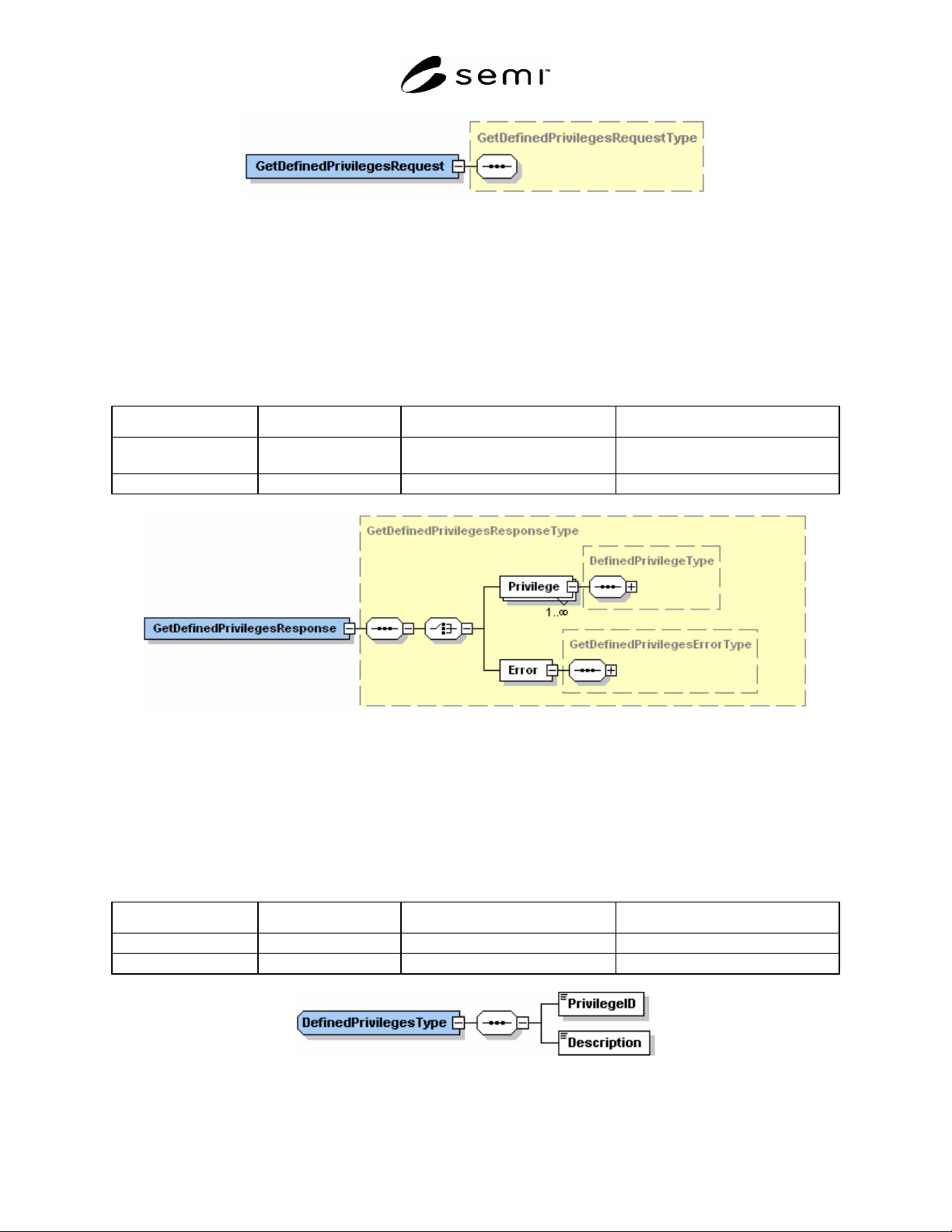
8.2.9.1.3.1 The service response is mapped to the XML Schema element GetDefinedPrivilegesResponse of type
GetDefinedPrivilegesResponseType. Table 16 shows how the output parameters are mapped to XML. Errors for
this operation are returned using the XML schema element Error of type GetDefinedPrivilegesErrorType described
in ¶8.2.9.1.5. The XML Schema diagram for the response element is shown in Figure 12.
Table 16 Translation Table for GetDefinedPrivileges Output Parameters
Argument Name Format XML Element or Attribute XML Name/Type
privileges Unordered list Element Privilege: DefinedPrivilegeType (one
or more)
error Structured data Element Error: GetDefinedPrivilegesErrorType
Figure 12
GetDefinedPrivilegesResponse XML Schema Element
8.2.9.1.4 DefinedPrivilege Class
8.2.9.1.4.1 The DefinedPrivilege class is mapped to the XML DefinedPrivilegesType. Table 17 shows how the
attributes and associations of DefinedPrivilege class are mapped to XML. Figure 13 shows the XML schema
diagram.
Table 17 Translation Table for DefinedPrivilege Class
Attribute or Role Name UML Name/Type XML Element or Attribute XML Name/Type
privilegeId Text Element PrivilegeID: xsd:string
description Text Element Description: xsd:string
Figure 13
DefinedPrivilegesType XML Schema Type
8.2.9.1.5 GetDefinedPrivileges Errors
SEMI E132.1-0305 © SEMI 2005 20
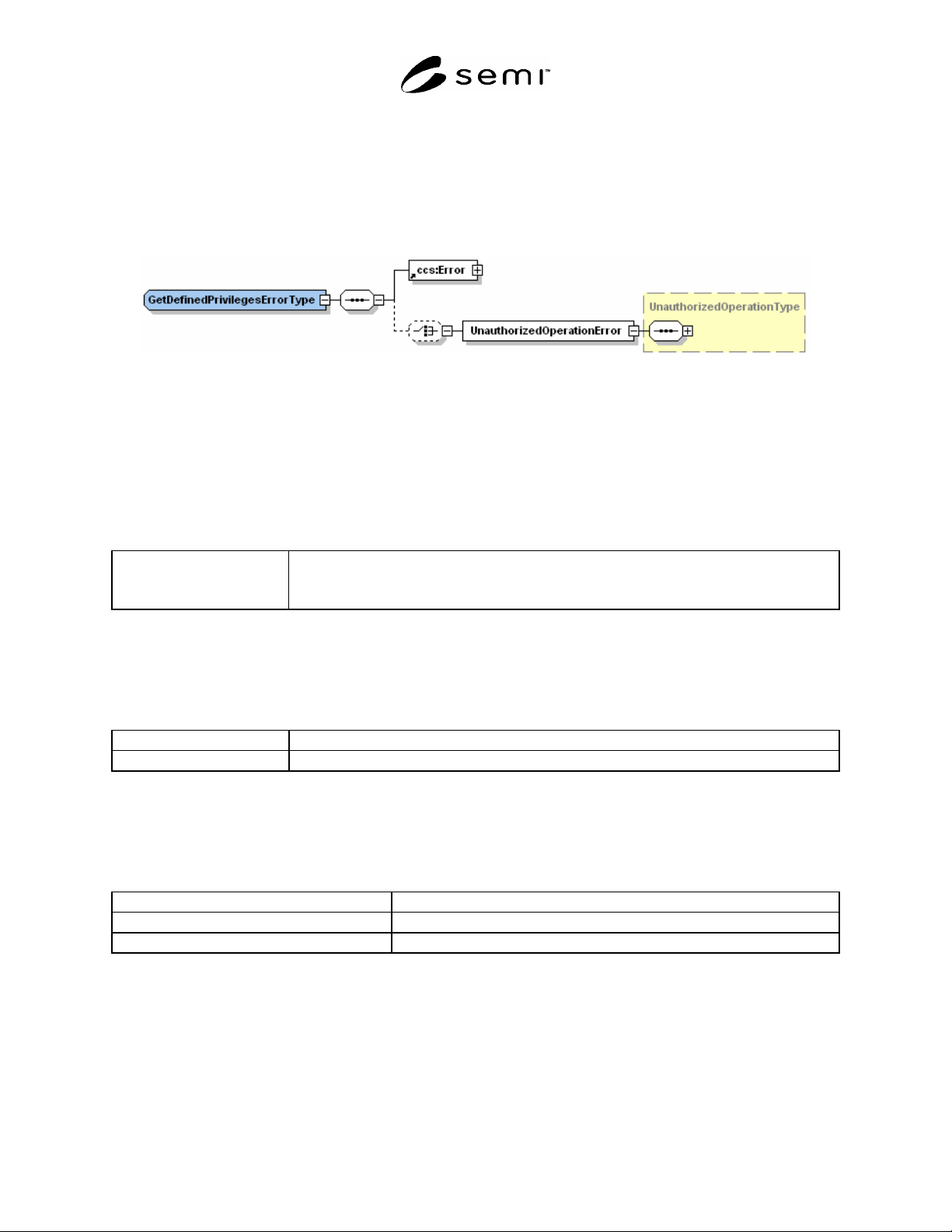
8.2.9.1.5.1 Errors for this operation are mapped to the XML Schema element Error of type
GetDefinedPrivilegesErrorType. Figure 14 shows the XML Schema diagram for the error type. As shown, any
error returned must contain the common error element as described in ¶8.2.6.1. In addition, if the error is an
Operation not authorized error, the UnauthorizedOperationError must also be included providing additional context
information as defined in SEMI E132. The mapping for the UnauthorizedOperationError class is as described in
¶8.2.6.2.
Figure 14
GetDefinedPrivilegesErrorType XML Schema Type
8.2.9.2 WSDL Message(s)
8.2.9.2.1 Three messages are defined for this operation corresponding to the SEMI E132 Header, Request and
Response messages. See the message definitions for “E132HeaderMessage”, “GetDefinedPrivilegesRequest
Message”, and “GetDefinedPrivilegesResponseMessage” in E132-SecurityAdmin-PortType.wsdl. Key information
is shown for convenience in Table 18.
Table 18 GetDefinedPrivileges Messages
Message Name
Schema
Element Name
E132HeaderMessage auth:E132Header
GetDefinedPrivilegesRequestMessage auth:GetDefinedPrivilegesRequest
GetDefinedPrivilegesResponseMessage auth:GetDefinedPrivilegesResponse
8.2.9.3 WSDL Operation
8.2.9.3.1 See the portType operation definition for “GetDefinedPrivileges” in E132-SecurityAdmin-PortType.wsdl.
Key information is shown for convenience in Table 19.
Table 19 GetDefinedPrivileges PortType Operation
Input Message Name
GetDefinedPrivilegesRequestMessage
Output Message Name GetDefinedPrivilegesResponseMessage
8.2.9.4 WSDL Operation Binding
8.2.9.4.1 See the operation binding for “GetDefinedPrivileges” in E132-SecurityAdmin-Binding.wsdl. Key
information is shown for convenience in Table 20.
Table 20 GetDefinedPrivileges Operation Binding
SOAPAction
urn:semi-org:ws.E132-1.V0305.secAdmin-binding:GetDefinedPrivileges
Input Headers (WSDL Message, Required) E132HeaderMessage, required
Output Headers (WSDL Message, Required) E132HeaderMessage, required
8.2.10 GetACL Operation
8.2.10.1 XML Schema Types
8.2.10.1.1 This section describes the XML mappings for the classes defined in SEMI E132 for the GetACL
operation. See GetDefinedPrivileges operation regarding schema conventions used.
8.2.10.1.2 GetACL Request