semi合集-English.pdf - 第4700页
SEMI C3.39-0304 © SEMI 1989, 2004 6 NOTICE: T his standard does not purport to address sa fety issu es, if any, associated w ith its use. It is the responsibility of th e users of this standard to establish appropriate s…
SEMI C3.39-0304 © SEMI 1989, 2004 5
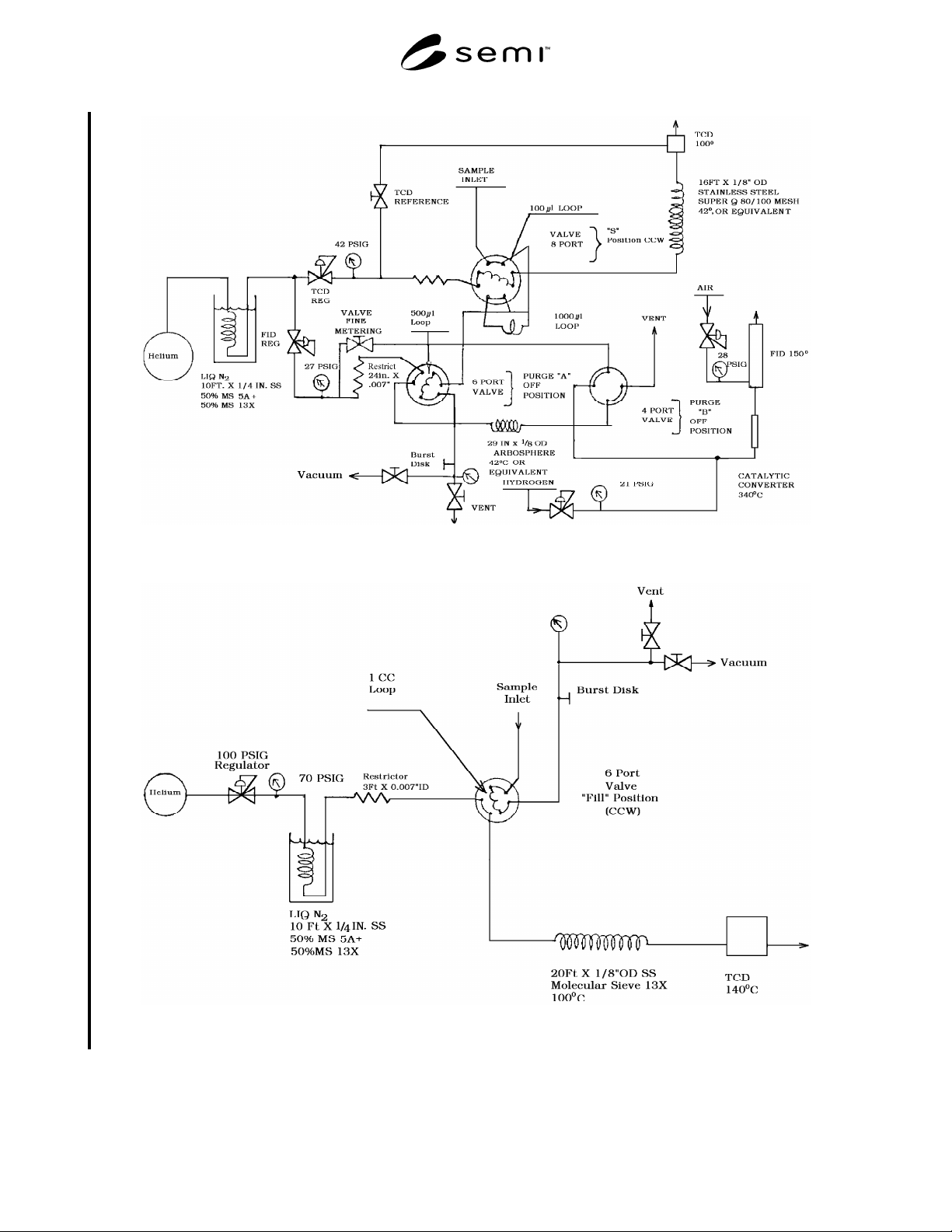
Figure 1
Configuration for the Analysis of CF
4
, CO
2
, N
2
O, SF
6
, and CO in NF
3
Figure 2
Configuration for the Analysis of O
2
/Ar and N
2
in NF
3

SEMI C3.39-0304 © SEMI 1989, 2004 6
NOTICE: This standard does not purport to address safety issues, if any, associated with its use. It is the
responsibility of the users of this standard to establish appropriate safety and health practices and determine the
applicability of regulatory or other limitations prior to use.
SEMI makes no warranties or representations as to the suitability of the standards set forth herein for any particular
application. The determination of the suitability of the standard is solely the responsibility of the user. Users are
cautioned to refer to manufacturer’s instructions, product labels, product data sheets, and other relevant literature
respecting any materials mentioned herein. These standards are subject to change without notice.
The user’s attention is called to the possibility that compliance with this standard may require use of copyrighted
material or of an invention covered by patent rights. By publication of this standard, SEMI takes no position
respecting the validity of any patent rights or copyrights asserted in connection with any item mentioned in this
standard. Users of this standard are expressly advised that determination of any such patent rights or copyrights, and
the risk of infringement of such rights, are entirely their own responsibility.
Copyright by SEMI® (Semiconductor Equipment and Materials
International), 3081 Zanker Road, San Jose, CA 95134. Reproduction o
f
the contents in whole or in part is forbidden without express written
consent of SEMI.
SEMI C3.58-0303 © SEMI 2000, 2003 1
SEMI C3.58-0303
SPECIFICATION FOR OCTAFLUOROCYCLOBUTANE, C
4
F
8
,
ELECTRONIC GRADE IN CYLINDERS
This specification was technically approved by the Global Gases Committee and is the direct responsibility of
the North American Gases Committee. Current edition approved by the North American Regional Standards
Committee on October 25, 2002. Initially available at www.semi.org December 2002; to be published March
0303. Originally published June 2000.
NOTICE: This entire document was completely revised in 2003.
1 Description
1.1 Octafluorocyclobutane, also known as
perfluorocyclobutane, is a gas under normal
atmospheric conditions (15°C and 760 mm Hg).
1.2 The gas is a non-flammable, non-toxic, colorless
and odorless gas which is stable under normal
conditions.
NOTICE: This standard does not purport to address
safety issues, if any, associated with its use. It is the
responsibility of the users of this standard to establish
appropriate safety and health practices and determine
the applicability of regulatory or other limitations prior
to use.
2 Specifications
Purity: 99.999%
Impurities Maximum Acceptable Level
Oxygen 1 ppmv
Moisture 3 ppmv
Other organic
(PFC-1216, PFC-31-10mc,
PFC-1318my, PFC-31-
10my, CFC-114, CFC-114a,
THF)
10 ppmv
Acidity (as HCl) 100 ppbw
Air (N
2
, O
2
, CO, CO
2
) 3 ppmv
3 Referenced Standards
None.
4 Physical Constants (for information only)
Formula C
4
F
8
or CF
2
• CF
2
• CF
2
• CF
2
Molecular weight 200
Melting point
−41.4°C
Boiling point
−6°C
Relative density, gas 6.9 (air = 1)
Relative density, liquid 1.6 (water = 1)
Vapor pressure 20°C
2.7 bar
Appearance/Color Colorless gas
Odor none
5 Analytical Procedures
NOTE 1: Samples of octafluorocyclobutane should be
equilibrated at no less than 30°C (85°F) for at least 24 hours
prior to analysis to ensure adequate vapor pressure for
analysis and consistency.
5.1 Acidity — This procedure is for the determination
of acidity in octafluorocyclobutane utilizing an aqueous
conductivity measurement. Calculations are made
relating sample conductivity to free acidity, calculated
as hydrochloric acid, in the sample.
5.1.1 Detection Limit — 30 ppb as HCl.
5.1.2 Apparatus: A conductivity bridge and cell, heat
gun, graduated cylinders, gas dispersion tube, wide-
mouth polyethylene bottle, hypodermic syringes,
polyethylene beaker, water purification system.
5.1.3 Reagents
5.1.3.1 Hydrochloric acid, 0.01 N standard in SDA-2B
ethyl alcohol (store the standard in separate 50-mL
serum capped vials).
5.1.3.2 CFC-11, special (analyzed to have an aqueous
conductance of < 0.5 µmho/cm). If CFC-11 is not
available, a similar degreasing solvent can be
substituted, such as HFC-43-10.
5.1.3.3 Distilled and de-ionized water, aqueous
conductivity < 0.5 µmho/cm, prepared immediately
prior to use by passing distilled water through a water
purification system and analyzing it with a conductivity
bridge. DO NOT STORE DE-IONIZED WATER FOR
USE IN THIS ANALYSIS.
5.1.3.4 RBS-35 cleaner.
5.1.4 Operating Procedure
5.1.4.1 Attach a suitable regulator to the cylinder
outlet.