semi合集-English.pdf - 第6878页
SEMI S3-91 © SEMI 199 1, 1996 5 NOTICE: These gu idelines do not purport to addres s all of the safety issues associated with their use. It is the responsibilit y of the users of these guidelines to establish appro priat…
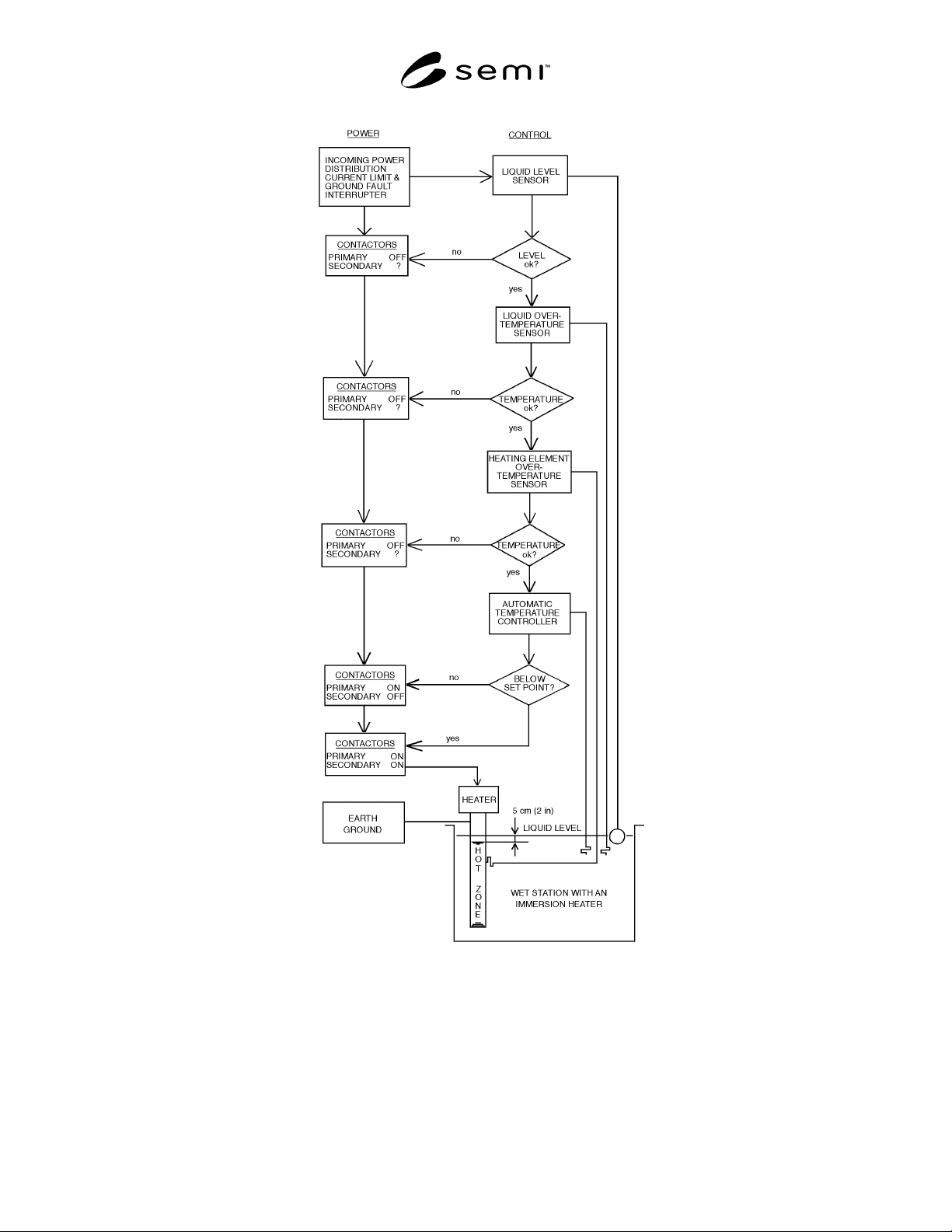
SEMI S3-91 © SEMI 1991 4
Figure 1

SEMI S3-91 © SEMI 1991, 19965
NOTICE: These guidelines do not purport to address
all of the safety issues associated with their use. It is the
responsibility of the users of these guidelines to
establish appropriate safety and health practices and
determine the applicability of regulatory limitations
prior to use. SEMI makes no warranties or
representations as to the suitability of the guidelines set
forth herein for any particular application. The
determination of the suitability of these guidelines is
solely the responsibility of the user. Users are cautioned
to refer to manufacturer’s instructions, product labels,
product data sheets, and other relevant literature
respecting any materials mentioned herein. These
guidelines are subject to change without notice.
The user’s attention is called to the possibility that
compliance with this standard may require use of
copyrighted material or of an invention covered by
patent rights. By publication of this standard, SEMI
takes no position respecting the validity of any patent
rights or copyrights asserted in connection with any
item mentioned in this standard. Users of this standard
are expressly advised that determination of any such
patent rights or copyrights, and the risk of infringement
of such rights, are entirely their own responsibility.
Copyright by SEMI® (Semiconductor Equipment and Materials
International), 3081 Zanker Road, San Jose, CA 95134. Reproduction o
f
the contents in whole or in part is forbidden without express written
consent of SEMI.

SEMI S4-0304 © SEMI 1992, 2004 1
SEMI S4-0304
SAFETY GUIDELINE FOR THE SEPARATION OF CHEMICAL
CYLINDERS CONTAINED IN DISPENSING CABINETS
This safety guideline was technically approved by the Global Environmental, Health, and Safety Committee
and is the direct responsibility of the North American Environmental, Health, and Safety Committee. Current
edition approved by the North American Regional Standards Committee on December 4, 2003. Initially
available at www.semi.org February 2004; to be published March 2004. Originally published in 1992.
NOTICE: This safety guideline was completely
rewritten in 2003.
NOTICE: Paragraphs entitled “NOTE” are not an
official part of this document and are not intended to
modify or supersede the official Safety Guideline.
These have been supplied by the Task Force to enhance
usage of the Safety Guideline.
NOTICE: The intent of the task force that produced
this document is that conformance to the “should”
provisions of this guideline comprises conformance
with this guideline.
1 Purpose
1.1 This safety guideline provides a method for
determining cylinders of which types of chemicals
should be in separate gas cabinets and which cylinders
may be in gas cabinets with each other.
1.2 The safety guideline is intended to be used by those
working or doing research in semiconductor-related
technology.
2 Scope
2.1 This safety guideline refers to chemicals, which
includes gases and liquids, contained in cylinders, that
are used in gaseous form because of their vapor
pressure or because they may be transported as a vapor
by a carrier gas.
2.2 It also pertains to all types of cylinders, up to and
including an internal volume of 1000 liters.
2.3 The primary intent of this guideline is directed to a
cylinder gas in use in, or being dispensed in, the
research and manufacturing processes.
2.4 This safety guideline addresses purge gases
supplied in cylinders and used to purge process
chemical lines.
2.5 This safety guideline addresses process chemicals
in cylinders which are designed to provide them at
pressures less than 101.3 kPa (one atmosphere).
NOTICE: This safety guideline does not purport to
address all of the safety issues associated with its use.
It is the responsibility of the users of this safety
guideline to establish appropriate safety and health
practices and determine the applicability of regulatory
or other limitations prior to use.
3 Limitations
3.1 This safety guideline does not pertain to those
cases where chemical cylinders are incorporated within
a piece of process equipment.
NOTE 1: Guidance regarding other aspects of the safety and
management of gas cylinders is contained in several of the
documents listed in the Related Documents section of this
safety guideline.
3.2 This safety guideline does not pertain to chemicals
used in fabrication facilities for ancillary purposes, such
as welding.
4 Referenced Standards
4.1 United States Code of Federal Regulations
16 CFR 1500.41 — Method of testing primary irritant
substances
1
49 CFR 173 — Shippers – General Requirements for
Shipment and Packaging
2
4.2 National Fire Protection Association
3
NFPA 49 — Hazardous Chemicals Data
NOTE 2: NFPA 49 is no longer part of the NFPA codes in
either the compact disc or hard copy version. It is now part of
the NFPA Fire Protection Guide to Hazardous Materials and
must be purchased separately from NFPA.
NFPA 704 — Identification of Fire Hazards of
Materials
1 The Office of the Federal Register, Washington, D.C. 20037
http://www.access.gpo.gov/nara/cfr/waisidx_00/16cfr1500_00.html
2 The Office of the Federal Register, Washington, D.C. 20037
http://www.access.gpo.gov/nara/cfr/waisidx_00/49cfr173_00.html
3 National Fire Protection Association, 1 Batterymarch Park, Quincy,
MA 02269, Website: www.nfpa.org