semi合集-English.pdf - 第4235页
SEMI F75-1102 © SEMI 2002 7 (PFA and P VDF) com ponents and are conti nuously leached into the UPW stream s. Plastic lined metal component s such as pumps, stora ge tanks, and other UPW processing vessels may develop pin…

SEMI F75-1102 © SEMI 2002 6
residue. There is also evidence that as an ion-exchange
bed approaches exhaustion, previously removed
dissolved silica can be subsequently released as
colloidal silica if the pH in the ion-exchange bed is
favorable. There is currently no specific measurement
of on-line colloidal silica, but detecting it as a
component of non-volatile residue can be beneficial.
8.7.2 Method of Measurement for NVR
8.7.2.1 The on-line measurement of nonvolatile residue
is based on the principle of determining “residue after
evaporation” of atomized ultrapure water droplets.
Droplets evaporate in a fraction of a second leaving an
ultrafine nonvolatile residue particle agglomerate a few
nanometers in diameter; the size of which is related to
the amount of residue impurity originally present in the
ultrapure water. A condensation particle counter then
monitors the concentration of ultrafine nonvolatile
residue particles. The measurement range of this
technique is 0.01 parts per billion to 20 parts per
million.
8.8 Ions
8.8.1 Mass Balance and Ionic Removal in UPW
Systems
8.8.1.1 The ionic composition of natural waters is in a
dynamic equilibrium (mass balance) with the geological
source. The total dissolved solid (TDS) content is
composed of negatively charged (anionic) and
positively charged (cationic) species that can be
analyzed by Ion Chromatography (IC). RO membranes,
ion-exchange resins, and electronic deionization (EDI)
are used to remove ionic species from water. The UPW
resin beds need to be monitored because each unit has a
fixed capacity to remove ions over time. Weakly bound
singly charged (monovalent) ions such as Na
+
and Cl
-
are continually displaced in favor of more highly
charged doubly charged (divalent) ions such as SO
4
2-
and Ca
2+
throughout the life of the resin. When ionic
breakthrough occurs, the weakly bound ions are
liberated in excess, and resin beds must be regenerated.
8.8.2 Ion Chromatography Techniques
8.8.2.1 Ionic (anions and cations) removal in UPW
systems can be quantified at very sensitive levels using
the technique of ion chromatography. During IC
analysis, a UPW sample is injected into an analytical
column packed with a special ion-exchange resin. The
ions from the samples are eluted (washed) down the
column by a suitable eluent. Depending on their
binding energy and sizes, the ions move down the
column at different speeds. In time, all of the ions are
separated and measured by a conductivity detector.
External calibration of a sensitive conductivity detector
across a wide range of concentrations allows accurate
quantification of anion and cations. The anions and
cations determined by IC are fluoride (F
-
), chloride
(Cl), nitrite (NO
2
-
), bromide (Br
-
), nitrate (NO
3
-
), sulfate
(SO
4
2-
). phosphate (PO
4
3-
) and lithium (Li
+
), sodium
(Na
+
), ammonium (NH
4
+
), potassium (K
+
), magnesium
(Mg
2+
), calcium (Ca
2+
) respectively.
8.8.3 Ions Critical in Semiconductor Processing
8.8.3.1 Certain types of haze formation on wafer
surfaces could be caused by high concentrations of
anions and cations on the silicon surface as residue.
There could be other causes for haze formations,
therefore, testing of anions and cations at the POU in
the rinse bath may be important to identify and prevent
this source of contamination.
8.9 Metals
8.9.1 Measurement Methods
8.9.1.1 Up to 68 metals may be determined by
instruments such as Graphite Furnace Atomic
Absorption Spectroscopy (GFAAS), Inductively
Coupled Plasma Atomic-Emission Spectroscopy (ICP-
AES) or Inductively Coupled Plasma-Mass
Spectrometry (ICP-MS).
8.9.2 Sources of Trace Metals
8.9.2.1 Trace metal concentrations in feed waters vary
over orders of magnitude according to the geology of
source rocks and the residence time of water in aquifers
and surface systems. Surface water supplies are often
mixed by the local municipal services, and seasonal
variations are also introduced as ground water and well
waters are brought in and out of service. Consequently,
periodic analysis of metals in incoming feedwater and
at key points of the UPW system including after the
final filter is essential so that significant changes in
performance may be corrected early in the process of
deionization.
8.9.3 Boron
8.9.3.1 Boron is a trace element that, like silica, is
weakly attracted to anion resins. Both elements serve
as a flag for the onset of ionic breakthrough through the
anion exchange resin. A rapid and systematic rise in
the boron content immediately after the resin bed is
typical when ion-exchange resins approach exhaustion
in the UPW system. Silica and boron breakthough rates
and each element’s selectivity in the ion exchange
process is a matter of ongoing study. The safest route is
to measure both, but at least to focus on the one most
prevalent in the city water feed stream.
8.9.4 Contaminants from the Distribution System
8.9.4.1 Certain heavy elements such as Zn, Mn, Ni, Cu,
Cr, and Pb may be present as trace impurities in plastic

SEMI F75-1102 © SEMI 2002 7
(PFA and PVDF) components and are continuously
leached into the UPW streams. Plastic lined metal
components such as pumps, storage tanks, and other
UPW processing vessels may develop pinholes, thereby
leaching out heavy metal impurities into the UPW
system.
8.9.5 Contaminants from Feed Water
8.9.5.1 The alkali metals (Na, K), alkali earths (Mg,
Ca) and Fe comprise the bulk elements of most natural
waters, and play a significant role in bulk water
chemistry including hardness, alkalinity and total
dissolved solids. Of these elements, sodium is the most
abundant and is present in final filter UPW at sub-ppb
level. Highly charged metals (Al, Fe, and Mn) have the
potential to coagulate and foul RO membranes, and Ba
and Sr can cause scaling of the RO and ion exchange
resins.
8.9.6 Priority Metals in Semiconductor Processing
8.9.6.1 Certain processing steps expose a wafer to
contamination from UPW in a unique way. Metals
from incoming materials (e.g., chemicals, wafers, etc.),
deteriorating wafer processing equipment, and new
processes and materials for deposited circuit layers can
lead to cross contamination and high concentrations of
metals “gettering” on the silicon wafer surface. Testing
for metals in the UPW at POU (e.g., the rinse bath) may
be important in identifying and preventing sources of
metal contamination on the wafer. Certain other
elements, calcium, magnesium and aluminum, have an
increased ability to contaminate the oxides of wafers.
There may be other metals that, depending on the
semiconductor process, can also act as harmful
contaminants.
8.9.7 Radioactive Elements
8.9.7.1 Radioactive elements such as uranium and
thorium can cause soft X-ray damage to devices when
present at ppt levels. These elements are detectable in a
full ICP-MS scan.
9 Typical Monitoring Programs
9.1 On-Line Monitoring
9.1.1 On-line monitors for UPW are readily available
from a variety of manufacturers. Before selecting an
instrument for on-line monitoring an evaluation should
be made about 1.) sensitivity of measurements, 2.)
accuracy of the measurements, 3.) reproducibility of the
measurements, 4.) calibration protocols for the
instrument, 5.) zero count for the instrument (particle
counters) and 6.) instrument cost and reliability.
9.1.2 If on-line monitors are not available at critical
sampling points, or the sensitivity of the on-line
monitor is not sufficient to accurately measure at the
required levels, grab samples may be taken and sent to
a qualified laboratory for equivalent testing. This off-
line sampling and testing requires special apparatus and
trained personnel. A clear understanding of the limits of
each method is required before its application.
9.1.3 All on-line monitoring requires clean and tight
sample port connections in order to eliminate false
counts.
9.2 Testing at critical sampling points, such as point-
of-use, requires special sampling apparatus and trained
personnel. The enclosures and mini-environments
around wet benches that are designed to prevent
accidental access and to isolate human contamination
from the wafer can make it difficult to sample the bath.
However, contamination-free sampling can be done in a
safe way using high purity fluoropolymer apparatus and
trained qualified personnel.
9.3 The utilization of unbiased, independent and
experienced personnel in obtaining data at critical
sampling sites with the UPW system where on -line
instrumentation is not available is essential in
determining the overall performance of the UPW
system.
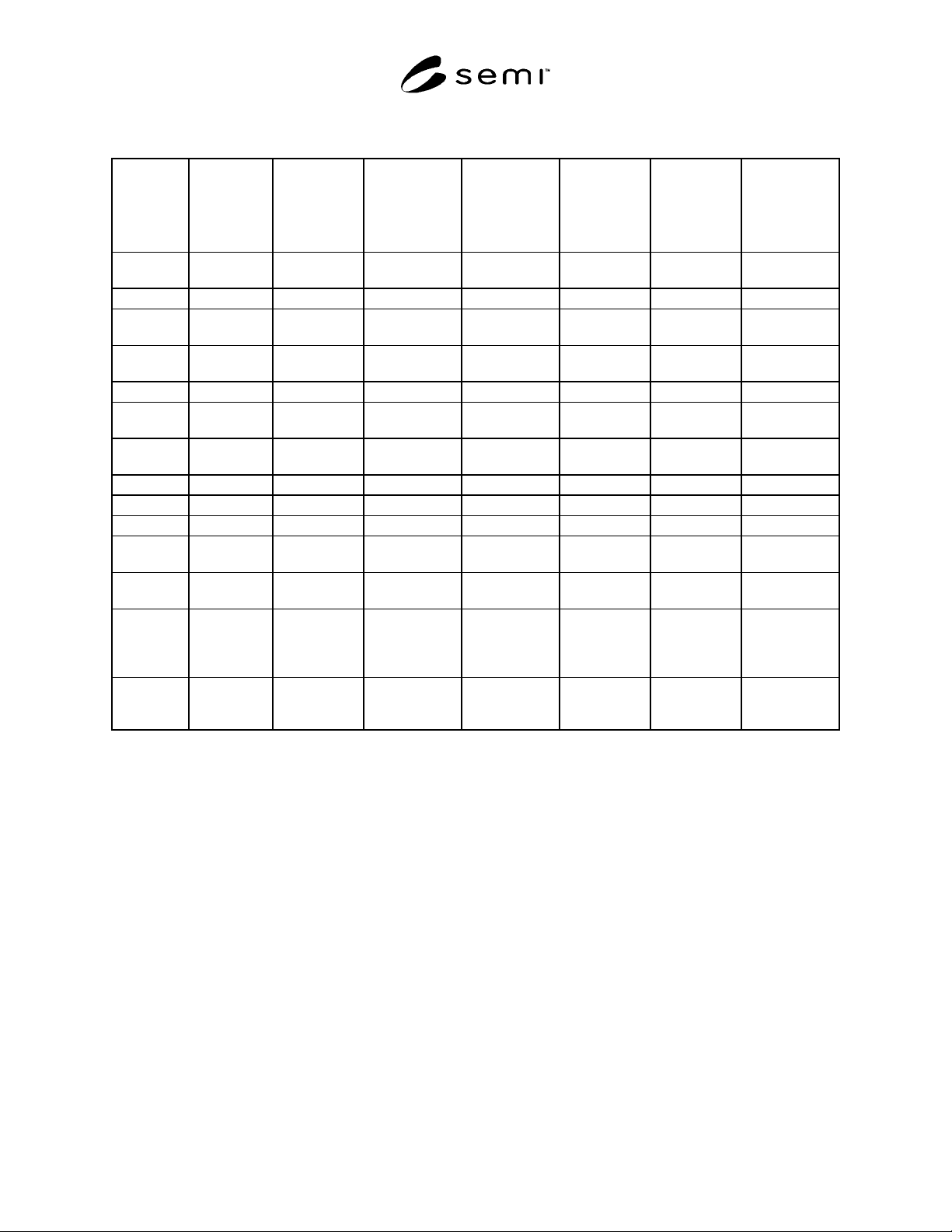
9.4 See Table 1, “UPW System Test Parameters,
Sampling Points, and Recommended Monitoring
Frequency for Assuring Good UPW System Operation”
for sample point and monitoring frequency
recommendations.
SEMI F75-1102 © SEMI 2002 8
Table 1 UPW System Test Parameters, Sampling Points and Recommended Monitoring Frequency for
Assuring Good UPW System Operation
Type of
Water
Source
Incoming
Feed pre
RO filters
Pre RO
Post RO
prefilters
UPW
Post RO
UPW
Post Ion
Exchange
UPW
Post Final
Filter
UPW
Return Loop
UPW
POU Tools
(Recommended)
Resistivity - Continuous
(Conductivity)
Continuous
(Conductivity)
Continuous
(Conductivity)
Continuous
(Conductivity)
Continuous
(
Conductivity)
-
TOC Bi-Weekly Bi-Weekly Continuous Continuous Continuous Continuous Bi-Weekly
Particles
OPC
Monthly Monthly Monthly Continuous Continuous Continuous Monthly
Particle
SEM
- - - Bi-monthly Monthly Bi-monthly Monthly
Bacteria Biweekly Biweekly Biweekly Biweekly Weekly Weekly Bi-weekly
Dissolved
Silica
Monthly Monthly Monthly Continuous Continuous Continuous Monthly
Total
Silica
Monthly Monthly Monthly Bi-weekly Weekly Weekly Bi-weekly
NVR - - - Continuous Continuous Continuous -
Sodium - - - Continuous Continuous Continuous -
Boron Monthly Monthly Monthly Quarterly Weekly - -
Anions &
Cations
Monthly Monthly Monthly Bi-weekly Bi-weekly Bi-weekly -
Critical
Ions
1
- - - - - - Bi-weekly
Trace
Metals-
Critical
2
Elements
- - - Bi-weekly - - Bi-weekly
Trace
Metals-
Full Scan
Quarterly Quarterly Quarterly Quarterly Monthly Monthly -
1
Critical Ions include Chloride, Fluoride, and Ammonium.
2
Critical Elements include Al, Ca, Cr, Cu, Fe, Mg, Ni, Na, and Zn
NOTE 7: The frequency noted for these parameters is not intended to assure against excursions due to improper maintenance
procedures or other external means of system contamination.
NOTICE: SEMI makes no warranties or representations as to the suitability of the standards set forth herein for
any particular application. The determination of the suitability of the standard is solely the responsibility of the user.
Users are cautioned to refer to manufacturer’s instructions, product labels, product data sheets, and other relevant
literature respecting any materials mentioned herein. These standards are subject to change without notice.
The user’s attention is called to the possibility that compliance with this standard may require use of copyrighted
material or of an invention covered by patent rights. By publication of this standard, SEMI takes no position
respecting the validity of any patent rights or copyrights asserted in connection with any item mentioned in this
standard. Users of this standard are expressly advised that determination of any such patent rights or copyrights, and
the risk of infringement of such rights, are entirely their own responsibility.
Copyright by SEMI® (Semiconductor Equipment and Materials
International), 3081 Zanker Road, San Jose, CA 95134. Reproduction o
f
the contents in whole or in part is forbidden without express written
consent of SEMI.