semi合集-English.pdf - 第2754页
SEMI E98-1102 © SEMI 2000, 2002 19 Table 5 Equipme ntIODevice Attribute De fi nitions Attribute Name Definition Access Reqd Form ObjType Object type RO Y Text = “EqpIODevice” ObjID Object identifier RO Y Text AlgorithmID…
SEMI E98-1102 © SEMI 2000, 2002 18
10.2.5 AbstractEquipmentElement Attributes — Table 4 defines the attributes of the AbstractEquipmentElement.
Table 4 AbstractEquipmentElement Attribute Definitions
Attribute Name Definition Access Reqd Form
ObjType Object type RO Y Text=“EqpElement”
ObjID Object identifier RO Y Text
Cycles Number of cycles (or hours) since installation or last reset. RO Y Unsigned long integer
ResetDate Date cycles set to zero. RO Y Text
Description User-definable text RW Y Text
Function Describes function of object (e.g., substrate-chuck, apply/develop track). RO Y Text
Supplier Name of manufacturer or provider RO Y Text
ImmutableID An unchangeable identifier such as serial number. RO Y Text
InService Available for work. RO Y Boolean
10.2.6 AbstractEquipmentElement Services — The user may be allowed to change the operational state of specific
AbstractEquipmentElement objects that are of significance for preventive maintenance. This is particularly
desirable for those subsystems for which preventive maintenance may be performed while the equipment is still
assigned to manufacturing operations.
10.2.6.1 ChangeService
10.2.6.1.1 The user may request that an element currently in the IN SERVICE state be placed in the OUT OF
SERVICE\ USER SELECT state. This request shall not affect any current activity for which the element is being
used. However, an element in the OUT OF SERVICE state shall not be used for any new activities.
10.2.6.1.2 The user may request that an element currently in the OUT OF SERVICE/USER SELECT state be
placed back into the IN SERVICE state.
10.3 EquipmentIODevice Object
10.3.1 An EquipmentIODevice object is a specialization of AbstractEquipmentElement used to represent the
sensors, actuators, and intelligent sensor/actuator devices that provide most of the process data sought by
manufacturing engineering. Individual I/O points are represented by individual Observables contained within the
EquipmentIODevice object.
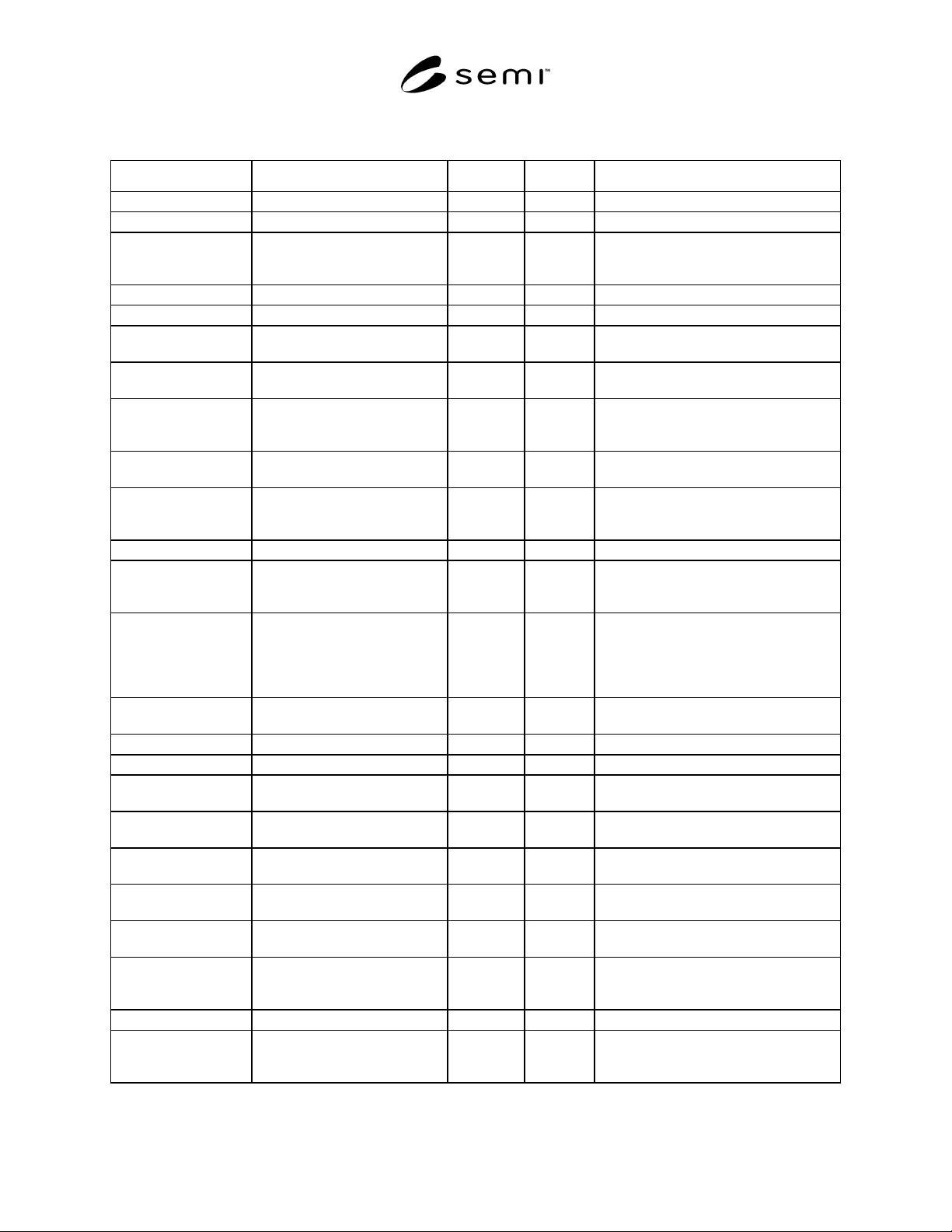
10.3.2 Observables are not formalized as standardized objects, as indicated by the thin line in Figure 9. The
EquipmentIODevice may represent a single I/O point, an aggregation of I/O points, or a virtual sensor providing
composite data.
10.3.3 Table 5 defines the attributes of the EquipmentIODevice. Attributes are in alphabetical order, with the
exception of the Observables
i
attribute, which is placed at the end with its structure members for clarity.
1+
Observable
DataDimensions
DataType
DeltaValue
InterlockStatus
Name
NominalValue
ObservableType
PossibleUnits
Range
ReadRate
ReportRate
ReportChange
Timestamp
Units
Value
AlgorithmID
Description
DeviceType
Function
HardwareRevision
ModelNumber
NumberOfObservables
Observables
SoftwareRevision
Equipment
IODevice
GetProgramDirectory
SelectProgram
Figure 9
EquipmentIODevice and Observable Object Types
SEMI E98-1102 © SEMI 2000, 2002 19
Table 5 EquipmentIODevice Attribute Definitions
Attribute Name Definition Access Reqd Form
ObjType Object type RO Y Text = “EqpIODevice”
ObjID Object identifier RO Y Text
AlgorithmID Identifier of any algorithm used
to produce the set of observable
values.
RO or RW Y Text
HardwareRevision Revision level for hardware. RO Y Text. 1–5 characters.
ModelNumber Manufacturer model number. RO Y Text. 1–20 characters.
Numberof-Observables The number of data items
provided
RO Y Integer
SoftwareRevision Revision level for s/w or
firmware
RO Y Text. 1–5 characters.
Observables
I
Information about the ith item of
observable data values.
RO Y Structure comprised of Name, Value,
Units, and Range, and Timestamp as
follows.
Name The name of the data, sensor, or
actuator.
RO Y Text
DataDimension Used for arrays to indicate the
number and length of “rows” of
data.
RO N.
Required
for arrays.
List of unsigned integers.
Datatype The form of the data. RO Y Enumerated.
DeltaValue Amount of change from the target
for reporting. Zero value
indicates it is not used.
RW N As indicated by Datatype.
InterlockStatus Status of current interlock. RO N.
Required
for
Actuator
types.
Enumerated: None, Off, On
NominalValue Target used for reporting change
of DeltaValue.
RW N Numeric text string. If empty, is not used.
ObservableType Type of Observable. RO Y Enumerated
Possible Units List of possible units RO N List of text
Range Valid interval or set of possible
discrete values.
RO Y Text
ReadRate Interval between sequential reads,
in seconds.
RO Y Floating point
ReportChange A user-settable switch to enable
or disable reporting.
RW N Boolean. Set TRUE when enabled.
ReportRate Interval between sequential
reports, in seconds.
RW N Floating point. Zero indicates no time-
based reporting.
Timestamp The date and time when the value
was last read or set.
RO Y Numeric. Specific form to be resolved.
Units Units of measurement RO or RW Y if value
is scalar.
Text. Conforms to units specified in SEMI
E5 (SECS-II) Units of Measurement
Identifiers.
Value Current value. RO Y Single item or array of numeric, or text
DeviceType Defines the type of device (e.g.,
“MFC”, “OES”, FTIR”, “CDG”,
etc.)
RO Y Text 1–8 characters
SEMI E98-1102 © SEMI 2000, 2002 20
Abstract
Equipment
Subsystem
held at
Material
Location
Material
provides
Abstract
EquipmentModule
Equipment
Subsystem
Figure 10
AbstractEquipmentSubsystem Subtypes
10.4 AbstractEquipmentSubsystem Object
10.4.1 The AbstractEquipmentSubsystem is a subtype
of AbstractEquipmentElement and inherits all of its
attributes and services. It may have associated
MaterialLocations to hold Material.
AbstractEquipmentSubsystem represents all subsystem
and subassembly components of which the equipment
is made up. The AbstractEquipmentSubsystem may or
may not be capable of holding material and may or may
not have recipe execution capability.
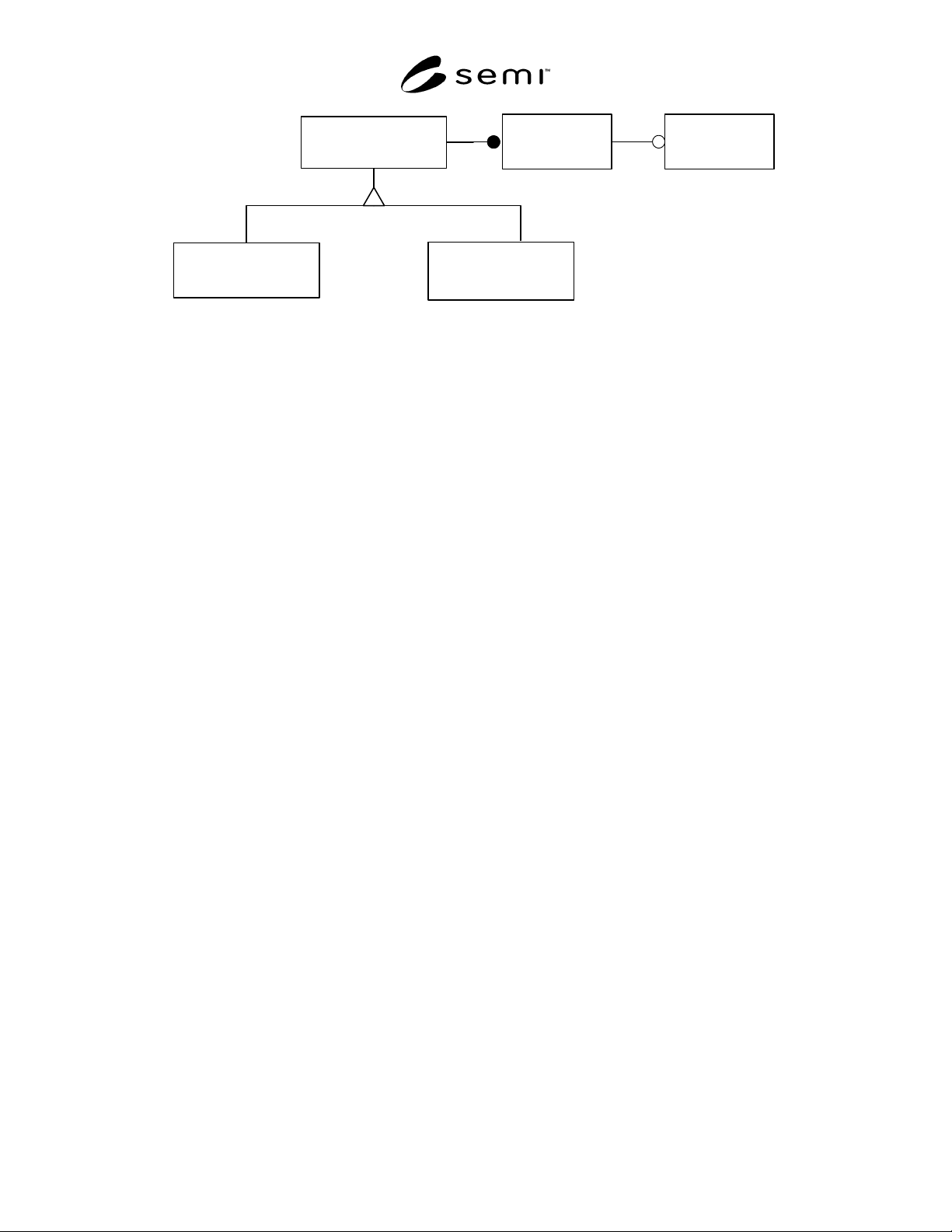
10.4.2 Figure 10 shows the relationships of the
EquipmentSubsystem.
10.4.3 Material Object
10.4.3.1 An AbstractEquipmentSubsystem may or may
not be able to hold material. Those that are able to hold
material owns any material that it holds at any given
point in time. They are expected to know the type of
material that they hold, whether material is present, and
the identifier of the material. In some cases, the
AbstractEquipmentSubsystem may be able to hold
multiple units of material or more than one type of
material.
10.4.3.2 There are three major subtypes of material
objects: consumables, durables, and substrates, where
the major subtypes of durables are carriers and process
durables.
10.4.3.3 Consumable materials, such as chemicals, are
used up (as opposed to worn out) during the
manufacturing process.
10.4.3.4 Durable material has a significant lifetime and
is not part of the equipment (is removable). It includes
material that some equipment may require to operate.
The subtype of durable of common interest to almost all
equipment is carrier. A carrier is a durable used to hold
substrates. Process durables are of special interest to a
limited subset of equipment. A process durable is an
identifiable durable that is specified for a certain
process step and recipe. For example, reticles are
identified by product id and the mask level where used,
and they are also identified by serial number. The
factory is very interested in the management and
tracking of process durables.
10.4.3.5 Product is typically a Substrate. In the
semiconductor industry, Substrates include Wafer, Die,
and Leadframe. Reticles are considered a Substrate by
some equipment. In the semiconductor industry,
reticles are considered as a process durable rather than a
product. Specific reticles are specified in recipes for
expose tools and modules. In other industries,
substrates include flat panel (for flat panel displays) and
discs (for hard disk drives).
10.4.3.6 Material objects are not formally defined in
OBEM. Carrier objects are defined in SEMI E87
(CMS) and substrate objects are defined in SEMI E90
(STS).
10.4.4 Material Locations
10.4.4.1 A material location is a place that is capable of
holding material.
10.4.4.2 A MaterialLocation is an abstraction used to
facilitate the tracking of material without regard to the
physical component associated with the tracking
location. For example, a substrate chuck is a subsystem
and can hold a single substrate on its surface. The
entire subsystem consists of a stage that may or may not
be able to move. It may use vacuum to hold the
substrate in place, and it may have additional
mechanisms and sensors. The MaterialLocation only
represents the surface of the chuck. For this reason, the
EquipmentSubsystem is said to provide a
MaterialLocation rather than to be made up of
MaterialLocations through aggregation.
10.4.4.3 This relationship is illustrated in Figure 11.
10.4.4.4 The MaterialLocation object is an abstract
type. Figure 11 shows the subtypes of
MaterialLocations of interest to OBEM.