semi合集-English.pdf - 第1439页
SEMI 30.1-0200 © SEMI 1998, 2000 14 9.2 Var iable Items and Reporti ng L e ve ls — Table 3 defines reporting levels and associated Data Collection Events for which Variable Items are valid for. Table 3 Variable It ems an…
SEMI 30.1-0200 © SEMI 1998, 200013
ensure that the data and the material remain synchronous. As a result, in some cases material processing may be
delayed due to extended data processing time.
8.1.2 The most fundamental level of data defined for ISEM equipment is the anomaly level for review equipment
and region level for inspection equipment. For example, review equipment has data available for individual
anomalies at the AnomalyDataComplete event. Anomaly data may be grouped for level reporting. For example, data
for anomalies found within a region on a substrate would be available at the RegionDataComplete event. This data
would be available as a list variable item for Region Anomalies. All anomalies found on a substrate would be
available at the SubstrateDataComplete event. This could either be 1) a list of list variable items for Region
Anomaly, or 2) a single list variable item of all Substrate Anomalies. In this way, data can be reported with less
high-level event reports, rather than as more low-level event reports.
8.1.3 Data produced by ISEM equipment is customarily grouped for reporting by processing, material, and
equipment constraints which are called reporting levels (i.e., run, substrate, group, site, and anomaly data). Level
data is grouped by these constraints for a reporting level. Data shall be grouped within a reporting level according to
other constraints by degree of processing (e.g., raw sensor, basic, or analyzed data), or statistically (e.g., summary,
correlation, or comparison).
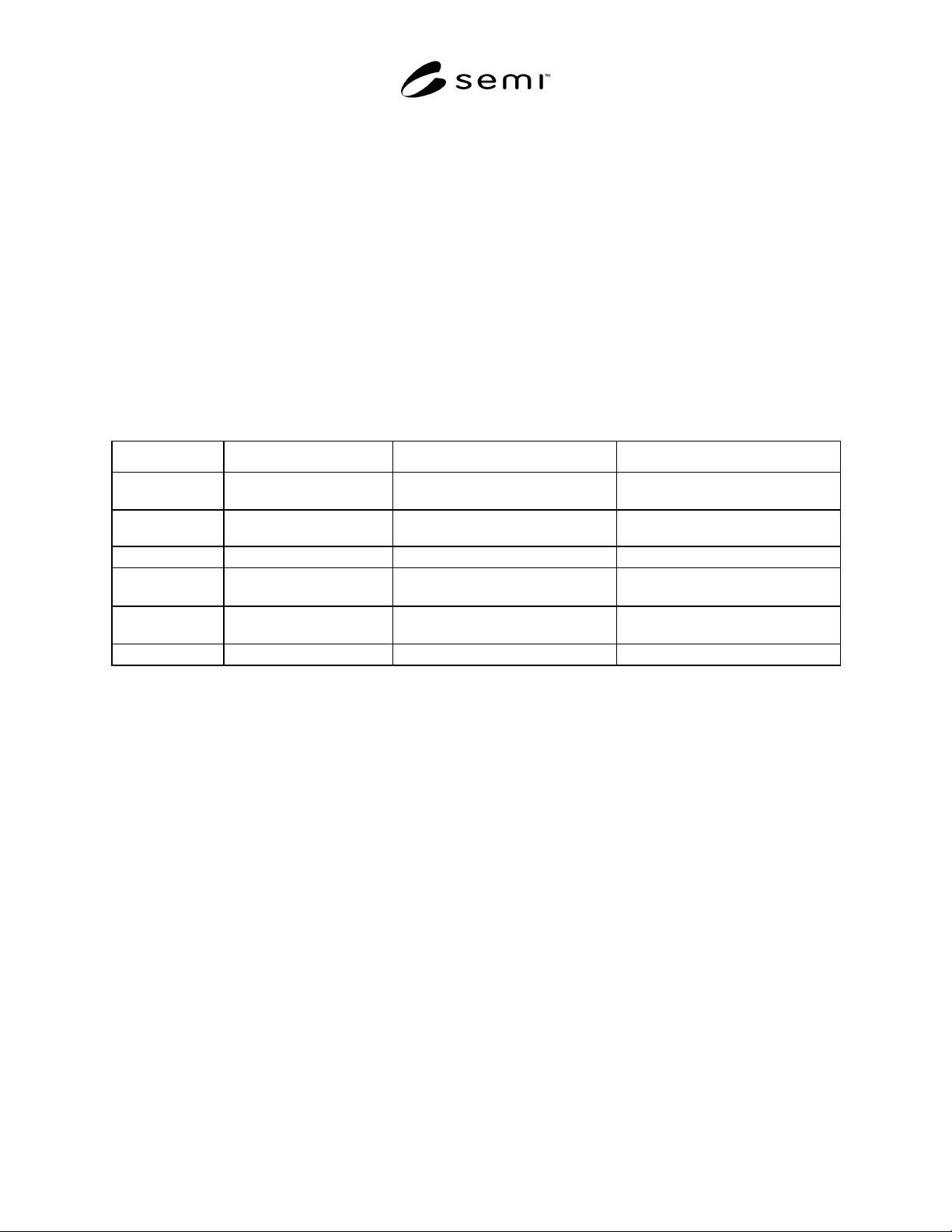
Table 2 Collection Events for ISEM Data Reporting
Reporting Level Data Collection Event Inspection Equipment Review Equipment
Run RunDataComplete
STOPPING → IDLE and LOAD →
SETTING UP
STOPPING → IDLE and LOAD →
SETTING UP
ProcessGroup ProcessBuildGroup-
Complete
LOAD → SETTING UP LOAD → SETTING UP
Substrate SubstrateDataComplete
UNLOAD → LOAD UNLOAD → LOAD
Group GroupDataComplete
INSPECT COMPLETE → ALIGN or
WORKING → UNLOAD
REVIEW COMPLETE → ALIGN or
WORKING → UNLOAD
Region RegionDataComplete
INSPECT REGION → INSPECT
SETUP
Not Defined
Anomaly AnomalyDataComplete Not Defined
CLASSIFY → REVIEW SETUP
NOTE 1: The data collection event shall occur before or on the processing state transition.
9 Variable Items
The purpose of this section is to define the list of variable item requirements for inspection and review equipment.
Values of these variables shall be available to the host via collection event reports and host status queries. These
variable items are separated into three categories: (a) common to all ISEM equipment; (b) specific to inspection
equipment; (c) and specific to review equipment.
If equipment supports the data item functionality defined by ISEM, then it is required and shall be implemented as
specified in Table 4 “Variable Item Dictionary”. That is, a variable item is only required if the equipment supports
the functionality necessary to support it. For example, if an inspection instrument only has the hardware to count
detected anomalies and lacks the hardware to determine their size, then the ISEM requires it to report anomaly count
(e.g., as SubstrateAnomalyCount), but reporting anomaly size (as AnomalySize) is not required by the ISEM.
9.1 Requirements
• All variable items and data item restrictions defined in SEMI E30 are required on ISEM equipment.
• All variable items in the ISEM Variable Item Dictionary for specific equipment classifications are required for
ISEM equipment. The data item restrictions are also required.
9.1.1 Variable items are categorized in the Variable Item Dictionary as follows:
• Common Variables (CV) — variables common to all ISEM equipment.
• Inspection-Specific Variables (ISV) — variables required only for inspection equipment.
• Review-Specific Variables (RSV) — variables required only for review equipment.
SEMI 30.1-0200 © SEMI 1998, 2000 14
9.2 Variable Items and Reporting Levels — Table 3 defines reporting levels and associated Data Collection Events
for which Variable Items are valid for.
Table 3 Variable Items and Reporting Levels
Level Reporting Level Data Collection Event
R Run RunDataComplete
P ProcessGroup ProcessGroupComplete
S Substrate SubstrateDataComplete
G Group GroupDataComplete
X Region RegionDataComplete
A Anomaly AnomalyDataComplete
ALL Run, Substrate, Group, Region, and Anomaly All of the above.
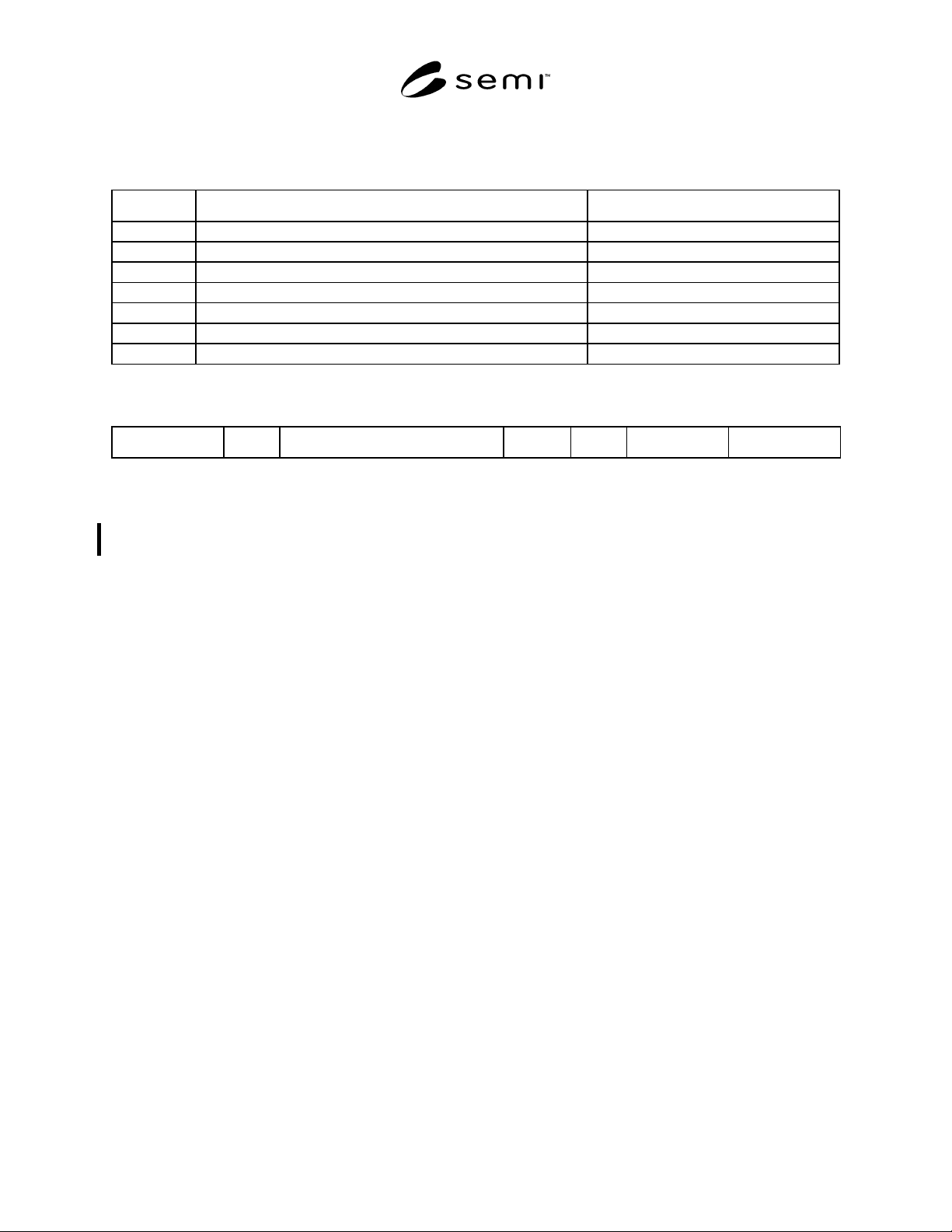
9.2.1 Variable items are documented in the ISEM Variable Item Dictionary using the following format:
Variable Name Type Description Level Class Format Comments
Where:
Variable Name: A unique name for the variable item (this name is for reference only).
Type: Defined as Common (CV), Inspection (ISV), Review (RSV), or Inspection/Review specific
variables (IRSV).
Description: If class is DVVAL, then the description shall contain a statement of when data is valid in terms of
ISEM events.
Level: The report level at which this variable is used <R| S| G| X| A| ALL> as defined in Table 3. It also
indicates when the variable item is valid.
Class: The data type of the item.
Format: <SECS Message Language (SML) mnemonic> acceptable formats are SEMI E5 lists, ASCII,
floating point, unsigned integer, or signed integer. A description of “ANY” indicates that only the
above formats are acceptable and is left to the tool vendor to decide.
Comments: Any additional information pertinent to the variable name.
9.3 Variable Item Types
9.3.1 Equipment Constants (ECV) — The value can be changed by the host using S2,F15. The operator may have
the ability to change some or all of the values. The value of an equipment constant may be queried at any time by
the host using the S2,F13/14 transaction or Stream 6 reports.
9.3.2 Status Variables (SV) — The values are valid at all times. A SV may not be changed by the host or operator
but may be changed by the equipment. A host or operator command may change an equipment status, thus changing
an SV. The value of status variables may be queried by the host at any time using the S1,F3/4 or Stream 6 reports.
9.3.3 Data Variables (DVVAL) — These are variables which are valid upon the occurrence of a specific collection
event and which may or may not be valid at other times, depending upon the equipment. An attempt to read a
variable item when it is invalid will not result in an error, but the data reported may not have relevant meaning.
9.4 Variable Item Dictionary
9.4.1 Data Validity — The “Level” column in Table 4 defines when the variable item is valid. The entry in this
column corresponds to a reporting level defined in Section 9.2 “Variable Items and Reporting Levels”. For example,
“RunAnomalyCount” is valid at the “RunDataComplete” event, and “AnomalySize” is valid at all reporting level
data collection events.

SEMI 30.1-0200 © SEMI 1998, 200015
Table 4 Variable Item Dictionary
Variable Name Type Description Level Class Format Comment
ActiveLocation CV The current carrier location
that has substrates in the
executing state of the
processing state model.
ALL SV U2 Valid in all data
collection events as
defined in Table 3.
AlignList CV A list of alignment sites
information being used by
the current active process
program.
ALL DVVAL L,n
1. <AlignName>
:
n.
The order in which the
alignment name appears
in the list is important
and is equipment-
dependent.
AlignName CV Alignment name ALL DVVAL A[1..16] An item in the
AlignList variable.
AnomalyArea CV The area within the bounds
of an anomaly (in units of
micron
2
).
ALL DVVAL F4
Anomaly-Attributes CV Miscellaneous anomaly
information that is
equipment-dependent and
defined by the equipment
supplier.
ALL DVVAL L,n
1. <attribute
1
>
:
n. <attribute
n
>
Mainly used as part of
other anomaly-related
data (list) (i.e.,
AnomalySize).
Anomaly-Comment RSV Operator-generated
comment associated with
the anomaly.
A DVVAL A[1..80]
AnomalyData2D CV Coordinate data for an
anomaly.
A DVVAL L,5
1. <AnomalyID>
2. <CoordSys>
3. <Coord2D>
4. <Anomaly-
Attributes>
AnomalyID CV A unique anomaly
identifier.
A DVVAL A[1..16]
AnomalySize CV The X,Y extent of the
anomaly in microns. The
dimensions of the smallest
rectangle that contains the
anomaly whose sides are
parallel to the X and Y axis.
A DVVAL L,2
1. <XExtent>
2. <YExtent>
XExtent and YExtent
are of Format F4.
AnomalyTable-
Name
CV Name identifier of anomaly
table.
ALL SV A[1..80]
AnomalyTable-Type CV Type of anomaly table.
(See Section 11.)
ALL SV A[1..20] “TABLE-AREA-DEF”,
“TABLE-ALIGN-
DEF”, “TABLE-
ANOMALY-DEF”,
“TABLE-M21-
ANOMALY-DEF”
BatchID CV The batch identification of
the current material
inspected/reviewed.
ALL DVVAL A[1..16]
CarrierBuild CV ID of the CARRIERBLD
ISEM job that the
inspection/review data is
associated with.
ALL SV A[1..80] See Section 14.
CarrierID CV Physical identification of
the current material
inspected/reviewed.
ALL DVVAL A[1..16]
CarrierNumber CV Used to identify carriers in ALL DVVAL A[1..16]