semi合集-English.pdf - 第1695页
SEMI E40-0705 © SEMI 1995, 2005 7 7.4.1 The process jo b includes a p rocessing descri p-tion (a recipe or proces s program) identifier that s hall be unique within the dom ain of the processing agent. The ty pe and cont…

SEMI E40-0705 © SEMI 1995, 2005 6
widely applicable supervisory control capability for automated processing of material in equipment, irrespective of
the particular process being used.
7.1.1 This standard assumes that, given the material and the recipe specification, the processing resource is capable
of independently achieving the required processing objectives.
7.1.2 Processing management does not provide services for material movement, but the service-provider does need
to coordinate its activities with regard to the receiving and sending of material, thereby maintaining system integrity.
7.2 Process Job — The process job is a dynamic ob-ject specified by the process supervisor (service-user) to effect
material processing by the processing resource. The high-level job contains all the information required by the
processing resource to achieve processing of the material, once it arrives, without further intervention by the
supervisor.
7.2.1 The process job encompasses up to four sequential phases:
processing resource pre-conditioning before material arrival,
material and processing resource preparation for processing,
material processing, and
processing resource post-conditioning after material departure.
7.2.2 The material processing phase is the only phase in which the material is altered and is the only required phase.
7.2.3 This standard specifies services for the creation, control (pausing, aborting, etc.) and tracking of the process
job. It does not define the low-level control of processing since this is application-dependent. The processing
resource performing a process job is responsible for doing whatever is appropriate to achieve its processing
objectives, as specified by the recipe and tuning parameters.
7.2.4 The material specified in a process job may be the actual single material elements to be processed or a
container, such as in the case of a cassette of wafers.
7.2.5 The process job lifecycle may extend beyond the active processing of the material. It may exist from before
material arrival, through setup and processing, and until after material departure. This allows for material
processing-related pre-conditioning of the processing resource before the material is received and for processing
resource post-conditioning (e.g., cleanup) after material is sent. Pre-conditioning and post-conditioning support is
not a fundamental requirement.
7.2.6 The processing resource may provide process job queuing in order to offer flexibility in systems where work
is pre-scheduled or the order of material arrival is unknown. Queuing is the acceptance of multiple process jobs in
advance of performing the processing activities. Queuing is generally needed to support more complex systems
requiring concurrent and consecutive jobs (see below). The jobs are listed in the queue in the order created.
Execution order may be significant, such as consecutive jobs on the same material. Queuing is not a fundamental
requirement.
7.3 Relation to Material Movement — Processing Management does not provide services for receiving material into
the processing agent domain for processing or sending the material away after processing is complete.
7.3.1 Processing depends on the presence of the material, and material departure depends on process completion.
There is also an interdependency requiring synchronization with material movement if processing resource pre-
conditioning and post-conditioning are applied. The equipment is responsible for maintaining integrity between
material transfer and processing.
7.3.2 Material movement management is outside the scope of this standard but may be achieved using applicable
SEMI standards.
7.4 Processing Description — The description of the processing to be applied by the Process Job is crucial. The
description may be supplied in the form of a Process Recipe (see SEMI E42) or a Process Program (see SEMI E30).
This specification will define mes-sages referencing only Process Recipes. Where there are special considerations
for using Process Programs instead of a Process Recipe, they will be noted.

SEMI E40-0705 © SEMI 1995, 2005 7
7.4.1 The process job includes a processing descrip-tion (a recipe or process program) identifier that shall be unique
within the domain of the processing agent. The type and content of the processing description must be appropriate
for the processing resource and the type of material.
7.4.2 Creation and management of recipes and process programs is outside the scope of this standard.
7.5 Process Tuning — Feedforward and feedback control between process steps is becoming increasingly important
for process tuning in stabilizing processes, such as those which lack in-situ metrology, and demand increasing yields
(or performance). The process tuning requirements differ considerably with application, and there is little consensus
on any particular method. It is not the intention of this standard to provide compre-hensive support for process
tuning, but rather to provide a simple mechanism which may be extended. Support for recipe tuning is not a
fundamental requirement.
7.5.1 Processing management provides a mechanism for specification of the type of recipe method to be applied.
Two methods are defined in the standard: RecipeID only, and RecipeID and Variables. User-defined methods may
also be used, requiring all com-municating entities to have a common understanding of the particular definition and
application requirements.
7.5.2 The RecipeID only method accepts the identifier of the recipe to be applied but no additional tuning
parameters. The application recipe body is not precluded from defining any application tuning, but there is no
standardized support.
7.5.3 The RecipeID and Variables method provides a simple process tuning mechanism at process job creation to
support limited run to run feedforward and feedback control. It defines the VariableTuning method, which supplies a
list of variable names and values in the process job create. This sets variables defined in the recipe. Each variable
name shall be one of the exposed variable definitions supported in recipe management, and its value shall fall within
the range specified in the variable definition.
7.5.4 Recipe parameter names (RecipeVarName) shall be specified using the nomenclature defined for ‘Object
Specification’ (ObjSpec) in SEMI E39 (Object Services Standard) within the scope of SEMI E40 (Note: see
OBJSPEC in SEMI E5). This use of the ObjSpec nomenclature is required to unambiguously identify parameters
within some complex recipes (e.g., cluster tool process recipes). If the specification of a recipe parameter is
unambiguous, then the form of the ObjSpec may be simplified to just the parameter name. Using the ObjSpec
nomenclature for SEMI E40 recipe parameter names requires an object model to describe equipment recipe
structure.
7.5.5 Figure 1 shows an example of a typical set of cluster tool hierarchical recipe relationships. A processing
parameter might be specified through Sequence Step AB, Process Recipe BB, Process Step CB, to Process
Parameter DB. In this example, the object specifier for Process Parameter DB would be:
“Sequence:Erma>SequenceStep:AB>ProcessRecipe:
BB>ProcessStep:CB>ProcessParameter:DB>”
or
“Erma>AB>BB>CB>DB>”
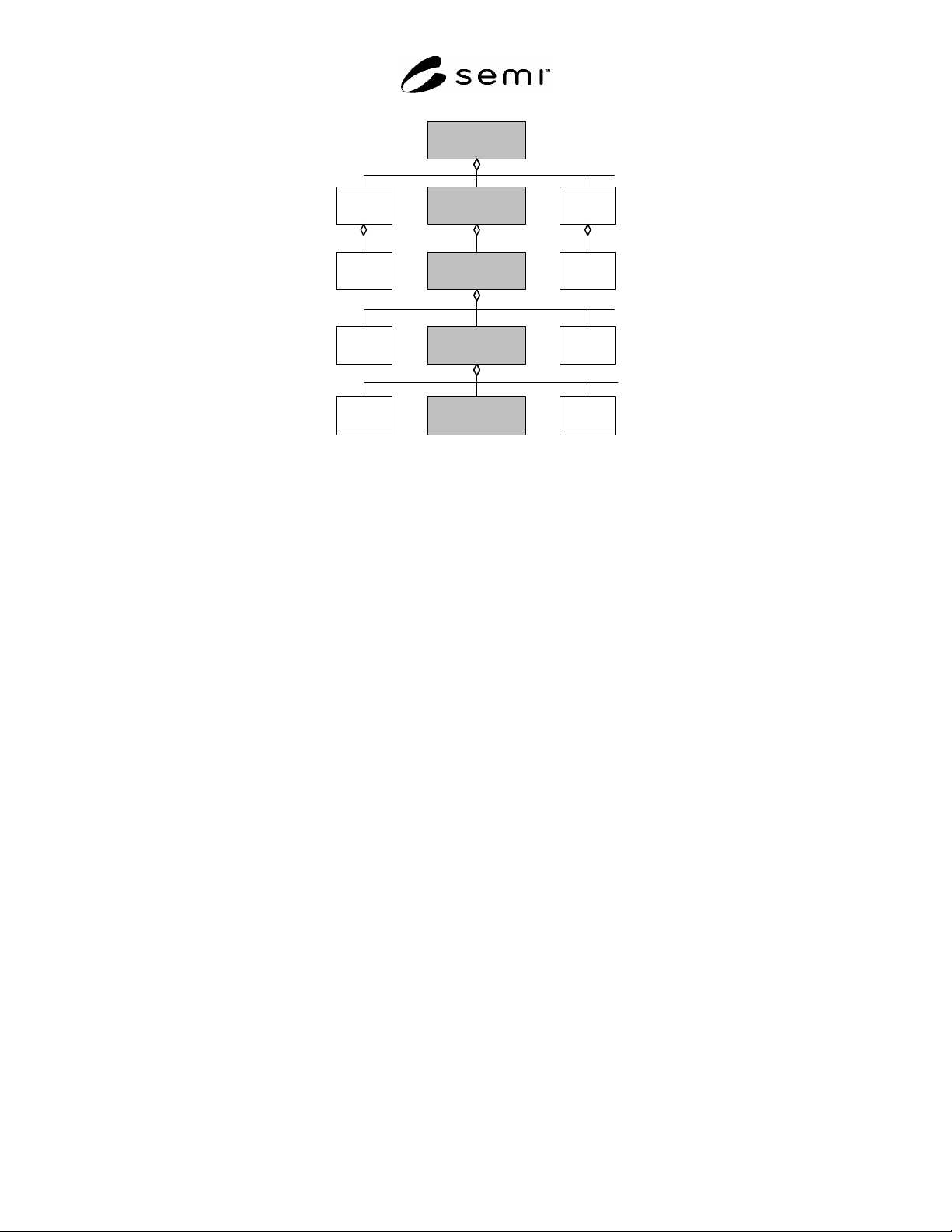
SEMI E40-0705 © SEMI 1995, 2005 8
Sequence
Erma
SS
AA
Sequence Step
(SS)
AB
SS
AC
PR
BA
Process Recipe
(PR)
BB
PR
BC
PS
CA
Process Step
(PS)
CB
PS
CC
PP
DA
Process Parameter
(PP)
DB
PP
DC
Figure 1
Cluster Tool Sequence Recipe Hierarchical Relationships
7.6 Processing Material Groups — Many equipment architectures require concurrent processing of groups of
material. A single process job can control a group of material, with certain restrictions. All material in the group
needs to be of the same type and processed identically. The processing of each material should be dependent on the
arrival of the group. That is, the full material group shall be received by the equipment before processing begins and
may not depart until all processing is complete. This ensures that the process job remains a simple logical control
mechanism while maintaining robust control, good coordination with material movement, and effective material
data tracking.
7.6.1 Two common examples of allowable material group processing are:
a) an equipment receiving a cassette of wafers to be processed identically. All the wafers in the group are received
together, in the cassette. The processing of the wafers may or may not be simultaneous but can only proceed
once the cassette has arrived. All wafer processing shall complete before the cassette may be removed. Note
that this may alternatively be specified as a simple process job with the cassette as the material; and
b) a cluster tool batch process module processing wafers together. Wafers are received singly. Processing of the
wafer group in the batch chamber begins when all the wafers specified in the process job have arrived. Wafers
are sent after processing is complete.
7.7 Concurrent Process Jobs — Concurrent process jobs is the situation where multiple jobs are active (not queued)
at the same time. A single process job is not always appropriate for concurrent processing of multiple material. In
such cases, multiple concurrent jobs shall be supported by the processing resource. Support of concurrent process
jobs is not a fundamental requirement.
7.7.1 An example of concurrent wafer processing which may not be achieved with a single process job is a carousel
type cluster tool process module. The processing of a single wafer is not dependent on the arrival of the group. In
this case, concurrent process jobs would be created, one for each wafer, even if they were to be processed
identically. This allows effective control and tracking of the process jobs.
7.7.2 Processing management considers concurrent process jobs to be logically independent of one other. They are
distinguished by unique job identifiers. Concurrent jobs may not apply to the same material because the processing
resource may not have more than one active process job associated with a particular material.
7.7.3 There may be interdependencies between concurrent jobs due to resource availability and equipment hardware
architecture.