semi合集-English.pdf - 第3099页
SEMI E125-0305 © SEMI 2003, 2005 7 defined by an equi pment node, an SEMI E3 9 ObjType, or an exception. Param eter description is defined in Section 10.4 . 8.1.4 Type and Units 8.1.4.1 Th is specification provides a wa …
SEMI E125-0305 © SEMI 2003, 2005 6
7.1.3 Equipment metadata is designed to be useful to applications that provide an interface to human end users for
the purposes of understanding and browsing equipment configuration, available data items, events, exceptions, etc.
In many cases, these users will be referring to equipment metadata so they can perform data collection for a variety
of objectives (diagnostics, troubleshooting, process control, etc.).
7.1.4 Equipment metadata is also designed to be useful to applications written to take advantage of standardized
state models and other data so that discovery and usage of this information can be automated, without requiring
human intervention. Diagnostics, health monitoring, or other supplier-provided applications that understand the
details of specific equipment types, for example, can also discover and use common equipment-specific
configuration and data without requiring manual assistance.
8 Overview
8.1 Equipment Metadata Organization
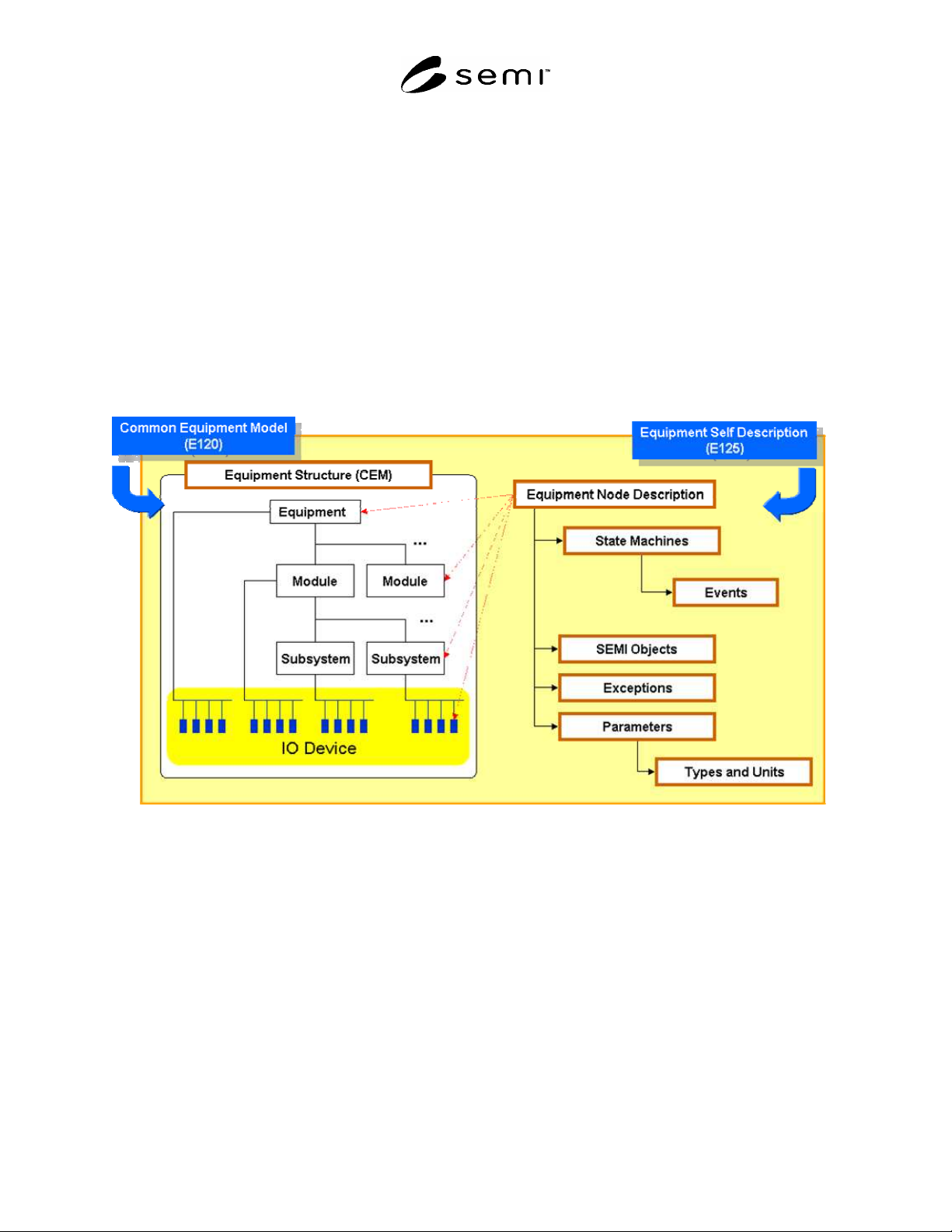
8.1.1 Figure 2 shows the concepts that are included in this specification and their relationship to the SEMI E120
Common Equipment Model. A brief description of the purpose of each metadata concept is provided in this section
only as an overview. For the detailed specification of the corresponding classes, refer to Section 10.
Figure 2
Organization of Metadata Concept
8.1.2 Equipment Node Description
8.1.2.1 This specification defines classes that provide a way to associate events, exceptions, parameters, and SEMI
E39 ObjTypes with any node in the physical equipment structure. SEMI E120 defines the classes that are used to
describe the physical equipment structure; this specification defines the classes that link E120 equipment nodes with
the events, exceptions, parameters, and ObjTypes that they produce. Equipment node description classes are defined
in Section 10.3 .
8.1.3 Parameters
8.1.3.1 This specification defines classes that can be used to describe any variables that are provided by the
equipment, and refers to all such variables as “Parameters”. Parameters can be used to model any concept that can
be represented as a data type. For example, the SEMI E30 concepts of equipment constants, data variables, and
status variables can all be represented by a parameter. Any type of data that the equipment can produce (for
example, measurement results on metrology equipment) can be represented by a Parameter. Parameters can only be

SEMI E125-0305 © SEMI 2003, 2005 7
defined by an equipment node, an SEMI E39 ObjType, or an exception. Parameter description is defined in Section
10.4 .
8.1.4 Type and Units
8.1.4.1 This specification provides a way to describe the data types and units used on the equipment to represent
Parameters. For example, if the equipment defines several Parameters that have a structured data type consisting of
an integer, a string, and an array of Booleans, this specification provides classes that can be used to describe the
structure of that data type. For numeric data types, this specification defines classes that can be used to describe the
units that a value of that data type has. For example, if some Parameter represents a capacitance in microfarads, this
specification can be used to describe the microfarad unit itself, as well as how to indicate that the parameter’s value
is in units of microfarads. Parameter type description is defined in Section 10.4.11 , and units description is defined
in Section 10.5.5 .
8.1.5 State Machine and Events
8.1.5.1 This specification defines classes that can be used to describe the state machines (and the corresponding
transitions and events) that are implemented by the equipment. These classes can be used to describe any SEMI-
defined state machine or any supplier-defined state machine. This specification also defines classes that can be used
to describe the Parameters that are available for reporting when a specific event occurs. State machine description is
defined in Section 10.8 .
8.1.6 SEMI Objects
8.1.6.1 This specification defines classes that can be used to describe any SEMI E39 ObjTypes that are
implemented by the equipment. SEMI ObjType state machines and events are described using the same classes that
are used to describe state machines. ObjType attributes are described using the same classes that are used to
describe Parameters and types. Description of ObjType services is not supported. SEMI ObjType description is
defined in Section 10.8 .
8.1.7 Exceptions
8.1.7.1 his specification defines classes that can be used to describe the existence of error conditions that the
equipment can detect and report as exceptions. An exception can represent any SEMI standard E30 alarm or
equipment-supplier-defined exception that can be reported to clients. Exception description is defined in Section
10.7 .
8.2 Accessing Equipment Metadata
8.2.1 Equipment metadata is directly associated with each unique equipment installation within a factory. Access to
metadata is provided by a collection of operations available from a specific equipment installation. This interface is
described in Section 9.1 .
9 Interfaces for Managing Equipment Metadata
9.1 Equipment Metadata Manager
9.1.1 Figure 3 shows the interface used to access equipment metadata descriptions.
SEMI E125-0305 © SEMI 2003, 2005 8
GetUnits() : Unit[]
GetTypeDefinitions() : ParameterTypeDefinition[]
GetStateMachines() : StateMachine[]
GetSEMIObjTy pes() : SEMIObjT ype[]
GetExc ept ions() : Ex cept ion[]
GetEquipment Structure() : EquipmentElement[ ]
GetEquipment NodeDesc riptions(in equipmentNodeIds : String[]) : NodeDesc riptionRes
u
GetLatestRevision() : Met adataRevis ion
NotifyOnRevisions(in notification : NotificationR equest)
«interface»
EquipmentMetadataManager
Figure 3
Interface for Accessing Equipment Metadata
9.1.2 EquipmentMetadataManager Operations
Table 5 EquipmentMetadataManager Operation Definition
Operation Description Type
GetUnits Retrieves all unit metadata provided by the equipment. RR
GetTypeDefinitions Retrieves all type definitions provided by the equipment. RR
GetStateMachines Retrieves all state machine metadata provided by the equipment. RR
GetSEMIObjTypes Retrieves all SEMI ObjTypes metadata provided by the equipment. RR
GetExceptions Retrieves all exception metadata provided by the equipment. RR
GetEquipmentStructure Retrieves all equipment structural metadata provided by the equipment. RR
GetEquipmentNodeDescriptions Retrieves all requested equipment node description metadata. RR
GetLatestRevision Retrieve the last date and time at which the equipment metadata was revised RR
NotifyOnRevisions Request that the equipment notify the requestor when changes to the metadata are
made
RR
9.1.2.1 GetUnits — Upon receiving this request, the equipment shall return all units metadata provided by the
equipment.
9.1.2.1.1 GetUnits Operation Arguments
Table 6 GetUnits Argument Definitions
Argument Description Kind Form
units All units defined for the equipment. out Unordered list of elements of type Unit, described in
Section 10.6 .
9.1.2.2 GetTypesDefinitions — Upon receiving this request, the equipment shall return all type definition metadata
provided by the equipment.
9.1.2.2.1 GetTypesDefinitions Operation Arguments
Table 7 GetTypesDefinitions Argument Definitions
Argument Description Kind Form
typeDefinitions All type definitions provided by the
equipment.
out Unordered list of elements of type
ParameterTypeDefinition, described in Section 10.5 .
9.1.2.3 GetStateMachines — Upon receiving this request, the equipment shall return all state machine metadata
provided by the equipment.