semi合集-English.pdf - 第2529页
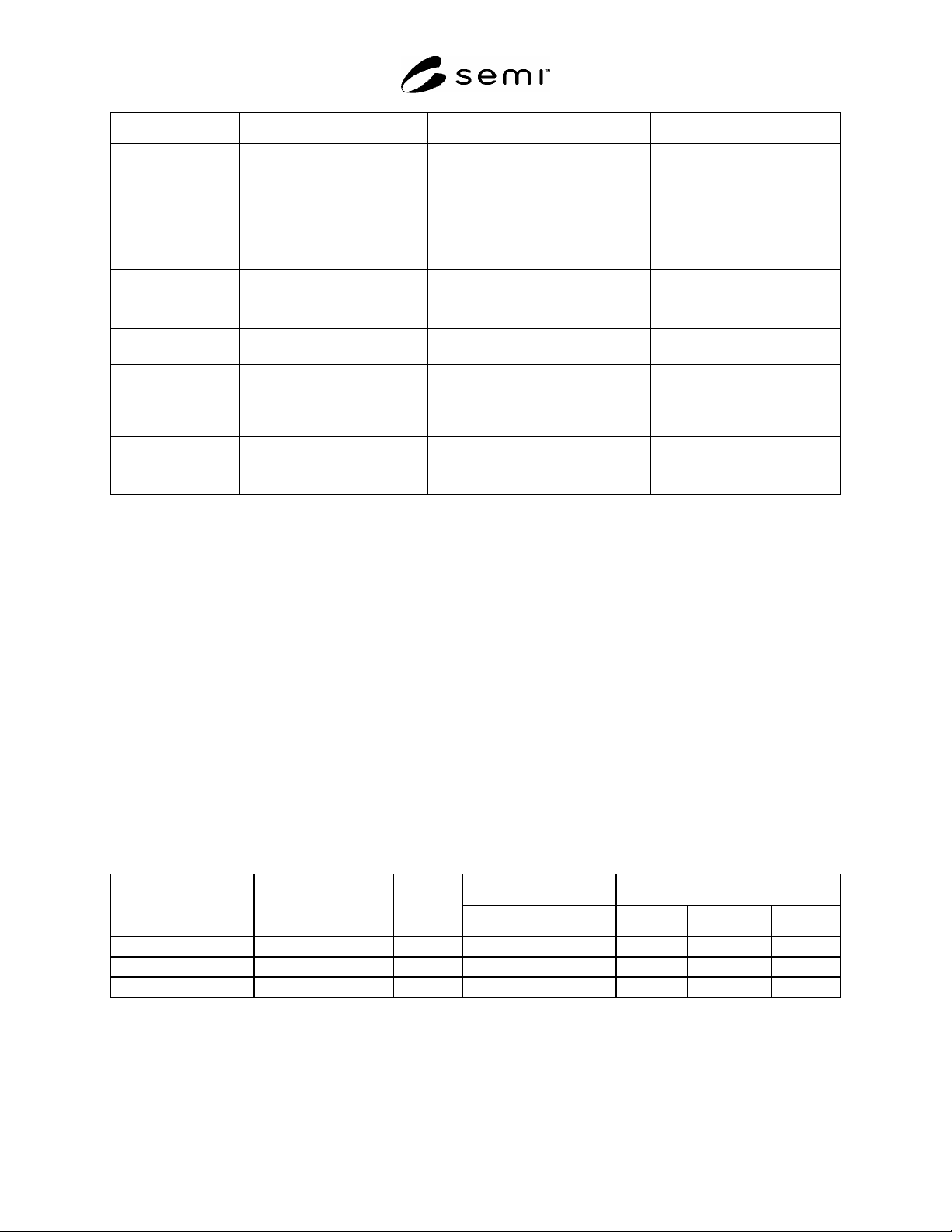
SEMI E88-1104 E © SEMI 1999, 2004 26 Table 10 Alarm ID, Alarm Set/Cleared Event Table Alarm ID (ALID) Alarm SET Event (CEID set ) Alarm CLEARED Event (CEID cleared ) 12 Remote Commands 12.1 The purpose of this section is…
SEMI E88-1104
E
© SEMI 1999, 2004 25
Variable Name Type Description Class Format Comments
ZoneCapacity
i
CV Available capacity (in
carriers) of a particular
zone.
SV U2 Example: If a stocker zone can
store 100 carriers and 25 of the
locations are currently occupied,
then the ZoneCapacity is 75.
ZoneData CV Information associated
with a particular zone.
DVVAL L,2
1. <ZoneName>
2. <ZoneCapacity>
ZoneData
i
CV Information associated
with a particular zone.
SV L,2
1. <ZoneName
i
>
2. <ZoneCapacity
i
>
ZoneName CV Alphanumeric name of a
particular zone.
DVVAL A[1–64]
ZoneName
i
CV Alphanumeric name of a
particular zone.
SV A[1–64]
ZoneSize
i
CV Size (in carriers) of a
particular zone.
SV U2 The physical size of the zone.
ZoneType
i
CV Type of the Zone. SV U2 1: Shelf
2: Port
3: Other
11 Alarm List
11.1 Since each model of Stocker SEM equipment differs in configuration, it is not practical to provide an
exhaustive list of all possible alarms. Instead, the Stocker SEM is requiring the two tables provided as described in
SEMI E30 (Section 8.4). Alarm List Table which is intended to provide for equipment configuration specific alarms
and Alarm ID, Alarm Set/Cleared Event Table. Any alarm that is displayed locally at the equipment, if enabled, is
required to be sent to the host. To be compliant, Tables 9 and 10 must be completed by the supplier, documenting
all alarms.
11.2 Alarm List Table
11.2.1 The alarm list table contains examples of alarms that pertain to various configuration aspects of equipment.
These examples are intended to illustrate that alarms pertain to situations in which there exists a potential for
exceeding physical safety limits associated with people, equipment, and material being transported as per the SEMI
E30 definition of an alarm. See SEMI E30 for further reference. The supplier is responsible for supplying
documentation associated with these alarm definitions. Each alarm will have an associated alarm text (ALTX) and
alarm identifier (ALID). Table 9 contains an example of alarm list information that is intended to be augmented
when the Stocker SEM equipment supplier documents their interface. Examples highlighted by (*) are required by
Stocker SEM.
Table 9 Alarm List Table
Danger Affected
Equipment Cfg. Alarm Text ALID
Potential Imminent Operator Equipment Material
Stocker stocker unit error* X X X
handoff error* X X X X
database error* X X
11.3 Alarm ID, Alarm Set/Cleared Event Table
11.3.1 The Alarm ID, Alarm Set/Cleared Event table documents the association of each ALID to a set and cleared
event as required by SEMI E30. See SEMI E30 for further reference. The supplier is responsible for supplying
documentation associated with these alarm definitions. Each alarm will have associated alarm set and cleared
collection event identifiers (CEID
set
and CEID
clear
).

SEMI E88-1104
E
© SEMI 1999, 2004 26
Table 10 Alarm ID, Alarm Set/Cleared Event Table
Alarm ID (ALID) Alarm SET Event (CEID
set
) Alarm CLEARED Event (CEID
cleared
)
12 Remote Commands
12.1 The purpose of this section is to identify remote
commands, command parameters, and valid commands
versus states pertinent to the Stocker SEM.
12.2 A. Requirements
The equipment shall support the SEMI E30
(according to the GEM capabilities required per
Section 13) required remote commands.
All the remote commands defined by Stocker SEM
are required to be implemented as specified.
The alphanumeric strings defined by Stocker SEM
for RCMD and CPNAME are required.
A completed table must be generated where an “X”
is placed in the table for each state that a given
command is valid.
If additional remote commands are supported then
a “remote commands versus valid states” matrix
must be generated for these additional commands.
For additional commands, a table must be
generated similar to the remote command
descriptions summary.
12.3 Remote Commands Description
12.3.1 ABORT — This command terminates the
activity of a specific TRANSFER command based on
CommandID while the command is in the ACTIVE
state. This command might not be accepted due to
mechanical issues if the stocker is in a specific con-
dition (e.g., moving a carrier). The exact conditions
surrounding when the ABORT command is not ac-
cepted by the SC must be documented by the Stocker
SEM equipment supplier. If accepted, this command
shall clear any error condition that was generated by the
TRANSFER command being aborted. For example, if
a ‘DestOccupied’ or ‘SourceEmpty’ error had occurred,
the error shall be cleared.
12.3.2 CANCEL — This command terminates the
activity of a specific TRANSFER command based on
CommandID while the command is in the QUEUED
state. This command must always be accepted by the
SC when in the QUEUED state.
12.3.3 INSTALL — This is used to update the SC
database by adding a specified CarrierID record to a
specified CarrierLoc. If the CarrierID specified by the
Host is already in the SC database then the additional
fields will be updated based on the information
contained in this command.
12.3.4 LOCATE — This command is used by the Host
to query the SC for database carrier information.
12.3.5 PAUSE — This command puts the SC in the
PAUSING state.
12.3.6 REMOVE — This is used to update the SC
database by deleting a specified carrier. This command
would be used for database recovery.
12.3.7 RESUME — This command puts the SC in the
AUTO state.
12.3.8 RETRY (Supplier Option) — This command
may be used by the Host when an error is encountered
by the stocker. The Host would use this command to
allow the stocker to retry the movement which gener-
ated the error condition. This command shall clear the
error condition that is being addressed by the command.
12.3.9 TRANSFER — This is a SECS-II Enhanced
Remote Command instead of a SECS-II Host
Command Send (S2,F49 instead of S2,F41). See the
examples in Section 15.1 for details.
12.3.10 This command is used to perform the entire
transfer command for the carrier to be transferred
between stocker locations. The execution of this com-
mand will include allocation of resources, acquiring the
carrier, moving the carrier to the destination, queuing
the carrier at an alternate destination (if needed),
depositing the carrier, and returning the resources for
other use. The number of carriers in the TRANSFER
command is always equal to one (i.e., the size of the
transfer unit is always equal to one carrier).
12.3.11 INFOUPDATE — This is used to associate
information with a carrier while in the SC database.
This command is an optional feature and is not required
for compliance. If this command is not supported, then
a HCACK of ‘1’ (Command does not exist ) shall be
returned. If the carrier does not exist in the SC
database, then a HCACK of ‘3’ (At least one parameter
is invalid) shall be returned.
SEMI E88-1104
E
© SEMI 1999, 2004 27
12.3.12 Remote Commands and Associated Host Command Parameters
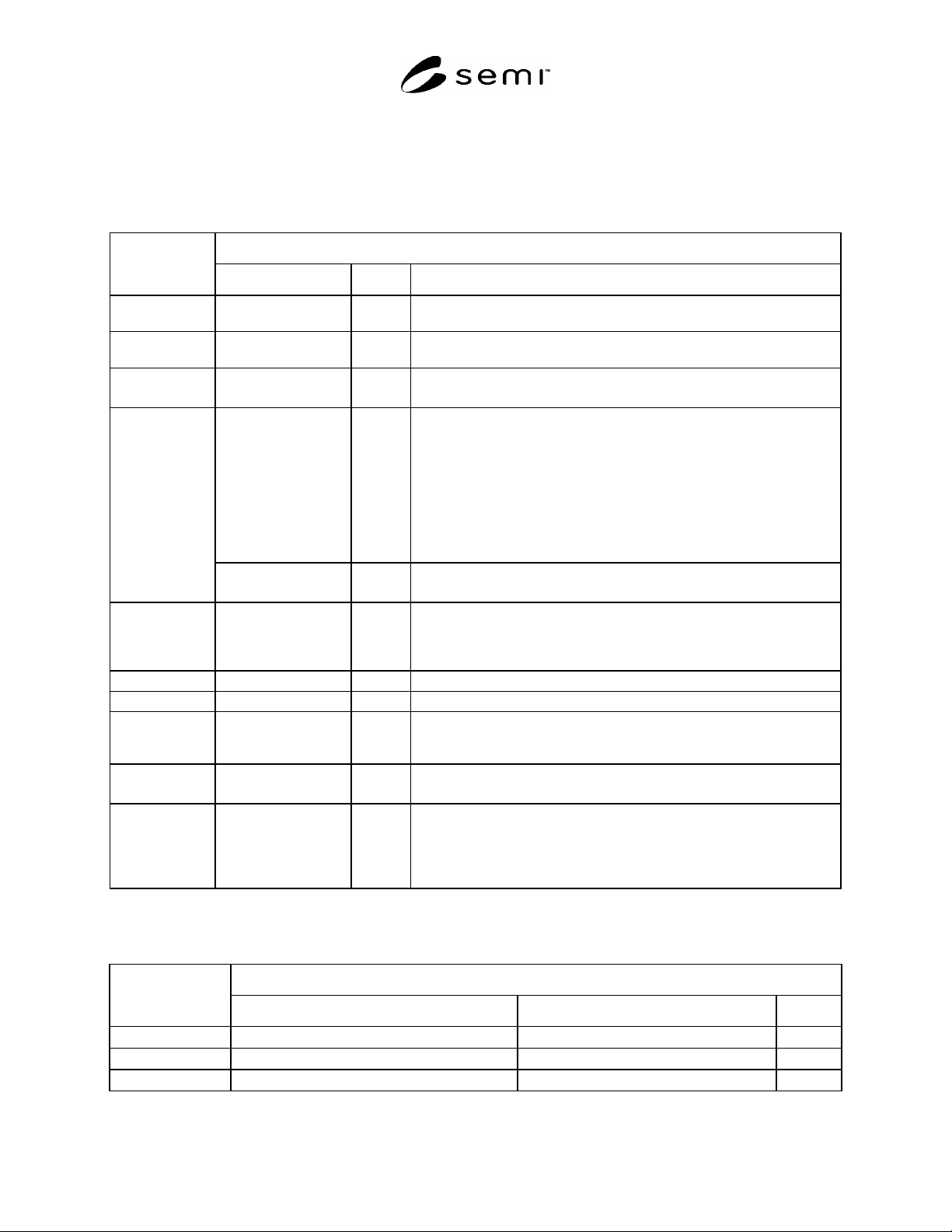
12.3.12.1 This table describes the allowable command parameters (CPNAME) for each remote command
(RCMD). Equipment shall support all parameters. The column marked Req/Opt, specifies which parameters are
required to be sent by the host and which parameters may be optionally sent by the host.
Table 11 Allowable Command Parameters
Parameters
Remote
Command
Cpname Req/Opt Comment
ABORT “COMMANDID” R Must specify the commandID that was used for the TRANSFER command
that is being ABORT’ed.
CANCEL “COMMANDID” R Must specify the commandID that was used for the TRANSFER command
that is being CANCEL’ed.
INSTALL “CARRIERID”
“CARRIERLOC”
R
R
“CARRIERID”
or
“ZONENAME”
or
“CARRIERLOC”
O
SC will check its database and return the carrier information to the Host
with a single ‘CarrierLocateCompleted’ event for all relevant carriers. If
the Host issues the LOCATE command with CARRIERID then SC returns
information associated with the carrier specified by the Host.
If the Host issues the LOCATE command with ZONENAME or
CARRIERLOC, all carrier information in the specified area (ZONENAME
or CARRIERLOC) will be returned.
If the Host issues the LOCATE command without a Cpname, all carrier
information in the SC database will be returned.
LOCATE
“COMMANDID” O
Unique Command Identifier for the LOCATE command. It does not have
a relationship to the CommandId of a TRANSFER command.
PAUSE None N/A Once received by the SC, the SC will queue any TRANSFER commands
until the SC receives and successfully executes the RESUME command.
Once in the AUTO state the SC will process the TRANSFER commands in
its queue.
REMOVE “CARRIERID” R
RESUME None N/A Returns the PAUSEd SC to the AUTO state.
RETRY
Supplier Option
“ERRORNUMBER” R Since more than one error can occur for the same TRANSFER command,
an ERRORNUMBER must be used to identify the ERRORNUMBER to
which to apply the RETRY.
TRANSFER “COMMANDINFO”
“TRANSFERINFO”
R
R
INFOUPDATE “CARRIERID”
“hostDefined”
R
O
The “HostDefined” cpnames are used to indicate the name of the data that
is to be associated with a carrier. See Section 13 for example scenarios.
The data associated with a carrier is for display purposes only and
information such as the carrier’s current location and state cannot be
changed with this command.
12.3.13 Host Command Parameters Name and Values
Table 12 Host Command Parameters CPNAMES
Parameter Value
Cpname
Description Range Format
CARRIERID Unique ID of the carrier.
A[164]
CARRIERLOC Unique carrier location within the stocker.
A[164]
COMMANDID Unique command identifier created by the Host.
A[164]