semi合集-English.pdf - 第4459页
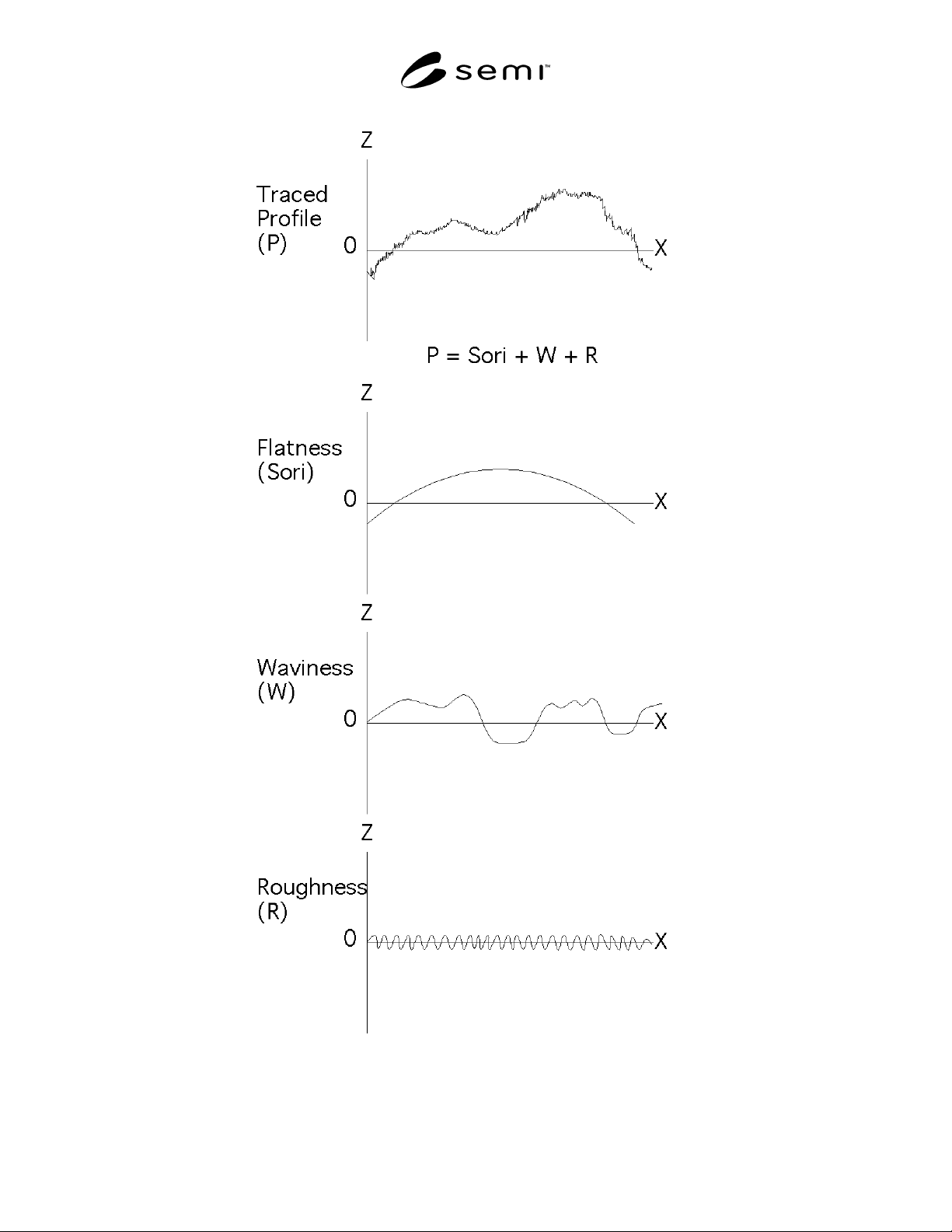
SEMI D15-1296 © SEMI 1996, 2003 4 Figure 2 Explanation of Surface Pro files
SEMI D15-1296 © SEMI 1996, 2003 3
Q
ax
or Q
ay
is longer than (L
t
– 2*λ
L
), L
e
is
recommended to be (L
t
– 2*λ
L
).
6.4.1 If the measurable length of the instrument is
shorter than the recommended length, then the
overlapped section, which contains several traced
profiles covering all of the recommended lengths,
should be used to evaluate W
fpd
.
6.5 Sampling Length, L
s
— Is recommended to be 20
mm (0.79 inch) at λ
L
= 8 mm (0.3 inch) or 25 mm (1
inch) at λ
L
= 25 mm (1 inch).
7 Test Specimen
7.1 A clean FPD glass substrate. No strain or oils
should be seen by the naked eye with fluorescent lamps
or incandescent lamps.
8 Measurement Procedure
8.1 Put the specimen on the leveled stage of the
instrument without bend and leave for five minutes or
more to condition the specimen to room temperature.
8.2 Put the stylus on the specimen and measure a real
profile parallel to the edge of substrate by tracing the
surface.
8.3 Apply the bandpass profile filter to the real profile
and get the bandpass-filtered waviness profile.
8.4 Calculate the FPD Waviness — W
fpd
with manual
template method or computer-aided method from the
bandpass-filtered waviness profile.
9 Reporting Results
9.1 Measurement Location and Direction — Describe
the measurement location and direction on the report;
for example, measure along the following two
directions:
a. the center line of the specimen parallel to the long
edge
b. the center line of the specimen parallel to the short
edge
9.2 Interpretation of Results — Show the measurement
results in units of 0.01 µm (micron) and count fractions
of 0.5 and over as a unit and cut away the rest.
Table 1 Example: Measurement Result
Direction L
e
W
lcd
Long Edge **mm 0. **µm
Short Edge **mm 0. **µm
Measuring Condition
Surface — The pattern surface
Instrument — Stylus method (type of instrument)
Long cut-off,
λ
L
— 8 mm
Short cut-off,
λ
c
— 0.08 mm
Sampling length, L
s
— 20 mm
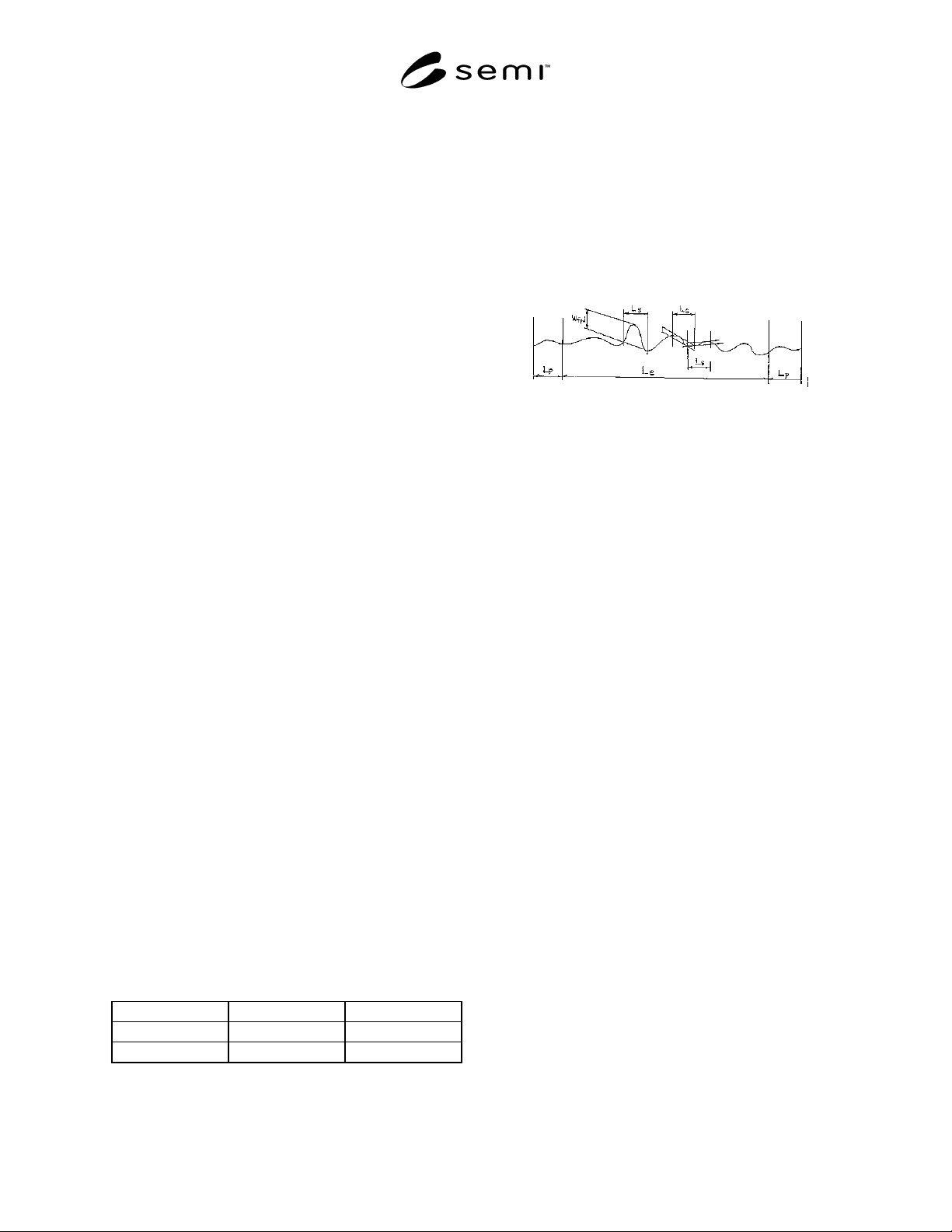
Figure 1
Explanation of L
e
, L
p
, L
s
SEMI D15-1296 © SEMI 1996, 2003 4
Figure 2
Explanation of Surface Profiles
SEMI D15-1296 © SEMI 1996, 2003 5
APPENDIX 1
NOTICE: This appendix was approved as an official part of SEMI D15 by full letter ballot procedures.
A1-1 Purpose
A1-1.1 FPD waviness W
fpd
requires a large amount of
calculation on this standard.
A1-1.2 Therefore, the approximate calculation method
shown below can be used instead.
A1-2 Terminology
A1-2.1 local peak of profile — the highest point of
profile between two adjacent minima of the profile.
A1-2.2 local valley of profile — the lowest point of
profile between two adjacent maxima of the profile.
A1-2.3 window — a sampling length for evaluation.
A1-3 Calculation Method
A1-3.1 Search all local peaks and local valleys within
the evaluation length.
A1-3.2 Calculation of a waviness value based on a
local peak.
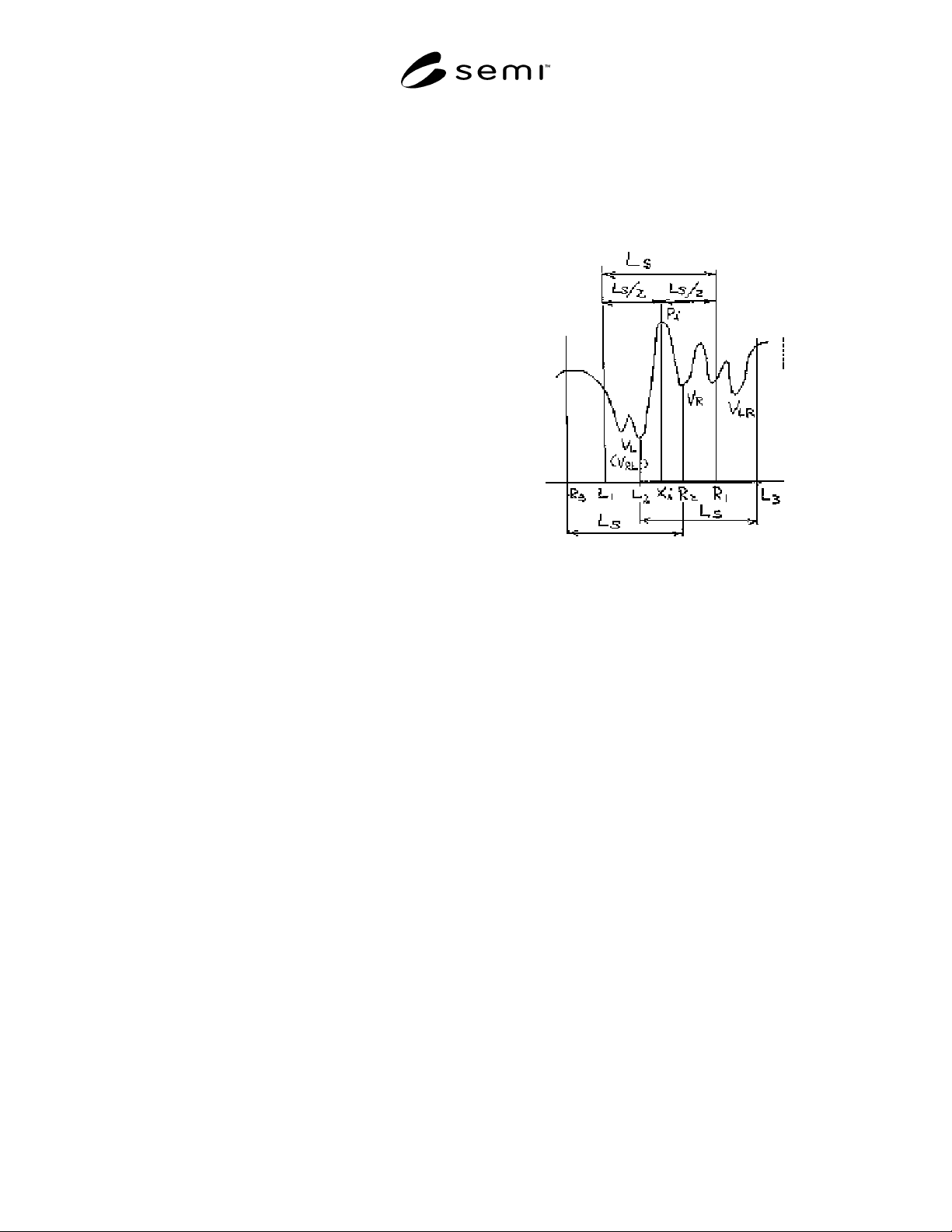
A1-3.2.1 Calculation of a waviness value, W
iL
, based
in the left window of a local peak, P
i
(position X
i
).
1. Open the left window (L
1
− X
i
) with L
s
/2 width
from the local peak, P
i
.
2. Search the lowest point, V
L
(position L
2
), in the
window (L
1
− X
i
).
3. Find the point L
3
= L
2
+ L
s
and open the window
(X
i
− L
3
).
4. Search the lowest point, V
LR
, in the window
(X
i
− L
3
).
5. W
iL
= |Z
i
− (V
L
+ V
LR
) /2|
A1-3.2.2 Calculation of a waviness value, Wi
R
, based
in the right window of a local peak, P
i
.
1. Open the right window (X
i
− R
1
) with L
s
/2 width
from the local peak, P
i.
.
2. Search the lowest point, VR (position R
2
), in the
window (X
i
− R
1
).
3. Find the point R
3
= R
2
- Ls and open the window
(R
3
− X
i
).
4. Search the lowest point, V
RL
, in the window
(R
3
− X
i
).
5. W
iR
= |Z
i
− (V
R
+ V
RL
) /2|
A1-3.2.3 Calculate W
iL
and W
iR
on all local peaks, P
i
,
then calculate the maximum value, WP
max
.
WP
max
= max {W
iL
, W
iR
} (i = 1 to n)
Figure A1-1
Calculation Points of a Local Peak
A1-3.3 Calculation of a waviness value based on a
local valley.
A1-3.3.1 Calculation of a waviness value, W
jL
, based
in the left window of a local valley, V
j
(position X
j
).
1. Open the left window (L
1
− X
j
) with L
s
/2 width
from the local valley, V
j
.
2. Search the highest point, P
L
(position L
2
), in the
window (L
1
− X
j
).
3. Find the point L
3
= L
2
+ L
s
and open the window
(X
j
− L
3
).
4. Search the highest point, P
LR
, in the window
(X
j
− L
3
).
5. W
jL
= |Z
j
− (P
L
+ P
LR
) /2|
A1-3.3.2 Calculation of a waviness value, W
jR
, based
in the right window of a local valley, V
j
.
1. Open the right window (X
j
− R
1
) with L
s
/2 width
from the local valley, V
j
.
2. Search the highest point, P
R
(position R
2
), in the
window (X
j
− R
1
).
3. Find the point R
3
= R
2
− L
s
and open the window
(R
3
− X
j
).