semi合集-English.pdf - 第6851页
SEMI S2-0703a E © SEMI 1991, 2004 80 R14-6.1.2 CAT. 4 — Category 4 (ac cording to ISO 13859-1) R14-6.1.3 CPU — Central Pro cessing Unit R14-6.1.4 EMO — Emergency Off R14-6.1.5 EUC — Equipm ent Under Control R14-6.1.6 FD …

SEMI S2-0703a
E
© SEMI 1991, 2004 79
R14-4.4 Where references to standards have been
incorporated into this Related Information. These
references do not imply applicability of the entire
standards, but only of the sections referenced.
R14-4.5 Because of the variety of uses for FECS
described in this Related Information, those responsible
for the application and use of FECS must satisfy
themselves that all necessary steps have been taken to
assure that each application and use meets all
performance and safety requirements, including any
applicable laws, regulations, codes and standards. The
illustrations, charts and layout examples shown in this
Related Information are solely for purposes of example.
R14-5 Referenced Standards
R14-5.1 SEMI Standards
SEMI E54 — Sensor/Actuator Network Standard
SEMI E81 — Provisional Specification for CIM
Framework Domain Architecture
SEMI E98 — Provisional Standard for the Object-
Based Equipment Model (OBEM)
SEMI S10 — Safety Guideline For Risk Assessment
R14-5.2 IEC Standards
18
NOTE 2: International standards bodies are indicated, with
the equivalent national standards shown in parenthesis.
IEC 60204-1 (EN 60204-1) — Safety of Machinery –
Electrical Equipment of Machines - Part 1: General
Requirements
IEC 61010-1 (EN 61010-1) — Safety Requirements for
Electrical Equipment for Measurement, Control, and
Laboratory Use - Part 1: General Requirements
IEC 61508 (EN 61508) — Functional Safety of
Electrical/Electronic/Programmable Electronic Safety-
Related Systems
NOTE 3: IEC 61508 consists of 7 parts, IEC 61508-1 through
IEC 61508-7
R14-5.3 ISO Standards
19
NOTE 4: International standards bodies are indicated, with
the equivalent national standards shown in parenthesis.
ISO 10218 (EN 775) — Manipulating Industrial
Robots-Safety
18 International Electrotechnical Commission, 3, rue de Varembé,
Case Postale 131, CH-1211 Geneva 20, Switzerland. Telephone:
41.22.919.02.11; Fax: 41.22.919.03.00 Website: http://www.iec.ch
19 International Organization for Standardization, ISO Central
Secretariat, 1, rue de Varembé, Case postale 56, CH-1211 Geneva 20,
Switzerland. Telephone: 41.22.749.01.11; Fax: 41.22.733.34.30
Website: http://www.iso.ch
ISO (ISO 13849-1 (EN 954-1)-1) — Safety of
Machinery-Safety-Related Parts of Control Systems
ISO 13849-2 (EN 954-2) — Safety of Machinery-
Safety-Related Parts of Control Systems – Part 2
Validation
ISO/IEC 13850 (EN 418) — Safety of Machinery –
Emergency Stop – Principles of Design
ISO 14118 (EN 1037) — Safety of Machinery –
Prevention of Unexpected Start-Up
ISO 14119 (EN 1088) — Safety of Machinery-
Interlocking Devices Associated with Guards –
Principles for Design & Selection
ISO 14121 (EN 1050) — Safety of Machinery-
Principles of Risk
NOTE 5: National and local Codes and Standards must be
applied as required by the installation location. Examples of
some that might apply are included below.
R14-5.4 ANSI Standards
20
ANSI/IEEE C95.1 (United States) — Standards for
Safety Levels with Respect to Human Exposure to
Radio Frequency Electromagnetic Fields
ANSI/ISA-S84.01-1996 — Application of Safety
Instrumented Systems for the Process Industry
ANSI/RIA R15.06 (United States) — Industrial Robots
and Robot System – Safety Requirements
R14-5.5 National Fire Protection Association
21
NFPA 79 (United States) — Electrical Standard for
Industrial Machinery
R14-5.6 VDI Standards
22
VDI/VDE 2180 Bl.2 (Germany) — Safety of Process
Control Technology
R14-5.7 DIN V VDE Standards
23
DIN V VDE 0801 — Principle for Computers in Safety
Related Systems
R14-6 Terminology
R14-6.1 Abbreviations and Acronyms
R14-6.1.1 ATL — Approved Testing Laboratory
20 American National Standards Institute, New York Office: 11 West
42nd Street, New York, NY 10036, USA. Telephone: 212.642.4900;
Fax: 212.398.0023 Website: http://www.ansi.org
21 National Fire Protection Association, 1 Batterymarch Park, P.O.
Box 9101, Quincy, MA 02269-9101, USA, www.nfpa.org
22 VDE-Verlag GmbH, Bismarkstrasse 33, 10625 Berlin, Germany,
www.vde.de
23 VDE-Verlag GmbH, Bismarkstrasse 33, 10625 Berlin, Germany,
www.vde.de

SEMI S2-0703a
E
© SEMI 1991, 2004 80
R14-6.1.2 CAT. 4 — Category 4 (according to ISO
13859-1)
R14-6.1.3 CPU — Central Processing Unit
R14-6.1.4 EMO — Emergency Off
R14-6.1.5 EUC — Equipment Under Control
R14-6.1.6 FD — Field Device
R14-6.1.7 FECS — Fail-to-Safe Equipment Control
System
R14-6.1.8 GUI — Graphical User Interface
R14-6.1.9 I/O — Input/Output
R14-6.1.10 IFD — Intelligent Field Device
R14-6.1.11 ISFD — Intelligent Safety Field Device
R14-6.1.12 PLC — Programmable Logic Controller
R14-6.1.13 SIL — Safety Integrity Level (according to
IEC 61508)
R14-6.1.14 SRM — Safety Relay Module
R14-6.2 Definitions
R14-6.2.1 certified — Evaluated and approved for use
in a particular intended function in conformance with a
recognized standard by an accredited testing laboratory
(ATL).
NOTE 1: See SEMI S2 for definition of ATL.
R14-6.2.2 combined I/O — I/O systems of an FECS in
which non-safety-related and safety-related signal
modules are combined. (see Figure R14-2).
R14-6.2.3 common cause failure — failure, which is
the result of one or more events, causing coincident
failures of two or more separate channels in a multiple
channel system, leading to system failure.
R14-6.2.4 distributed I/O — input/output modules for
sensors and actuators interfacing to a network.
R14-6.2.5 electrical/electronic/programmable
electronic (adj.) — based on electrical OR electronic
OR programmable electronic technology.
NOTE 6: The term above is intended to cover any and all
devices or systems operating on electrical principles.
R14-6.2.6 Fail-to-safe equipment control system — A
programmable system of control circuits designed and
implemented for safety-related functions in accordance
with internationally recognized standards such as ISO
13849-1 (EN 954-1) or IEC 61508. These systems (e.g.
safety PLC, safety-related I/O modules) diagnose
internal and external faults and react upon detected
faults in a controlled manner in order to bring the
equipment to a safe state.
R14-6.2.7 field device — sensors and actuators such as
valves (electrical or pneumatic), temperature sensors,
proximity switches, pumps, motors etc.
R14-6.2.8 functional safety — The overall safety
design related to the EUC and the EUC control system.
Effective functional safety includes the correct
functioning of the electrical, electronic, or
programmable-electronic safety-related systems; or on
other-technology safety-related systems and may
include risk reduction measures.
R14-6.2.9 industrial controller — general term for
controller-technology, which includes PLC and PC-
based technology.
R14-6.2.10 intelligent field device — sensors and
actuators that use local intelligence to perform
functions such as communication, diagnosis and
interfacing to a network.
R14-6.2.11 network — general term for bus
technology, which includes field bus technology used in
control applications.
R14-6.2.12 programmable logic controller —
microprocessor based controller for sequential control;
the control logic of which can be changed through a
programming device connected to the controller, e.g.
programming panel, host computer, handheld terminal,
either directly or remotely through a network.
R14-6.2.13 random hardware failure — failure,
occurring at a random time, which results from one or
more of the possible degradation mechanisms in the
hardware.
R14-6.2.14 safety function — function to be
implemented by an electrical or electronic or
programmable electronic safety-related system, other
technology safety-related system or external risk
reduction facilities, which is intended to achieve or
maintain a safe state for the EUC, in respect of a
specific hazardous event.
R14-6.2.15 safety integrity — probability of a safety-
related system satisfactorily performing the required
safety functions under all the stated conditions within a
stated period of time.
R14-6.2.16 safety integrity level (SIL) — discrete level
(one out of a possible four) for specifying the safety
integrity requirements of the safety functions to be
allocated to the electrical or electronic or programmable
electronic safety-related systems, where safety integrity
level 4 has the highest level of safety integrity and
safety integrity level 1 has the lowest.
R14-6.2.17
safety network — a network certified for
safety applications (this can also be a subpart of a
standard network).
SEMI S2-0703a
E
© SEMI 1991, 2004 81
R14-6.2.18 safety PLC — a programmable logic
controller and associated I/O, certified as having the
necessary safety integrity to execute the safety-related
function.
R14-6.2.19 safety relay (SR) —- A positive or force-
guided relay, that is used in safety relay modules
(SRMs) to achieve a fail-to-safe circuit.
R14-6.2.20 safety relay module (SRM) — redundant
self monitoring electro-mechanical/ solid state device
certified for use in safety applications
R14-6.2.21 safety-related I/O modules —I/O modules
capable of diagnosing internal and external faults and
configured to be redundant. (e.g., a second shutdown
path is included for output-circuits).
R14-6.2.22 safety-related programmable system —
systems designed and implemented for safety functions
in accordance with ISO 13849 or IEC 61508. These
system types (e.g. safety PLC, safety-related I/O
modules) can diagnose internal and external faults and
can react upon detected faults in a controlled manner.
R14-6.2.23 safety requirements specification —
specification containing all the requirements of the
safety functions that have to be performed by the
safety-related systems.
R14-6.2.24 solid state electronics — designation used
to describe devices and circuits fabricated from solid
materials such as semiconductors, ferrites, or thin films
as distinct from devices and circuits making use of
electromechanical technology, e.g. solid state relay,
micro controller.
R14-6.2.25 systematic failure — failure related in a
deterministic way to a certain cause, which can only be
eliminated by a modification of the design or of the
manufacturing process, operational procedures,
documentation or other relevant factors.
R14-7 State-of-the-Art Safety Control System
— Comprised of Solid State Electronics
R14-7.1 Failure to perform normal function (for
example a failure of a computer or its software) may
cause economic loss, but is not necessarily a safety
issue. However, failure of a safety-related component
to perform its safety function could result in a
hazardous condition. A fail-to-safe system should be
designed in a manner to ensure that failures do not
result in a hazardous situation. It is therefore important
to perform a system risk assessment to determine
safety-related functions and the - safety performance
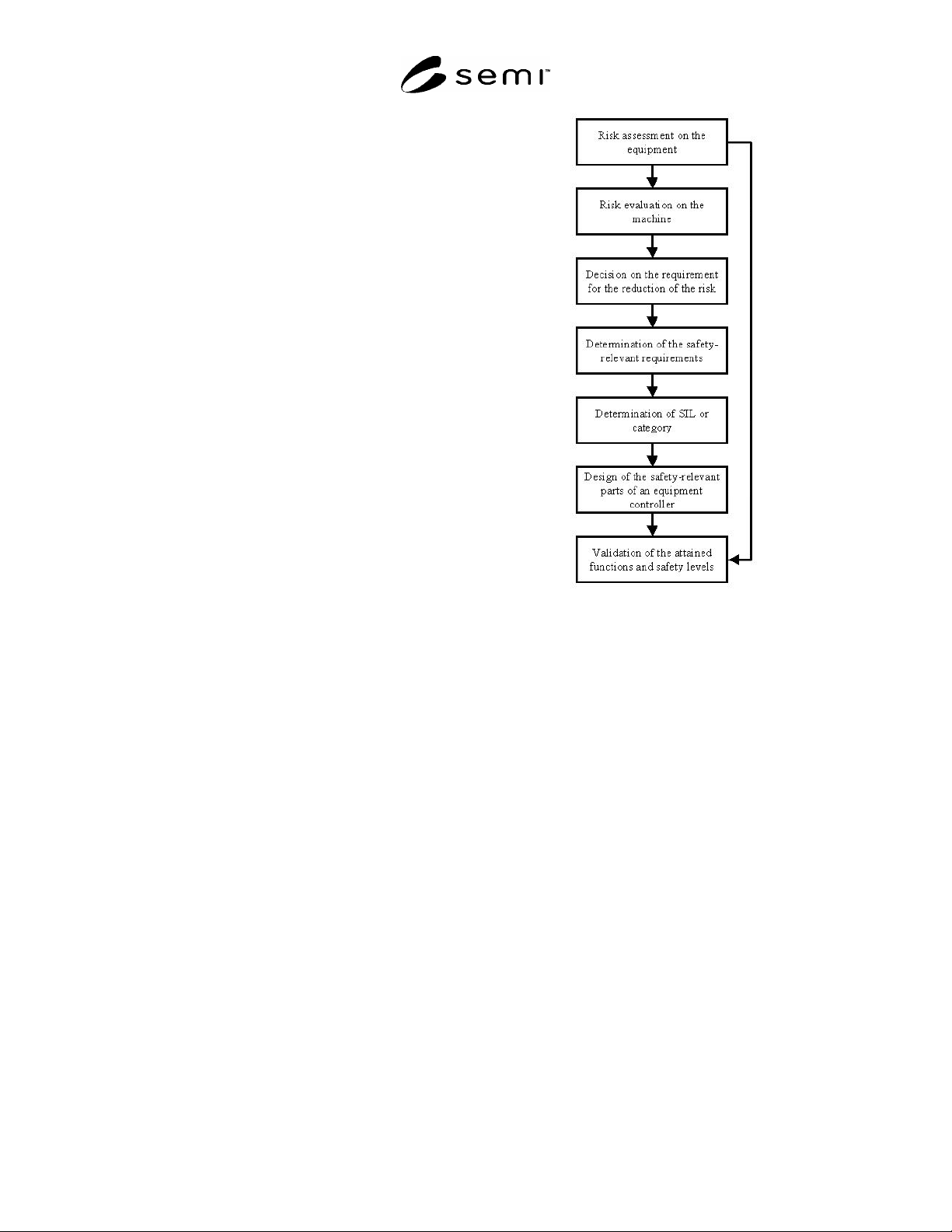
required. The process outlined in following figure
should be followed.
Figure R14-1
Roadmap to Risk Assessment and System Design
R14-7.2 Safety Interlocks — Semiconductor
manufacturing equipment requires the use of fast,
reliable and efficient means of safety interlocking.
Important issues concerning complex machine
architectures include availability and diagnostic
capabilities for quick troubleshooting.
R14-7.2.1 A FECS should, even in the case of failure,
maintain a safe state of the EUC. Therefore, a FECS is
able to detect faults and cause the system to go to a safe
state. A properly designed FECS – using methods such
as self-monitoring for fault detection and subsequent
well defined reaction – can offer high availability and
diagnostics.
R14-7.2.2 Section 11.6 of SEMI S2 (including
exceptions and notes) indicates a preference for
electromechanical devices and components, and gives
guidance on their use. However, non-
electromechanical devices and components are
permitted and they can provide necessary risk reduction
while maintaining safety performance. Section 11.6,
Note 26 of SEMI S2, suggests some tools for
investigation of suitability for use. Additionally, IEC
61508, ANSI/ISA-SP84.01, and ISO 13849-1 (EN 954-
1) provide guidance on the safety system design,