semi合集-English.pdf - 第6369页
4.1.3 product packag e — the first tie, wrap, or container to a single item or quantity thereof th at constitutes a complete identi f iable pack. Product packa ge may be pac kaged together or a gro up of the parts packag…

SEMI G71-0996 (Reapproved 1104)
SPECIFICATION FOR BARCODE MARKING OF INTERMEDIATE
CONTAINERS FOR PACKAGING MATERIALS
This standard was technically approved by the Global Assembly & Packaging Committee and is the direct
responsibility of the Japanese Packaging Committee. Current edition approved by the Japanese Regional
Standards Committee on July 23, 2004. Initially available at www.semi.org September 2004; to be published
November 2004. Originally published in 1996.
1 Purpose
1.1 This specification describes a common format,
content, size, and location for printed, machine-
readable labels on an intermediate container of
materials used for semiconductor packaging.
1.2 This specification provides for a smooth transition
from existing traceability and labeling procedures to a
comprehensive, unified system envisioned for the
future.
2 Scope
2.1 This document applies to the following packaging
materials:
2.1.1 Leadframe
2.1.2 Molding compound
2.1.3 Bonding wire
2.1.4 Die attach materials
2.2 This document applies to only the intermediate
container. Barcode specification for shipping pack is
referred to EIA 556A or EIAJ barcode specification.
2.3 This document does not apply to product package
label.
NOTE 1: There are requests for labeling on product packages
from the customers. However, task force concluded that the
product package label was not included in scope of the
specification because of limitation of area to be labeled on the
package. For further activity, two-dimensional barcode
symbol may be needed to standardize the barcode marking
specification for product packages.
NOTICE: This standard does not purport to address
safety issues, if any, associated with its use. It is the
responsibility of the users of this standard to establish
appropriate safety and health practices and determine
the applicability of regulatory or other limitations prior
to use.
3 Referenced Standards
3.1 AIM Specification
1
USS-39 — Universal Symbol Specification Code 39
3.2 ANSI Specifications
2
ANSI X3.182 — Barcode Print Quality - Guideline
ANSI/FACT-1 — Data Application Identifier Standard
3.3 EIA Specification
3
EIA 556A — Outer Shipping Container Bar Code
Label System
3.4 EIAJ Specification
4
EIAJ — Standard, Bar Code Label System
NOTICE: Unless otherwise indicated, all documents
cited shall be the latest published versions.
4 Terminology
4.1 Definitions
4.1.1 Many items relating to barcode technology are
defined in EIA 556, Appendix Definitions, and EIAJ
Bar Code Label Systems, Appendix A.
4.1.2 intermediate container — a container housing
one or more product packages for the purpose of
product/ order segregation in a shipping container.
AIM USA, 634 Alpha Drive, Pittsburg, PA 15238 1
2 American National Standards Institute, Headquarters: 1819 L
Street, NW, Washington, DC 20036, USA. Telephone: 202.293.8020;
Fax: 202.293.9287, New York Office: 11 West 42nd Street, New
York, NY 10036, USA. Telephone: 212.642.4900; Fax:
212.398.0023, Website: www.ansi.org
3 Electronic Industries Alliance, EIA Engineering Department,
Standards Sales Office, 2001 Eye Street, NW, Washington, D.C.
20006, USA., Website: www.eia.org
4 Electronic Industries Association of Japan, Available through:
Japan Electronics and Information Technology Industries
Association, 3rd Fl., Mitsui Sumitomo Kaijo Bldg. Annex 11, Kanda
Surugadai 3-chome, Chiyoda-ku, Tokyo 101-0062, Japan,
http://www.jeita.or.jp/eiaj/english/
1 SEMI G71-0996 © SEMI 1996, 2004
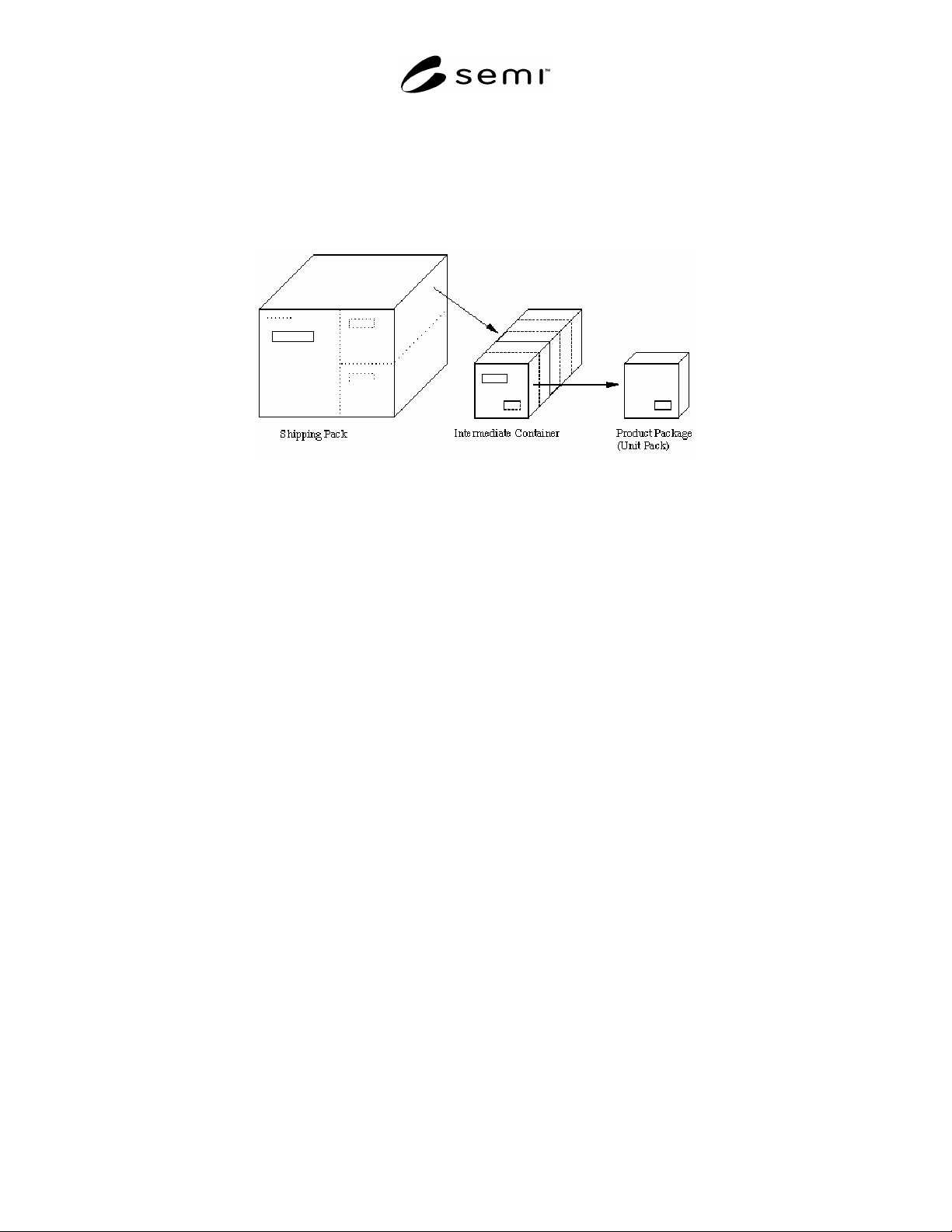
4.1.3 product package — the first tie, wrap, or container to a single item or quantity thereof that constitutes a
complete identifiable pack. Product package may be packaged together or a group of the parts packaged together.
Product package is also called unit pack.
4.1.4 shipping pack — a package or shipping container/ final container that is of sufficient strength to be used in
commerce for packing, storing, and transporting products (see Figure 1).
Figure 1
Definition of Package Form
4.1.5 Package forms for each material type are defined in Table 1.
5 Ordering Information
5.1 Purchase orders for the materials furnished in an intermediate package to the specification shall be include the
following:
5.1.1 Content of message characters for customer product ID.
5.1.2 User-specified data, if required.
5.2 In addition, the following optional items may be specified.
5.2.1 Label location on the intermediate container.
5.2.2 Label size, if a label larger than the specified size in this specification.
6 Content of Data Field
6.1 The label shall include vendor field and customer field.
6.2 The customer field shall contain three data fields for barcode symbols. Each data field shall contain a maximum
17 message in addition to the start and stop characters. The content of the barcode symbol is shown in Table 2.
6.2.1 The upper data field shall contain a barcode symbol with customer product ID which consists of maximum 15
characters, preceded by a “P”, the data identifier for this item as specified in ANSI/FACT-1.
6.2.2 The middle data field shall contain a barcode symbol with lot number which consists of maximum 12
characters, preceded by a “1T”, the data identifier for this item as specified in ANSI/FACT-1.
6.2.3 The lower data field shall contain quantity and the production date concatenated into a single barcode symbol.
Quantity is indicated by maximum 7 characters, preceded by a “7Q”, the data identifier for this item as specified in
ANSI/FACT-1. The production date is indicated by 6 characters, preceded by a “D”, the data identifier for this item
as specified in ANSI/FACT-1. The quantity and the production date are separated by a space.
6.2.3.1 Quantity indicated in this field shall be quantity in the intermediate container. The unit of measure should
follow the quantity data to indicate what unit of measure is being used in the quantity count. The Unit uses 2
characters listed in Appendix D of ANSI/FACT-1.
SEMI G71-0996 © SEMI 1996, 2004 2
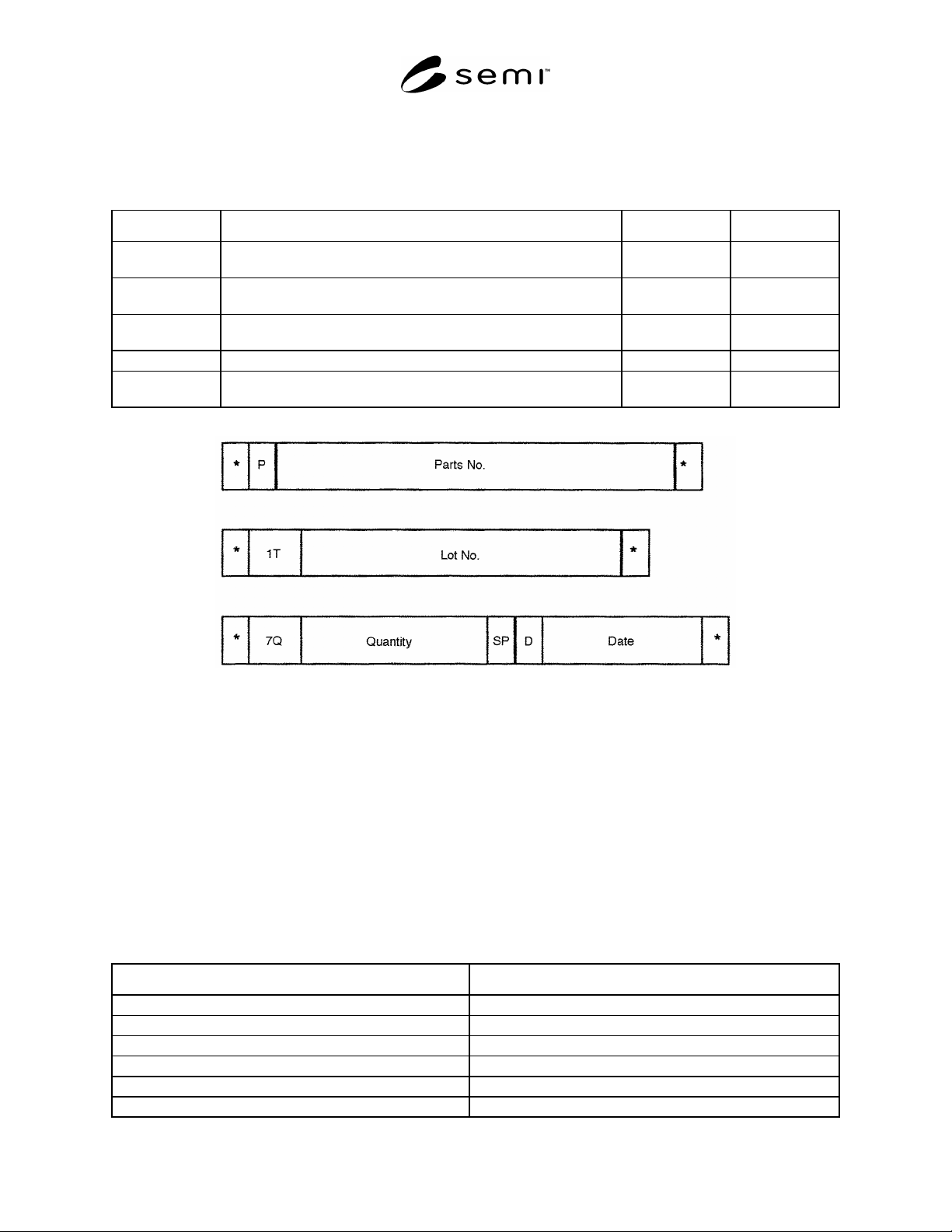
6.2.3.2 Quantity that are not filled by a message characters shall contain hyphen (-) as a place saver to that the
symbol always has exactly 7 characters.
6.3 Vendor company name and its logo mark; supplier’s ID may be included in the supplier’s field.
Table 1
Explanation Data Identifier No. of Characters
Part No. Customer part number. The number is assigned by the customer in the
ordering information.
P 15 max.
Lot No. Lot number is assigned by the supplier to identify or trace a unique
group of the entries.
1T 12 max.
Quantity Quantity and unit within the package. The unit uses characters listed in
Appendix D of ANSI/FACT-1.
7Q 7
Production Data The Date of production. The date is shown by “YYMMDD”. D 6
Supplier’s Field Supplier’s name, supplier’s company logo mark, supplier’s code
(agreed between supplier and customer) country, etc.
- (Option)
Figure 2
Barcode Arrangement
7 Barcode Character
7.1 The barcode characters specified in AIM USS-39 shall be used.
7.2 Character Set — The Code 39 character set consists of 43 characters: 0–9, A–Z, ., $, /, %, and space. In
addition, an asterisk (*) is used only for both the stop and stop characters.
7.3 Print Quality — The Code 39 print quality shall be B/03/630 or better in accordance with ANSI X3.182. To
assure reading efficiency, the minimum reflectance of the quiet zones shall be 60%, the minimum reflectance of
spaces shall be 51%, and the maximum reflectance of bars shall be 10%.
7.4 Symbol Dimensions — Barcode symbol dimensions shall be as listed in Table 2.
Table 2 Symbol Dimensions
Code 39 Dimension
Narrow Element Width 0.250 mm
Wide Element Width 0.625 mm (Element Width Ratio 1:2.5)
Space between Characters 0.250 mm
Character Height 8.0 mm
Quiet Zone 5.0 mm (after and before barcode symbol)
Space between Barcode Field 5.0 mm
3 SEMI G71-0996 © SEMI 1996, 2004