semi合集-English.pdf - 第247页
SEMI E35-0305 © SEMI 1995, 2005 16 = P [All pass] – P [All characteristics conform , All tests passed]

SEMI E35-0305 © SEMI 1995, 2005 15
– P[Item is conforming, All gauges show conforming]
A1-5.2.4 The overall
value,
T
, is calculated from the equation:
T
=
n
i
i
1
(10)
NOTE 3: This equation is based on the probability P that the item is nonconforming but that all gauges give a conforming result:
T
= P[Item is nonconforming, All gauges show pass]
A1-5.3 Extension to Multiple Inspections with the Same Metrology System
A1-5.3.1 Multiple inspection with the same metrology system is a special case of inspection with multiple gauges.
If the same measurement system is used to measure the item characteristic repeatedly, one merely lets
i
=
and
i
=
for all i, as the
and
error rates will not change for the same gauge.
A1-5.4 Extension to Decisions Based on Multiple Characteristics
A1-5.4.1 It is also possible to develop a model where a decision is based on more than one characteristic. As with
the case of multiple gauges, several assumptions must be made.
A1-5.4.1.1 The characteristics being measured are independent or an independent combination of their values is
used.
A1-5.4.1.2 All tests are performed before a decision to reject or pass is made.
A1-5.4.1.3 F(x) has been deconvolved from F·G.
A1-5.4.1.4 A conforming unit is defined as one in which all measured characteristics are shown to be within
specification.
A1-5.4.1.5 A nonconforming unit is taken to be one in which at least one characteristic is outside of specification.
A1-5.4.2 It is then possible to define a set of
and
errors for each gauge. Let
1
,
2
, …,
n
be the
values and
1
,
2
, …,
n
be the
values associated with the n different characteristics.
A1-5.4.3 The overall
value,
T
, is calculated from the equation:
T
=
n
i
n
i
ii
11
1
(11)
where:
USL
ii
xxf d
, and
f
i
(x) = PDF of the characteristic i.
This equation is based on the probability P that all characteristics conform, but that at least one test failed:
T
= P[All characteristics conform, At least one test failed]
= P[All characteristics conform]
– P[All characteristics conform, All tests passed]
A1-5.4.4 The overall
value,
T
, is calculated from the equation:
T
=
n
i
n
i
ii
P
11
1
(12)
where:
P
i
= proportion of observations within specification for characteristic i.
This equation is based on the probability P that one or more characteristics are nonconforming but that all tests
passed:
T
= P[1 characteristic nonconforming, All tests passed]

SEMI E35-0305 © SEMI 1995, 2005 16
= P[All pass]
– P[All characteristics conform, All tests passed]
SEMI E35-0305 © SEMI 1995, 2005 17
RELATED INFORMATION 1
COST OF OWNERSHIP
NOTICE: This related information is not an official part of SEMI E35 and was derived from North American
Metrics Committee. This related information was approved for publication by full letter ballot on December 10,
2004.
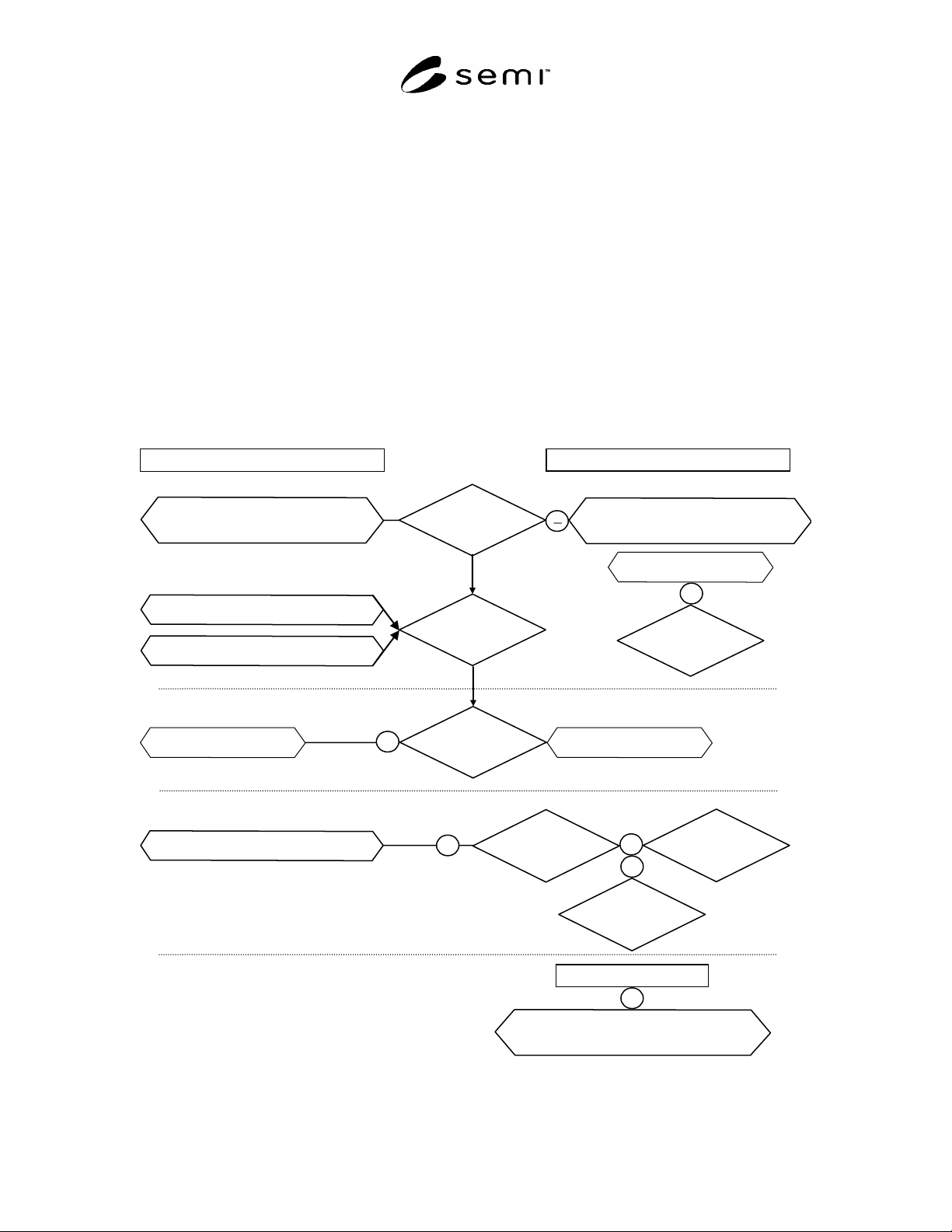
R1-1 COO Calculation Graphical Overview
R1-1.1 A discussion of COO is provided in this related information to supplement the presentation within the
guideline.
R1-1.2 The COO calculation is shown graphically in Figure R1-1. This figure is not a flowchart, but rather is
meant to illustrate the elements of the calculation.
R1-1.3 The left side of the diagram shows various cost factors, while the right side shows how they are incorporated
in the calculation. The upper section is the determination of the number of pieces of equipment required to process
the specified number of units. In the middle section, the fixed costs are converted to an annual basis and combined
with the recurring costs. In the last section, the total cost is then divided by the number of good unit equivalents.
Production Utilization
Recurring Cost Categories
Fixed Cost Categories
Annualized
Fixed Costs
Total
Annual
Cost
Recurring
Costs
+
=
Nonproduct
Units
COST FACTORS CALCULATION
Volume
Re
q
uiremen
t
#
Equipment
Required
#
Good
Units
Throughput per Equipment
Unit Volume Required
(e.g., Wafers, Devices)
Fixed
Costs
=
=
÷ Lifetime
Cost of Equipment Ownership
per Unit for # Equipment
Required
÷ Number of Units
× Yield
Figure R1-1
Cost of Equipment Ownership