semi合集-English.pdf - 第2796页
SEMI E102-0600 © SEMI 2000 4 of Transport J obs. The Material Transport and Storage Compon e nt uses services prov ided by the Machine AIG to access interfaces of Machines and Ports that serve as the sou rce or destinati…

SEMI E102-0600 © SEMI 20003
3 Limitations
3.1 The Material Transport and Storage Component
provides AMHS Framework level interfaces to
interoperable AMHS Equipment. This level of material
transport is factory level movement, i.e., the transport
of product and durables between machines, areas or
material tracking locations. The Material Tracking and
Storage Component does not provide interfaces that
make material movement within machines visible.
3.2 Provisional Status — This specification is
designated as provisional due to known areas that need
to be completed. The following items summarize the
deficiencies of the provisional specification to be
addressed before a subsequent ballot to upgrade it to
full standard status.
3.2.1 Dependence on Global Declarations and
Abstract Interfaces — Components of this document
reference global declarations and specialize abstract
interfaces for material, resource and job concepts. The
provisional specification for these declarations and
interfaces was balloted and recommended by the SEMI
Information and Control Committee in July, 1999.
When this specification is published a revision will be
undertaken to clearly define the relationship of this
specification to those common elements of the CIM
Framework.
3.2.2 Dependence on Durables Management
Component — The Material Transport and Storage
Component depends upon interfaces specified as part of
the Durables Management Component of the CIM
Framework. This document includes only the required
interfaces from Durables Management. Those
interfaces, found in Section 6.2.3, will be removed from
this document when the Durables Management
Component of the CIM Framework is adopted in a
future ballot.
3.2.3 Dependence on Machine Abstract Interface
Group — The Material Transport and Storage
Component depends upon interfaces specified as part of
the Machine Abstract Interface Group (Machine AIG)
of the CIM Framework. This document includes only
the required interfaces from the Machine AIG. Those
interfaces, found in Section 6.2.4, will be removed from
this document when the Machine AIG of the CIM
Framework is adopted in a future ballot.
3.2.4 Dependence on Factory Operations Component
— The Material Transport and Storage Component
depends upon interfaces specified as part of the Factory
Operations Component of the CIM Framework. This
document includes only the required interfaces from the
Factory Operations Component. Those interfaces,
found in Section 6.2.5, will be removed from this
document when the Factory Operations Component of
the CIM Framework is adopted in a future ballot.
3.2.5 Deterministic Prediction of Transport Time —
The responsibility for providing estimates of predicted
transport time of future TransportJobs in a deterministic
way is beyond the scope of the Provisional
Specification. This capability may be offered in future
upgrades of this specification based on added
experience with such predictions. It may be found that
heuristic methods for transport time prediction are the
most practical way to provide such estimates.
4 Referenced Standards
4.1 SEMI Documents
SEMI E81 — Provisional Specification for CIM
Framework Domain Architecture
4.2 Other Documents
ISO/IEC International Standard 14750 (also ITU-T
Recommendation X.920): Information Technology –
Open Distributed Processing – Interface Definition
Language
1
UML Notation Guide, Version 1.1, document number
ad/97-08-05, Object Management Group
2
5 Terminology
5.1 Abbreviations and Acronyms
5.1.1 AMHS — Automated Material Handling System
5.1.2 MTSC — Material Transport and Storage
Component
6 Requirements
6.1 The following sections specify the interfaces that
comprise the Material Transport and Storage
Component of the CIM Framework. Additionally, the
subsets of interfaces from Durables Management,
Machine Abstract Interface Group, and Factory
Operations required to support Material Transport and
Storage are included here pending future ballots that
will address the full scope of these other specifications.
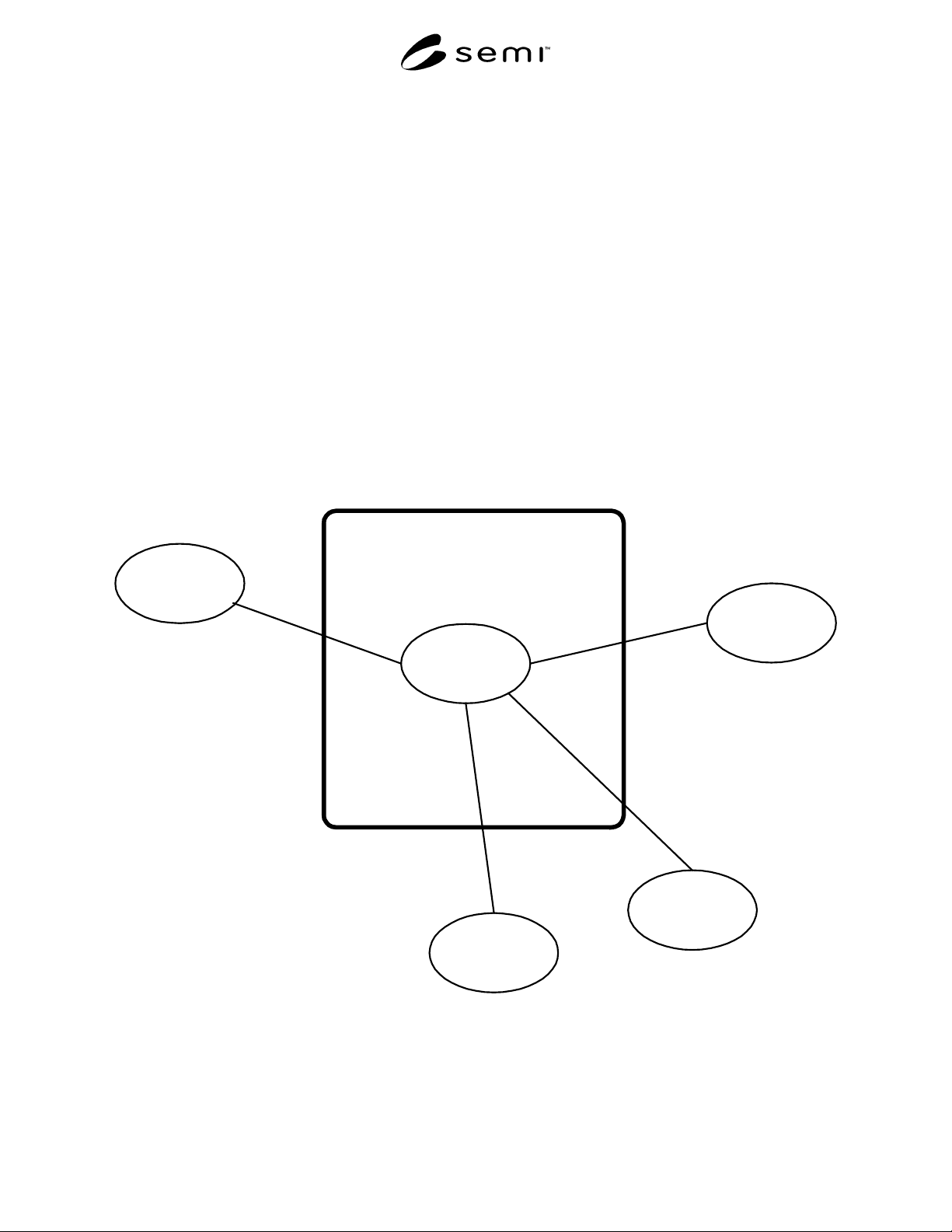
6.1.1 Figure 2 illustrates the context of the Material
Transport and Storage Component within the CIM
Framework. The Factory Operation component
requests the transport of material by the Material
Transport Manager which provides services for creation
1 ISO Central Secretariat, 1, rue de Varembé, Case postale 56, CH-
1211 Genève 20, Switzerland
2 UML Notation Guide v1.1 is available to the general public at
http://www.omg.org/cgi-bin/doclist.pl, +1-508-820 4300, Object
Management Group, Inc. , Framingham Corporate Center, 492 Old
Connecticut Path, Framingham, MA 01701.
SEMI E102-0600 © SEMI 2000 4
of Transport Jobs. The Material Transport and Storage
Component uses services provided by the Machine AIG
to access interfaces of Machines and Ports that serve as
the source or destination of Transport Jobs. The MES
Factory defines areas within a factory which represent
groups of machines. Finally, Durables Management
provides the services needed to manage the material
containers that are moved.
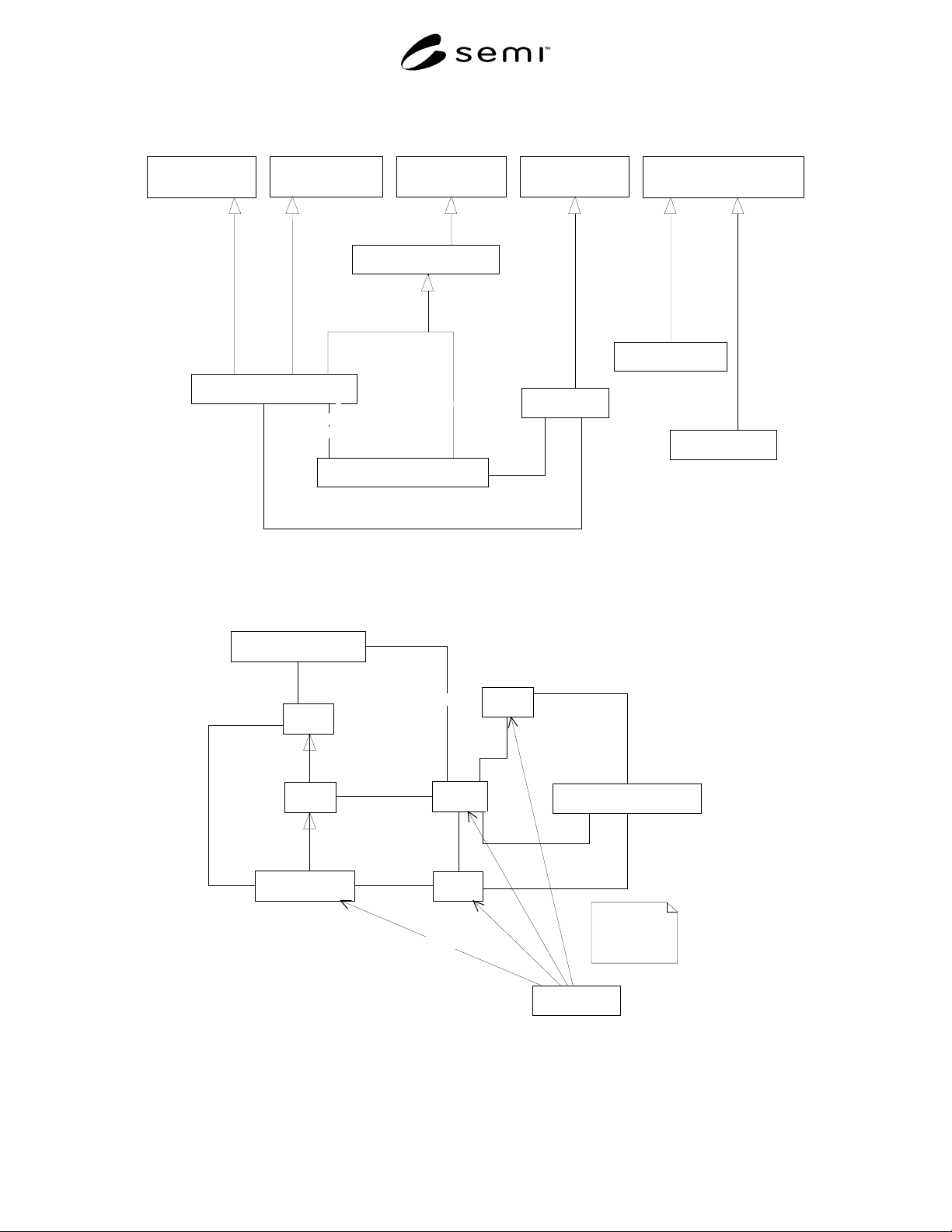
6.1.2 Figure 3 shows the Material Transport and
Storage Component information model, including the
inherited interfaces and the associations between
interfaces. These interfaces are fully defined in Sections
6.3 and 6.4. The interfaces associated with the Material
Transport and Storage are as follows:
1. TransportJobSupervisor – abstract interface,
2. MaterialTransportManager,
3. MaterialTransportController, and
4. TransportJob.
6.2 Required Subsets of Future CIM Framework
Specifications
6.2.1 This specification depends on interfaces from
Durables Management Component, the Machine
Abstract Interface Group and the Factory Operations
Component that will eventually be contained in future
CIM Framework component specifications. They are
included with this document to support a complete
specification for AMHS support within the CIM
Framework. When these items are balloted as separate
documents, they will be removed from this
specification and referenced in their full form.
6.2.2 Figure 4 illustrates the dependencies of the
Material Transport and Storage Component.
Material
Transport
Manager
Material Transport and Storage
Component
Factory
Operations
requests material
movement
defines
factory areas
manages material
containers
MES Factory
Durables
Management
Equipment
Tracking and
Maintenance
tracks
machine and
port status
Figure 2
Material Transport and Storage Component Context
SEMI E102-0600 © SEMI 20005
ComponentManager
(from Factory
Component)
Material Transport and Storage Component
MaterialTransportController
TransportJob
0..*
0..1
0..*
0..1
MaterialTransportManager
0..*
1
0..*
1
0..*
0..1
0..*
0..1
creates and manages
JobSupervisor
(from Job Supervision
A
IG
)
Job
(from Job Supervision
AIG)
JobRequestor
(from Job Supervision
AIG)
TransportMachine
StorageMachine
Machine
(from Machine Abstract Interface
Group)
TransportJobSupervisor
creates
and
manages
registers and
delegates to
Figure 3
Material Transport and Storage Information Model
Material
MaterialTrackingLocation
0..1
0..*
0..1
0..*
tracks
Durable
MaterialContainer
0..1
0..*
0..1
0..*
held in
Port
0..1
0..1
0..1
0..1
bound to
Machine
1
0..*
1
0..*
tracks
material for
0..1
0..*
0..1
0..*
assigned to
1
1..*
1
0..*
has
TransportJobSupervisor
0..*
0..*
0..*
0..*
Area
0..*
0..*
0..*
0..*
groups
0..*
0..*
enabled for
enabled for
enabled for
0..*
0..*
0..*
0..*
0..*
0..*
TransportJob
TransportJob
Specification
of source and
destination
moves
Figure 4
Material Transport and Storage Dependencies