semi合集-English.pdf - 第3095页
SEMI E125-0305 © SEMI 2003, 2005 3 SEMI E39 Object Services Standard: Co ncept, Behavior, and Services SEMI E120 Pro visional Speci fication for the Common Equipm ent Model (CEM) 4.2 ISO St andards 1 ISO 639:1 988 — …

SEMI E125-0305 © SEMI 2003, 2005 2
1 Purpose
1.1 Specification Purpose
1.1.1 This specification describes a method for allowing equipment suppliers to provide a description of the
variables, events, exceptions, and physical equipment configuration available from their equipment. With this
information available for consumption by software systems, it can be used as a tool to aid the process of integrating
equipment into a factory’s automation system.
2 Scope
2.1 In-scope
2.1.1 This document specifies the classes that suppliers are to use to describe essential data, events, and exceptions
provided by their equipment. The specification only describes information that is static in nature (that is,
information that does not change dynamically while the equipment is running). This document also specifies an
interface that clients can use to access this information.
2.1.2 This specification applies to all semiconductor manufacturing equipment that supports the data acquisition
interface defined in the SEMI specification for Data Collection Management.
2.2 Out of Scope
2.2.1 This specification does not define any new behavior required of the equipment other than that necessary for
retrieving information describing equipment configuration, interfaces, and available data, and keeping this
information current.
2.2.2 The details of any underlying concepts and behavioral models (for example, carrier management,
process/control job, etc.) that can be described by metadata are to be separately specified in a document dedicated to
those concepts. Only the ability to describe the fact that a supplier has implemented such a concept and that a client
can discover this implementation and any data it can produce is in scope for this specification.
2.2.3 This specification does not require that the metadata provided by the equipment be directly human readable.
It is expected that applications will be written to organize and present this information to human users in a form that
is easier for end users to digest.
NOTICE: This standard does not purport to address safety issues, if any, associated with its use. It is the
responsibility of the users of this standard to establish appropriate safety and health practices and determine the
applicability of regulatory or other limitations prior to use.
3 Limitations
3.1 Abstract Model
3.1.1 This specification is an abstract model only. Adjunct specifications must be developed to bind this
specification to an implementation technology.
3.2 Other Limitations
3.2.1 This specification does not define the mechanism used for determining how to locate clients that are to receive
notifications defined by this specification. It assumes that the equipment has established a communications context
with any clients that can submit requests, and has provided any context necessary to send notifications to those
clients.
3.2.2 This specification does not define the mechanism used for identifying or authenticating clients. It assumes
that clients can be uniquely identified, and that the equipment is capable of distinguishing requests originating from
different clients.
4 Referenced Standards
4.1 SEMI Standards
SEMI E30 — Generic Model for Communications and Control of Manufacturing Equipment (GEM)

SEMI E125-0305 © SEMI 2003, 2005 3
SEMI E39 Object Services Standard: Concept, Behavior, and Services
SEMI E120 Provisional Specification for the Common Equipment Model (CEM)
4.2 ISO Standards
1
ISO 639:1988 — Code for the representation of names of languages
ISO 3166-1:1997 — Codes for the representation of names of countries and their subdivisions – Part 1: Country
codes
ISO 8601 — Representations of dates and times, 1988-06-15
ISO 8601 Draft Revision — Representations of dates and times, draft revision, 2000
4.3 Other Standards
American National Standards Institute (ANSI) X3.135-1992 – Information Systems – Database Language – SQL
(
http://www.ansi.org)
2
Internet Engineering Task Force (IETF) RFC 1776 – Tags for the Identification of Languages, ed. H. Alvestrand.
1995 (
http://www.ietf.org/rfc/rfc1766.txt)
Unified Modeling Language (UML) Specification, Version 1.4, OMG Specification 01-09-67, available from
http://www.omg.org/technology/documents/modeling_spec_catalog.htm
Uniform Resource Name (URN) Syntax, IETF RFC 2141, May 1997 (
http://www.ietf.org/rfc/rfc2141.txt)
NOTICE: Unless otherwise indicated, all documents cited shall be the latest published versions.
5 Terminology
5.1 Abbreviations and Acronyms
5.1.1 Descriptions of many of the abbreviations and acronyms used in this specification may be found in the SEMI
Compilation of Terms, available on the SEMI web site,
http://www.semi.org/. In most cases, these terms are not
included in this section.
5.1.2 IDL — Interface Definition Language
5.1.3 OMG — Object Management Group
5.1.4 SQL — Standard Query Language
5.1.5 UML — Unified Modeling Language
5.1.6 URN — Uniform Resource Name
5.1.7 XML — eXtensible Markup Language
5.2 Definitions
5.2.1 Definitions or descriptions of many of the terms used in this specification may be found in the SEMI
Compilation of Terms, available on the SEMI web site,
http://www.semi.org/. In most cases, these terms are not
included in this section.
5.2.2 Related Information 8 contains useful definitions of UML terms taken directly from the UML standard. UML
terms used in this document conform to these definitions. Please refer to this section as needed.
5.2.3 metadata — data used to describe data. For example, if a tool can report an event with several associated
variables under certain conditions, the metadata for that event would provide a description of what condition will
produce the event, what the type and units are of each variable, and the id of the event itself.
1 International Organization for Standardization, ISO Central Secretariat, 1, rue de Varembé, Case postale 56, CH-1211 Geneva 20, Switzerland.
Telephone: 41.22.749.01.11; Fax: 41.22.733.34.30, Website: /www.iso.ch
2 American National Standards Institute, Headquarters: 1819 L Street, NW, Washington, DC 20036, USA. Telephone: 202.293.8020; Fax:
202.293.9287, New York Office: 11 West 42nd Street, New York, NY 10036, USA. Telephone: 212.642.4900; Fax: 212.398.0023, Website:
www.ansi.org
SEMI E125-0305 © SEMI 2003, 2005 4
6 Conventions
6.1 Document and Notation Conventions
6.1.1 Unified Modeling Language (UML) — This specification uses the UML conventions for representing all
class, state, object, and sequence diagrams. Refer to the UML specification for a detailed description of these
conventions.
6.1.2 Attribute Tables — The table below provides an example of the tables used to list and describe attributes of
classes defined in this specification.
Table 1 Attribute Table Format
Attribute Name Definition Required Form
Y or N See list below
6.1.2.1 Form — Defines the data type of the attribute. The terms used to describe data types in this column are
defined in the SEMI Compilation of Terms, or are included as part of the specification. Refer to the compilation of
terms for the definition of SEMI type name meanings.
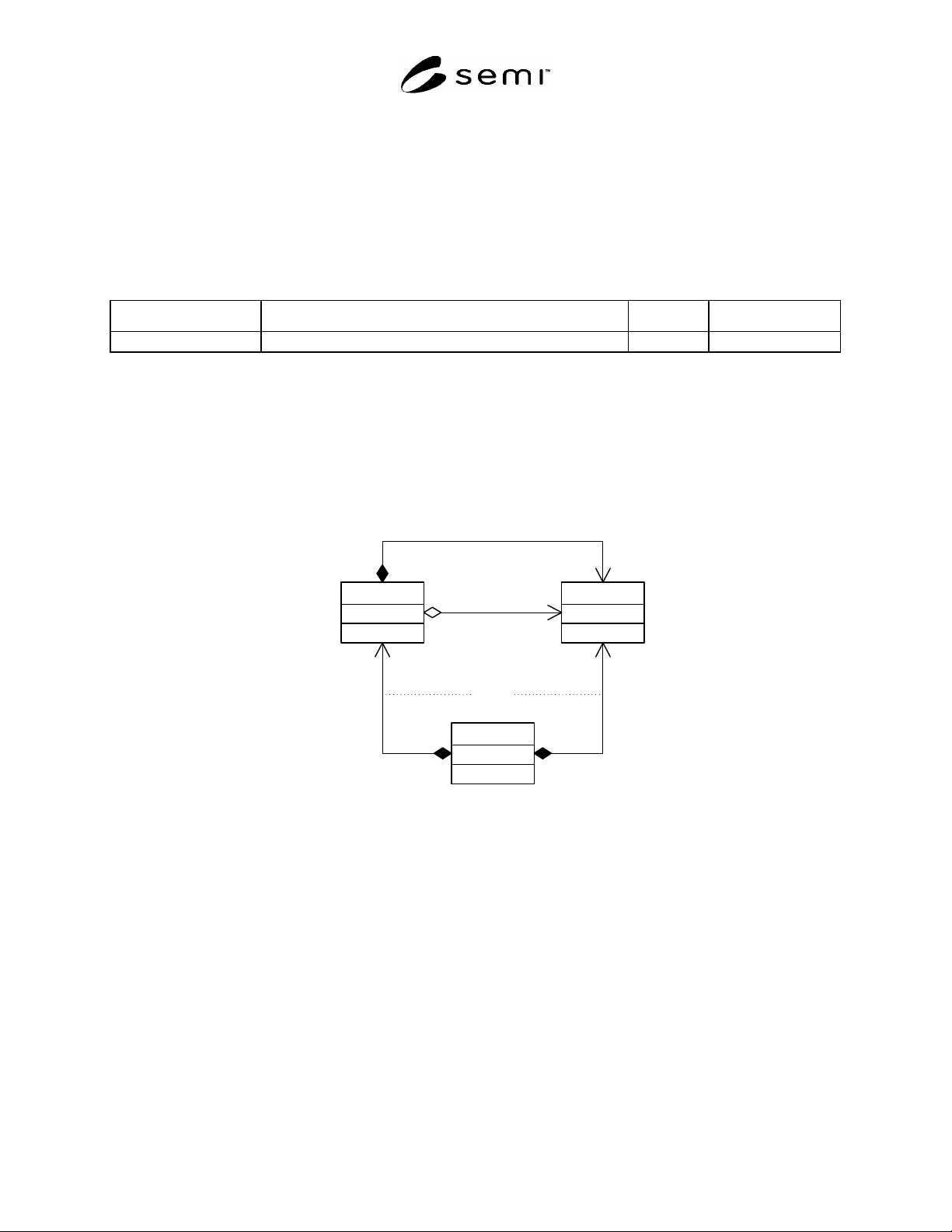
6.1.3 UML Associations — The mechanism used for representing UML associations between classes is
implementation dependent. This document is abstract in nature, and does not specify or imply any such mechanism.
Any adjunct standard that provides an implementation of this specification must include a description of the
mechanism used for representing the UML associations shown in this document.
Class2Class1
1 roleName10..*
1..*
roleName2
1
{XOR}
Class3
1
roleName3 1
1
roleName4 1
Figure 1
Association Notation
6.1.3.1 Association Notation — This document uses the UML aggregation diamond adornment, role names, end
multiplicities, and navigability in all class diagrams specifying associations. Unadorned associations are not used,
for economy of notation. See the UML 1.4 specification, Section 3.43 for details. All role names are public by
default; therefore the visibility symbols are not used.
6.1.3.1.1 Open diamond adornments indicate that instances of the target class may be shared among aggregate
classes. Closed diamond adornments indicate that target instances belong to at most one composite class. The part-
whole semantics of the aggregation/composition symbol is not significant in this specification. See the UML 1.4
specification, sections 3.43.2.5 and 3.48 for further information.
6.1.3.1.2 Some diagrams use the UML “XOR” constraint where applicable. An “XOR” constraint indicates that
only one of many possible associations can be instantiated at any one time for a given instance of the association
class. See the UML 1.4 specification, Section 3.42.5.1 for further information.
6.1.4 Association Tables — The table below provides an example of the tables used to list and describe associations
between classes defined in this specification.