semi合集-English.pdf - 第1849页
SEMI E42-0704 © SEMI 1995, 2004 118 programs for vision system s) , but this restriction may be removed when the tec hnology a dvances. Editing on the equipment may st ill be desirable, particularly in a Development Fab.…
SEMI E42-0704 © SEMI 1995, 2004 117
R1-3 Background
The material in this section provides a context for the
Recipe Management Standard and is intended for
background information only.
In a complex environment, equipment and host become
relative terms indicating roles of two independent
agents with respect to each other. In general, both
equipment and host may provide services to one
another, and some services may be provided by both. In
certain cases, one may provide services to its partner
that the other does not. With respect to recipes,
equipment refers to the recipe’s executor, whereas host
represents a supervisory agent who may delegate
recipes which will be executed by the equipment.
For clusters, cells, and local-area stations, where a mid-
level controller communicates both to lower-level
components and to a higher level factory system, that
controller may alternately take the role of host to its
components and of equipment to the factory system.
Where role is significant, the terms equipment and host
are used in this section to indicate the relationship of
the two agents to one another.
R1-3.1 Traceability — A main management objective
in both a Development Fab and a Production Fab is
traceability of manufacturing conditions to the final
device characteristics. This traceability is required in a
Development Fab to support the analysis and
characterization of the process under development.
Certain customers of a Production Fab require this
traceability in order to do business. Even without such a
customer requirement, traceability is important for
process control and postmortem analysis of unexpected
device characteristics.
The recipe is the primary specification of
manufacturing conditions to the equipment; therefore,
the management of recipes is critical to this traceability.
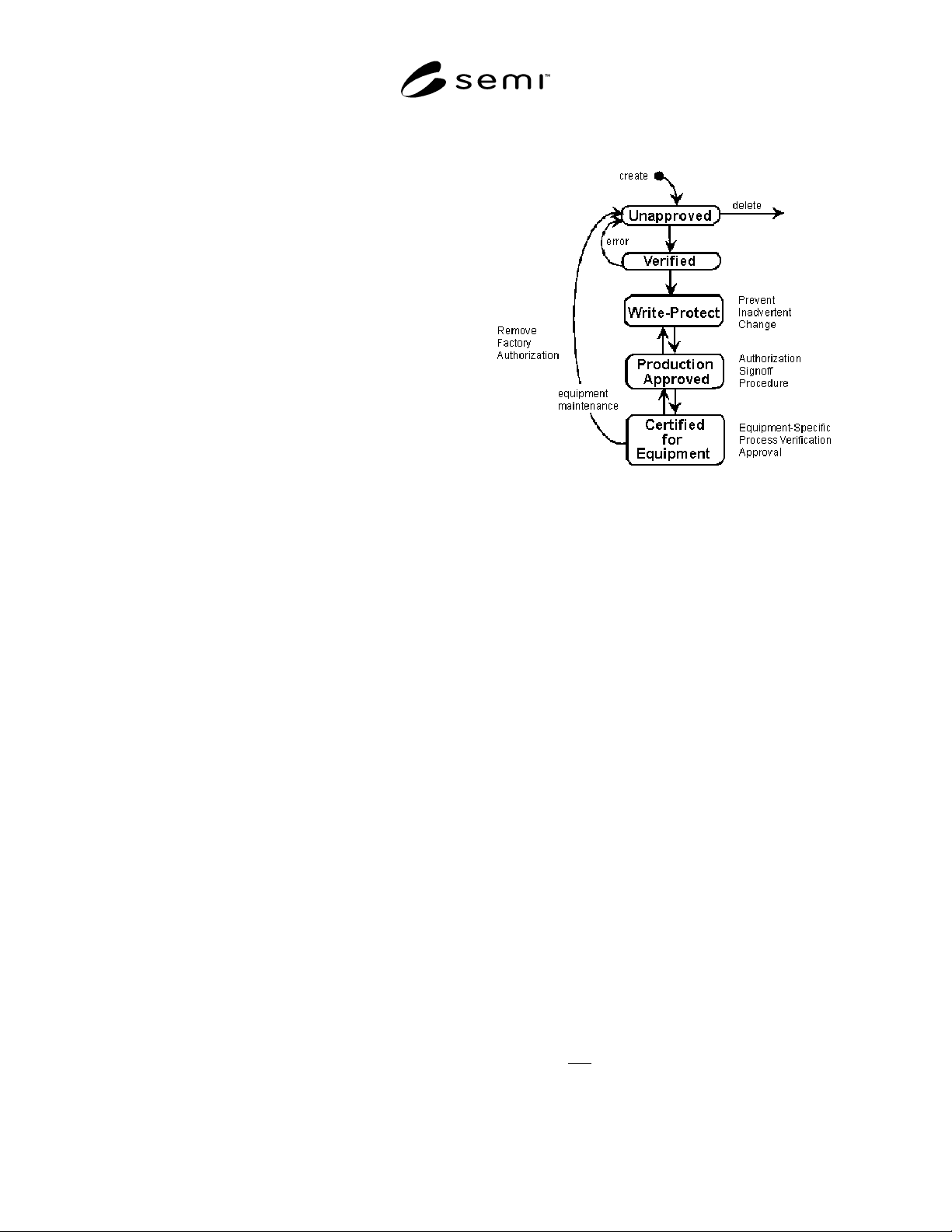
R1-3.2 Recipe Life Cycle — The lifetime of a recipe in
a Fab typically has several phases, as illustrated in
Figure R1-1. While being developed, it may contain
errors, or it may not produce the desired results. The
recipe may be edited several times during its initial
development. At some point, the recipe enters the test
phase, where it will be executed and its results
evaluated. A check for syntax correctness occurs at or
before the time the equipment prepares it for execution.
Still further changes may be made to fine-tune the
process to achieve a particular result. During this
process, it is still desirable to be able to protect it from
inadvertent change or deletion. Finally, the recipe is
ready for production and goes through a series of
signoffs which constitutes a formal authorization
procedure. In many factories, only recipes which have
been approved as production-worthy may be used in
production runs.
Figure R1-1
Typical Recipe Life Cycle
Also, because results may vary between different
installations of equipment, an additional level of
authorization may be required that certifies individual
equipment for a given approved recipe.
A factory change control system must accommodate
different levels of protection for recipes in different
phases of their life cycle. To accomplish this,
equipment must recognize and support the different
requirements for each phase.
R1-3.3 Recipe Editing — Traditionally, recipes are
developed on the equipment that runs them. Besides
requiring time on the target machine (a potentially
scarce and expensive resource), this requires the person
defining the recipe to be inside a clean area. A potential
solution is for equipment manufacturers to provide
versions of their dedicated recipe editors that can be
integrated into the factory manufacturing systems.
Aside from the difficulty of the equipment
manufacturer supporting the variety of platforms
currently in use internationally, even in a distributed
factory environment, a proliferation of different
dedicated recipe editors required for the different types
of equipment is not considered a good solution.
A better solution is to permit editing external to the
cleanroom and then to transmit the completed recipe to
the equipment for verification. This can be achieved by
providing a text
form of the equipment manufacturer’s
recipe language which can be created and modified
with any standard text editor. This may not be possible
with some types of recipes (e.g., pattern recognition

SEMI E42-0704 © SEMI 1995, 2004 118
programs for vision systems), but this restriction may
be removed when the technology advances.
Editing on the equipment may still be desirable,
particularly in a Development Fab. When the equipment
permits a recipe to be changed, the equipment must
provide reporting mechanisms that inform the host of
changes and allow the host’s change control system to
operate.
R1-3.4 Recipe Sharing — A Fab may have several
installation of the same type of equipment (equipment
with the same functionality and the same recipe
language). Therefore, where possible, the same recipe
should be able to be shared between different
equipment of this same type.
R1-3.5 Protection and Process Control — The primary
goal of process control is to ensure that the final result
of the manufacturing process does not change over
time. This may be accomplished by both feedback and
feedforward methods. These methods modify the
settings used in the process. This requires two
capabilities that seem to be in conflict:
• The definition of the process settings (the recipe)
should not change.
• The process settings should change to counter the
drift inherent in real processes.
The first capability is particularly important in a
Production Fab. Most Fab policies prohibit processes
from changing after they have been approved for
production. This is easy to build into a change control
system on the host. However, if the equipment allows
local editing, then it must also enforce this policy.
Wholesale changes in a recipe are never necessary for
the second purpose. Usually only a few parameter
values are modified in small increments to effect
control of the process. A well-defined process specifies
the parameters that vary and their range of variation.
For any given recipe, it must be possible for the host to
specify different values of such parameters for each
piece of equipment so that the recipe may be “tuned”
for that equipment to produce uniform results. In
addition, the process control agent, on the equipment or
the host, may need the ability to calculate the parameter
value changes for each run and to inform the equipment
of the new values. Mechanisms are provided to support
such interactions.
R1-3.6 Recipe Selection — Typical operation of
equipment requires an operator or the host to initially
select the recipe to be run. Recipe selection may be
specified implicitly within the definition of a higher
order “process job”. In either case, the specification of a
recipe is accomplished by referring to its recipe
identifier (i.e., the identifier used by the change control
system) and, where needed to resolve ambiguity, its
location. Once selected, a recipe is initiated by an
appropriate start command, which may be explicitly
given by the operator or host or implicitly given by the
equipment when executing a higher order process job.
Repeated runs of the same recipe may be accomplished
via subsequent start commands without the necessity of
formal recipe re-selection.
R1-4 Example of a Factory Implementation of Approval Levels
A factory might implement different levels of approval by regulating the following levels of recipe approval on the
equipment:
Approval Level
FACTORY POLICY
Level 0 “Unapproved”
Level 1 “In Test”
Level 2 “Non-Production”
Level 3 “Ready for Release”
Level 4 “Released for Production”
with
RecipeReadOnlyLevel = 2 Level 2 = read-only
R1-5 Examples of Variable Parameters
The recipe body may have statements that allow parameters to be changed within fixed limits. For example, recipe
BAKE;2.3 may contain statements such as:
Parameter BakeTime of TIME default = 200 seconds

SEMI E42-0704 © SEMI 1995, 2004 119
minimum = 100 seconds
maximum = 300 seconds;
or
TIME BakeTime • (200,100,300,”s”) /* default,min,max,units */
that define the process parameter “BakeTime”, its initial value and restrictions. The BAKE;2.3 recipe may use the
BakeTime parameter in further internal statements to determine the length of time a wafer is processed, such as:
wait for TIME BakeTime;
This parameter may then be set by a parent recipe as in Example (1) below or from the EqpSpec_PARAM attribute
(see 5.3.1.4) or with a “Select Recipe” command from the host or operator.
For example, a recipe “BAKE;2.3” may define a variable “BakeTime”, while a recipe “RAMP;1,0” may define a
variable “RampSetPoint”. A parent recipe “XYZ” might contain external references in the text of the source form
such as:
(1) RUN RAMP;1 // use default for RampSetPoint
RUN BAKE;2.3 with BakeTime=10 // bake for 10 seconds
or
(2) set RampSetPoint to 500; /* ramp up to 500 degC */
do RAMP(RampSetPoint);
set Baketime to 120; /* 120 sec (2 min.) bake */
do BAKE;2.3(BakeTime);
or
(3) RAMP(RampSetPoint:=500)
BAKE;2.3(BakeTime:=Time_A) /* 1st bake time may vary */
RAMP(RampSetPoint:=650)
BAKE;2.3(BakeTime:=Time_B) /* 2nd bake time may vary*/
RAMP(RampSetPoint:=800)
BAKE;2.3(BakeTime:=Time_B+50) /* 2nd bake plus 50 sec */
where “Time_A” and “Time_B” were both formally defined within XYZ.
In example (1), no initial value is specified for RampSetPoint. In this case, when the main recipe is selected, the
initial value specified either in EqpSpec_LinkParam
or in Gen_LinkParam (that is the same as the definition in
RAMP;2.3) is used. However, in this example, the parameter BakeTime is assigned a value by the parent recipe,
and this supersedes any value from a recipe attribute or a “Select Recipe” command from the host or operator. In
the example given, BakeTime is assigned a value outside of the declared domain. This should create an error when
the recipe is verified.
Examples (2) and (3) illustrate how subrecipes RAMP and BAKE may be referenced multiple times by a parent
recipe, and the parent may provide different values with each reference (Example 2) or may define new parameters
to use with different references (Example 3).
In the above examples, PARAMETERS (set when each individual recipe is verified) and Gen_LinkParam (set when
XYZ is linked) will contain parameter definitions as follows:
Recipe
PARAMETERS n_LinkParam
XYZ;0.8 Time_A Time_A
Time_B Time_B
RampSetPoint
BakeTime
RAMP;1.0 RampSetPoint undefined for unlinked recipe