semi合集-English.pdf - 第6977页
SEMI S10-1103 © SEMI 1996, 2003 7 Table A1-3 Risk Ranking Matrix LIKELIHOOD RISK RANKING MATRI X FREQUENT A LIKELY B POSSIBLE C RARE D UNLIKELY E CATASTROPHIC 1 SEVERE 2 MODERATE 3 S E V E R I T Y MINOR 4 Overall Risk Ra…
SEMI S10-1103 © SEMI 1996, 2003 6
APPENDIX 1
RISK RANKING TABLES
NOTICE : The material in this appendix is an official part of SEMI S10 and was approved by full letter ballot procedures on
April 2, 2003.
NOTE A1-1: The following Tables A1-1 and A1-2 give the groups of severity and likelihood. Other examples can be found in
Related Information 3 (Risk Ranking Number) and Related Information 4 (more detailed numerical Severity and Likelihood).
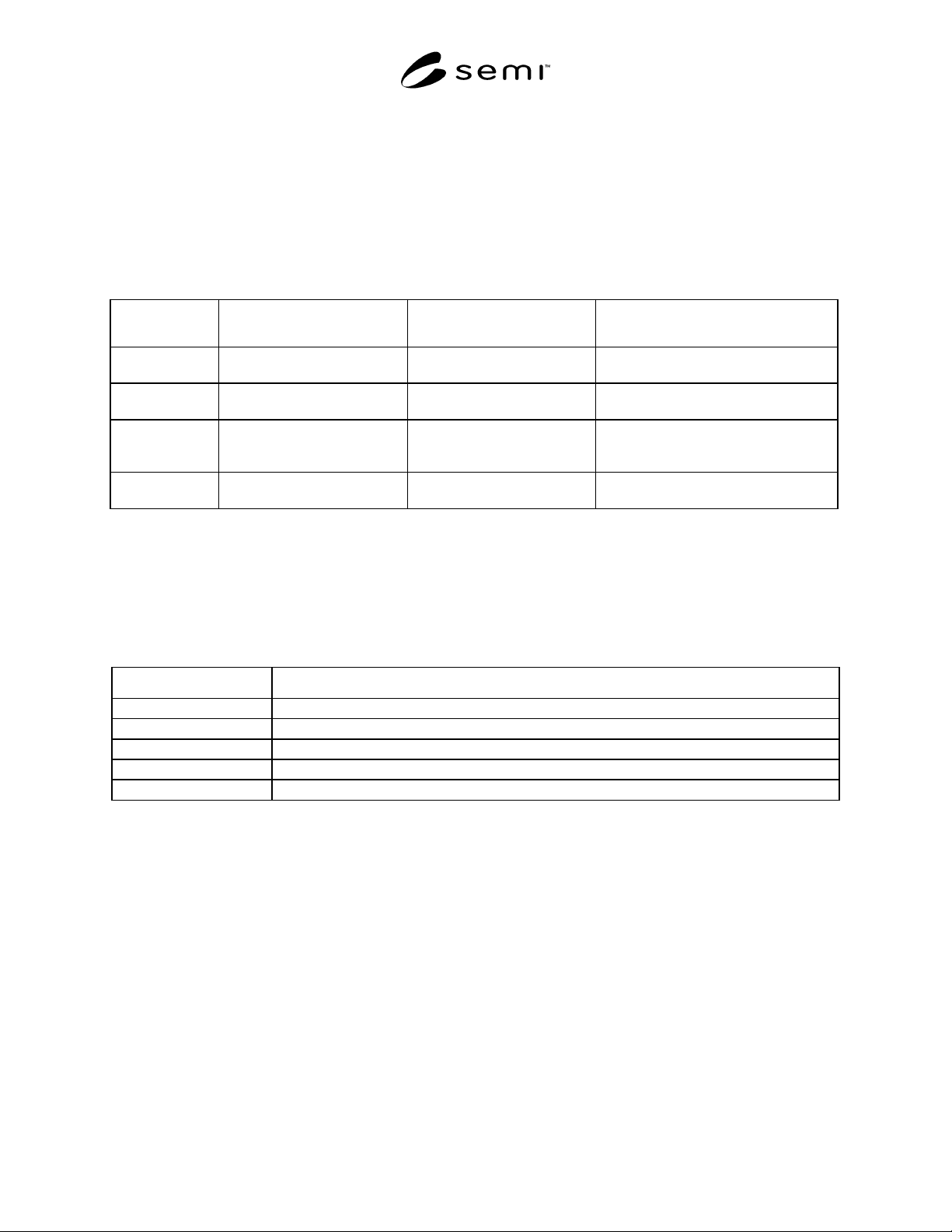
Table A1-1 Severity Groups
Severity Group People (See Note A1-2.) Equipment/Facility
(See Note A1-3.)
Property
1 – Catastrophic One or more fatalities. System or facility loss. Chemical release with lasting
environmental or public health impact.
2 – Severe Disabling injury/illness. Major subsystem loss or facility
damage.
Chemical release with temporary
environmental or public health impact.
3 – Moderate Medical treatment or restricted
work activity (OSHA
recordable).
Minor subsystem loss or facility
damage.
Chemical release triggering external
reporting requirements.
4 – Minor First aid only. Non-serious equipment or
facility damage.
Chemical release requiring only routine
cleanup without reporting.
NOTE A1-2: This number is if 1-2 people are exposed to the risk. The severity group should be reconsidered to a
more severe severity group when 3 or more people are involved.
NOTE A1-3: Although it is not a safety risk it adds value to take in account product (e.g. wafers, reticles) damage.
No descriptions are given due to the fact of the value and number of products on a equipment can vary. Possible
descriptions can be: Rework of a wafer, Rework of a batch, Loss of a batch.
Table A1-2 Likelihood Groups
Likelihood Group Expected Frequency (% of Units- Year) (See Note 1.)
A – Frequent More than 1%
B – Likely More than 0.2% but not more than 1%
C – Possible More than 0.04%, but not more than 0.2%
D – Rare More than 0.02%, but not more than 0.04%
E – Unlikely Not more than 0.02%
Note 1: The frequency (in percent) is calculated by dividing the number of (observed or expected) occurrences by the number of unit-years that
the hazard has existed or is anticipated to exist, then multiplying the quotient by 100.
NOTE A1-4: If data are available, they should be used. If data are not available, the frequencies should be estimated.
NOTE A1-5: The following two example calculations are added for clarification of Table A1-2 only:
Example 1:
If something expected to happen 1 time in 5 units operated for 6 years the frequency will become:
(1 time/(5 units × 6 year of operation)) × 100% = 3.3% (= A – Frequent)
Example 2:
If something expected to happen 2 times on 50 units with 30 are operated for 6 years and 20 are operated for 7 years
the frequency will become
(2 times/(30 units × 6 year of operation + 20 units × 7 year of operation)) × 100% = 0.625% (= C – Possible)
SEMI S10-1103 © SEMI 1996, 2003 7
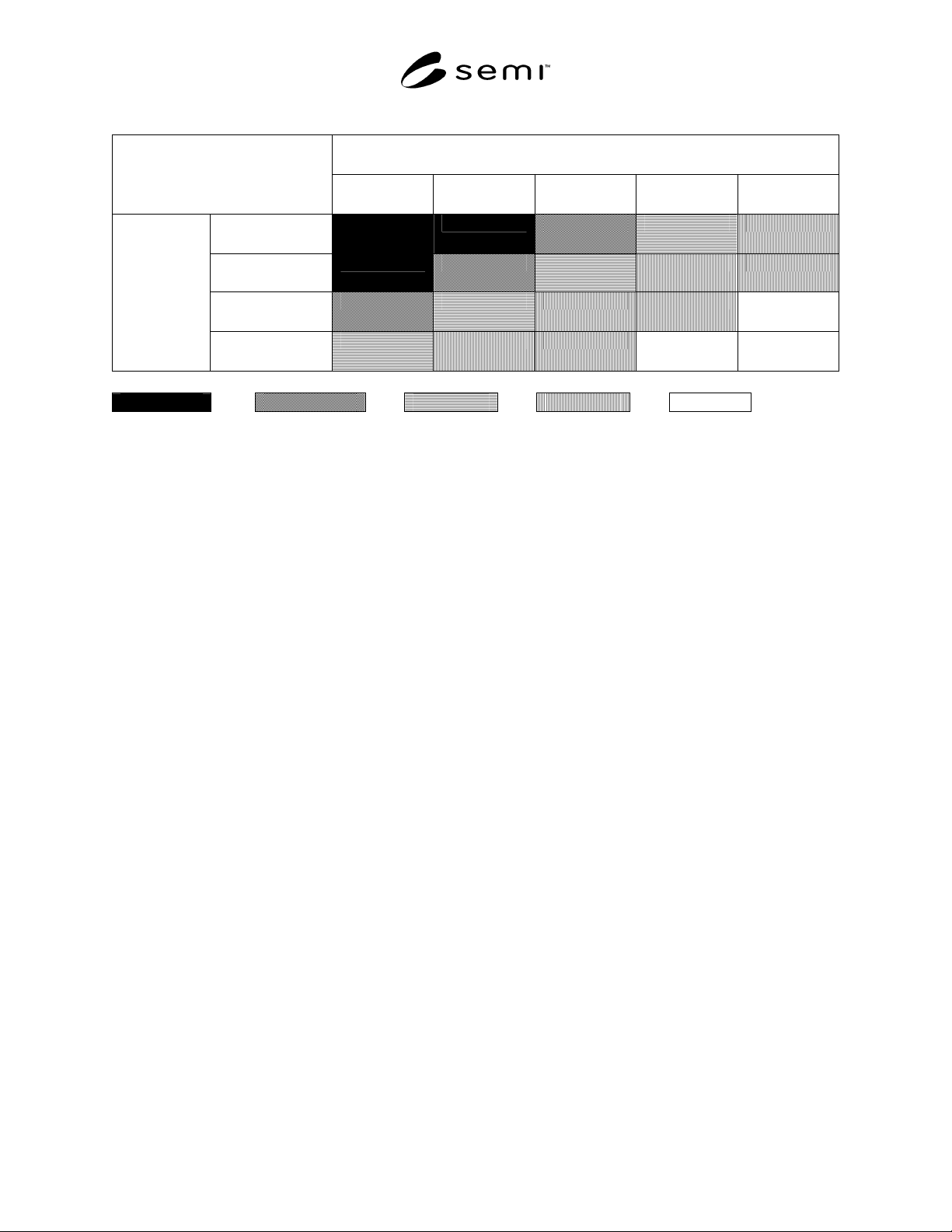
Table A1-3 Risk Ranking Matrix
LIKELIHOOD
RISK
RANKING
MATRIX
FREQUENT
A
LIKELY
B
POSSIBLE
C
RARE
D
UNLIKELY
E
CATASTROPHIC
1
SEVERE
2
MODERATE
3
S
E
V
E
R
I
T
Y
MINOR
4
Overall Risk Ranking Categories:
VERY HIGH HIGH MEDIUM LOW VERY
LOW
NOTE A1-6: The Risk Categories of “Very High” and “Very Low” correspond identically with the Risk Categories,
used in previous SEMI documents (e.g., S10-12-96, S2, and S14) of “Critical” and “Slight”. The terms were
changed to facilitate translation from English.
NOTICE: SEMI makes no warranties or representations as to the suitability of the guidelines set forth herein for
any particular application. The determination of the suitability of the standard is solely the responsibility of the user.
Users are cautioned to refer to manufacturer' s instructions, product labels, product data sheets, and other relevant
literature, respecting any materials or equipment mentioned herein. These standards are subject to change without
notice.
By publication of this guideline, Semiconductor Equipment and Materials International (SEMI) takes no position
respecting the validity of any patent rights or copyrights asserted in connection with any item mentioned in this
guideline. Users of this guideline are expressly advised that determination of any such patent rights or copyrights,
and the risk of infringement of such rights are entirely their own responsibility.
SEMI S10-1103 © SEMI 1996, 2003 8
RELATED INFORMATION 1
HAZARD IDENTIFICATION CHECKLIST
NOTICE: This related information is not an official part of SEMI S10 and was derived from EN 1050. Figure 1
from BS EN 1050: 1997 is reproduced with the permission of BSI under license number 2003DH0150. British
Standards can be obtained from reproduced with the permission of BSI Customer Services, 389 Chiswick High
Road, London, W4 4AL, United Kingdom, Tel + 44 (0)20 8996 9001.
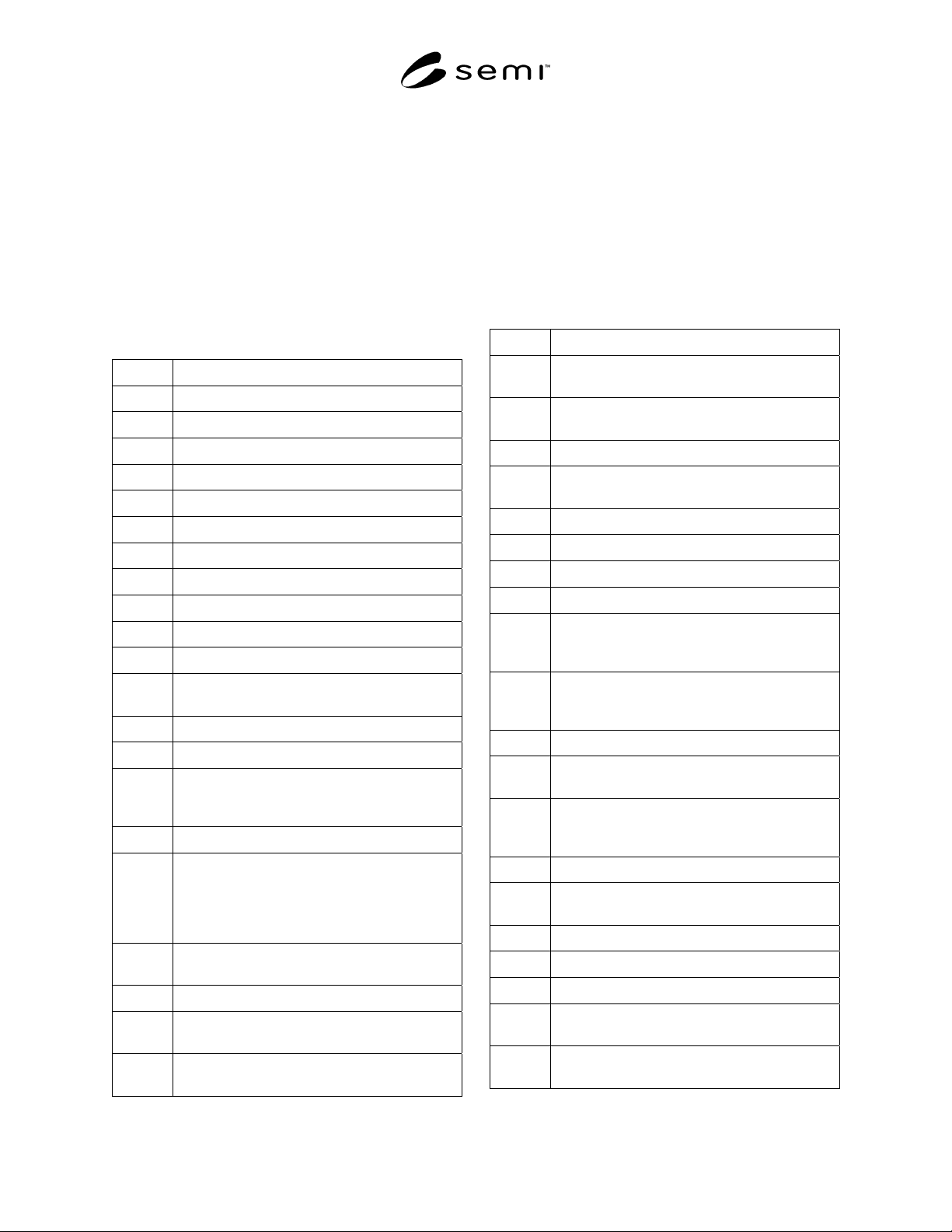
R1-1 Hazard Identification Checklist
R1-1.1 This checklist is produced to assist the assessor in identifying potential hazards. Other SEMI safety
guidelines may also be used.
Table R1-1 List of Hazards (copied from EN 1050)
1 Mechanical hazards
1.1 Crushing hazard
1.2 Shearing hazard
1.3 Cutting or severing hazard
1.4 Entanglement hazard
1.5 Drawing-in or trapping hazard
1.6 Impact hazard
1.7 Stabbing or puncture hazard
1.8 Friction or abrasion hazard
1.9 High pressure fluid injection or ejection hazard
2 Electrical hazards
2.1 Contact of persons with live parts (direct contact)
2.2 Contact of persons with parts which have become
live under faulty conditions (indirect contact
2.3 Approach to live parts under high voltage
2.4 Electrostatic phenomena
2.5 Thermal radiation or other phenomena such as the
p
rojection of molten particles and chemical effects
from short circuits, overloads, etc.
3 Thermal hazards, resulting in:
3.1 Burns, scalds and other injuries by a possible
contact of persons with objects or materials with
an extreme high or low temperature, by flames or
explosions and also by the radiation of heat
sources
3.2 Damage to health by hot or cold working
environment
4 Hazards generated by noise, resulting in:
4.1 Hearing loss (deafness), other physiological
disorders (e.g., loss of balance, loss of awareness)
4.2 Interference with speech communication, acoustic
signals, etc.
5 Hazards generated by vibration
5.1 Use of hand-held machines resulting in a variety
of neurological and vascular disorders
5.2 Whole body vibration, particularly when
combined with poor postures
6 Hazards generated by radiation
6.1 Low frequency, radio frequency radiation, micro
waves
6.2 Infrared, visible and ultraviolet light
6.3 X and gamma rays
6.4 Alpha, beta rays, electron or ion beams, neutrons
6.5 Lasers
7 Hazards generated by materials and substances
(and their constituent elements) processed or used
by the machinery
7.1 Hazards from contact with or inhalation/ ingestion
and subcutaneous injection of harmful fluids,
gases, mists, fumes, and dusts
7.2 Fire or explosion hazard
7.3 Biological or microbiological (viral or bacterial)
hazards
8 Hazards generated by neglecting ergonomic
principles in machinery design as, e.g., hazards
from:
8.1 Unhealthy postures or excessive effort
8.2 Inadequate consideration of hand-arm or foot-leg
anatomy
8.3 Neglected use of personal protection equipment
8.4 Inadequate local lighting
8.5 Mental overload and underload, stress
8.6 Human error, human behavior (e.g.:due to
improper training, selection, …)
8.7 Inadequate design, location or identification of
manual controls