semi合集-English.pdf - 第2560页
SEMI E88-1104 E © SEMI 1999, 2004 57 RELATED INFORMATION 2 REQUIREMENTS FO R COMPLIANCE NOTICE : This related information is not an official part of SEMI E88, but was approved for publ ication by f ull letter ballot proc…
SEMI E88-1104
E
© SEMI 1999, 2004 56
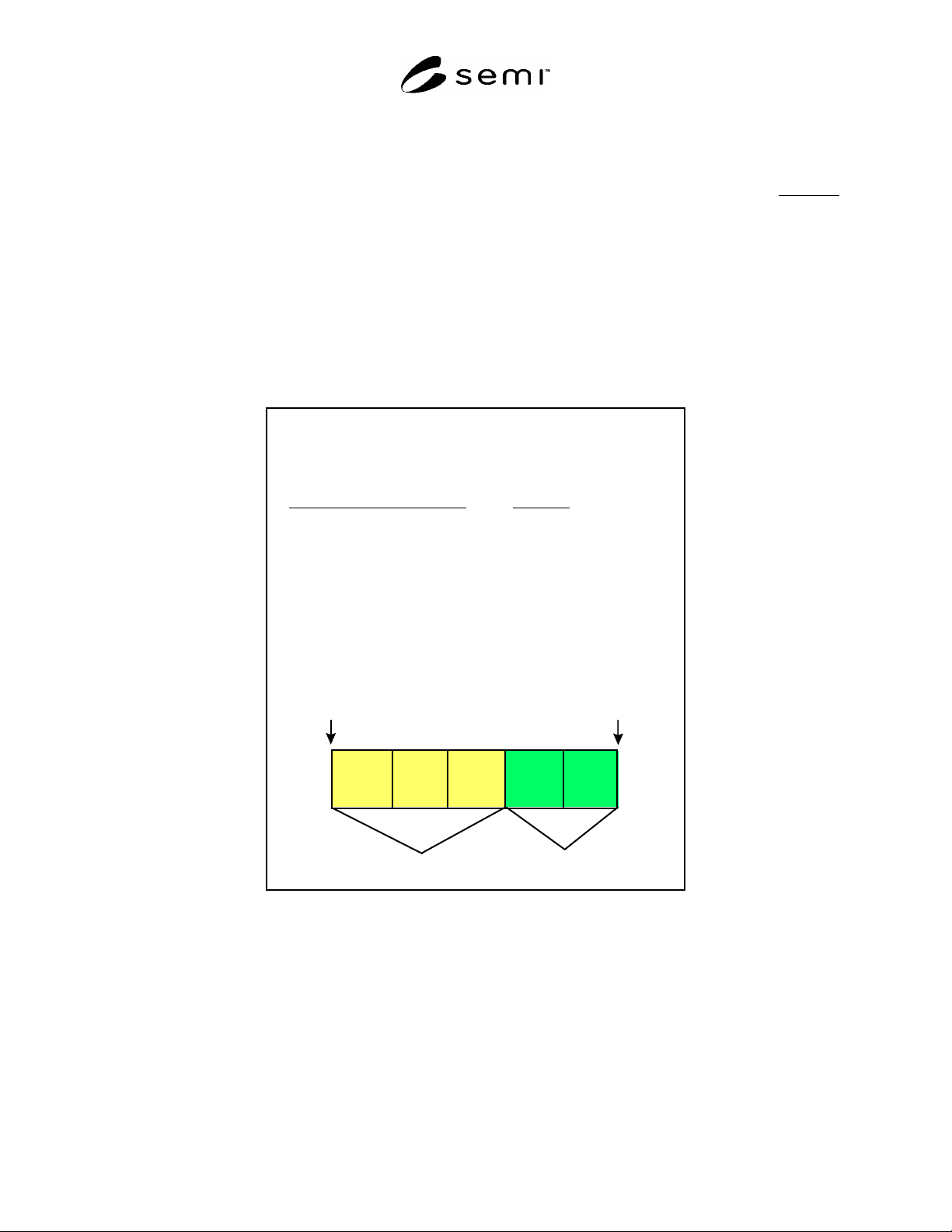
R1-4 Stocker Command Scheduling Characteristics
R1-4.1 At a minimum, the SC must offer Priority-based First-In-First-Out (FIFO) queuing of TRANSFER
commands. In other words, all TRANSFER commands which have yet to be processed by the SC must be serviced
in the order in which they are received by the SC based on the priority given in the host command. The minimum
priority levels required to be available on Stocker SEM equipment are “Normal” and “High” (refer to Figure R1-4
for an example). “Normal” and “High” priorities will be denoted by U2 compatible numbers as per the definition of
the priority in the Variable Data and Remote Command sections of this document. Other options may be
implemented, but to be a Stocker SEM equipment it must at a minimum have the ability to be configured to perform
Priority-based FIFO queuing of TRANSFER commands. Additionally, the command priorities are to be utilized
during execution of the commands to the following level: any “High” priority command will cause all other
commands that are not “High” priority to be usurped. That is to say that all other commands will modify the
execution steps to allow the “High” priority commands to be completed in the minimal elapsed time possible.
Multiple “High” priority commands will act upon each other according to the same rules as “Normal” commands act
on each other.
The following TRANSFER commands are
received by the SC in top to bottom order:
TRANSFER Command
Priority
1 Normal
2 Normal
3 High
4 Normal
5 High
4 2 1 5 3
head
tail
Corresponding SC processing queue
for outstanding TRANSFER commands :
Normal
High
A-1.1.1.13 Figure R1-4
A-1.1.1.14 SC Priority-Based FIFO TRANSFER Command Processing Example
A-1.1.1.15
R1-4.2 The SC must manage the resources so that TRANSFER requests are queued for later service if all resources
are currently utilized.

SEMI E88-1104
E
© SEMI 1999, 2004 57
RELATED INFORMATION 2
REQUIREMENTS FOR COMPLIANCE
NOTICE: This related information is not an official part of SEMI E88, but was approved for publication by full
letter ballot procedures.
Table R2-1 provides a checklist for Stocker SEM compliance.
R2-1 Stocker SEM Compliance Statement
Table R2-1 Stocker SEM Compliance Statement
Fundamental Stocker SEM Requirements Implemented Stocker SEM Compliant
SC State Model Yes No Yes No
Transfer Command State Model Yes No Yes No
Stocker Crane State Model (optional, see section 8.5) Yes No Yes No
Stocker Carrier State Model Yes No Yes No
Collection Event List Yes No Yes No
Collection Event Data Availability Yes No Yes No
Variable Data Items Yes No Yes No
Variable Data Availability Yes No Yes No
Alarm List Yes No Yes No
Remote Command List Yes No Yes No
Remote Command Parameters Yes No Yes No
Remote Command Mapping Yes No Yes No
Transfer Command Format Yes No Yes No
System Architecture Yes No Yes No
Stocker Command Scheduling Characteristics Yes No Yes No
NOTICE: SEMI makes no warranties or representations as to the suitability of the standards set forth herein for any
particular application. The determination of the suitability of the standard is solely the responsibility of the user.
Users are cautioned to refer to manufacturer's instructions, product labels, product data sheets, and other relevant
literature, respecting any materials or equipment mentioned herein. These standards are subject to change without
notice.
By publication of this standard, Semiconductor Equipment and Materials International (SEMI) takes no position
respecting the validity of any patent rights or copyrights asserted in connection with any items mentioned in this
standard. Users of this standard are expressly advised that determination of any such patent rights or copyrights, and
the risk of infringement of such rights are entirely their own responsibility.
Copyright by SEMI® (Semiconductor Equipment and Materials
International), 3081 Zanker Road, San Jose, CA 95134. Reproduction of
the contents in whole or in part is forbidden without express written
consent of SEMI.

SEMI E90-0705 © SEMI 1999, 2005 1
SEMI E90-0705
SPECIFICATION FOR SUBSTRATE TRACKING
This specification was technically approved by the global Information & Control Committee. This edition
was approved for publication by the global Audits and Reviews Subcommittee on April 7, 2005. It was
available at www.semi.org in June 2005 and on CD-ROM in July 2005. Originally published
September 1999; previously published March 2004.
1 Purpose
1.1 The purpose of this standard is to provide the standard services of equipment to track substrates (manufactured
product) in manufacturing equipment. This standard defines the concepts and behaviors for the information
management of substrates, as well as the messages/services.
2 Scope
2.1 Essentially, information about substrates must be managed by the factory system, while the equipment is
required to provide the services for the substrate information management. This standard addresses the requirement
for the equipment services to manage information of substrates that reside in the equipment.
2.2 The scope of this standard is to define the information services of equipment that can be requested by the user.
To clarify required services, the concepts and behaviors of the substrate, the substrate location, the batch and the
batch location are defined.
2.3 This standard is applicable to any manufacturing equipment that handles substrates. To implement these
services, the equipment and factory system must be integrated by means of a communication link.
NOTICE: This standard does not purport to address safety issues, if any, associated with its use. It is the
responsibility of the users of this standard to establish appropriate safety and health practices and determine the
applicability of regulatory or other limitations prior to use.
3 Limitations
3.1 This standard assumes that the substrate(s) to be managed has been resident in the equipment and has been
given a substrate identifier.
3.2 The service for a substrate is valid while the substrate is registered in the equipment. That is, the service is
available from the moment that the substrate is registered into the equipment and, to the moment that the substrate is
removed from the equipment.
3.3 This standard is only for information services. It does not address any mechanism to read or write information
from/to the substrate.
4 Referenced Standards and Documents
4.1 SEMI Standards
SEMI E30 — Generic Model for Communications and Control of Manufacturing Equipment (GEM)
SEMI E39 — Object Services Standard: Concepts, Behavior, and Services
SEMI E53 — Event Reporting
SEMI E87 — Specification for Carrier Management (CMS)
NOTICE: Unless otherwise indicated, all documents cited shall be the latest published versions.
5 Terminology
5.1 Definitions
5.1.1 batch — a group of substrates to be processed in a process resource simultaneously.
5.1.2 batch location — locations in the equipment where substrates visit as a group of substrates for storage or
processing.