semi合集-English.pdf - 第2440页
SEMI E87-0705 © SEMI 1999, 2005 9 9.5.4 Load Port Transfer State Transitio n Table Table 5 Load Port Transfer State Transition Definition Num Previous State Trigger New State Actions Comments 1 (no state) System reset. O…
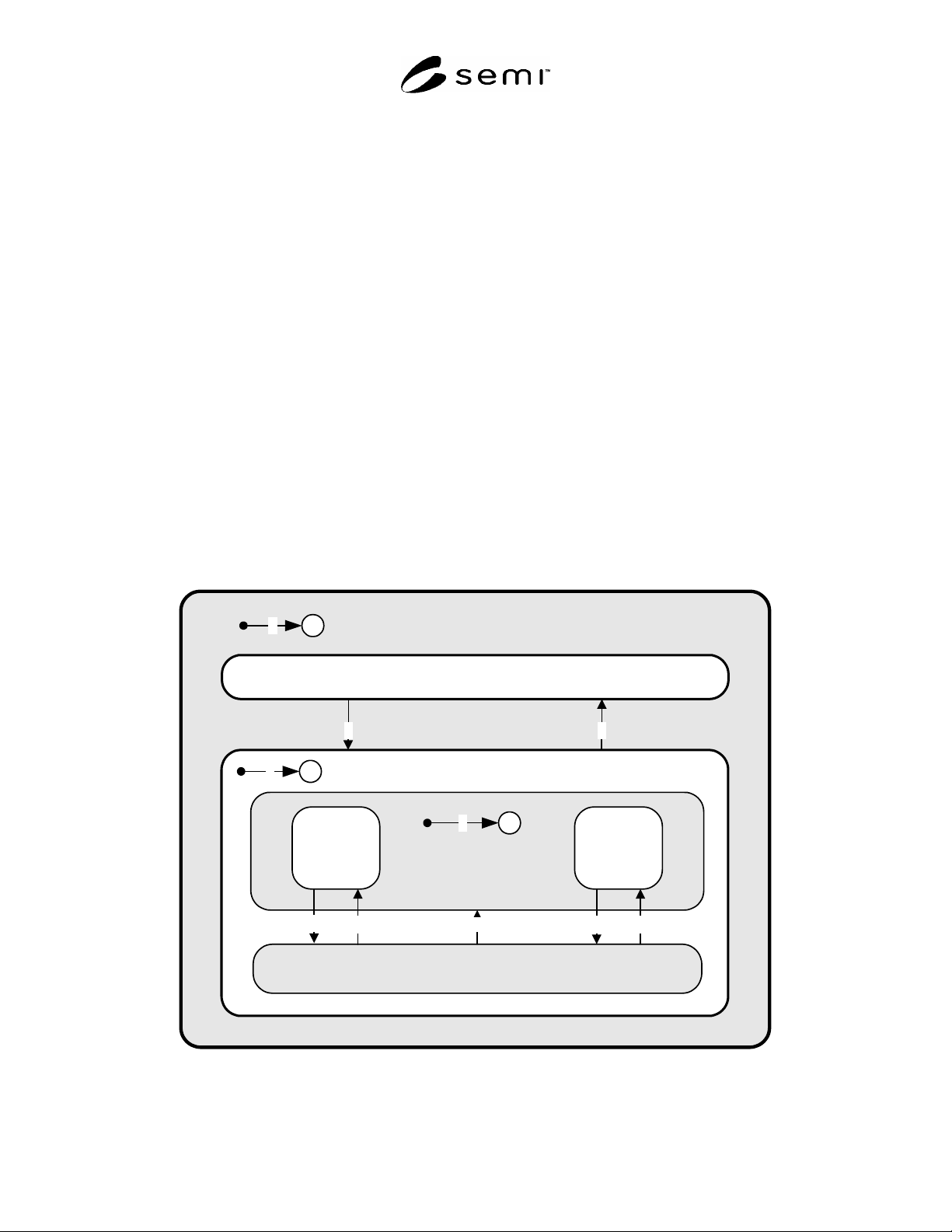
SEMI E87-0705 © SEMI 1999, 2005 8
9.5.3 Load Port Transfer State Definitions
9.5.3.1 LOAD PORT TRANSFER — The super state for the IN SERVICE and OUT OF SERVICE states.
9.5.3.2 OUT OF SERVICE — Transfer to/from this load port is disabled. A transition to IN SERVICE is required to
continue using this load port for transfers.
9.5.3.3 IN SERVICE — Transfer to/from this load port is enabled. A transition to OUT OF SERVICE disables the
load port for transfer use.
9.5.3.4 TRANSFER READY — A sub-state of IN SERVICE. The load port is available for carrier transfer. The
transfer can either be manual or automated, and can be a load or an unload. This state contains two sub-states, which
are used depending on whether or not a carrier is present on the load port (READY TO LOAD and READY TO
UNLOAD).
9.5.3.5 READY TO LOAD — A sub-state of TRANSFER READY. When transitioning to the TRANSFER READY
state, if a carrier is not present on the specified load port, this is the active sub-state. In this state, the load port is
available to be loaded with an external carrier, or with a carrier that is currently located inside the equipment (i.e.
internal buffer).
9.5.3.6 READY TO UNLOAD — A sub-state of TRANSFER READY. When transitioning to the TRANSFER
READY state, if a carrier is present on the specified load port, this is the active sub-state. In this state, the load port
is available for unloading of a carrier from the loadport to material handling equipment. When the load port is being
used by the equipment, the state shall transition to TRANSFER BLOCKED.
9.5.3.7 TRANSFER BLOCKED — The carrier transfer state is neither READY TO LOAD nor READY TO
UNLOAD. Because of load port related activity being performed, transfer is not available to/from this load port at
this time.
LOAD PORT TRANSFER
OUT OF SERVICE
IN SERVICE
TRANSFER BLOCKED
TRANSFER READY
READY TO
LOAD
READY TO
UNLOAD
2 3
6
8 97
10
4
C
5 C
1
H
Figure 2
Load Port Transfer State Model Diagram

SEMI E87-0705 © SEMI 1999, 2005 9
9.5.4 Load Port Transfer State Transition Table
Table 5 Load Port Transfer State Transition Definition
Num Previous State Trigger New State Actions Comments
1 (no state) System reset. OUT OF
SERVICE
or
IN SERVICE
(History)
This transition is based on what the current
transfer status was prior to system reset.
Data required to be available for this event
report:
PortID
PortTransferState
2 OUT OF
SERVICE
The host or an operator has
invoked the ChangeServiceStatus
service for this load port with a
value of IN SERVICE.
IN SERVICE Load port is now usable for transfer.
Data required to be available for this event
report:
PortID
PortTransferState
3 IN SERVICE The host or an operator has
invoked the ChangeServiceStatus
service for this load port with a
value of OUT OF SERVICE.
OUT OF
SERVICE
Load port is now rendered unusable for
transfer. Attempted usage of the load port
for carrier transfer after the state transition
results in an alarm.
Data required to be available for this event
report:
PortID
PortTransferState
4 IN SERVICE Service: The host or an operator
has invoked the
ChangeServiceStatus service for
this load port with a value of IN
SERVICE.
System Reset: This transition can
be activated by an equipment re-
initialization.
TRANSFER
READY
or
TRANSFER
BLOCKED
This is the default entry into IN SERVICE.
The state is TRANSFER BLOCKED if the
carrier, or load port, is not available for
carrier transfer. Otherwise, the state is
TRANSFER READY.
Data required to be available for this event
report:
PortID
PortTransferState
5 TRANSFER
READY
Service: The host or an operator
has invoked the
ChangeServiceStatus service for
this load port with a value of IN
SERVICE.
System Reset: This transition can
be activated by an equipment re-
initialization.
Failed Transfer: If a transfer fails,
this transition is activated by
transition #10.
READY TO
LOAD
or
READY TO
UNLOAD
When entering the TRANSFER READY
state, if a carrier is present, the sub-state is
READY TO UNLOAD, else the sub-state
is READY TO LOAD.
If the state is READY TO LOAD, data
required to be available for this event
report:
PortID
If the state is READY TO UNLOAD, data
required to be available for this event
report:
PortID
CarrierID
PortTransferState

SEMI E87-0705 © SEMI 1999, 2005 10
Num Previous State Trigger New State Actions Comments
6 READY TO
LOAD
Manual: The equipment recognizes
the logical indication of the start of
a manual load transfer. This trigger
is configurable by the user,
examples are included in Table 8.
Automated: The PIO load transfer
is beginning and the PIO
“READY” signal is activated (see
SEMI E84).
Internal Buffer: A CarrierOut
service has started for this load
port.
TRANSFER
BLOCKED
When a CarrierOut service is queued and
the equipment load port is currently in the
TRANSFER BLOCKED state, the
equipment shall keep the load port in the
TRANSFER BLOCKED state.
Data required to be available for this event
report:
PortID
PortTransferState
7 READY TO
UNLOAD
Manual: The equipment recognizes
the logical indication of the start of
a manual unload transfer. This
trigger is configurable by the user,
examples are included in Table 8.
Automated: The PIO unload
transfer is beginning and the PIO
“READY” signal is activated (see
SEMI E84).
Internal Buffer: A CarrierIn
service has started for this load
port.
By CarrierReCreate Service: A
CarrierReCreate service command
has been issued by host or
operator.
TRANSFER
BLOCKED
When a CarrierOut service is queued and
the equipment load port is currently in the
TRANSFER BLOCKED state, the
equipment shall keep the load port in the
TRANSFER BLOCKED state.
Data required to be available for this event
report:
PortID
PortTransferState
8 TRANSFER
BLOCKED
Manual: The carrier unload
transfer has completed, and the
load port is now empty and ready
for load transfer. This is indicated
when two conditions are met, the
presence signal indicates that no
carrier is present and the operator
has logically indicated that the
transfer is complete.
Automated: The PIO unload
transfer ends with the PIO
“COMPT” signal (see SEMI E84).
Internal Buffer: The carrier has
finished its move from the load
port into the internal buffer, and no
CarrierOut services are queued for
this load port.
READY TO
LOAD
A carrier can now be loaded onto the load
port from either an external entity, or by
the equipment’s internal material handling
resource.
Data required to be available for this event
report:
PortID
PortTransferState