semi合集-English.pdf - 第2769页
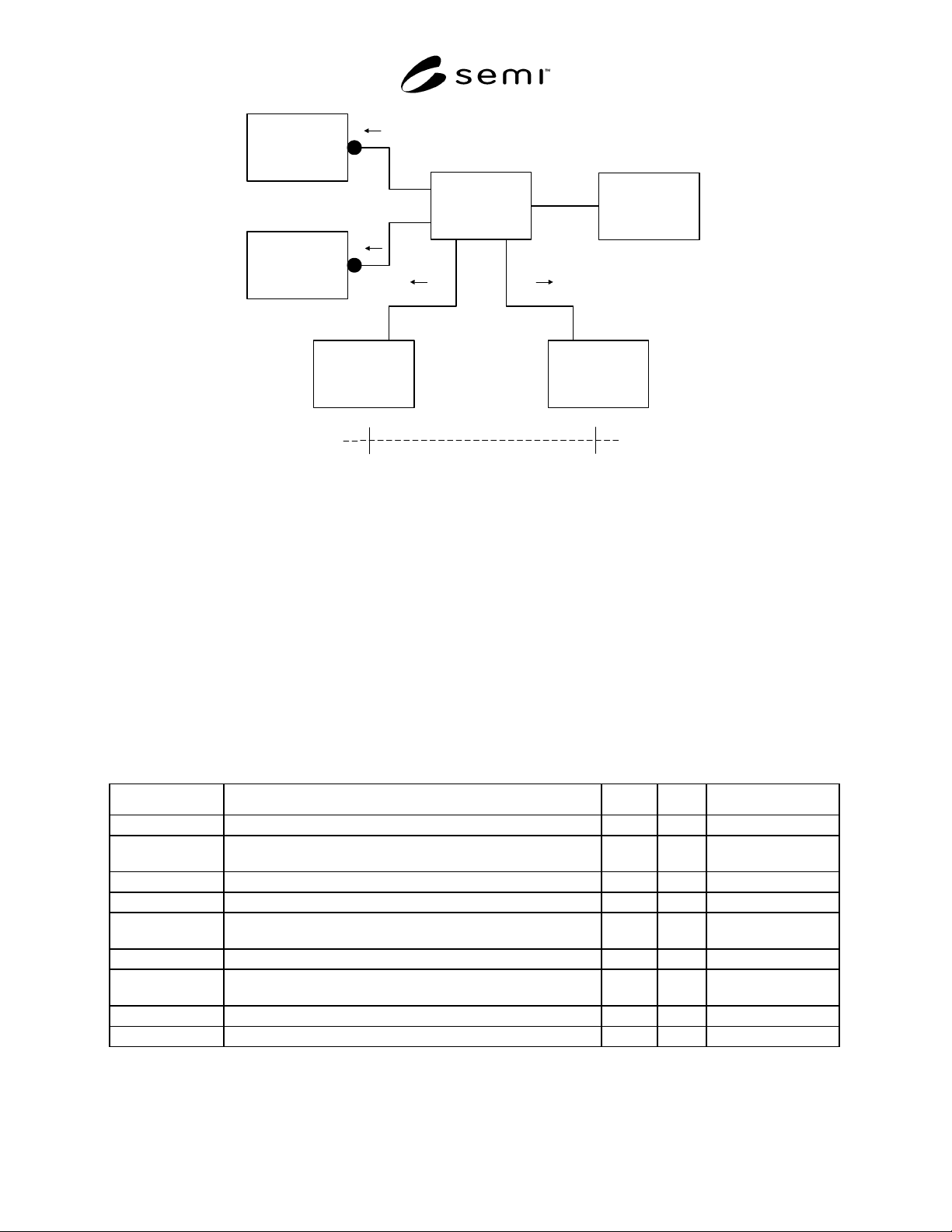
SEMI E98-1102 © SEMI 2000, 2002 34 A ccess Manager Factory Interface Security Human Interface Command Interpreter Equipment 1+ 1+ one or more of each ty pe has has manages access manages access Figure 24 Access Managemen…

SEMI E98-1102 © SEMI 2000, 2002 33
10.6.6.3 Operational Services
10.6.6.3.1 Abort — The user may direct the Equipment
to abort its operations at any time. The Equipment shall
stop all activity as soon as possible while maintaining
the safety of the product, the Equipment itself, and
people. Product is not returned to the carriers.
10.6.6.3.2 Cleanup — When product is left in the
Equipment following an abort operation, it may be
necessary to request the Equipment to return all
substrates to their carriers.
10.6.6.3.3 Pause — The user may request the
Equipment to pause its operations. The Equipment is
responsible for determining the appropriate points
within its process where it is safe to temporarily stop.
As with the Stop command above, the multi-module
Equipment may direct individual EquipmentModules to
Pause one at a time.
10.6.6.3.4 Resume — This command directs the
Equipment to resume normal operations from the
PAUSED state.
10.6.6.3.5 Start — The Start command directs the
Equipment to begin an activity that is already setup and
ready. Its use is not intended for automatic processing
by Equipment providing Process Job capabilities.
10.6.6.3.6 Stop — The user may direct the Equipment
to stop activity at any time. The Equipment shall be
responsible for ensuring that all of its components stop
their activities in an orderly fashion at the first
opportunity. Processing shall be completed for all work
in process (e.g., substrates that have already been
removed from their input carrier), but no processing
shall be started for remaining work.
For Equipment with multiple EquipmentModules
performing individual process steps in a sequence of
steps, a Stop command to the Equipment is equivalent
to issuing a Stop command to the first
EquipmentModule in the sequence, followed by
subsequent Stop commands to each EquipmentModule
once it has accepted the substrate last started.
10.6.6.4 Time Services — This section describes the
services provided by the clock.
10.6.6.4.1 Request Date and Time — The user shall be
able to read the equipment’s current date and time as a
numeric value.
10.6.6.4.2 Set Date and Time
10.6.6.4.2.1 If UseNet is disabled, the user shall be
able to set the current date and time as a numeric value.
Note that this method does not generally give good
synchronization results.
10.6.6.4.2.2 Set Date and Time shall not cause a
discontinuity in timestamps for data associated with an
individual substrate in process.
10.6.6.4.3 Request Formatted Date and Time — The
user shall be able to read the equipment’s current date
and time as a formatted text string.
10.6.6.4.4 Set Formatted Date and Time — If UseNet
is disabled, the user shall be able to set the current date
and time as a formatted text string. Note that this
method does not generally give good synchronization
results.
10.6.6.4.5 Synchronize Date and Time — The user may
request the equipment to synchronize date and time
from the network as soon as it can do so without
disrupting the timestamp series for any work in process.
11 OBEM Equipment Functional Requirements
11.1 The functional areas of the equipment are
described in the Functional View in Section 8.3.
Section 11 defines the requirements for each of these
functional areas. These are requirements at the level of
the Equipment object, in addition to those specified in
Section 10.
11.2 Access Management
11.2.1 Access Management is responsible for all
communications with the user, including local
operators, factory systems, and remote users. As
illustrated in Figure 24, the equipment may be required
to support multiple users, with at least one connection
to the factory and at least one interface to the local
operator. Where automation is used for material
handling, more than one human interface will be
required.
11.2.2 Objects shown in Figure 24 are not standardized
objects. Further work is required to determine
requirements for standardized objects to support access
management.
11.2.3 Arbitration — This section is reserved.
11.2.4 Authorization — This section is reserved.
SEMI E98-1102 © SEMI 2000, 2002 34
Access
Manager
Factory
Interface
Security
Human
Interface
Command
Interpreter
Equipment
1+ 1+
one or more
of each type
has
has
manages
access
manages
access
Figure 24
Access Management Model
11.2.5 Multiple Operator Interfaces
11.2.5.1 The equipment shall support a minimum of two user interfaces, one that is dedicated to factory system
communications and one that is dedicated for local operations.
11.2.5.2 Equipment may support additional interfaces as well. Equipment handling large wafers (300 mm diameter
or more) may be required to provide a second operator interface away from the traditional interface at the front. The
factory may require separate connections for direct communications with AMHS and/or advanced process control.
The equipment supplier’s customer service may need remote access for diagnostics.
11.2.6 Remote Dial-in — This section is reserved for requirements for remote dial-in using a modem.
11.2.7 Access Attributes — Table 16 defines the attributes of the Access Object.
Table 16 Access Session Configuration Data
Attribute Name Definition Access Reqd Form
Authorization Level of authorization specifies user access. RO Y Equipment-specific
FDControl User may detect a probable fault and instruct that no new work be
started.
RO Y Boolean
FormatCode Indicates the code used for interpretation of text. RW Y Enumerated
Language Indicates the preferred language for text. RW Y Enumerated
Recipe Access The user may request recipe upload, download, and other recipe-
access requests.
RW Y Enumerated
R2Rcontrol User may issue instructions for run-to-run control. RO Y Boolean
MaterialControl User may issue instructions related to loading and unloading
carriers.
RO Y Boolean
OperationsControl User may issue operational instructions. RO Y Boolean
UserID Identification of the user RO Y Text
11.3 Date/Time Management — Equipment shall have an OBEM-compliant Clock with sufficient resolution to
differentiate the order in which events occur. (See Section 12.)

SEMI E98-1102 © SEMI 2000, 2002 35
11.3.1 Timestamp Data — Date/time information is
used by the factory for a variety of purposes, including
analysis of historical data. Should time change
significantly during processing, the assumed ordering
of events can be affected so that later events appear
earlier, large unexplained gaps can appear in a sequence
of events, or data can seem to appear from the past. For
these reasons, any change in current time shall not be
applied to material in the middle of a process.
11.3.2 Date/Time Values — Date and Time information
shall be expressed as a numeric value.
11.3.3 Local Time Change — Where local time
changes automatically, the equipment is responsible for
maintaining the correct difference between local time
and Greenwich Mean Time (GMT) in the Clock
attribute GMTDelta.
11.3.4 Optional Timestamp Format — The equipment
shall provide an option for the user to include the value
of GMTDelta as an additional field in timestamps. The
user may enable and disable use of GMTDelta by
setting and clearing the Boolean Clock attribute
UseDelta.
11.4 Equipment Control — Control is divided into
several areas: Fault Detection Control, Run to Run
Control, Material-Control, and Operational Control.
Control of each of these four areas shall be assigned to
exactly one user at any point in time. However, that
user may be the same for one or more of these areas.
11.4.1 Advanced Process Control (APC) — Two
categories of APC are described herein: run-to-run
control (between lots, carriers, or substrates), and fault-
detection control. Support for APC may be required at
the EquipmentModule level.
11.4.2 Run-to-Run Control (R2R) — The factory may
dedicate a separate session for Run-to-Run Control.
Run-to-run control consists of adjusting Variable
Parameter settings of Process Recipes within a process
job.
11.4.3 Fault Detection Control (FDC)
11.4.3.1 Fault detection is able to detect a probable
fault before it can be detected by SPC, equipment
failure, or product failure. The user may provide fault
detection through analysis of process data in
conjunction with data from external sensors.
11.4.3.2 A separate dedicated session may be used for
fault detection control because of its need for large
amounts of data. FDC may instruct the Equipment to
put itself into a downtime state as soon as it completes
work currently in process.
11.5 Event Management — Equipment shall provide
standard mechanisms for notifying the user of events of
interest to the user, together with any data the user has
associated with specific events.
11.6 Exception Management — The equipment shall
comply with SEMI E41 (EMS).
11.7 Job Management — This section is reserved for
requirements related to specifications for managing
jobs. Jobs are defined by SEMI E94 Control Job
Management and by SEMI E40 Process Management.
11.8 Material I/O Management — Material I/O
Management allows the user to request services related
to management of the carrier ports and internal buffers
required for managing the movement of product
through the factory (material logistics). Equipment
shall comply with the fundamental requirements of
SEMI E87 (CMS).
11.9 Material Management
11.9.1 Material Management is responsible for all
material present at the equipment from the time it is
loaded from the factory until it is unloaded. This
includes tracking of all material that is identifiable.
11.9.2 The location of all material that is mobile, such
as product, shall be known at all times. The factory
may inquire about what material is currently present
and where (at what MaterialLocation) that material is
placed.
11.9.3 Consumables that are not mobile; such as gold
wire on a wire-bonder, may be identified by lot number.
The equipment may be required to store current lot
numbers for non-mobile material when that information
is provided by the factory.
11.9.4 Equipment shall comply with the fundamental
requirements for SEMI E90 (STS).
11.10 Operational Control — The user with Operation
Control may issue operational commands related to
starting, stopping, process job management, and recipe
access, including upload, download, and recipe
selection.
11.11 Object Management
11.11.1 This section is reserved for requirements
concerning data and information.
11.11.2 Object Management is responsible for
providing all data and information required by the
factory through Object Services.
11.12 Performance Management — As a type of
AbstractEquipmentModule, the equipment shall con-
form to the Operational State Model defined in Section
10.5.5 and compliance to SEMI E58 (ARAMS).