semi合集-English.pdf - 第583页
SEMI E79-0304 © SEMI 1999, 2004 17 Non-Sche duled Schedu led and Unscheduled Downtime Standby Engineering DEE Losses Theoretical Production Time for Effective Units No Product Time Equipment Down No Prod uct Time Plan ne…

SEMI E79-0304 © SEMI 1999, 2004 16
A2-2 Additional Productivity Metrics Involving
Denominators Other Than Total Time
A2-2.1 This section presents three productivity metrics
for assessing efficiency of the equipment resource
relative to a time frame less than total time.
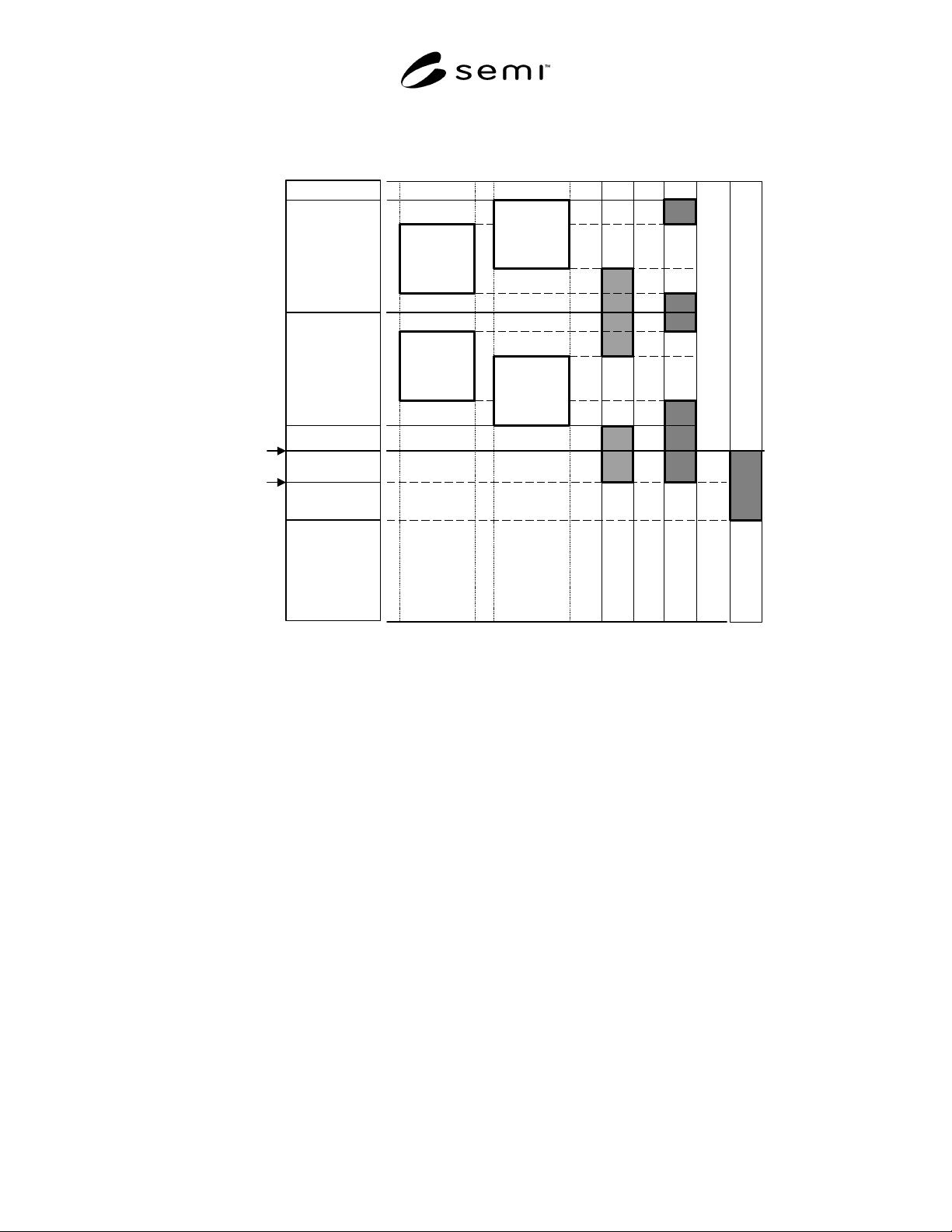
A2-2.2 Production Equipment Efficiency and Demand
Equipment Efficiency exclude portions of no product
time from productivity losses, as depicted in Figure A2-
2. While the idle time due to no product is excluded
from the operational losses in these particular measures
of equipment efficiency, the user should be aware that
the additional productivity losses due to sub-optimal
load or batch sizes may also be present as rate
efficiency losses. Such losses, which result from
fluctuations in product flow or tool loading policies, are
considered in any equipment efficiency calculation that
uses theoretical time per unit.
A2-2.3 Production Equipment Efficiency (PEE)
A
measure of equipment productivity during the time that
work is available to process at the tool. One application
of PEE is to measure the productivity of non-constraint
tools, which are expected to have periods of idle time
due to lack of available work.
Production Equipment Efficiency (PEE)
= (Theoretical Production Time for Effective Units)
/[(Operations Time) - (No Product Time)
- (Equipment Down No Product Time)]
= Overall Equipment Efficiency × Total Time
/[(Operations Time) - (No Product Time)
- (Equipment DownNo Product Time)]
A2-2.3.1 Sample Production Equipment Efficiency
(PEE) Calculation
Production Equipment Efficiency (PEE)
= (146 hours)/[(168 hours) - (6 hours) - (4 hours)]
= 0.9241
A2-2.4 Demand Equipment Efficiency (DEE) A
measure of equipment productivity during the time that
work is planned to be available to process at the
equipment. A factory model or production schedule
that defines the expected or planned idle time at the
equipment is required to calculate Demand Equipment
Efficiency. DEE measures the productivity of the
equipment relative to the requirements of the factory
model or production schedule.
Demand Equipment Efficiency (DEE)
= (Theoretical Production Time for Effective Units)
/[(Operations Time) - (Planned No Product Time)]
= Overall Equipment Efficiency × Total Time
/[(Operations Time) - (Planned No Product Time)]
A2-2.4.1 Sample Demand Equipment Efficiency (DEE)
Calculation
Demand Equipment Efficiency (DEE)
= (146 hours)/[(168 hours) - (8 hours)]
= 0.9125
A2-2.5 Intrinsic Equipment Efficiency (IEE)
A
measure of equipment productivity that compares
value-added, in-process theoretical production time to
the actual production time. IEE measures the combined
productivity losses due to rate efficiency losses, recipe
design, and equipment design.
Intrinsic Equipment Efficiency (IEE)
= [
∑
i
(Actual Units of Recipe i × VTHT
i
)]
/(Production Time)
where VTHT
i
= value-added in-process theoretical production
time per unit for recipe i. See Section A2-1.3.
A2-2.5.1 Sample Intrinsic Equipment Efficiency (IEE)
Calculation
Production Time = 155.00 hours
Intrinsic Equipment Efficiency (IEE)
= [∑
i
(Actual Units of Recipe i × VTHT
i
)]
/(Production Time)
= [(1500 units × 0.01000 hr/unit)
+ (600 units × 0.00500 hr/unit)
+ (800 units × 0.01000 hr/unit)
+ (500 units × 0.0050 hr/unit)]/(155 hours)
= 0.1839
SEMI E79-0304 © SEMI 1999, 2004 17
Non-Scheduled
Scheduled
and
Unscheduled
Downtime
Standby
Engineering
DEE
Losses
Theoretical
Production
Time for
Effective Units
No Product
Time
Equipment
Down
No Product
Time
Planned
No Product
Time
(Downtime)
PEE
Losses
Value-Added
In-Process
Theoretical
Production
Time for
Actual Units
IEE
Losses
Planned
No Product
Time
(Standby)
Production Time
No Product
Time
(Planned)
No Product
Time
(Actual)
Figure A2-2
Productivity Losses Included in PEE and DEE, and IEE Metrics (shaded regions)
NOTICE: SEMI makes no warranties or representations as to the suitability of the standard set forth herein for any
particular application. The determination of the suitability of the standard is solely the responsibility of the user.
Users are cautioned to refer to manufacturer’s instructions, product labels, product data sheets, and other relevant
literature respecting any materials mentioned herein. These standards are subject to change without notice.
The user’s attention is called to the possibility that compliance with this standard may require use of copy-righted
material or of an invention covered by patent rights. By publication of this standard, SEMI takes no position
respecting the validity of any patent rights or copyrights asserted in connection with any item mentioned in this
standard. Users of this standard are expressly advised that determination of any such patent rights or copyrights, and
the risk of infringement of such rights, are entirely their own responsibility.
SEMI E79-0304 © SEMI 1999, 2004 18
RELATED INFORMATION 1
GUIDELINES FOR DETERMINING THEORETICAL PRODUCTION TIME
PER UNIT
NOTICE: This related information is not an official part of SEMI E79. This related information was approved for
publication by vote of the responsible committee on December 15, 1999.
R1-1 Background
R1-1.1 Overall Equipment Efficiency (OEE) is
computed in terms of the theoretical production time
per unit for each recipe performed. This theoretical time
per unit is based on the actual recipe, the actual
equipment design in use, and an assumed load size that
optimizes equipment throughput (expressed in units of
output per hour) for that recipe.
R1-1.2 OEE is intended to express the true efficiency
of the equipment resource. A score of 50% OEE
indicates that exactly half of the maximum productive
potential of the equipment resource is being realized; a
score of 100% indicates that no further increase in
productivity is feasible, taking the existing process
recipes and equipment design as given.
R1-1.3 To accurately calculate OEE in turn requires
that theoretical production times per unit be accurately
defined. In particular, theoretical production times per
unit shall be defined so that the speed losses are always
non-negative, i.e.,
Speed Losses
= (Production Time) - (Theoretical Production Time for
Actual Units) ≥ 0
R1-1.4 According to now-classical industrial
engineering practice, standards for ideal performance
are determined by application of the following:
• Break work methods down into their operational
elements (hereafter simply referred to as elements).
• Study each of these elements separately to
determine its ideal duration.
• Design a new ideal method offering the shortest
sequence of only the necessary elements (where the
term “sequence” as used herein may involve
parallel performance of some or all elements).
R1-1.5 It is remarked that even when the durations of
all elements are ideal, if the sequence of elements is not
ideal, ideal overall performance cannot be achieved.
Based on this understanding, theoretical processing
time for an equipment recipe shall be based on both an
ideal element sequence as well as ideal durations for all
elements.
R1-2 Modeling Operational Element
Sequences
R1-2.1 A graphical model of the sequence of
operational elements comprising the performance of an
equipment recipe can be helpful for determining
theoretical production time per unit. This model has the
following components:
R1-2.2 Resource Utilization Chart — a Gantt chart
displaying a separate timeline for each primary resource
within the equipment. Utilization sequences displayed
for each primary resource may be used to show how
each resource within an equipment system is utilized,
and how resources may interact.
R1-2.3 Operational Element — An operational
element occurring within a utilization sequence is
depicted by a box-shaped bar with a label. The time for
this element to execute may be fixed, recipe-dependent,
or calculated from parameters. Operational elements
that are not related to material handling operations have
a thick outline.
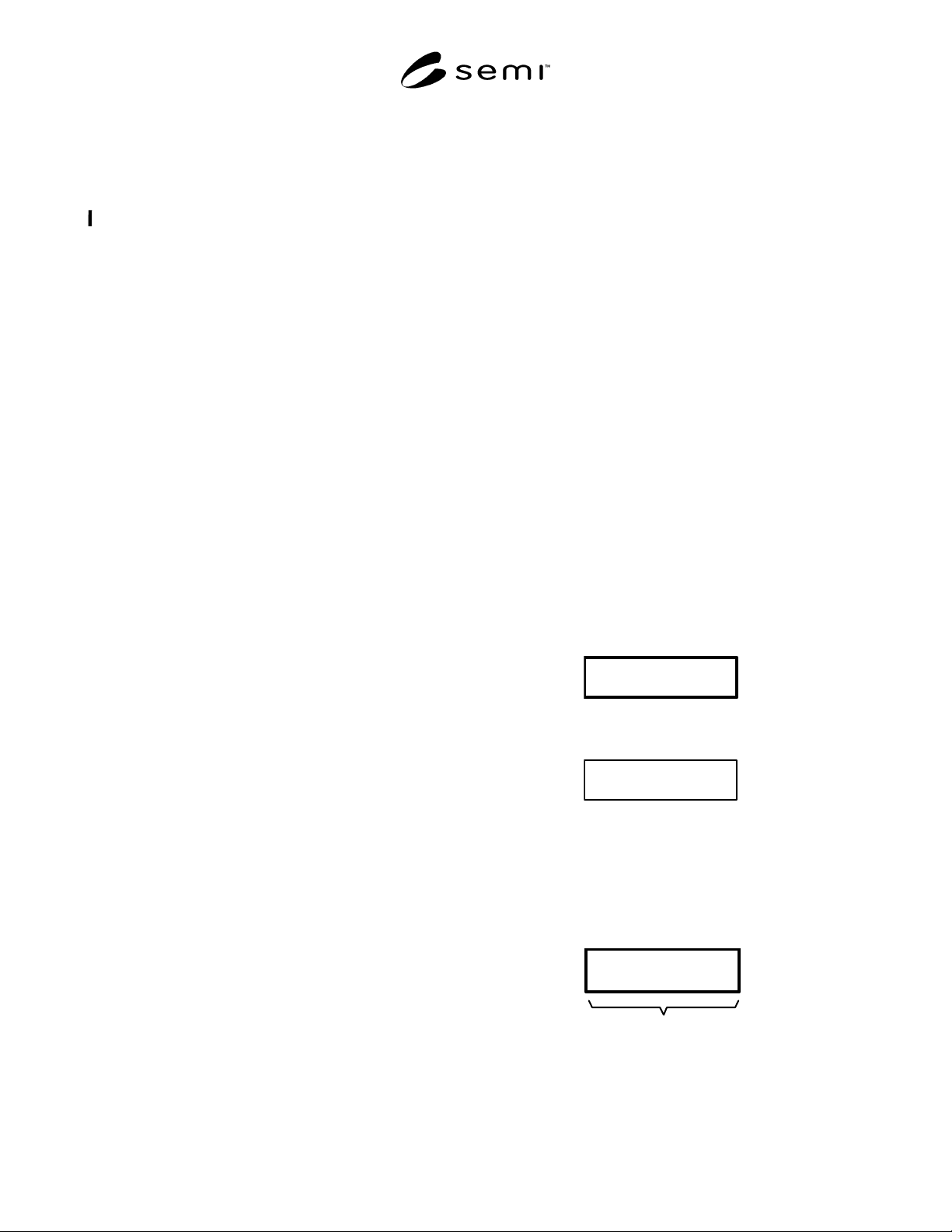
Operational Element
R1-2.3.1 Material handling elements have a thin
outline.
Material Handling
Operational Element
R1-2.4 Repeated Groups — A bracket underneath a
group of operational elements indicates that the group
repeats multiple times based on the parameter shown.
For elements that occur conditionally, the number of
repetitions may be zero. These repetitions apply to all
elements in all timelines positioned in the vertical range
of the bracket.
Repeated
Operational Element(s)
x (# repetitions)
R1-2.5 Sub-Sequences — A number in front of an
element label indicates that the element represents a