semi合集-English.pdf - 第1637页
SEMI E38-1296 © SEMI 1995 , 1996 26 Modules that require m ore than one recipe class for an execution cycle shall support m ulti- part recipes. That is, the ability to select multip le recipes in a single pro cess job re…

SEMI E38-1296 © SEMI 1995, 199625
The cluster controller may direct recovery of error
conditions using the EXRecover service. The module
resource performs the recovery action and reports its
completion using the EXRecoveryComplete service.
The module resource is only required to permit a single
recovery action at a time on all set exception
conditions, but may support multiple recovery actions.
The module resource shall support the
EXRecoveryAbort service, which ceases any activity
and terminates the recovery action.
Exception condition object attributes required to be
accessible through object services:
Attribute Name Description: Requirements
ObjType The object type: EXCEPTION.
EXID Identifier for the exception condition.
EXType Type of exception condition:alarm or
error condition.
EXMessage Text message describing the
abnormal situation monitored.
EXEnabled Indicates reporting to decision
authority enabled/disabled.
EXRecActList Possible recovery actions (none for
alarms).
EXStateList All concurrent substates of the
exception.
Exception management messaging services required:
Message Name Description: Requirements
EXPost Notify/update on abnormal situation.
EXCleared Notify resolution of abnormal
situation.
EXRecover Command to perform recovery
action.
EXRecoveryComplete Notify completion of recovery action.
EXRecoveryAbort Command to abort a recovery action.
Reporting of all exception conditions is set to be
enabled on establishment of an association, and those in
the set state are posted.
Module resource capabilities required, but not already
specified above:
• Reject incomplete, invalid, and unsupported
requests.
Module resource capabilities permitted, but not to be
required, by a service-user:
• Multiple concurrent recovery actions.
• Dynamic update of exception condition message
and valid recovery actions.
8.5 Recipe Management Services — Recipe
management across a cluster tool module
communications interface is achieved using the recipe
management services. These services provide the
communications and behavior required of the module
by the recipe models described in Section 7.1.6 of this
document.
The recipe management services follow SEMI E42
(Recipe Management Standard). Cluster tool module
communications require full compliance with the
information, behavior, and messaging services of the
fundamental requirements of a recipe executor, and
optionally the recipe namespace management, as
defined in that standard.
The module requiring recipe services contains a recipe
executor that is capable of performing recipe download,
verification, selection, deselection, and deletion as
requested by the cluster controller. The module may
also support recipe namespace services.
In certain configurations, the module may require
recipe management services to be provided by the
cluster controller, in order that it may request a selected
recipe that is not stored locally. The module is the
service-user in this case, and the cluster controller
should support the necessary recipe namespace
services.
The module coordinates the activities of the processing
resource and the recipe executor to ensure the
appropriate recipes are loaded into the execution area
for material processing.
Recipe executor object attributes required to be
accessible through object services:
Attribute Name Description
ObjType The object type: “RcpExec”
ObjID Identifier for the recipe executor
DefaultNamespace Namespace for all hardware-dependent
recipes
RecipeSelectID List of recipe identifiers for the currently
selected recipe
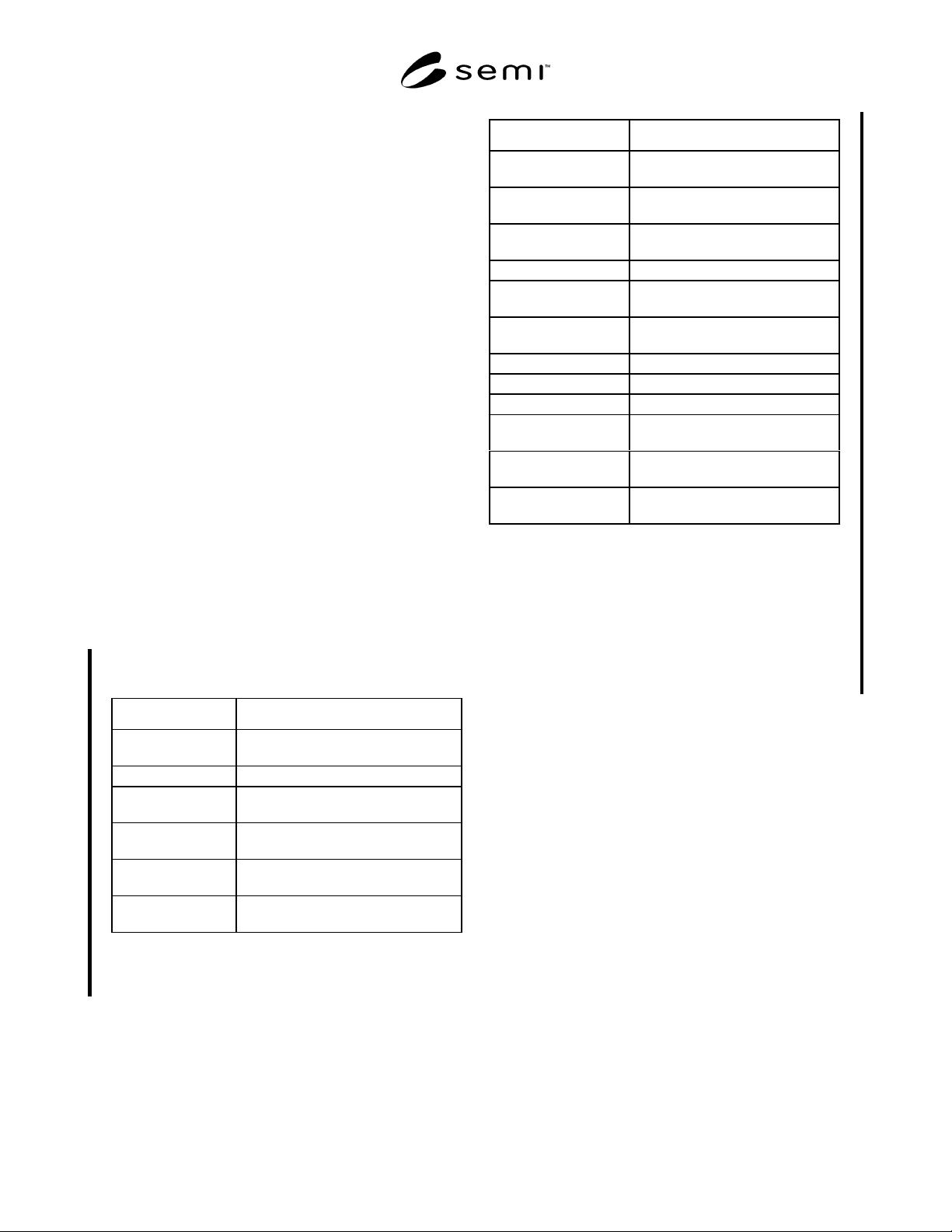
Recipe management messaging services required:
Message Name Description: Requirements
RMEDnldVer Receive a recipe, optionally verify it, and
put it into storage
RMEDelete Delete a recipe from storage
RMESelect Select recipes for execution
RMEDeselect Deselect a recipe to prevent its execution
RMEComplete Notify service-user of completion of an
action
SEMI E38-1296 © SEMI 1995, 1996 26
Modules that require more than one recipe class for an
execution cycle shall support multi-part recipes. That is,
the ability to select multiple recipes in a single process
job request is not supported in processing management.
Recipe executor capabilities required and not already
specified above:
• Reject incomplete, invalid, and unsupported
requests
Recipe executor and module capabilities permitted by
not to be required by a service-user:
• Support for variable parameters (attributes and
select service),
• Support for multi-part recipes,
• Upload a recipe,
• Support recipe namespace services for local recipe
management,
• Local editing.
8.6 Event Reporting Services — Event reporting
services are to be supported in accordance with the
models described in Section 7.1.7. Both event-based
reporting and tracing are required. Support for user-
defined reports is not required.
Event reporting for CTMC-compliant modules shall be
based on services as described in SEMI E53.
8.6.1 The attributes defined in the following table shall
be supported by CTMC compliant modules.
Attribute Name Description: Requirements
ObjID The identifier for Data Reports, Event
Reports, and Trace Reports.
DataReportList List of data report identifiers.
Enabled A flag which controls generation of
Event and Trace Reports.
SamplePeriod Time delay between samples in a Trace
report.
TotalSamples Maximum number of samples to
include in a Trace report.
GroupSize Number of samples to include before
sending a report to a service user.
8.6.2 Support for the following messages from SEMI
E53 shall be provided.
Message Name Description: Requirements
EventReportRequest User can ask for a report to be
generated and sent.
EventReportSend Provider generates and sends report
on an event.
DataReportCreate Define attributes to be sampled for a
report.
DataReportDelete Delete report definitions
DataReportRequest User requests sample and send of a
report.
CollectionEventLink Link data reports to a collection
event.
CollectionEventUnlink Unlink a data report
TraceReportCreate Define a trace report
TraceReportDelete Delete trace report definitions
TraceReportRequest User requests a sample and send of a
trace data.
TraceReportSend Service provider sends a trace report
to the user.
TraceReportReset A trace reporting is set to its IDLE
state.
8.6.3 Support for dynamic and user defined reports is
optional. However, implementations which support
these advanced capabilities, shall comply with the
specifications of SEMI E53 and SEMI E39. SEMI E39
service messages shall use the optional object specifier
arguments, such as EvtSrcSpec. Object services can
then be used to interrogate objects for their reportable
attributes.
8.7 Clock Services — The clock services provide for
synchronization of the clocks on the modules with that
of the cluster controller. These services provide the
communications required of the appropriate module
resources through defining the clock object.
The clock services are fully specified in terms of the
clock attributes accessed through the get and set
services of SEMI E39 (Object Services Standard:
Concepts, Behavior, and Services). Cluster tool module
communications require full compliance with the
information, behavior, and messaging services of the
fundamental requirements of that standard.
The clock object is uniquely identified for the module.
Table 3 describes the attributes of the clock object. The
identifier of the clock used for communications services
is defined. The clock attribute Time is kept current and
used to determine the value of the timestamp used in
service messages. The module returns the current Time
when it receives a get.
The clock time is synchronized by using the object set
service on the Time attribute. On receipt of a set

SEMI E38-1296 © SEMI 1995, 199627
request, the module performs the operations necessary
to set the clock to the value supplied, within its
resolution, from which it shall continue immediately.
The DateTime attribute of the Clock object as used in
Clock Services has a resolution in the range of seconds
to centiseconds. If it is possible to specify the DateTime
accurate to centiseconds, then centiseconds should be
specified. If it is not possible to resolve time to less than
a second, then centiseconds shall be reported as “00.”
This requirement is for the reporting of the DateTime
attribute of the Clock object in Clock Services only;
other services may require greater resolution, in which
case the Clock Services DateTime attribute resolution
shall also be greater.
8.8 Required Services — Within a standards-compliant
Cluster Tool, a number of services must be supported,
at least to the fundamental requirements level. Due to
the specialization of the modules in a Cluster Tool as
detailed in the concepts section above, each module
type only needs to support a subset of the service
groups as shown in the message flow diagrams.
The services requirements for each module controller
are described in this section. An example of use of
services by a cluster controller is also given.
8.8.1 Transport Module Controller
• Material transfer functions for the end-to-end
establishment of material movement within the
cluster (supported through the Material Movement
services). Material transfer is set up through a
Transfer Job requested of the transport module by
the service-user (e.g., cluster controller).
• Material Handoff between the process and cassette
modules and the transport module (supported
through the Material Movement services).
• Exception capabilities to post and manage
exception conditions within the transport module
(supported through the Exception Management
services).
• Reporting of module variable data linked to events
to the service-user (supported through the Event
Reporting services).
• Access to standard objects of the specific services
above as required by the service-user (supported
through the Object services).
8.8.2 Cassette Module Controller
• Material I/O functions for the management of
moving cassettes in and out of the cluster as well as
for moving material between the cassette module
and the transport module (supported through the
Material Movement services). Material I/O is set
up through a Transfer Job requested of the cassette
module by the service-user (e.g., cluster
controller).
• Material Handoff between the cassette module and
the transport module (supported through the
Material Movement services).
• Exception capabilities to post and manage
exception conditions within the transport module
(supported through the Exception Management
services).
• Reporting of module variable data linked to events
to the service-user (supported through the Event
Reporting services).
• Access to standard objects of the specific services
above as required by the service-user (supported
through the Object services).
8.8.3 Process Module Controller
• Material processing functions (supported through
the Processing Management services). Processing
is specified through a Process job requested of the
process module by the service-user (e.g., cluster
controller).
• Recipe Management to verify and transfer recipes
between the process module and the service-user
(supported through the Processing Management
services).
• Material I/O functions for the management of
moving material in and out of the process module
(supported through the Material Movement
services). Material I/O is set up through a Transfer
job requested of the process module by the service-
user (e.g., cluster controller).
• Material Handoff between the process module and
the transport module (supported through the
Material Movement services).
• Exception capabilities to post and manage
exception conditions within the transport module
(supported through the Exception Management
services).
• Reporting of module variable data linked to events
to the service-user (supported through the Event
Reporting services).
• Access to standard objects of the specific services
above as required by the service-user (supported
through the Object services).
8.8.4 Example Cluster Controller
• Scheduling and primary module control.
Schedules Transfer and Process jobs in order to