semi合集-English.pdf - 第3400页
SEMI E132.1-0305 © SEMI 2005 27 8.2.12.1.3 DeleteACLEntry Response 8.2.12.1.3 .1 The service response i s mapped t o the XML Sc hema elem ent DeleteACLEntry Response of type DeleteACLEnt ryResponse. Table 36 shows how th…
SEMI E132.1-0305 © SEMI 2005 26
8.2.11.2 WSDL Message(s)
8.2.11.2.1 Three messages are defined for this operation corresponding to the SEMI E132 Header, Request and
Response messages. See the message definitions for “E132HeaderMessage”, “AddACLEntryRequestMessage”, and
“AddACLEntryResponseMessage” in E132-SecurityAdmin-PortType.wsdl. Key information is shown for
convenience in Table 32.
Table 32 AddACLEntry Messages
Message Name
Schema
Element Name
E132HeaderMessage auth:E132Header
AddACLEntryRequestMessage auth:AddACLEntryRequest
AddACLEntryResponseMessage auth:AddACLEntryResponse
8.2.11.3 WSDL Operation
8.2.11.3.1 See the portType operation definition for “AddACLEntry” in E132-SecurityAdmin-PortType.wsdl. Key
information is shown for convenience in Table 33.
Table 33 AddACLEntry PortType Operation
Input Message Name
AddACLEntryRequestMessage
Output Message Name AddACLEntryResponseMessage
8.2.11.4 WSDL Operation Binding
8.2.11.4.1 See the operation binding for “AddACLEntry” in E132-SecurityAdmin-Binding.wsdl. Key information
is shown for convenience in Table 34.
Table 34 AddACLEntry Operation Binding
SOAPAction
urn:semi-org:ws.E132-1.V0305.secAdmin-binding:AddACLEntry
Input Headers (WSDL Message, Required) E132HeaderMessage, required
Output Headers (WSDL Message, Required) E132HeaderMessage, required
8.2.12 DeleteACLEntry Operation
8.2.12.1 XML Schema Types
8.2.12.1.1 This section describes the XML mappings for the classes defined in SEMI E132 for the DeleteACLEntry
operation. See GetDefinedPrivileges operation regarding schema conventions used.
8.2.12.1.2 DeleteACLEntry Request
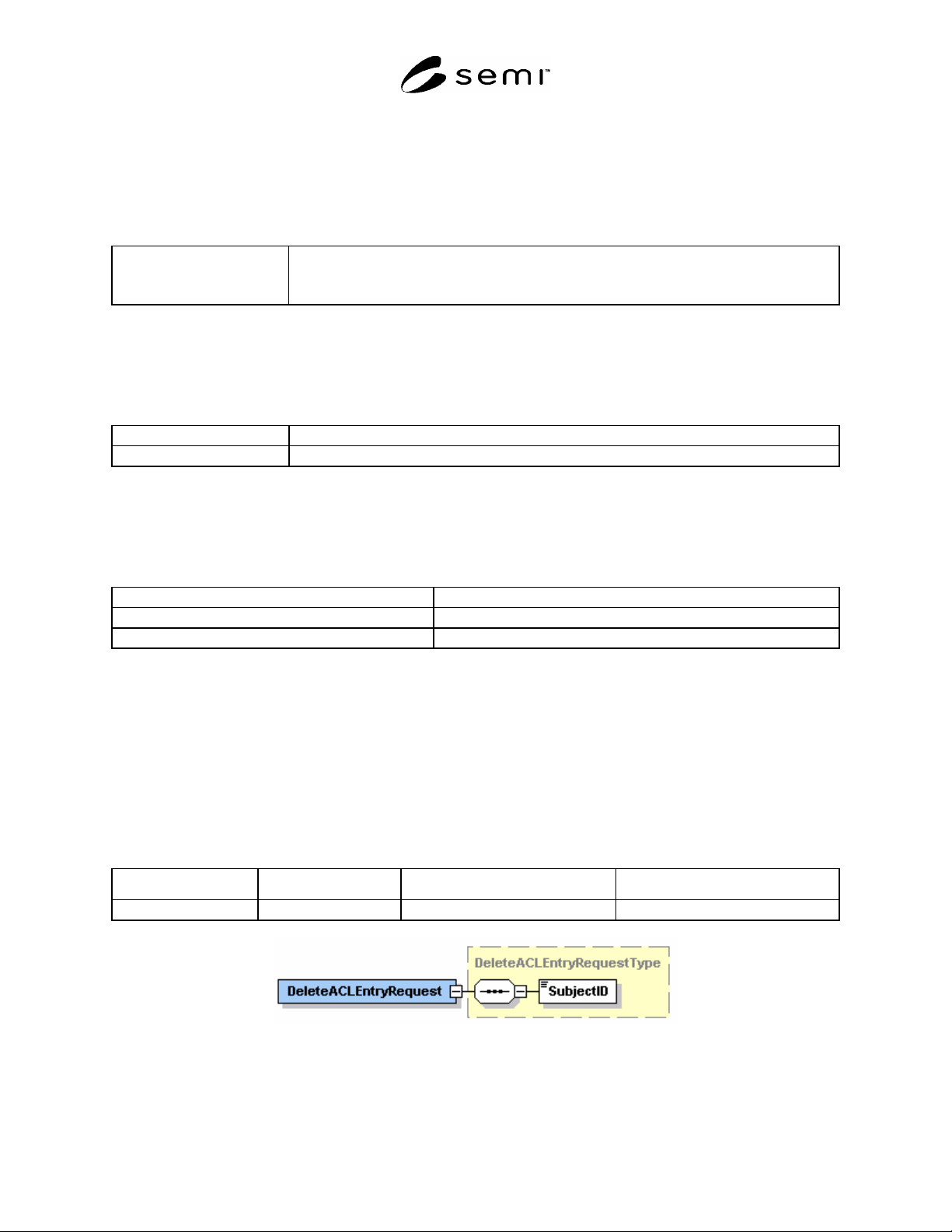
8.2.12.1.2.1 The service request is mapped to the XML Schema element DeleteACLEntryRequest which is of type
DeleteACLEntryRequestType. Table 35 shows how the input parameters are mapped to XML.
Table 35 Translation Table for DeleteACLEntry Input Parameters
Argument Name Format XML Element or Attribute XML Name/Type
subjectId Structured type Element SubjectID: xsd:string
Figure 23
DeleteACLEntryRequest XML Schema Element
SEMI E132.1-0305 © SEMI 2005 27
8.2.12.1.3 DeleteACLEntry Response
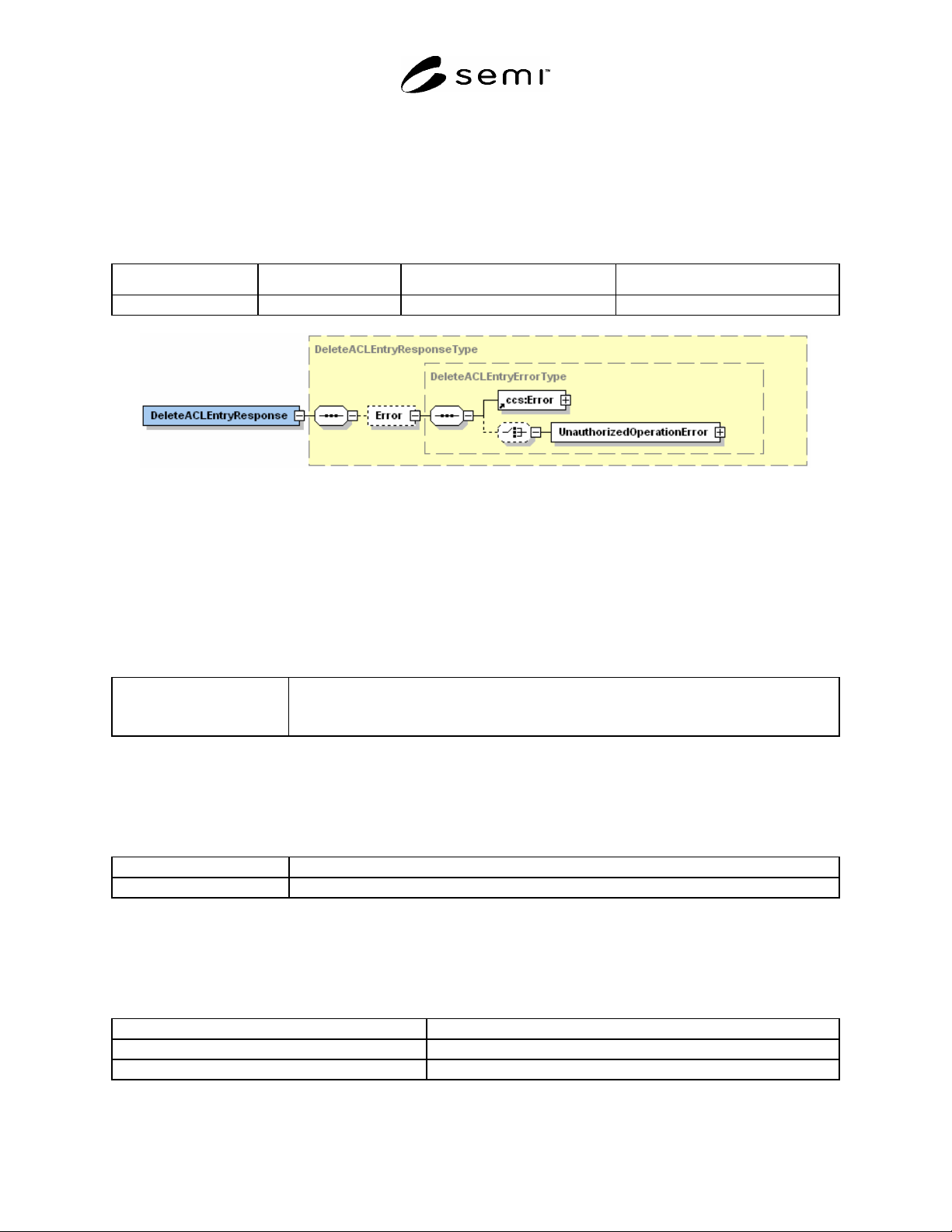
8.2.12.1.3.1 The service response is mapped to the XML Schema element DeleteACLEntryResponse of type
DeleteACLEntryResponse. Table 36 shows how the output parameters are mapped to XML. The XML Schema
diagram for DeleteACLEntryResponse is shown in Figure 24. Errors for this operation are returned using the XML
Schema element Error of type GetACLErrorType. The error type is the same as that defined for the
GetDefinedPrivileges operation described in ¶8.2.9.1.5.
Table 36 Translation Table for DeleteACLEntry Output Parameters
Argument Name Format XML Element or Attribute XML Name/Type
error Structured data Element Error: DeleteACLEntryErrorType
Figure 24
DeleteACLEntryResponse XML Schema Element
8.2.12.2 WSDL Message(s)
8.2.12.2.1 Three messages are defined for this operation corresponding to the E132Header, Request and Response
messages. See the message definitions for “E132HeaderMessage”, “DeleteACLEntryRequestMessage”, and
“DeleteACLEntryResponseMessage” in E132-SecurityAdmin-PortType.wsdl. Key information is shown for
convenience in Table 37.
Table 37 DeleteACLEntry Messages
Message Name
Schema
Element Name
E132HeaderMessage auth:E132Header
DeleteACLEntryRequestMessage auth: DeleteACLEntryRequest
DeleteACLEntryResponseMessage auth: DeleteACLEntryResponse
8.2.12.3 WSDL Operation
8.2.12.3.1 See the portType operation definition for “DeleteACLEntry” in E132-SecurityAdmin-PortType.wsdl.
Key information is shown for convenience in Table 38.
Table 38 DeleteACLEntry PortType Operation
Input Message Name
AddACLEntryRequestMessage
Output Message Name AddACLEntryResponseMessage
8.2.12.4 WSDL Operation Binding
8.2.12.4.1 See the operation binding for “DeleteACLEntry” in E132-SecurityAdmin-Binding.wsdl. Key
information is shown for convenience in Table 39.
Table 39 DeleteACLEntry Operation Binding
SOAPAction urn:semi-org:ws.E132-1.V0305.secAdmin-binding:DeleteACLEntry
Input Headers (WSDL Message, Required) E132HeaderMessage, required
Output Headers (WSDL Message, Required) E132HeaderMessage, required
SEMI E132.1-0305 © SEMI 2005 28
8.2.13 GetActiveSessions Operation
8.2.13.1 XML Schema Types
8.2.13.1.1 This section describes the XML mappings for the classes defined in SEMI E132 for the
GetActiveSessions operation. See GetDefinedPrivileges operation regarding schema conventions used.
8.2.13.1.2 GetActiveSessions Request
8.2.13.1.2.1 The service request is mapped to the XML Schema element GetActiveSessionsRequest of type
GetActiveSessionsRequestType. There are no input parameters for this operation.
Figure 25
GetActiveSessionsRequest XML Schema Element
8.2.13.1.3 GetActiveSessions Response
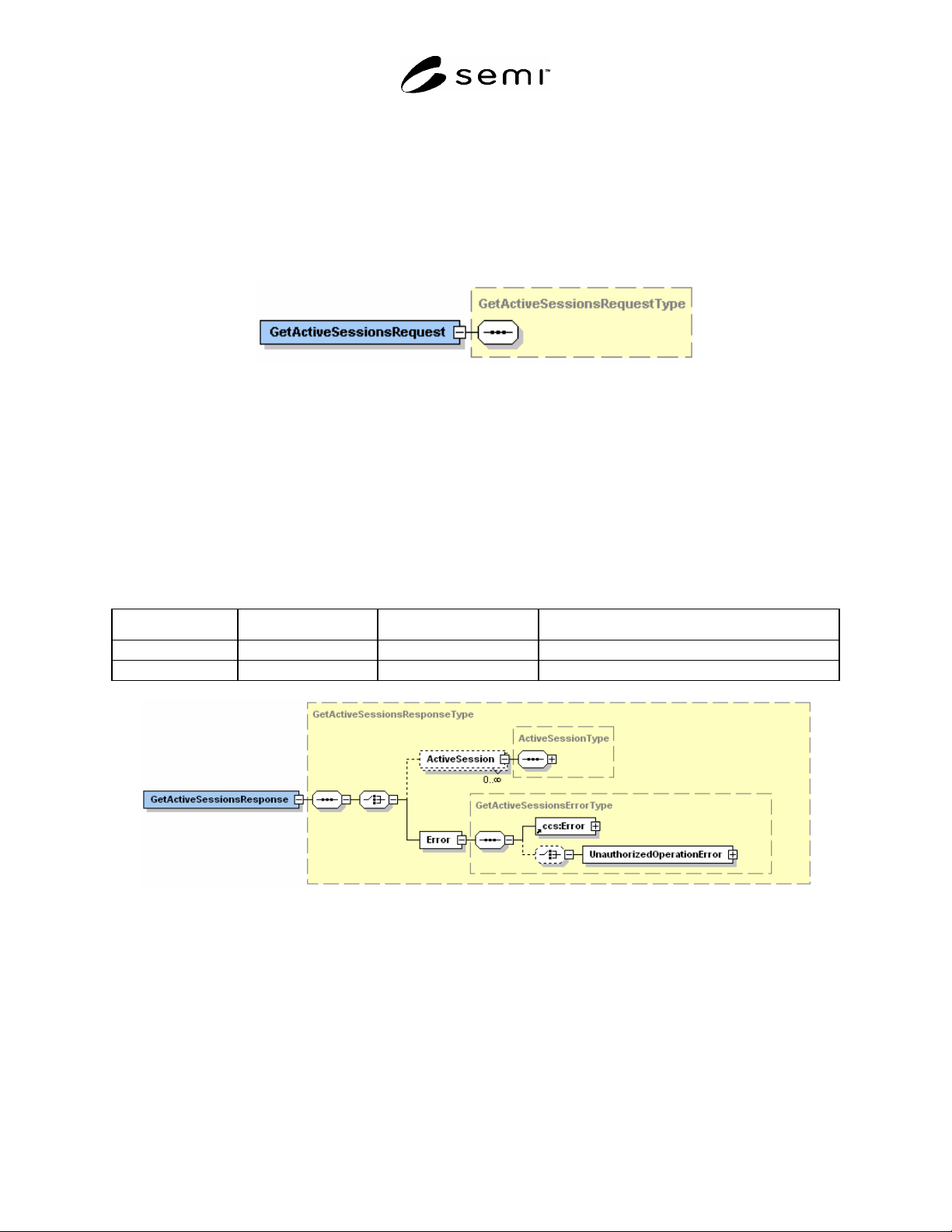
8.2.13.1.3.1 The service response is mapped to the XML Schema element GetActiveSessionsResponse of type
GetActiveSessionsResponseType. Table 40 shows how the output parameters are mapped to XML. The XML
Schema diagram for GetActiveSessionsResponse is shown in Figure 26. The ActiveSession class is described in
¶8.2.13.1.4. Errors for this operation are returned using the XML Schema element Error of type
GetActiveSessionsErrorType. The error type is the same as that defined for the GetDefinedPrivileges operation
described in ¶8.2.9.1.5.
Table 40 Translation Table for GetActiveSessions Output Parameters
Argument Name Format XML Element or Attribute XML Name/Type
activeSessions Unordered list Element ActiveSession: ActiveSessionType (one or more)
error Structured data Element Error: GetActiveSessionsErrorType
Figure 26
GetActiveSessionsResponse XML Schema Element
8.2.13.1.4 ActiveSession Class
8.2.13.1.4.1 The ActiveSession class is mapped to the XML ActiveSessionType. Table 41 shows how the attributes
and associations of ActiveSession class are mapped to XML. The XML Schema diagram is shown in Figure 27.
The association with the EndPoint class is modeled as an XML element of type EndPointSelectorType, and
currently has but one choice defined for allowed derived class, the HTTPEndPointType which contains just an URL.