semi合集-English.pdf - 第6929页
SEMI S8-0705 © SEMI 1995, 2005 26 Table R1-3 A w kward Postures b y Body Part Body Part Awkward Posture #1 (angle in degrees from neutral) Comments Image Upper Extremities 1. Shoulder flexion > 45 Shoulder flexion is …
SEMI S8-0705 © SEMI 1995, 2005 25
R1-2 Neutral and Awkward Postures
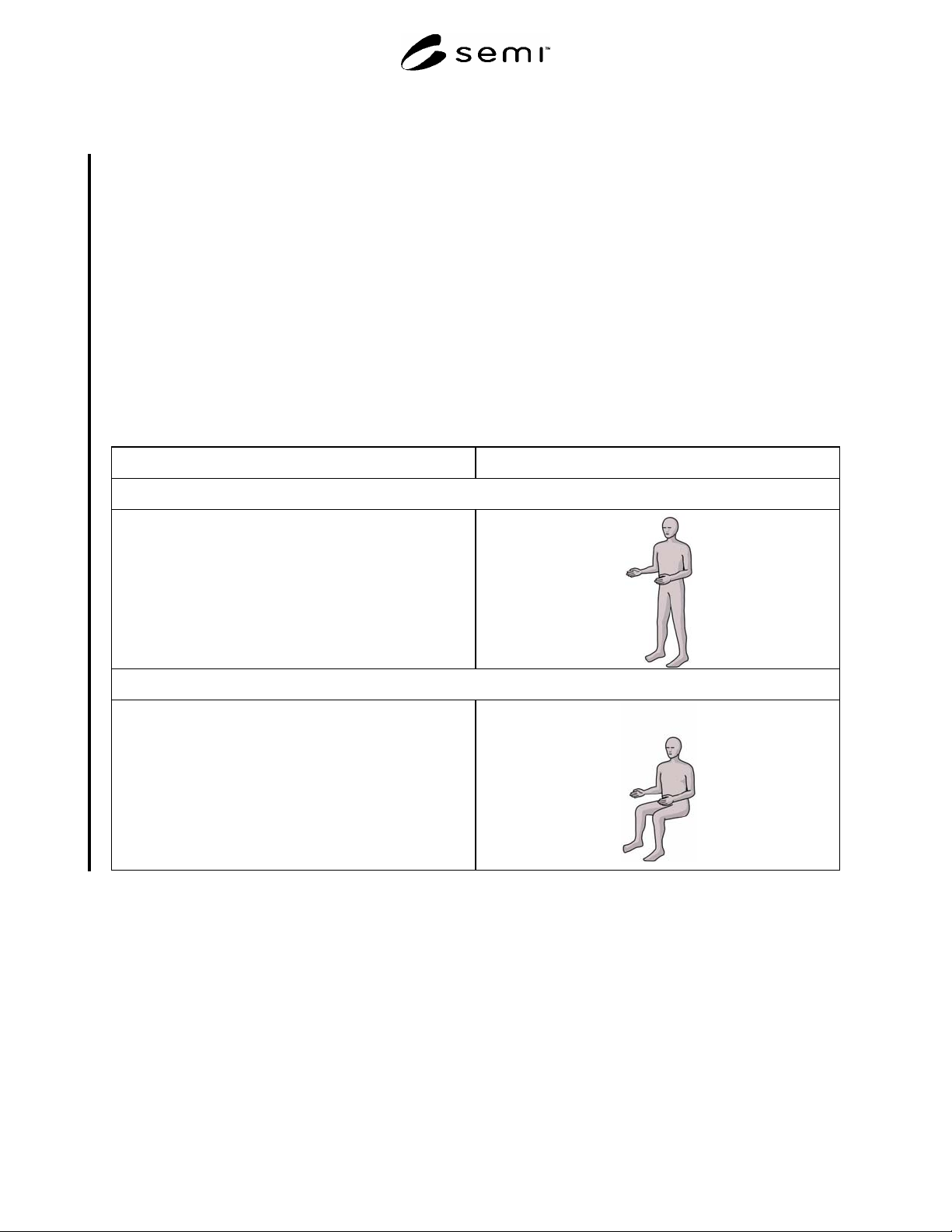
R1-2.1 An important concept in the field of ergonomics is the “neutral posture”. A neutral posture is the body
position that minimizes stresses on the joints and is the posture where a person has the greatest strength potential.
The neutral posture for each joint is near the middle of its range of motion. Generally, the body in its neutral
position is standing erect with the eyes looking forward, and the arms hanging by the sides, as defined by ¶5.2.25.
R1-2.2 Neutral postures are shown for standing and seated tasks in Table R1-2. The joint angles of these neutral
postures are used as the origin when measuring angular deviations of body part(s) to determine if a posture is
awkward.
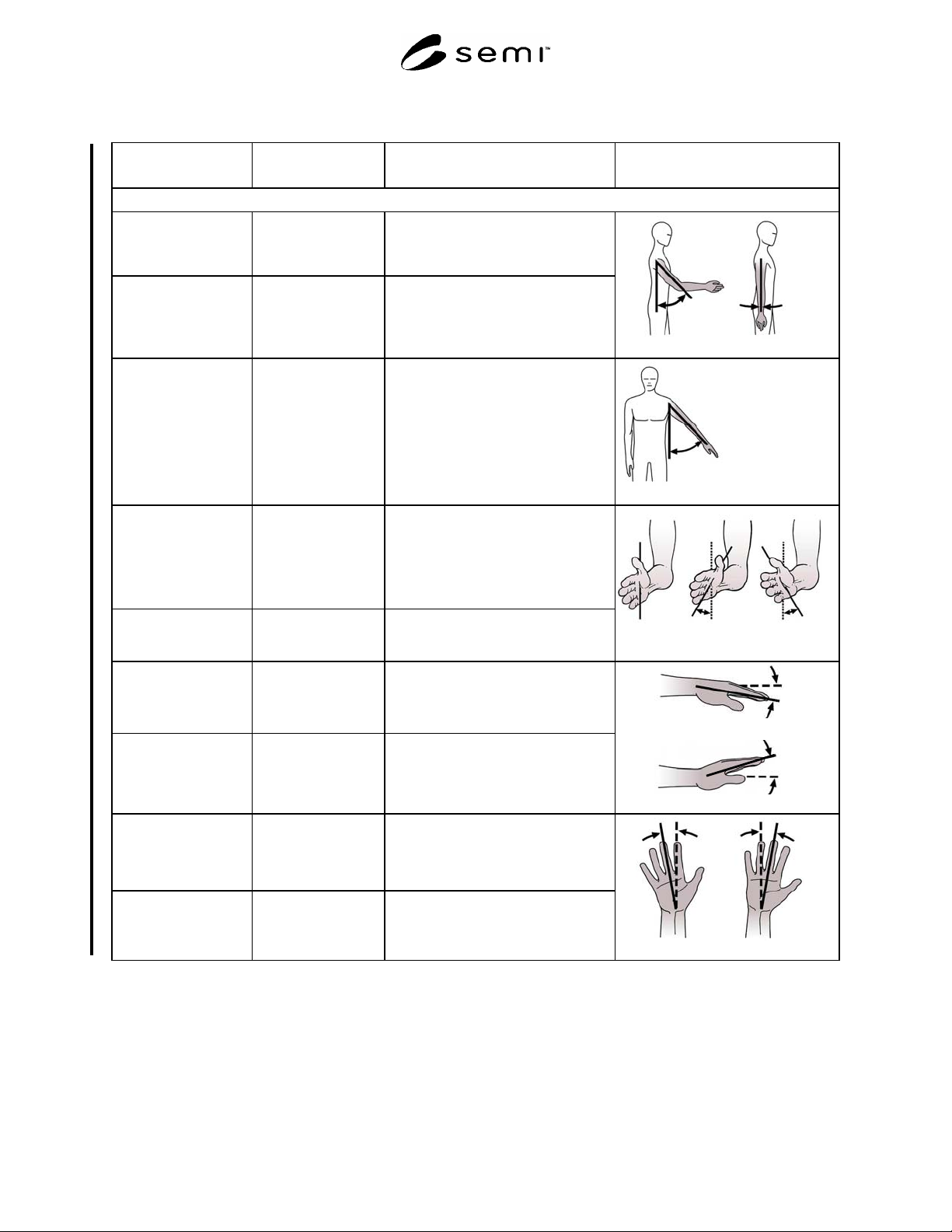
R1-2.3 When the body is in a non-neutral posture, potential strength and efficiency decrease. Table R1-3 depicts
selected awkward postures. Angular deviations of the body part(s) from a neutral posture are shown for the
appropriate joint(s).
R1-2.4 It is not always practicable to design equipment and tasks so that personnel remain in neutral postures. The
intent of these tables is to show the neutral postures for reference and the awkward postures that, according to the
normative portions of this document (e.g., ¶6.1.1 and ¶A2-1.2) should be avoided.
Table R1-2 Neutral Postures for Standing and Seated Tasks
Posture Image
Standing Task
Arms loosely at the sides with the shoulders relaxed
Forearms parallel with the floor
Hands in the “handshake” position
Back has a natural “S” curve
Knees slightly bent
Feet are shoulder-width apart, pointing slightly outward
Head looking forward and slightly downward
Seated Task
Arms loosely at the sides with the shoulders relaxed
Forearms parallel with floor
Hands in the “handshake” position
Back has a natural “S” curve
Knee angle greater than 95 degrees
Feet are shoulder-width apart, pointing slightly outward
Head looking forward and slightly downward
SEMI S8-0705 © SEMI 1995, 2005 26
Table R1-3 Awkward Postures by Body Part
Body Part
Awkward Posture
#1
(angle in degrees from neutral)
Comments Image
Upper Extremities
1. Shoulder flexion > 45 Shoulder flexion is defined as reach in
front of body mid-line.
2. Shoulder extension > 0 Shoulder extension is defined as reach
behind body mid-line.
1 2
3. Shoulder abduction > 45 Abduction is movement of elbow away
from body.
3
4. Forearm pronation > 30 Pronation is “palm facing down.”
Measured from neutral (handshake)
position.
Note: Forearm pronation is less
stressful than either supination or
forearm rotation about the elbow.
5. Forearm supination > 30 Supination is “palm facing up”.
Measured from neutral (handshake)
position.
Neutral 4 5
6. Wrist flexion > 10 Flexion is closing (reducing) the angle
of the wrist.
7 Wrist extension > 15 Extension is opening (increasing) the
angle of the wrist.
6
7
8. Wrist ulnar
deviation
> 10 Ulnar deviation is bending the wrist in
the direction of the little finger.
9. Wrist radial
deviation
> 10 Radial deviation is bending the wrist in
the direction of the thumb.
8 9
SEMI S8-0705 © SEMI 1995, 2005 27
Body Part
Awkward Posture
#1
(angle in degrees from neutral)
Comments Image
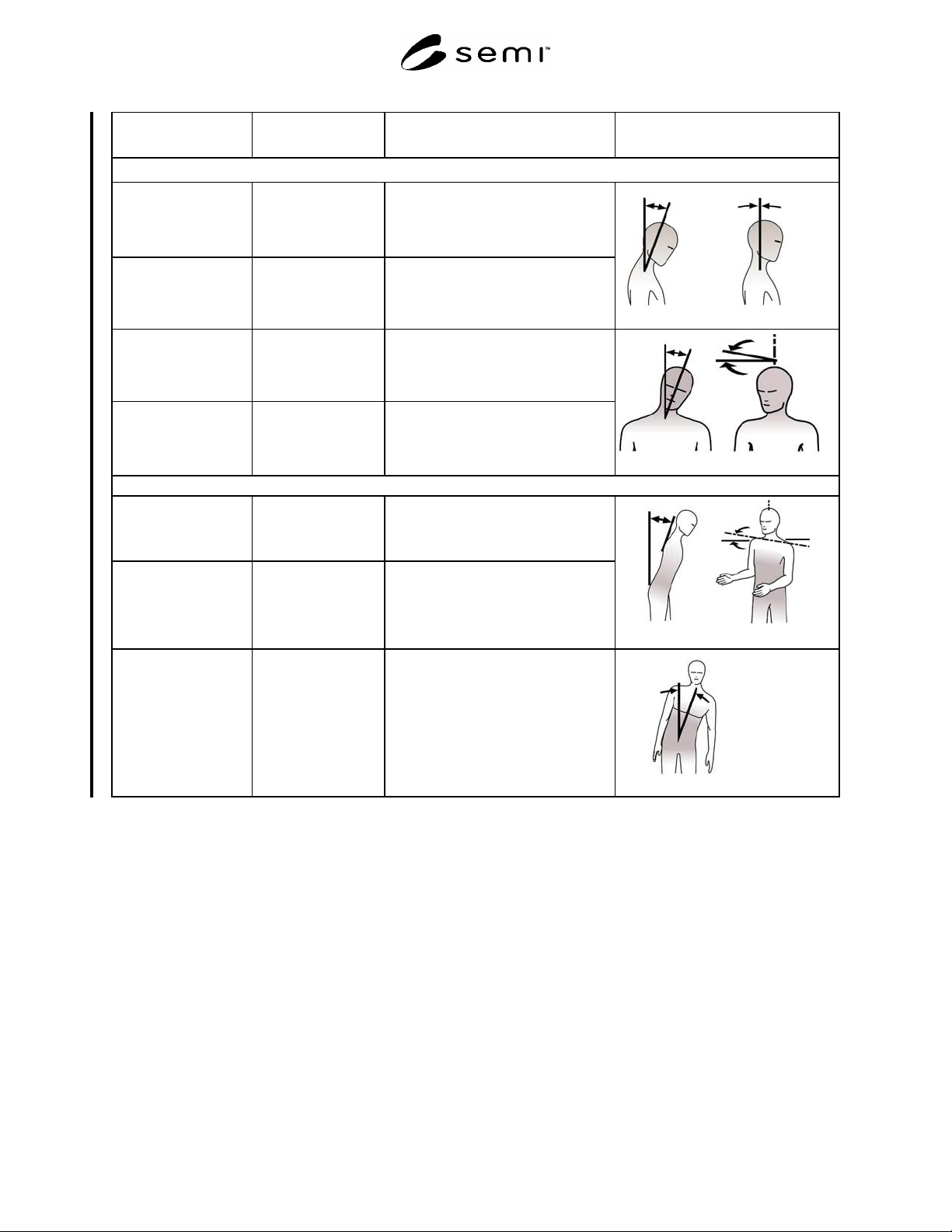
Head / Neck
10. Neck flexion > 20 Neck flexion is bending the neck
forward (e.g., looking downward).
11. Neck extension > 0 Neck extension is bending the neck
back (e.g., looking up).
10 11
12. Neck lateral
flexion
> 20 Neck bent with the ear toward the
shoulder.
13. Head rotation > 45 Neck rotation is turning the neck (e.g.,
looking to the side).
12 13
Back (Standing)
14. Back bend,
forward flexion
> 20 Definition of “Awkward Posture”
applies if posture is static.
15. Back twist > 30 Measured from mid-sagittal plane of
body.
Note: mid-sagittal plane is defined as a
plane line drawn down the mid-line of
the body, perpendicular to the back.
14 15
16. Lateral bend > 20 Bend to the side of the body.
16