semi合集-English.pdf - 第229页
SEMI E34-95 © SEM I 1995 1 SEMI E34-95 GUIDELINE FOR MA SS FLOW DEVICE RETURN NOTICE: This sa fety guideline does not p urport to address all of th e sa fety issues ass ociated with its use. It is th e responsibility of …

SEMI E33-94 © SEMI 1994 6
APPENDICES
The appendices are not an official part of this standard.
However, they contain relevant information for
customizing the basic standards for testing of
semiconductor equipment and facilities, and point out
areas of concern for which no standard currently exists.
A.1 Appendix A: Charged Wafer Testing
Due to overriding microcontamination concerns, non-
static-dissipative wafer carriers must be used during
semiconductor fabrication. It is suggested that any
equipment which handles wafers be tested with wafers
charged to 18 kV/in. The charge generator used for
801-2 testing can be used to charge the wafer. Some
experimentation will be required to determine the best
means to carry out this test. Alternately, the handling
mechanism may be challenged by air or contact
discharge directed to the mechanism.
It is suggested that wafer handlers be designed to
dissipate charge on incoming wafers in a controlled,
non-sparking manner. A simple AM radio tuned
between stations and placed near the handler has been
found to be a good qualitative means to detect sparking.
Sparking will result in pops and static being heard on
the radio.
A.2 Appendix B: ESD Test Methods
Although the contact method of ESD testing has been
found to be much more reproducible than the air
discharge, the air discharge is a more realistic
simulation of possible events that can occur in the
semiconductor factory. Also, the air discharge method
is the only realistic way to test objects that are primarily
fabricated from insulators, such as wet stations and
keyboards.
In addition to testing surfaces that come in contact with
humans and wafers, it is important to test any area of
the equipment that can be exposed to ESD. For
instance, wet stations are composed of assemblies
involving large masses of insulators in proximity to
metallic sensors and controllers. It is possible for the
insulating surfaces to build up charge, which then
sparks to a sensor or controller — all internal to the
equipment itself.
A.3 Appendix C: Future Directions
Items in this section are not requirements of this
standard, but are included to indicate currently ill-
defined goals for further improvements to
semiconductor factory EMC.
A.3.1 Static Charge — Minimization of static charge
promotes cleanliness, and avoids damage to material in
process and reticles.
It is suggested that electrostatic fields be held to under
200 V/cm (500 V/in). This would be applicable to
personnel, wafers, cassettes, cassette boxes, reticles,
reticle boxes, and all equipment and facility surfaces in
proximity to these items as well as all surfaces exposed
to filtered airflow. Measurements shall be made using a
properly-grounded electrostatic field meter in
accordance with its manufacturer's instructions.
A.4 Appendix D: National Requirements
A.4.1 U.S. — Section 5.1.1 Table 1, row 1.2: Radiated
immunity testing outside a shielded enclosure is legally
accomplished by obtaining an experimental license
from the FCC using FCC form 442. The FCC
recommends using techniques such as scanning or
hopping to avoid interference.
A.4.2 Europe — The earth port: Refer to Table 1.6 of
the informative annex to EN 50 082-2 for test
requirements applicable to the earth.
NOTICE: These standards do not purport to address
safety issues, if any, associated with their use. It is the
responsibility of the user of these standards to establish
appropriate safety and health practices and determine
the applicability of regulatory limitations prior to use.
SEMI makes no warranties or representations as to the
suitability of the standards set forth herein for any
particular application. The determination of the
suitability of the standard is solely the responsibility of
the user. Users are cautioned to refer to manufacturer’s
instructions, product labels, product data sheets, and
other relevant literature respecting any materials
mentioned herein. These standards are subject to
change without notice.
The user’s attention is called to the possibility that
compliance with this standard may require use of
copyrighted material or of an invention covered by
patent rights. By publication of this standard, SEMI
takes no position respecting the validity of any patent
rights or copyrights asserted in connection with any
item mentioned in this standard. Users of this standard
are expressly advised that determination of any such
patent rights or copyrights, and the risk of infringement
of such rights, are entirely their own responsibility.
Copyright by SEMI® (Semiconductor Equipment and Materials
International), 3081 Zanker Road, San Jose, CA 95134. Reproduction o
f
the contents in whole or in part is forbidden without express written
consent of SEMI.

SEMI E34-95 © SEMI 19951
SEMI E34-95
GUIDELINE FOR MASS FLOW DEVICE RETURN
NOTICE: This safety guideline does not purport to
address all of the safety issues associated with its use. It
is the responsibility of the users of this guideline to
establish appropriate safety and health practices and
determine the applicability of regulatory limitations
prior to use.
1 Purpose
Mass flow devices (mass flow controllers, mass flow
meters and flow control valves) are used as an integral
part of the chemical delivery system in semiconductor
processing equipment. Many of the chemicals used in
semiconductor processes can be hazardous to
equipment and personnel. Once exposed to these
chemicals, the contaminated mass flow devices can
present a hazard to repair personnel and equipment if
not handled properly.
Implementing the procedures outlined in this guideline
provide a mechanism to reduce the risk associated with
shipping and/or receiving any potentially hazardous
mass flow device used to monitor or control gases or
liquids.
2 Scope
This guideline is intended to:
Recommend and encourage the purging of devices used
with hazardous materials prior to removal to reduce the
risk of handling them.
Alert the recipient of possibly hazardous mass flow
devices to the nature of the hazard.
Establish mechanism for properly identifying and
documenting possibly hazardous mass flow devices by
using an orange tag and a health and safety disclosure
form.
3 Referenced Documents
49 CFR
1
— Title 49 of the Code of Federal
Regulations (CFR)
NFPA 704
2
— Standard System for the Identification
of Fire Hazards of Materials
1 United States Government Printing Office, Washington, D.C. 20402
2 National Fire Protection Association, Batterymarch Park, Quincy,
MA 02269
4 Terminology
4.1 hazardous materials — Those chemicals or
substances that are physical hazards or health hazards
as defined and classified in NFPA 704 whether the
materials are in use or in waste conditions.
4.2 mass flow controller (mfc) — A self-contained
device, consisting of a mass flow transducer, control
valve, and control- and signal-processing electronics,
commonly used in the semiconductor industry to
measure and regulate the mass flow of gas.
4.3 mass flow meter (mfm) — A self-contained device,
consisting of a mass flow transducer and signal-
processing electronics, commonly used in the
semiconductor industry to measure the mass flow of
gas.
4.4 material safety data sheet (msd s) — Written or
printed material concerning a hazardous material which
is prepared in accordance with the provisions of 29
CFR 1910.1200.
4.5 protective container — A sealable plastic bag or
other container which will keep hazardous material
from the mass flow device from contaminating the
outer package. The container should be transparent, if
possible.
4.6 purge — To dilute potentially harmful material in
the mass flow device by flowing an inert gas through
the device. Purging a chemical delivery line containing
a mass flow device with an inert substance is intended
to dilute hazardous materials and reduce the level of the
hazard. To be effective, the inert substance must be able
to reach all points within the chemical delivery system
in sufficient quantity to dilute the hazardous material to
safe levels. The nature of the hazard and the physical
configuration of the chemical delivery system must be
considered when developing a purge procedure.
4.7 safe — Free of conditions that can cause
occupational illness, injury, or death to personnel or
damage to or loss of equipment or property or the
environment.
5 Procedure
5.1 Disclosure Form
• Complete the disclosure form for mass flow device
return.
• Send the completed form via Fax or other suitable
method to the recipient of the mass flow device.
SEMI E34-95 © SEMI 1995 2
• Attach a copy of the form to the exterior of the
shipping container.
• Enclose another copy inside the package attached
to the protective plastic bag containing the mass
flow device during shipment.
• Retain the original form for your records.
5.2 Purging Prior to Removal — Thoroughly purge
the mass flow device following the applicable purge
procedure. Purge procedures are usually unique to the
equipment and installation. Obtain purging procedures
from your facilities manager, corporate safety
department, and/or the equipment manufacturer. If a
formal purge procedure is available, note on the
disclosure form the purge procedure document number
and source.
5.3 Equipment Removal — WARNING: Do not
remove the mass flow device until it has been properly
purged.
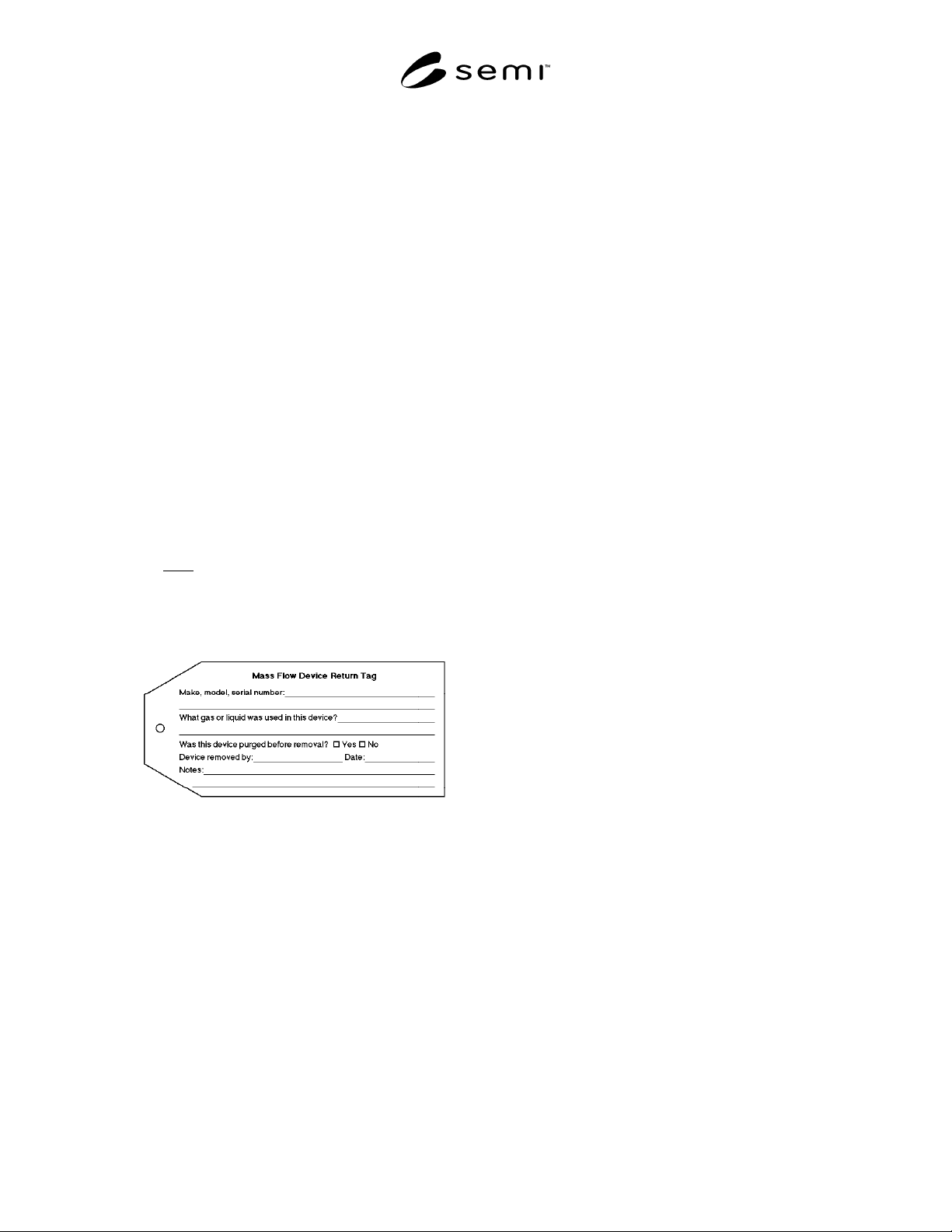
5.3.1 The person removing the mass flow device
should fill out an orange-colored device tag indicating
the process gas(es) or chemicals used, possible exterior
contamination and the purge procedure document
number prior to removal of the device. A sample orange
device tag is shown in Figure 1.
Figure 1
Sample Orange Device Tag
5.3.2 Carefully remove the mass flow device from the
installation or system.
5.3.3 The inlet and outlet ports should be sealed to
prevent any leakage into or out of the mass flow device.
5.3.4 The person removing the mass flow device
should attach the orange tag to the device.
5.4 Equipment Packaging — Package all mass flow
devices for shipment per government regulations
including the following:
5.4.1 Seal the device in a protective container to
prevent the contamination of the shipping package. If
the orange tag is not visible through the container, an
additional tag should be attached to the outside of the
container.
5.4.2 Place the device in a shipping container with
adequate packing to avoid damage to the device and the
protective container during shipment.
5.5 Shipping — Ship the device so that it conforms to
all applicable regulations of the countries of origin,
trans-shipment, and destination governing the shipment
of materials.