semi合集-English.pdf - 第3387页
SEMI E132.1-0305 © SEMI 2005 14 XM L Schema WSD L P or t Ty pe WSDL Bindi ng xsd:import wsdl:i m port Inte rfa ce D efin ition (operat ions, i nputs, output s ) Dat a Ty pes Figure 5 XML Schema and W SDL File Organizatio…

SEMI E132.1-0305 © SEMI 2005 13
7.2.3.2 Each client must also have an ACLEntry defined on the equipment granting the appropriate privileges to
support its functions prior to establishing SEMI E132 sessions with the equipment. This can be done via the
Security Admin or via the equipment console.
7.2.3.3 Equipment shall reject all SEMI E132 establish session requests if client does not have an ACLEntry
defined, even if client possesses a valid certificate issued by trusted CA.
7.3 Enabling/Disabling SSL Authentication
7.3.1 There may be some integration, development, and/or test environments in which it is not practical or feasible
to install equipment and/or client certificates in order to communicate with the equipment. As a practical
consideration for such environments only, the equipment shall support the ability of the user to enable or disable
SSL authentication at the equipment.
7.3.2 If enabled, all SEMI E132-based communication with the equipment shall take place via mutually-
authenticated SSL as described in ¶7.1.
7.3.3 If disabled, all SEMI E132-based communication with the equipment shall take place via the normal,
unauthenticated HTTP transport. While disabled, requests shall still follow the normal authorization verifications
using the client ID provided in the FROM field of the SEMI E132 header; however, because requests are not
authenticated there can be no guarantee that the requesting application is authentic. Users should be aware that
disabling SSL authentication provides unrestricted access to all SEMI E132 equipment operations for any
application (factory authorized or not) with network access to the equipment.
7.3.4 Equipment shall provide a configuration option to allow switching between SSL and non-SSL
communications. Only one such communication port shall be active at any time. During a configuration change, it
is the responsibility of the equipment user to close existing sessions prior to the change, as the active port will no
longer be available for requests following the change, and clients will not be notified of the change by the
equipment.
7.3.5 After a configuration change, any pre-existing persistent sessions shall remain active as defined in the SEMI
E132 Session State Model. Users should be aware that all requests made by those sessions after the change must
take place on the new port. The equipment is not required to retain non-persistent sessions in the active state
following a configuration change. If an equipment reset is required to change this configuration, then persistent
sessions shall be resumed, and non-persistent sessions shall be closed as for any equipment shutdown as defined in
the SEMI E132 Session State Model.
8 Mapping of SEMI E132 UML to XML Schema and WSDL
8.1 WSDL Organization
8.1.1 Each interface definition in SEMI E132 is mapped to a WSDL portType and binding definition. WSDL
portType definitions are named after the interface and its operations as they appear in SEMI E132. WSDL binding
definitions for each portType are used to specify the SOAP 1.1 envelope contents for each operation, and to define
the corresponding XML encoding styles and HTTP header usage. All SEMI E132 WSDL interfaces use
document/literal encoding, with the complete SOAP header and body contents defined in XML Schema file(s) via
global element definitions.
8.1.2 Figure 5 shows the relationship between the WSDL binding and portType definitions and the XML Schema
types used for each interface. The portType definition imports XML Schema type definitions used in each operation
via the XML Schema “import” statement. The WSDL binding definition imports the portType definition via the
WSDL “import” statement.
SEMI E132.1-0305 © SEMI 2005 14
XML Schema
WSDL Port Type
WSDL Binding
xsd:import
wsdl:import
Interface Definition
(operations, inputs,
outputs)
Data Types
Figure 5
XML Schema and WSDL File Organization
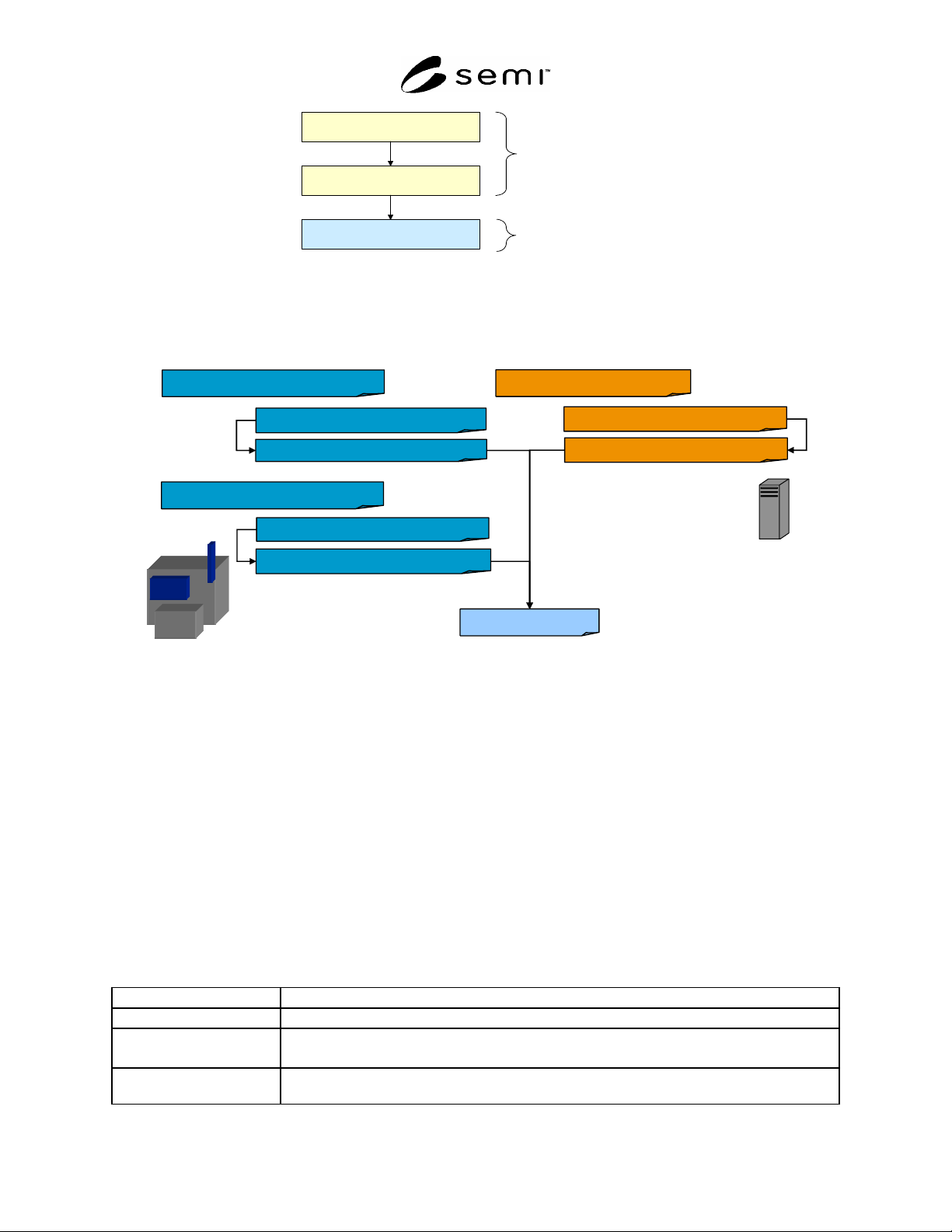
8.1.3 Figure 6 shows the specific XML Schema and WSDL files defined for SEMI E132.
consoleconsole
E132 SecurityAdmin Interface
E132-SecurityAdmin-PortType.wsdl
E132-SessionClient-PortType.wsdl
E132-SecurityAdmin-Binding.wsdl
E132-Schema.xsd
E132-SessionClient-Binding.wsdl
E132 SessionClient Interface
Equipment
E132 Client
E132-SessionManager-PortType.wsdl
E132-SessionManager-Binding.wsdl
E132 SessionManager Interface
Figure 6
XML Schema and WSDL files for SEMI E132
8.2 SecurityAdmin Interface
8.2.1 Establishing an ACLEntry for the Security Admin
8.2.1.1 An ACLEntry defining the Security Admin shall be added via the local equipment interface at time of
equipment install. The subject id of the ACLEntry must match the common name (CN) attribute of the subject
distinguished name of the certificate issued to the Security Admin, see ¶7.2.1.3. The Security Admin ACLEntry
must grant the reserved privilege “urn:semi-org.auth:securityAdminPrivileges” as defined by SEMI E132.
8.2.1.2 Exactly one ACLEntry shall exist for the Security Admin.
8.2.2 XML Schema and WSDL Files
8.2.2.1 The XML Schema and WSDL defined by this specification for the SecurityAdmin interface is contained in
the following documents:
Table 9 XML Schema
File Name E132-1-V0305-Schema.xsd
Target Namespace urn:semi-org:xsd.E132-1.V0305.auth
Imported/Referenced
Namespaces
http://www.w3.org/2001/XMLSchema
urn:semi-org:xsd.CommonComponents.V0305.ccs
Description
This file defines all of the SEMI E132 data types and elements used by the SecurityAdmin,
SessionManager and SessionClient interfaces.
SEMI E132.1-0305 © SEMI 2005 15
Table 10 SecurityAdmin PortType Definitions
File Name E132-1-V0305-SecurityAdmin-PortType.wsdl
Target Namespace urn:semi-org:ws.E132-1.V0305.secAdmin-portType
Imported/Referenced
Namespaces
urn:semi-org:xsd.E132-1.V0305.auth
http://schemas.xmlsoap.org/wsdl/
http://www.w3.org/2001/XMLSchema
Description
This file defines all of the input/output messages and operations for the SecurityAdmin interface,
based on the data types defined in the SEMI E132 XML Schema.
Table 11 SecurityAdmin Binding Definitions
File Name E132-1-V0305-SecurityAdmin-Binding.wsdl
Target Namespace urn:semi-org:ws.E125-1.V0305.secAdmin-binding
Imported/Referenced
Namespaces
urn:semi-org:ws.E132-1.V0305.secAdmin-portType
http://schemas.xmlsoap.org/wsdl/soap/
http://schemas.xmlsoap.org/wsdl/
Description
This file binds the abstract portType definition to HTTP and SOAP, specifying required SOAP
and HTTP headers for each operation and the XML encoding style for the SecurityAdmin
interface.
8.2.2.2 These documents are a part of this specification and should accompany this document. The contents of
these documents constitute the core part of this specification.
8.2.3 WSDL Port Type Overview
8.2.3.1 The SecurityAdmin WSDL portType definition organizes the SEMI E132.1 XML Schema data types into a
collection of named operations with inputs and outputs that correspond to the UML operations that are defined for
the SecurityAdmin interface in SEMI E132. The WSDL portType itself is named after the SEMI E132 interface,
and each WSDL portType operation is named after the corresponding UML operation defined for the interface.
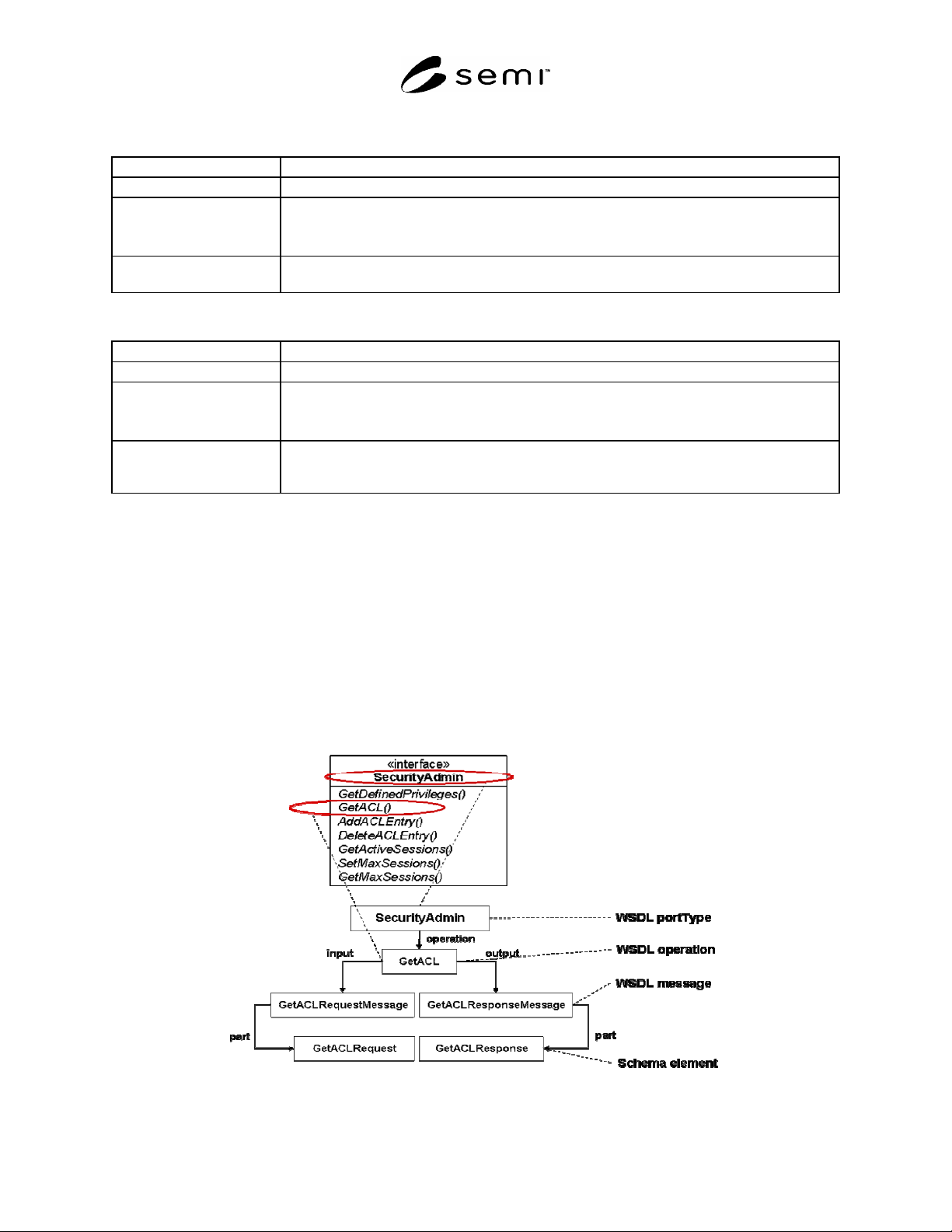
Each WSDL operation consists of two WSDL message definitions corresponding to the input and output (request
and response) for the UML operation defined in SEMI E132. Figure 7 illustrates the relationship between the SEMI
E132 UML interface and the WSDL portType definition; Table 12 describes this in tabular form. The WSDL
message and operation definitions are described in ¶¶8.2.9 through 8.2.15.
Figure 7
Mapping the SecurityAdmin interface to a WSDL portType