semi合集-English.pdf - 第1114页
SEMI E5-1104 © SEMI 1982, 2004 56 Table 19 Recipe Namespace Attribute Definition Attribute Name Definition Access Format Value “ObjType” The object ty pe. RO 20 “RNS” “ObjID” The name of the namespace . RO 20 A name of “…
SEMI E5-1104 © SEMI 1982, 2004 55
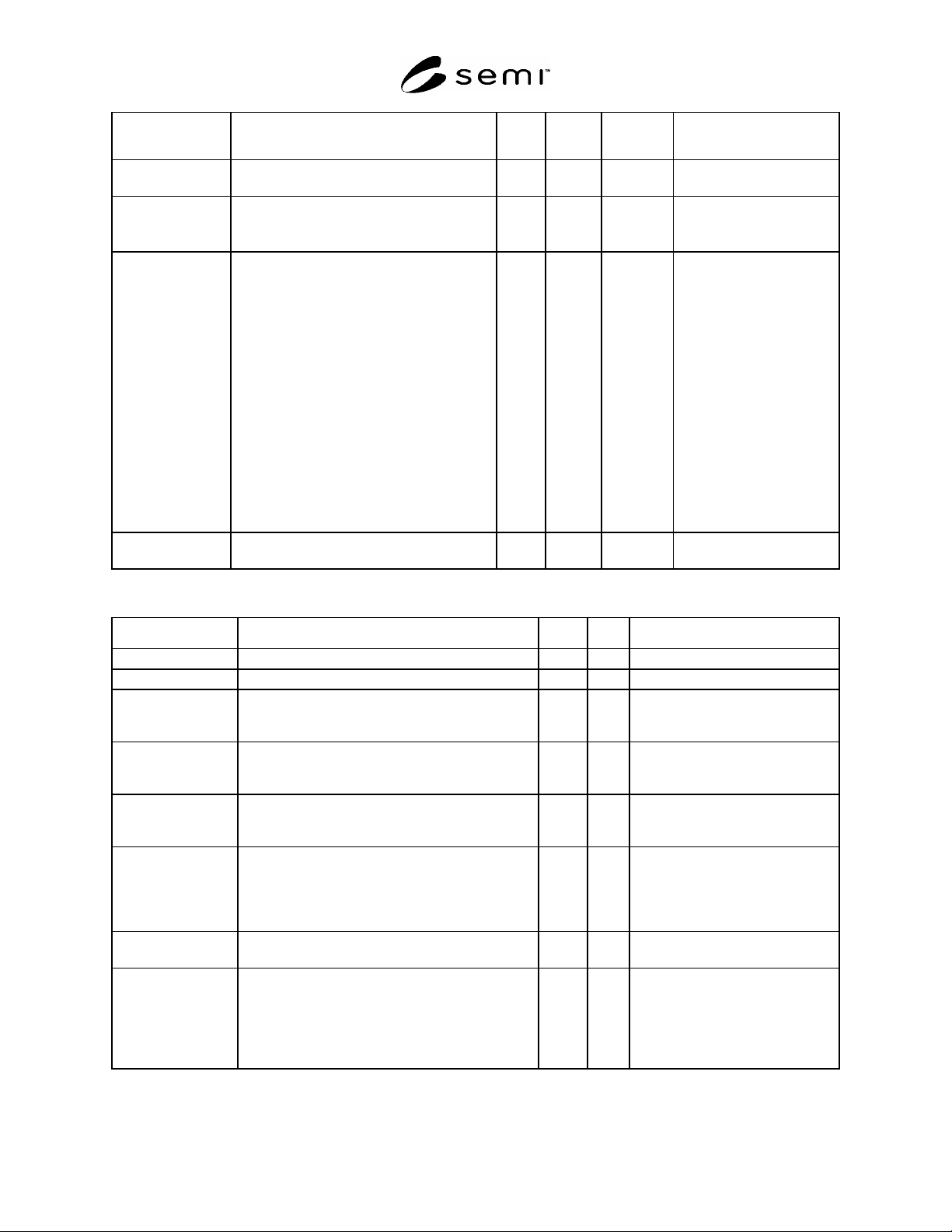
Attribute Name Description Access Format Related
Data Item
Value
“RecID” Object Specifier of Recipe used by a Process
Job, see SEMI E39 and SEMI E42
RO 20 - -
“PRRecipeMethod” Indicates any special handling for a Process
Job’s Recipe
RO 20 - allowed values:
“STANDARD”
“USETUNING”
“PRJobState” Indicates the current state of a Process Job.
The state of a job may be a combination of
sub-states and concurrent states.
RO 20 - Composed from the set:
“WAITINGFOR JOB”
“JOBQUEUED”
“JOB CANCELLED”
“JOBACTIVE”
“SETUP”
“WAITINGFORSTART”
“PROCESSING”
“NOTPAUSED”
“PAUSING”
“PAUSED”
“NOTSTOPPING”
“STOPPING”
“NOTABORTING”
“ABORTING”
“PROCESSCOMPLETE”
“JOBCOMPLETE”
“PRProcessStart” Processing should start automatically after Job
is defined when this Boolean is set TRUE
RO 11 - Boolean
Table 18 Recipe Executor Attribute Definition
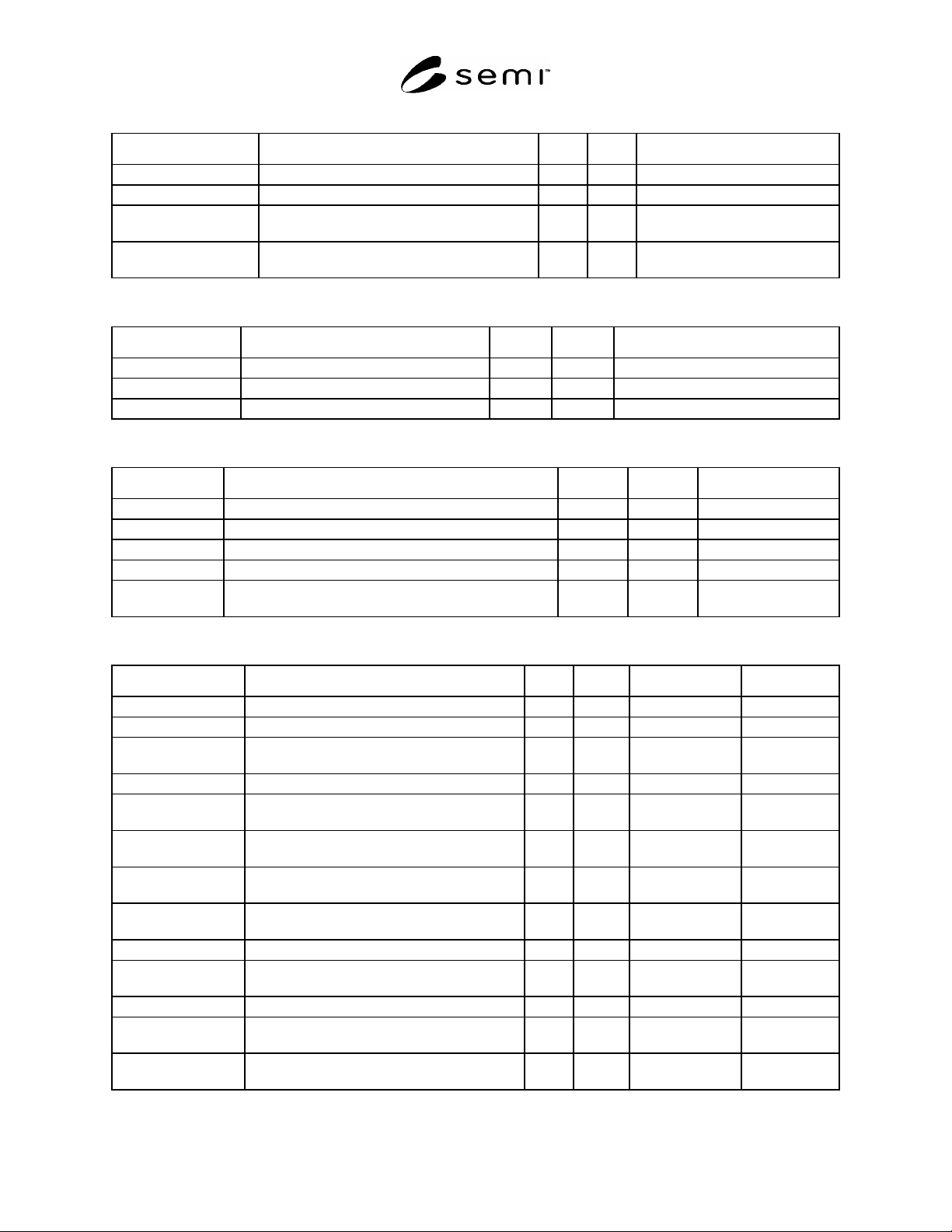
Attribute Name Description Access Rqmt Form
“ObjType” The object type RO Y Text = “RcpExec”
“ObjID” Text RO Y Text
“DefaultNamespace” The name of an executing agent’s name-space used
for all hardware-dependent and other agent-specific
recipes.
RW Y Text
“ProdApprove” The minimum value of a recipe’s approval level
accepted during productive and standby states.
Required for SEMI E10 support only.
RW N Unsigned integer
“ProdCertify” The minimum value of a recipe’s certification level
accepted during productive and standby states.
Required for SEMI E10 support only.
RW N Unsigned integer
“RunCycleUnit” The process unit on which the calculation of the
estimated value of the recipe generic attribute
EstRunTime is based.
RO N Case-sensitive formatted text
composed of a unit of measure and
an optional numeric suffix.
Compliant with SEMI E5, Section
12.
“RecipeSelectID” A list of recipe identifiers for the currently selected
recipes.
RO Y List of formatted text.
“RecipeSelect-
Parameters”
A list of all parameter definitions in effect for the ith
recipe identifier in RecipeSelectID. The maximum
value for i is determined by the equipment supplier
as the maximum number of recipes which may be
selected at the same time. Required if variable
parameters are supported.
RO N List of structures composed of
parameter name, parameter value,
parameter restriction.
SEMI E5-1104 © SEMI 1982, 2004 56
Table 19 Recipe Namespace Attribute Definition
Attribute Name Definition Access Format Value
“ObjType” The object type. RO 20 “RNS”
“ObjID” The name of the namespace. RO 20 A name of “Default” is prohibited.
“RecipeReadOnlyLevel” The level of approval at which recipes are read-
only.
RW 52
“Members” The names of agents capable of verifying and
executing the recipes in the namespace.
RW 00 List of items of format 20.
Table 20 Recipe Namespace Manager Attribute Definition
Attribute Name Definition Access Format Value
“ObjType” The object type. RO 20 “RNS_Mgr”
“ObjID” The manager’s name. RO 20
“NamespaceName” The name of the namespace managed. RO 20
Table 21 Table Attribute Definition
Attribute Name Definition Access Format Value
“ObjType” The object type. RO 20 “Table”
“ObjID” The object’s identifier. RO 20 1–80 characters.
“NumCols” Number of columns. RO 5() Non-zero.
“NumRows” Number of rows. RO 5() Non-zero.
“TableLength” Total number of bytes required to store the table elements,
exclusive of any formatting required for storage.
RO 5() Non-zero.
Table 22 Trace Object
Attribute Name Description Access Format Related Data Items Value
“ObjType” Trace Report Object type RO 20 - “TRACE”
“ObjID” Identifier of a specific Trace Report RO 20 TRID -
“Enabled” Boolean true means the specific Trace Report is
enabled.
RW * CEED -
“ReportID” List or report linked to this Trace Report RO 20 - (list of) RPTID
“SamplePeriod” Time between report samples given in floating
point seconds.
RW 4 () TRSPER -
“TotalSamples” The maximum number of samples that this Trace
Report will perform.
RW * TOTSMP -
“GroupSize” Number of trace reports to be grouped before a
report is sent.
RW * REPGSZ -
“StartEventID” Identifier of the event which starts trace
reporting.
RW 20 CEID -
“StartEvtSrcSpec” Source for the start event RW 20 EVNTSRC -
“StopEventID” Identifier of the event which stops trace
reporting.
RW 20 CEID -
“StopEvtSrcSpec” Source for the stop event RW 20 EVNTSRC -
“AutoDelete” Boolean true means this report is deleted when
reporting is complete.
RW 11 TRAUTOD -
“ReportChangeOnly” Boolean, if true, then trace reports are sent only
if at least one of the reported variables changes.
RW 11 RPTOC -
SEMI E5-1104 © SEMI 1982, 2004 57
9.8.2 attribute name — A reserved text string, of at most 40 characters, that is unique for that object.
9.8.3 description — A description of the attribute.
9.8.4 access — Indicates whether the attribute may be set through messages. Access is either read-only (RO) or
read-write (RW).
9.8.5 format — Indicates the type of data (format code).
9.8.6 timestamp format — Text form indicating date and time in the format “YYYYMMDDhhmmsscc”.
9.8.7 related data items — Indicates an explicit relationship with a corresponding data item.
9.8.8 value — Specifies any restrictions on the possible values. Examples of restrictions include exclusion of zero
for format 5(), a maximum length for text, a format imposed on text, an order imposed on a list, or an enumerated
set of valid values.
9.8.9 Requirements
The attributes “ObjType” and “ObjID” are required for all object definitions and shall use format 20.
The attribute “ObjType” shall be assigned a fixed value for each object.
The value of “ObjID” may not be changed by using SetAttr (S14F3).
9.8.10 The value of “ObJType” may be used for messages using the data item OBJTYPE. The value of the attribute
“ObjID” may be used for messages using the data item OBJID.
9.8.11 The name of a public attribute may be used for messages using the data item ATTRID. The value of a public
attribute may be used for messages using the data item ATTRDATA.
9.8.12 Variable data items defined in Section 9.7 may be regarded as attributes of the object type “Equipment”,
where SVs and DVVALs are RO and ECVs are RW.
9.9 With the use of Harel
4
state diagrams to describe the behavior of objects, an object’s state must be describable
as a combination of a set of sub-states and concurrent states. The rules for describing the state of an object are: (1)
use the comma (‘,’) to deliminate concurrent states, (2) use the foreslash (‘/’) to delimit a super-state and sub-state,
(3) to deliver the set of lowest level concurrent states, and (4) optionally omit super-state names when there are no
ambiguities in the names of the lowest level states.
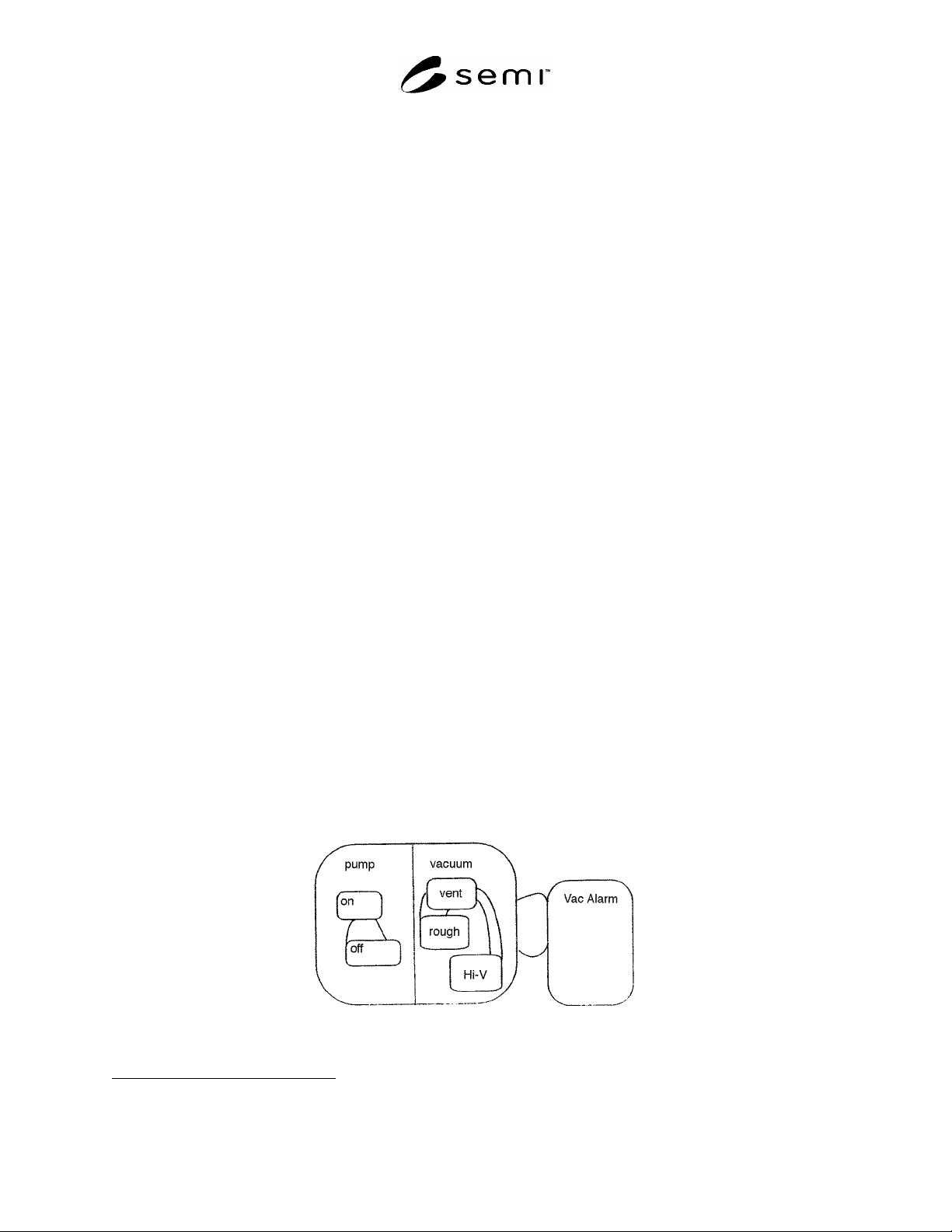
9.9.1 Please refer to Figure 3 in order to follow the discussions for the notations. In Harel notation, ‘pump’ and
‘vacuum’ are concurrent states. The text to specify this relation in a response to a request for state is ‘pump,
vacuum’. The comma can be read as meaning ‘and’. ‘on’ and ‘off’ are sub-states of ‘pump’. ‘vent’, ‘rough’, and
‘Hi-V’ are sub-states of ‘vacuum’. The sub-state syntax is ‘state/sub-state’ where the ‘/’ can be read as ‘is in sub-
state’. So using the example in Figure 3, if the pump is off and the vacuum is vented, then the text message which
conveys this is ‘pump/off, vacuum/vent’. This message can be shortened to ‘off,vent’ because there is no ambiguity
in doing so.
Figure 3
State Chart Example
4 Harel D. “Statecharts: A Visual Formalism for Complex Systems”, Science of Computer Programming, 8, 1987, pp. 231-274. Elsevier Science,
P.O. Box 945, New York, NY 10159-0945, http://www.elvesier.nl/homepage/browse.htt