semi合集-English.pdf - 第1316页
SEMI E5-1104 © SEMI 1982, 2004 258 Unit Identifier Equivalence Prefix Allowed Suffix Allowed Description waferframe wffr None No Yes Special SECS generic unit corresponding to a temporary fixture for wafers. Th e unit ca…
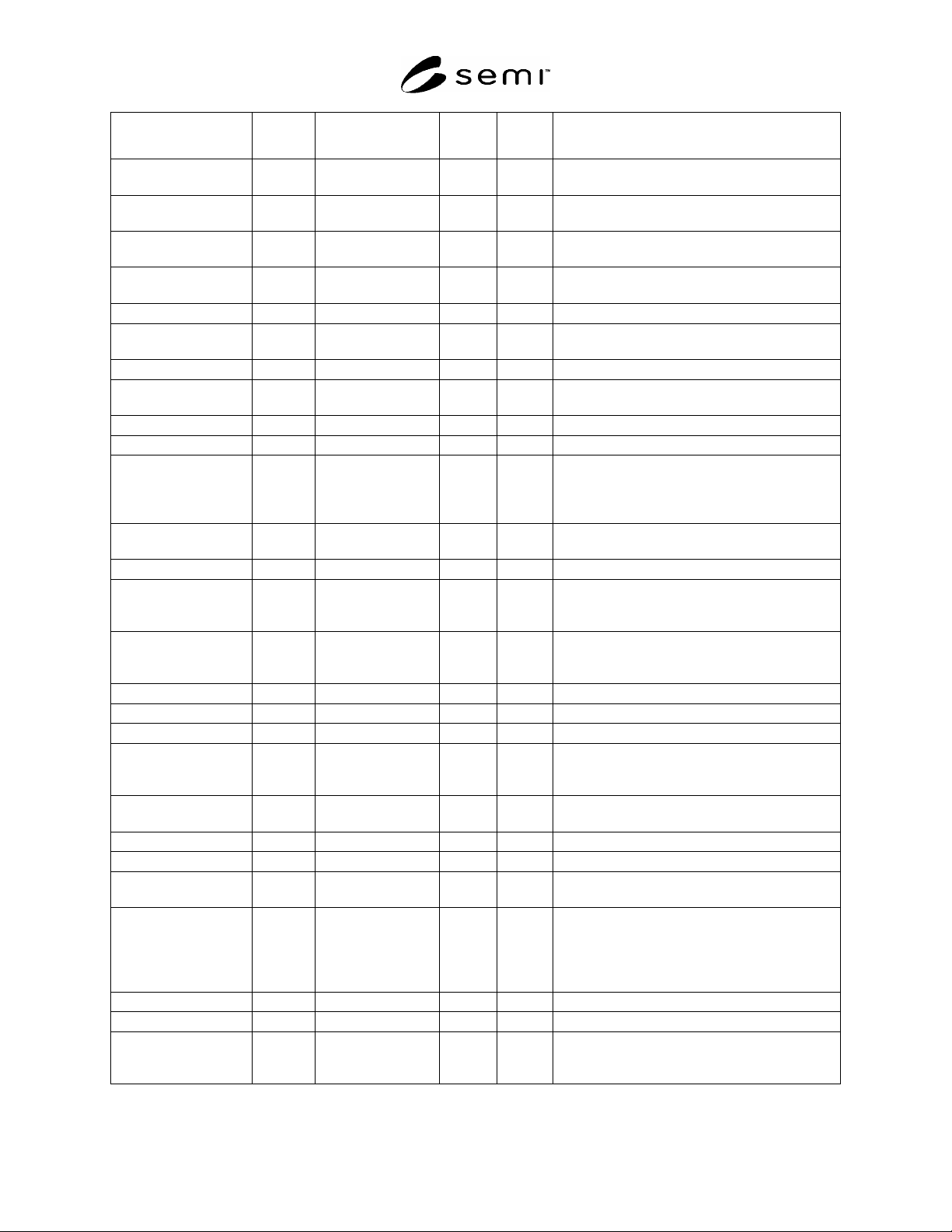
SEMI E5-1104 © SEMI 1982, 2004 257
Unit Identifier Equivalence Prefix
Allowed
Suffix
Allowed
Description
quart (UK) qtUK 1.1365*1 No No United Kingdom version of an English unit of
capacity.
quart (US dry) qtUS 1.1012*1 No No United States version of an English unit of dry
capacity.
quart (US liquid) qt 0.94635*1 No No United States version of an English unit of liquid
capacity.
rad rd 10^-2*Gy Yes No A unit of absorbed dose in the field of radiation
dosimetry.
radian rad None Yes No SI unit of plane angle.
rem rem 10^-2*Sv Yes No A unit of dose equivalent in the field of radiation
dosimetry.
revolution r c No No One complete cycle of a rotating body.
roentgen R Unknown No No A unit of exposure in the field of radiation
dosimetry.
second (plane angle) sec mins/60 No No One sixtieth of a minute of a degree.
second (time) s None Yes No SI unit of time.
siemens S 1/ohm SI unit
of
conducta
nce.
Yes No
sievert Sv Unknown Yes No SI unit of dose equivalent in the field of radiation
dosimetry.
slug slug 14.5939*kg No No English unit of mass.
standard cubic
centimeter per minute
sccm cc/min No No A unit of flow equivalent to one cubic centimeter
of a gas at standard temperature and pressure
flowing past a point in one minute.
standard liter per
minute
slpm 1/min No No A unit of flow equivalent to one liter of a gas at
standard temperature and pressure flowing past a
point in one minute.
steradian Sr Unknown Yes No SI unit of solid angle.
stilb sb cd/cm^2 Yes No A CGS unit of luminance.
stokes St P*cm^3/g Yes No A CGS unit of kinematic viscosity.
substrate substrate None No No Special SECS generic unit corresponding to the
entity of material being operated on, processed or
fabricated.
tesla T N/(A*m) or Wb/m^2 Yes No SI unit of magnetic flux density (magnetic
induction).
therm thm 10^5*Btu No No An English unit of energy.
ton (short) ton 2000*lbf No No English unit of weight.
torr torr mmHg Yes No Pressure unit. Alternative name for millimeters of
mercury.
tube tube None No Yes Special SECS generic unit corresponding to a
holder of packages arranged in a flow. The unit
capacity is specified by the symbol’s suffix, if
provided. Otherwise, the capacity is situation-
dependent.
var var Unknown Yes No SI unit for reactive power.
volt V W/A Yes No SI unit of voltage.
wafer wfr None No No Special SECS generic unit corresponding to the
entity of material on which semiconductor devices
are fabricated.
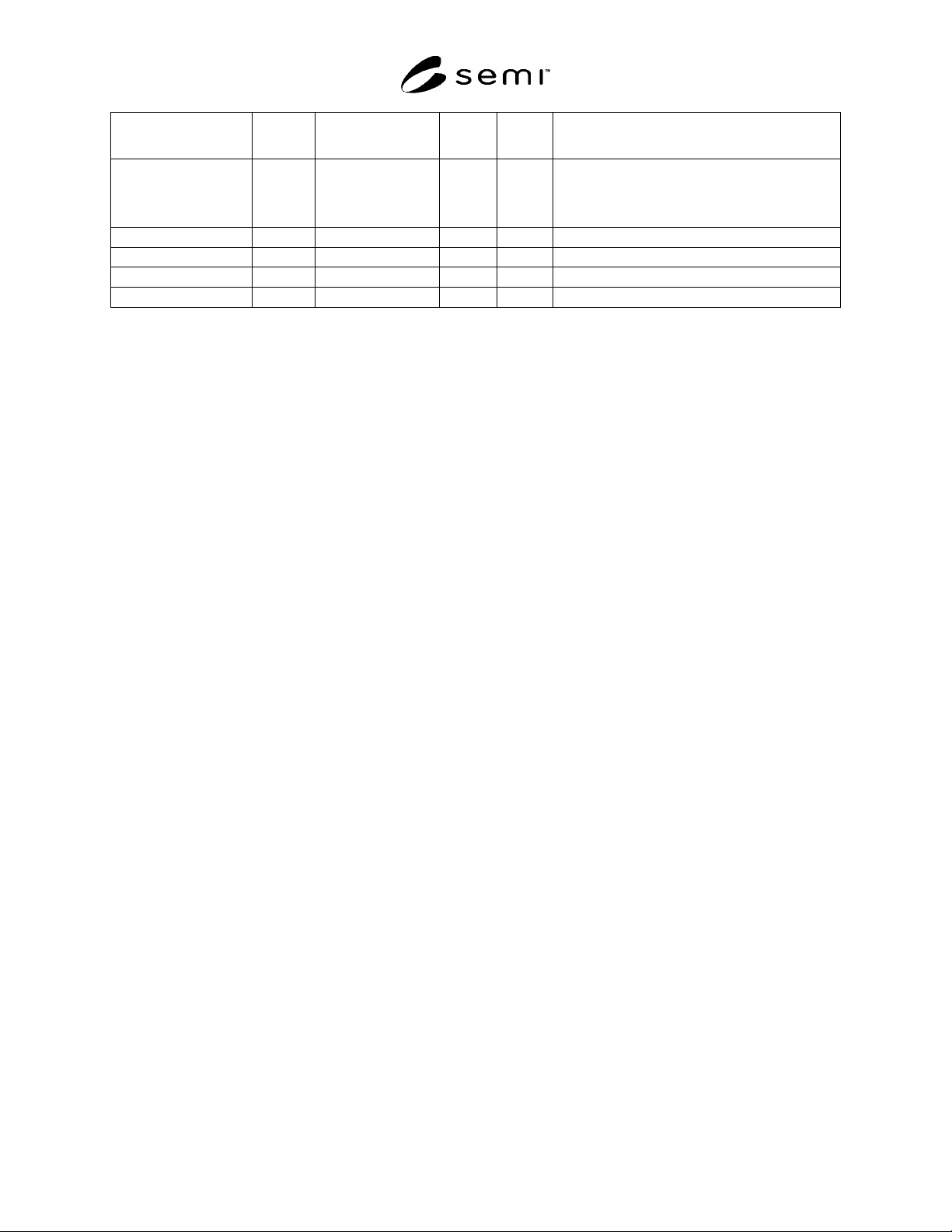
SEMI E5-1104 © SEMI 1982, 2004 258
Unit Identifier Equivalence Prefix
Allowed
Suffix
Allowed
Description
waferframe wffr None No Yes Special SECS generic unit corresponding to a
temporary fixture for wafers. The unit capacity is
specified by the symbol’s suffix, if provided.
Otherwise, the capacity is situation-dependent.
watt W J/s Yes No SI unit of power.
watthour Wh 3600*J Yes No Unit of energy.
weber Wb V*s Yes No SI unit of magnetic flux.
year yr None No No Unit of time.
NOTICE: SEMI makes no warranties or representations as to the suitability of the standard set forth herein for any
particular application. The determination of the suitability of the standard is solely the responsibility of the user.
Users are cautioned to refer to manufacturer’s instructions, product labels, product data sheets, and other relevant
literature respecting any materials mentioned herein. These standards are subject to change without notice.
The user’s attention is called to the possibility that compliance with this standard may require use of copyrighted
material or of an invention covered by patent rights. By publication of this standard, SEMI takes no position
respecting the validity of any patent rights or copyrights asserted in connection with any item mentioned in this
standard. Users of this standard are expressly advised that determination of any such patent rights or copyrights, and
the risk of infringement of such rights, are entirely their own responsibility.

SEMI E5-1104 © SEMI 1982, 2004 259
RELATED INFORMATION 1
APPLICATION NOTES
NOTICE: The material contained in this Related Information section is not an official part of SEMI E5 and is not
intended to modify or supersede the official standard. Rather, these notes describe possible methods for
implementing the protocol described by the standard and are included as reference material. The standard should be
referred to in all cases. SEMI makes no warranties or representations as to the suitability of the material set forth
herein for any particular application. The determination of the suitability of the material is solely the responsibility
of the user.
R1-1 The General Node Transaction Protocol
R1-1.1 This application note has been moved to follow
SEMI E4 (SECS-I) as Application Note A7.
R1-2 Some Suggested Message Usage
R1-2.1 The number of messages implemented and the
choice of messages are greatly influenced by the actual
function of the equipment. To illustrate which
messages might be appropriate, the following
suggestions are offered for a variety of different types
of equipment capabilities. It is assumed that the
minimum message sets S1,F1; F2 and S9,F1; F3; F5;
F7 are always implemented.
R1-2.2 For equipment which makes nondestructive in-
process measurements using a fixed measurement
procedure, it may be necessary only to implement S6,
F9 to send the data according to a fixed format upon
measurement. Optional remote control can be added
with S2,F21 to start a measurement.
R1-2.3 If the equipment has a variety of measurement
routines, it might be desirable to respond to S1,F5 with
S1,F6, which would give the host a brief report of the
test being made. The test can be thought of as a process
program. Accordingly, S7,F1 and S7,F2 could be used
for the host to select the program. The same messages
in conjunction with S7,F3 and S7,F4 could load a new
test procedure. S7,F19 could be used by the host to
find out what tests were available.
R1-2.4 Some equipment which automatically processes
wafers in a batch might make more extensive use of
S1,F5 or S1,F3 and might include some error reporting
on S5,F1. More sophisticated equipment may include
some trace features with S2,F23 and S6,F1 or some
control loop tuning by S2,F15.
R1-2.5 Equipment using in-line wafer movement could
utilize Stream 4, S1,F9, and Stream 3 to keep track of
wafers.
R1-2.6 Stream 7,F9 through F19 can be used to
manage a local backup of process programs should the
host fail for a short while.
R1-2.7 Microprocessor equipment can benefit from
features such as provided by Stream 8 and S2,F1
through F12 which allow managing and servicing the
software routines.
R1-2.8 Equipment, including a CRT, might elect to
make it available to the host by including Stream 10
messages.
R1-2.9 Some equipment, such as functional testers,
might have sufficient need to undertake remote file
usage such as provided in Stream 13.
R1-2.10 These brief suggestions serve to illustrate that
the final choice of the messages included in a given
equipment depends upon its function. The messages
can be viewed as interface features in the same way that
other parts of the equipment are viewed as processing
features or wafer handling features.
R1-3 Notes on SECS-II Data Transfers
R1-3.1 Introduction
R1-3.1.1 There are two primary ways to send and ask
for data in SECS-II. One of these is to use the trace
feature and the other is to use the event reporting
method. The purpose of this note is to describe the
intended operation of the messages described in the
existing standard. Discussion of completeness or need
for other reporting methods is left for task force and
committee work.
R1-3.2 Trace Data Collection and Reporting
R1-3.2.1 This method of collecting data is intended for
engineering and developmental use rather than routine
data collection for production. The features included
allow the collection of relatively large amounts of real
time data over a finite amount of time. The data is
generated at regular time intervals as determined by a
timing generator in the equipment. The function of the
host is to set up the trace and then to subsequently store
the data as it is received from the equipment. It is
assumed that some host resident applications will exist
to analyze the data either as it is received or at some
later time.