semi合集-English.pdf - 第1778页
SEMI E42-0704 © SEMI 1995, 2004 47 7 Agents This section describes the agent and resources as they are used in Recipe Managem ent. The concept of agent is introduced t o cover the different t ypes of RMS implem entations…
SEMI E42-0704 © SEMI 1995, 2004 46
6.6.4 Last Value — Some recipe executors may also
want to save the last value set by the user for each
variable parameter and use it as the new initial value of
that parameter when the same recipe is rerun.
This is useful when internal conditions drift in a
consistent manner over time, the parameters are
occasionally modified to compensate for such drift, and
the last setting used is, therefore, a better “default” than
the one specified in the recipe itself.
Permission to save the last value may be expressly
granted by the user in the recipe attribute ExecChgCtrl
.
Care should be taken to prevent unintentional
modifications.
6.7 Production — Equipment utilizations states are
defined by SEMI E10 (Standard for Definition and
Measurement of Equipment Reliability, Availability,
and Maintainability (RAM)). These states include the
PRODUCTIVE and STANDBY states used by the
factory for normal production work. The attributes
ProdApprove
and ProdCertify are defined as required
only for equipment supporting states defined in this
document.
To ensure that only recipes authorized for production
are executed while the executing agent is in the
PRODUCTIVE state, or are selected while in the
STANDBY state, the authorized user may set the
values of the attributes ProdApprove
and/or ProdCertify
to non-zero values. Non-zero values in ProdApprove
or
ProdCertify
represent minimums for a recipe's
ApprovalLevel
and Certified attributes, respectively.
The recipe executor is responsible for comparing the
corresponding recipe attributes ApprovalLevel
and
Certified
. When a recipe is selected for execution
(implicitly or explicitly) while either of the
PRODUCTIVE or STANDBY states is active, the
value of ApprovalLevel
is required to be equal to or
greater than the value in ProdApprove
, and the value in
Certified
is required to be equal to or greater than the
value in ProdCertify
. Otherwise, the select shall fail.
6.8 Recipe Executor Attributes — The recipe executor
is owned by the agent that provides a recipe execution
resource. The recipe executor in turn owns the recipes
that it has stored. It shall support Object Services for its
owned object types and for itself.
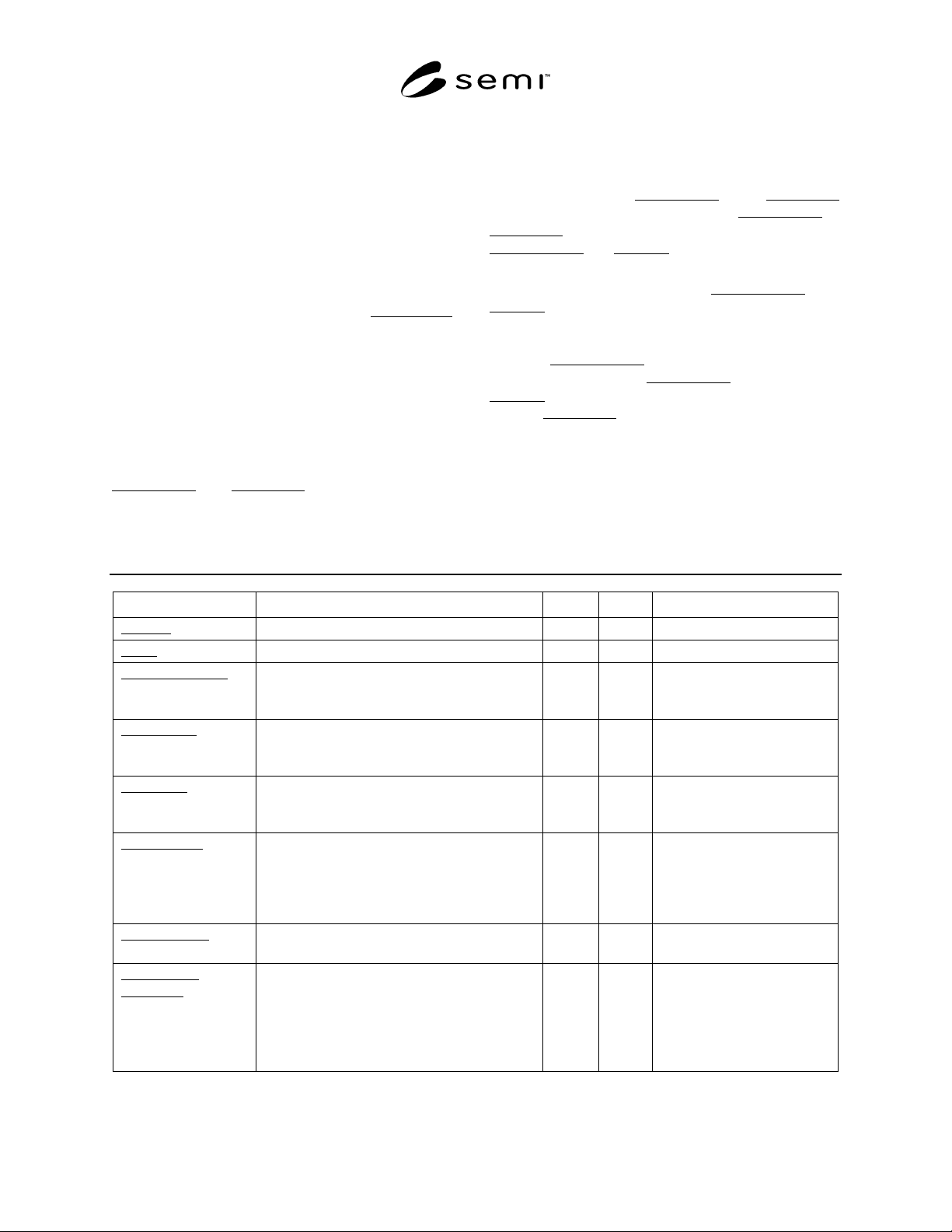
Table 6.2 defines the attributes of the recipe executor in
alphabetical order.
Table 6.2 Recipe Executor Attribute Definition
Attribute Name Definition Access Rqmt Form
ObjType The object type. RO Y Text = "RcpExec"
ObjID Text. RO Y Text.
DefaultNamespace The name of an executing agent’s namespace
used for all hardware-dependent and other
agent-specific recipes.
RW Y Text.
ProdApprove The minimum value of a recipe’s approval
level accepted during productive and standby
states. Required for SEMI E10 support only.
RW N Unsigned integer.
ProdCertify The minimum value of a recipe’s certification
level accepted during productive and standby
states. Required for SEMI E10 support only.
RW N Unsigned integer.
RunCycleUnit The process unit on which the calculation of the
estimated value of the recipe generic attribute
EstRunTime is based.
RO N Case-sensitive formatted text
composed of a unit of
measure and an optional
numeric suffix. Compliant
with SEMI E5, Section 9.
RecipeSelectID A list of recipe identifiers for the currently
selected recipes.
RO Y List of formatted text.
RecipeSelect-
Parameters
A list of all parameter definitions in effect for
the i
th
recipe identifier in RecipeSelectID. The
maximum value for i is determined by the
equipment supplier as the maximum number of
recipes which may be selected at the same time.
Required if variable parameters are supported.
RO N List of structures composed
of parameter name, parameter
value, parameter restriction.
SEMI E42-0704 © SEMI 1995, 2004 47
7 Agents
This section describes the agent and resources as they are used in Recipe Management. The concept of agent is
introduced to cover the different types of RMS implementations and to provide a context for the other specific
object types introduced in RMS.
7.1 Definitions — A resource is an owned entity that has an active role in factory operations. A factory has many
different kinds of resources. Some resources, such as valves, may be primarily physical. A software application is a
type of resource not generally considered as physical. The factory itself is a resource for the corporation.
An agent is a system in a factory — a type of resource that includes both hardware and software components, at
least some of which are also resources. Intelligent equipment that provides recipe namespace capability, for
example, would be an agent with a recipe namespace resource, as well as a computer platform, operating system,
and electro-mechanical components, some or all of which represent other types of resources. An agent may be a
component of another agent, and it may also contain other agents as components. For example, a cluster module is a
component of a cluster and may itself contain intelligent subsystems as components.
Agents may, in some cases, share certain resources with other agents. An example is a docking station that connects
two clusters.
Services defined by RMS may be provided at various levels within the factory. The generic term agent may be
applied at any of these levels as appropriate. Typical agents that use and provide Recipe Management services
include equipment, clusters, cluster modules, cells, and independent recipe namespace servers
9
. The term agent
applies equally well to each of these.
A service resource is a set of services within a particular area of specialization. Service resources of interest to
RMS are the recipe namespace resource, the recipe execution resource, and the Object Services Resource. The
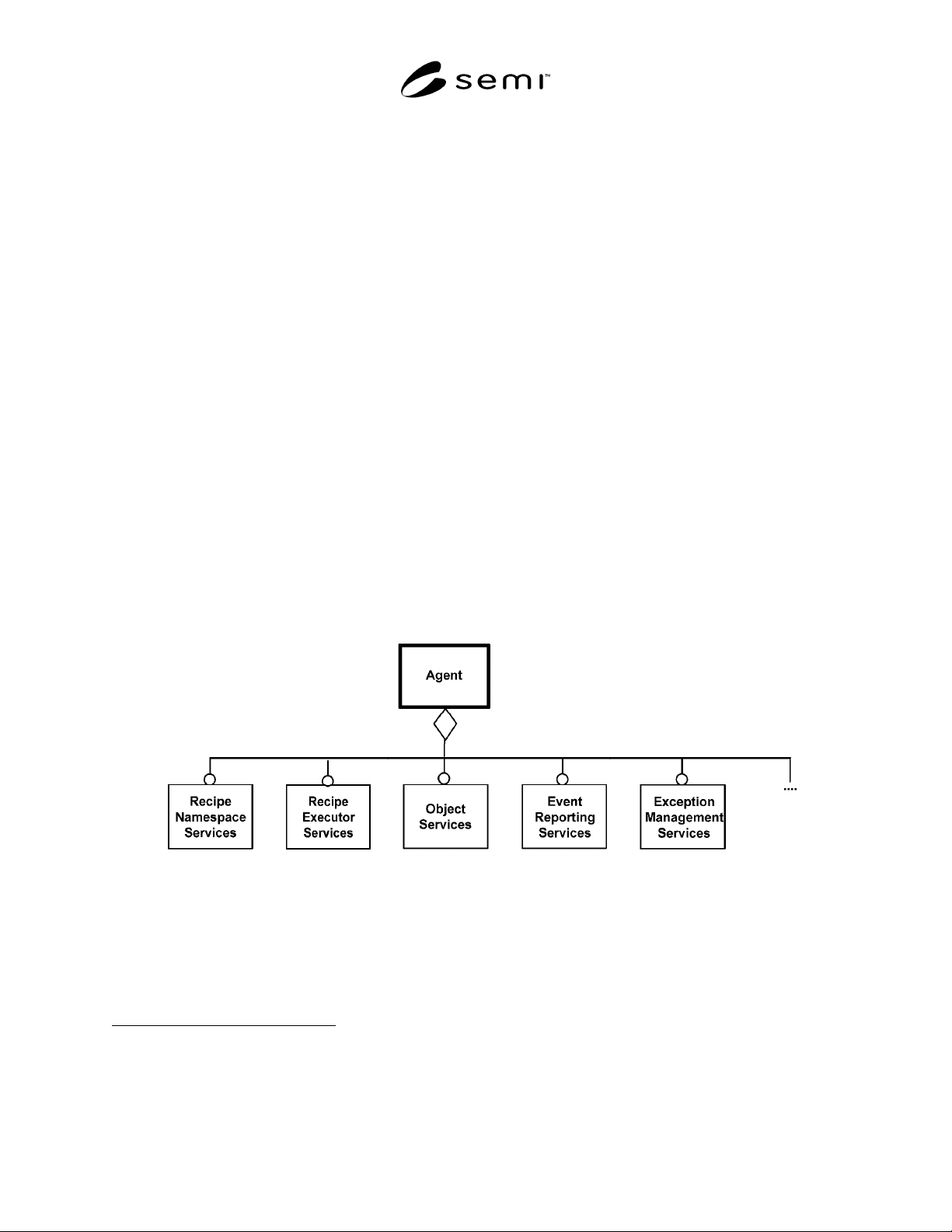
service resource object, illustrated in Figure 7.1, allows a group of message services defined by a service standard
(such as RMS) to be represented by a single object, one of the subtypes of the service resource. However, this
concept is introduced for clarification only. The service resource object is not a standardized object.
Figure 7.1
Examples of Service Resource Subtypes
An agent is introduced as a standardized object that provides one or more service resources. Figure 7.1 shows an
example of an agent composed of different service resources. Also, an agent may supervise subordinate agents or
be supervised by a superior agent, each of which in turn will possess their own service resources.
9 A recipe namespace server is an agent whose primary function is to provide recipe namespace capabilities.

SEMI E42-0704 © SEMI 1995, 2004 48
Agents interact with one another collaboratively and/or
hierarchically, through the service resources that they
provide, to perform work in the factory.
7.2 RMS Resources — The service resources defined
by RMS are the recipe namespace resource and the
recipe execution resource.
A recipe namespace resource consists of the set of
message services defined in Section 12, corresponding
to the namespace operations defined in Sections 8 and
9. All services required for operations designated as
required are fundamental and shall be provided for an
RMS-compliant recipe namespace resource.
A recipe execution resource consists of the set of
messages defined in Section 14 corresponding to the
recipe executor operations defined in Section 11. All
services required for operations designated as required
are fundamental and shall be provided for an RMS-
compliant recipe execution resource.
7.3 Agent Attributes — Table 7.1 defines the public
attributes of agents that are required for recipe
management.
Table 7.1 Agent Attribute Definition
Attribute
Name
Definition
Access
Reqt
Form
ObjType Agent object
type.
RO Y Text:
“Agent”
ObjID The agent's
name, assigned
by an
authorized
user.
RO Y Text.
8 Recipe Management Operations
There are two important kinds of operations involving
recipes within a namespace. Those that change a
recipe's attributes or body are called recipe
management operations. Those that affect the set of
recipe identifiers within a namespace are part of recipe
namespace management operations. A few operations
qualify as both recipe management and namespace
management and are discussed in their different aspects
under both topics.
A third type of operation is informational only and
requires reading but not changing recipe attributes.
Operations of this type that require knowledge of the
attributes of the namespace or of more than one recipe
are discussed in Section 9.
This section describes recipe management operations.
Requests for recipe operations are always directed to
the namespace where the recipe is stored. Recipe
management operations are delegated by the namespace
manager to the namespace segment, which is
considered as the recipe manager. This is invisible for
a centralized namespace and explicit for a distributed
recipe namespace.
Operations may be invoked by the operator or through
namespace services defined in Section 12. In many
cases, service scenarios consist of a single message
request from the service user and a corresponding
response from the namespace manager. This case is
illustrated in Section 12.2, Figure 12.1. Operations
requiring additional messages are discussed in Section
8.2.
The service user is responsible for proper authorization
of the user prior to requesting an operation that is
restricted to authorized users
through RMS services.
8.1 Recipe Lifecycle — A typical production recipe
goes through various stages in its development within a
namespace. These stages are shown below in a typical
order through their associated operations. The attributes
concerning the body are provided by the initiator of the
operation.
create — The create operation enters a recipe body
into the namespace.
Editing is expected, but not required, to be performed
outside the namespace. Where provided by the
manager, the same requirements concerning creating or
updating a recipe are to be followed.
update — A recipe is updated when a body (typically,
a modification of the original body) is entered into the
namespace to replace the body of an existing recipe that
is not write-protected. The attributes concerning the
body are provided by the initiator of the operation.
verify — The verify operation is used to build a recipe.
Checks for semantic correctness may also be performed
at this time but are not required. The recipe body is read
and checked for syntactical correctness, and all external
references and variable parameter definitions are
collected. The verification operation may be delegated
to a recipe executor, which returns the required
information.
write-protect — At some point during its development,
an authorized user needs to be able to prevent the
accidental deletion or modification of a recipe and
requests to have it be write-protected. A write-
protected (read-only) recipe may not be updated,
renamed, deleted, unlinked, or relinked.
link — The link operation is used to signify that the
recipe is ready for execution. If the recipe has external
references, linking also builds a linked recipe set by
collecting the external references and variable
parameter definitions and saving them for quick access