semi合集-English.pdf - 第349页
SEMI E49.7-0304 © SEMI 1995, 2004 8 NOTICE: SEMI makes no warranties or representations as to the suitability o f the standards set forth herein for any particular application. The determination of the suitability o f th…

SEMI E49.7-0304 © SEMI 1995, 2004 7
closing the fitting. Manufacturer recommendations for
torque should be applied.
10.5.4 For tapered threaded connections, such as
National Pipe Thread (NPT) and Japanese Industrial
Standard (JIS), wrap tapered threads with a suitable
tape, (such as PTFE tape) prior to assembly. Use of ¼”
wide tape is recommended on nominal sizes of ½” or
smaller. Wrap the threads three times in the direction
that does not unravel during installation of the fitting.
To reduce the possibility of tape entering the liquid
stream, do not cover the last two threads at the narrow
end of the fitting.
10.6 Tubing and Pipe Support
10.6.1 Route flexible tubing neatly and secure with tie-
wraps or similar mechanical fastener.
10.6.2 Support distances and support clamps for pipe
should employ the manufacturer’s recommendations,
where possible. These clamps typically cradle the pipe
within a plastic fixture. Metal and/or constrictive types
of clamps may induce stress into piping components
and should be avoided. However, if they must be used
then elastomer inserts between the pipe and clamp are
recommended.
10.7 Labeling Recommendations
10.7.1 All ultrapure water and Liquid Chemical
systems should be labeled in accordance with SEMI
F34 when possible.
10.7.2 Additional labeling to support proper operation
of the system(s) should be included when indicated on
assembly drawing(s).
10.8 Final Assembly Inspection Recommendations
10.8.1 Inspect the system within the appropriate
assembly environment.
10.8.2 Verify the following:
• System is complete per drawings
• Critical dimensions, squareness, offsets, and
straightness are per drawings and assembly
specifications
• Overall configuration is correct
• Support is adequate
• No pipe, tube, or fitting is nicked, cracked, or
abused
• Each weld is visually acceptable
• Gaskets are in place and bolts are torqued to proper
values
• Proper installation of valves per manufacturer’s
recommendations
• Unions and mechanical connections are tight
• Tubing, pipe, inlets, and outlets are labeled
appropriately
10.8.3 Shop drawings that have been marked up should
be returned to the engineering department for updates.
The QA manager should be notified that the assembly
has passed inspection, been tagged as such, and is ready
for final testing.
11 System Testing Recommendations
11.1 The equipment manufacturer should successfully
complete functional testing (for example leak and
pressure decay testing). In addition, testing may be
required to demonstrate that the system is not adversely
affecting the quality of the liquid.
11.2 Any assemblies that have been wetted during
testing shall be dried with Nitrogen.
NOTE 11: As outlined in limitations Section 3.1, it is beyond
the scope of this document to define the performance
requirements of the equipment systems.
12 Packaging Recommendations
12.1 Packaging is recommended to ensure the
cleanliness and dryness of wetted surfaces during
transport or storage. All open connections should be
capped to isolate wetted materials from contamination.
Additional guidelines for packaging can be found in
other SEMI documents. For smaller assemblies refer to
the requirements found in SEMI F57. For larger
assemblies refer to the requirements found in SEMI
E49.1.
13 Traceability Recommendations
13.1 A completed assembly should have permanent
identification such that it is traceable to the
documentation recommended within this guide. The
manufacturer is responsible for maintaining records that
include but are not limited to the following:
• Test methods and results
• Final assembly inspection
• Assembly drawing modifications
• Weld logs

SEMI E49.7-0304 © SEMI 1995, 2004 8
NOTICE: SEMI makes no warranties or
representations as to the suitability of the standards set
forth herein for any particular application. The
determination of the suitability of the standard is solely
the responsibility of the user. Users are cautioned to
refer to manufacturer' s instructions, product labels,
product data sheets, and other relevant literature,
respecting any materials or equipment mentioned
herein. These standards are subject to change without
notice.
By publication of this standard, Semiconductor
Equipment and Materials International (SEMI) takes no
position respecting the validity of any patent rights or
copyrights asserted in connection with any items
mentioned in this standard. Users of this standard are
expressly advised that determination of any such patent
rights or copyrights, and the risk of infringement of
such rights are entirely their own responsibility.
SEMI E49.7-0304 © SEMI 1995, 2004 9
RELATED INFORMATION 1
FLOW CONSIDERATIONS FOR ULTRAPURE WATER SYSTEMS
NOTICE: This related information is not an official part of SEMI E49.7 and was derived from North American
Liquid Chemicals. This related information was approved for publication by full letter ballot on April 30, 2002.
R1-1 Ultrapure Water Considerations
R1-1.1 An ultrapure water system may benefit from
maintaining continuous flow with a velocity greater
than or equal to those listed in the following table:
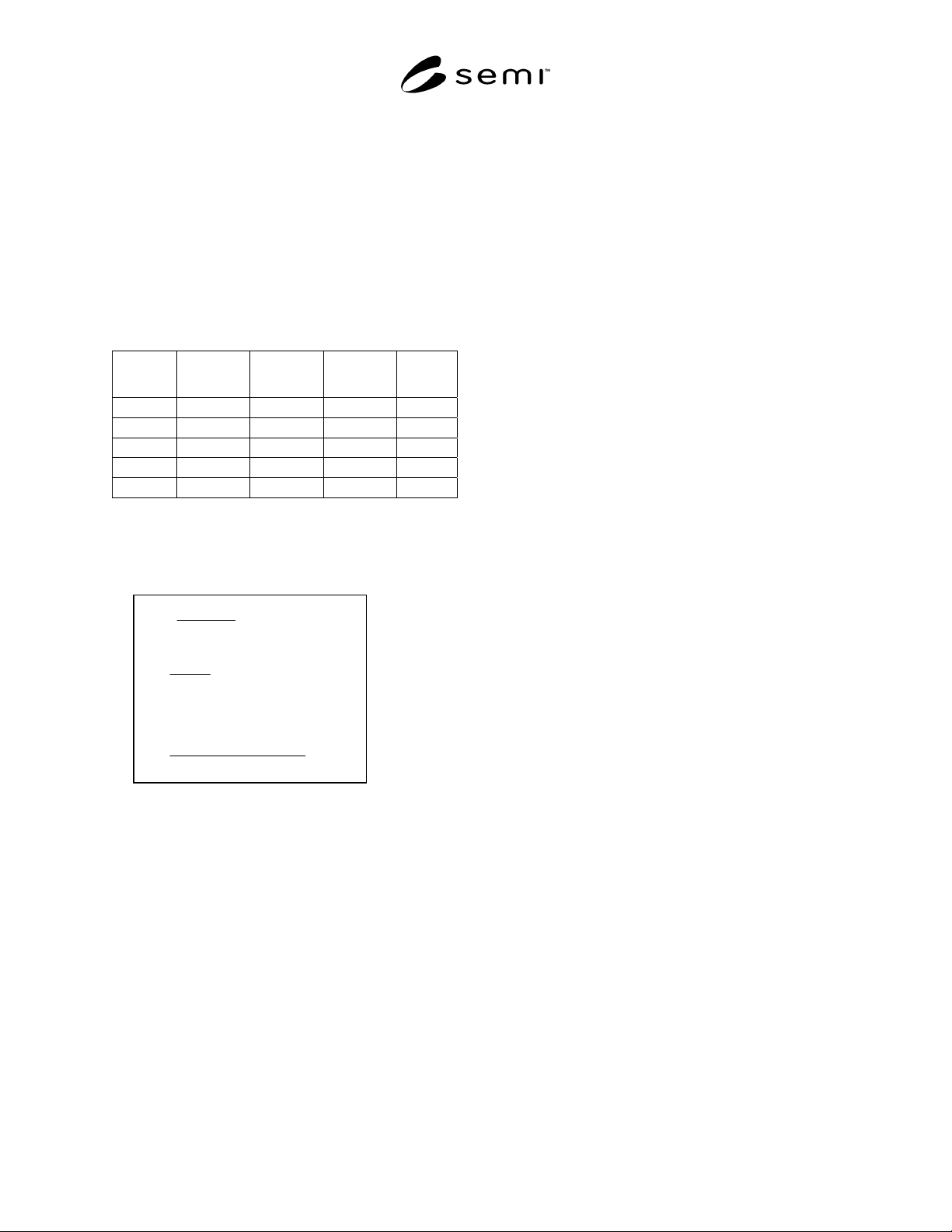
Table R1-1
Nom. Size Tube ID
(inches)
V (ft/s) Tube ID
(cm)
V (cm/s)
¼” 0.125 5.2 0.3175 158.1
3/8” 0.250 2.6 0.6350 79.0
½” 0.375 1.7 0.9525 52.7
¾” 0.625 1.0 1.5875 31.6
1” 0.875 0.7 2.2225 22.6
R1-1.2 For reference this information is based on the
following equations, using a Reynolds number of 5000
and water at a temperature of 20°C.
Where:
Re is Reynolds number (dimensionless)
ρ is density (g/cm
3
)
V is fluid velocity (cm/sec)
D is tube diameter (cm)
µ is viscosity (g/cm-s)
NOTICE: SEMI makes no warranties or
representations as to the suitability of the standards set
forth herein for any particular application. The
determination of the suitability of the standard is solely
the responsibility of the user. Users are cautioned to
refer to manufacturer' s instructions, product labels,
product data sheets, and other relevant literature,
respecting any materials or equipment mentioned
herein. These standards are subject to change without
notice.
By publication of this standard, Semiconductor
Equipment and Materials International (SEMI) takes no
position respecting the validity of any patent rights or
copyrights asserted in connection with any items
mentioned in this standard. Users of this standard are
expressly advised that determination of any such patent
rights or copyrights, and the risk of infringement of
such rights are entirely their own responsibility.
()( )
()()
1.158
9982.03175.0
01002.05000
V
:example
D
Re
V
DV
Re
=
⋅
⋅
=
ρ⋅
µ⋅
=
µ
⋅⋅ρ
=
Copyright by SEMI® (Semiconductor Equipment and Materials
International), 3081 Zanker Road, San Jose, CA 95134. Reproduction o
f
the contents in whole or in part is forbidden without express written
consent of SEMI.