semi合集-English.pdf - 第1237页
SEMI E5-1104 © SEMI 1982, 2004 179 10.18 Stream 14 Object Services The functi ons in this stream are used for ge neric functions concerning objects, including obtaining information abou t objects and setting values for…
SEMI E5-1104 © SEMI 1982, 2004 178
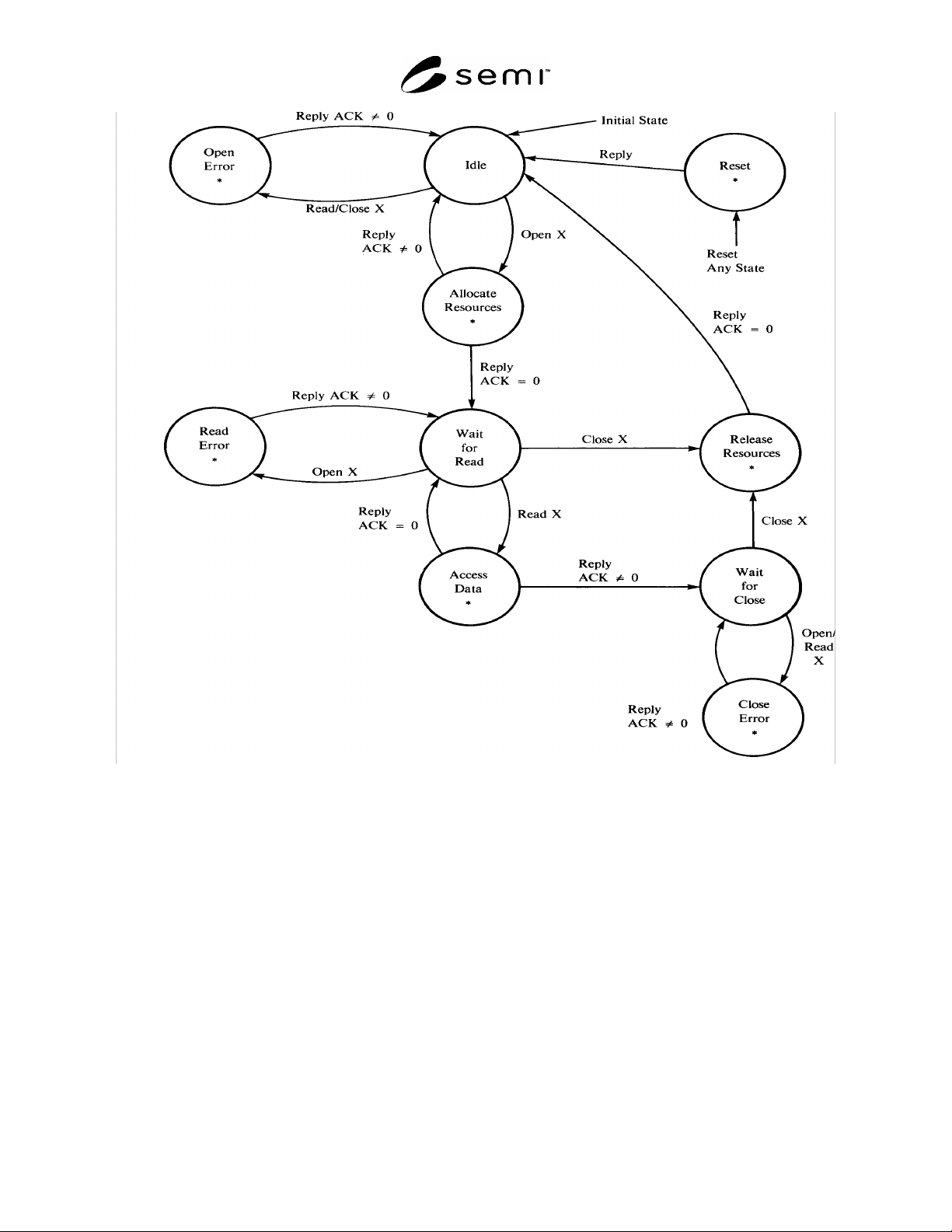
Figure 11
The Sending System’s State Diagram During a Data Set Transfer
An Asterisk (*) marks the states where a primary message which uses handle X would result in a secondary
message with the error code for “Pending Transaction.”
SEMI E5-1104 © SEMI 1982, 2004 179
10.18 Stream 14 Object Services The functions in this stream are used for generic functions concerning objects,
including obtaining information about objects and setting values for an object.
Stream,Function Name (Mnemonic) Direction
S14,F0 Abort Transaction (S14F0) S,H<->E
Description
Same form as S1,F0.
Structure
Exception
SEMI E5-1104 © SEMI 1982, 2004 180
Stream,Function Name (Mnemonic) Direction
S14,F1 GetAttr Request (GAR) S,H<->E,reply
Description
This message is used to request a set of specified attributes for one or more objects. It consists of an “object specifier” for the
owner of the target objects (the objects of interest), the target object type, a list of identifiers of the target objects, a filter (a list of
qualifying relationships) that limits the target objects of interest to those that meet all of the qualifications in and the specific
attributes whose values are requested.
The object specifier provides a specification of the owner of the target object(s). It contains a sequence of hierarchical object
relationships. Each element of the object specifier identifies a specific object instance that is the superior of the following object
instance in the sequence. The last object instance in the sequence is in a hierarchical relationship to the target objects. The target
object type designates the type of the target object, and the list of object identifiers indicates the specific instance of that type that
are of interest. The target type may be omitted only if object identifiers are unique across all object types and the list of
identifiers is not empty.
The object filter is an optional list of qualifications, each of which provides a condition to be applied to the object instances of
interest. Each qualification objects of interest are those that meet all of the specified qualifications.
The attribute relationship quantifier is a logical binary relationship ATTRRELN
i
that the specified qualifying value
ATTRDATA
i
has to the corresponding attribute of each instance of the desired object type(s). The objects that are to be
qualified with this filter have an attribute value V
i
such that the statement “ATTRDATA
i
ATTRRELN
i
V
i
” is TRUE. If
ATTRRELN
i
is omitted, the relationship of equality is intended.
For ASCII attribute values ATTRDATA
i
, the characters for question mark “?” and asterisk “*” are used as “wild characters” to
provide filtering for certain object types. The character “?” may be used in any attribute or key attribute value with an ASCII
format to represent “any single character” and may be repeated. The asterisk character “*” may be similarly used to represent a
variable-length string, including a null string. The string “*x” represents a string of any length that ends in “x”, the string “x*”
represents any string that begins with “x”, and the string “*” represents any string of any non-zero
length. The comparison for
text characters is case insensitive.
Equipment is not required to support wild characters in particular, or attribute filters in general.
Structure
L,5
1. <OBJSPEC>
2. <OBJTYPE>
3. L,i i = identifiers of the object instances requested
1. <OBJID
1
>
.
.
i. <OBJID
i
>
4. L,q q = # object qualifiers to match
1. L,3
1. <ATTRID
1
>
2. <ATTRDATA
1
>
3. <ATTRRELN
1
>
.
.
q. L,3
1. <ATTRID
q
>
2. <ATTRDATA
q
>
3. <ATTRRELN
q
>
5. L,a a = # attributes requested
1. <ATTRID
1
>
.
.
a. <ATTRID
a
>
Exception
If OBJSPEC is a zero-length item, no object specifier is provided. If i = 0,only the filter is to be applied. If q = 0, no filter is
specified. If both i and q = 0, information for all instances of the objects are requested. If a = 0, all attributes are requested.