semi合集-English.pdf - 第6663页
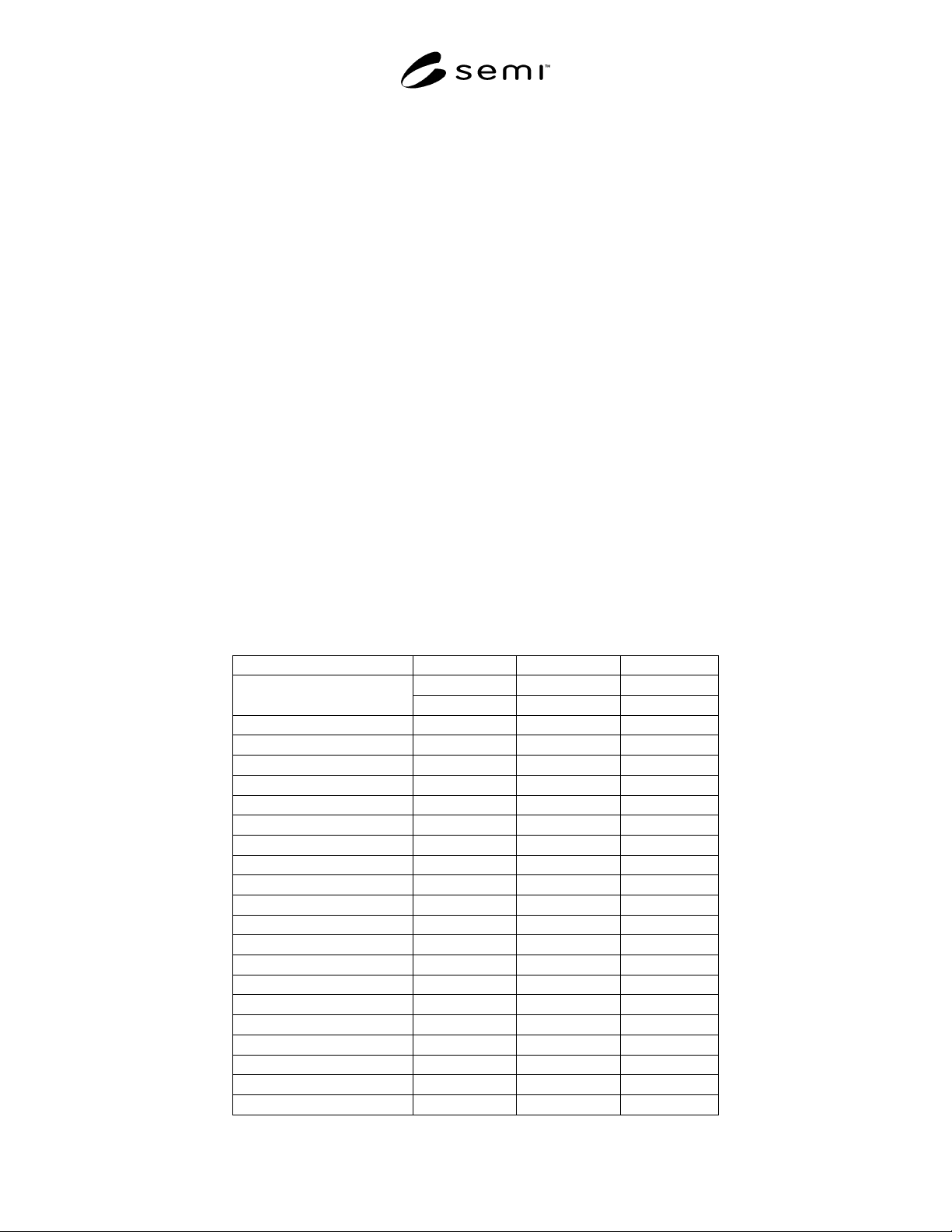
SEMI C29-0301 © SEMI 1990, 2001 4.9 % H Y D R O FLU O R IC A C ID 4 Previous SEMI Ref erenc e # C7.4- 93 C8.4-02 98 C12.3-96 Grade 2 Grade 3 Tier C (Specif ication) ( Specif ication) (Guide line) Copper (C u) 10 ppb m ax…
4.9% HYDROFLUORIC ACID SEMI C29-0301 © SEMI 1990, 20013
the indium internal standard solution. Run a reagent
blank.
10.2.4 Analysis
10.2.4.1 Using the prepared solutions and blanks,
analyze sodium, potassium, calcium, and iron by
graphite furnace atomic absorption (GFAA) and the
remaining elements by inductively coupled plasma
mass spectrometry (ICP/MS). For calibration, the
standards are made up with the 4.9% hydrofluoric acid
solution and a final concentration of 20 ng/g of the
indium internal standard.
NOTE 7: Analysis of dilute hydrofluoric acid requires the use
of special hydrofluoric acid-resistant sample introduction
systems for inductively coupled plasma mass spectrometry.
These systems are available from most instrument suppliers.
NOTE 8: Analysis of dilute hydrofluoric acid can produce
rapid corrosion of nickel cones commonly used in inductively
coupled plasma mass spectrometry; platinum cones should be
considered as an alternative when performing this analysis.
11 Grade 4 Procedures
11.1 This section does not apply to this chemical.
12 Grade 5 Procedures
12.1 This section does not apply to this chemical.
13 VLSI Grade Procedures
13.1 This section does not apply to this chemical.
14 Tier A Procedures
14.1 This section does not apply to this chemical.
15 Tier B Procedures
15.1 This section does not apply to this chemical.
16 Tier C Procedures
16.1 Standardized test methods are being developed
for all parameters at the purity levels indicated. Until
standardized test methods are published, test
methodology shall be determined by user and producer.
The Process Chemicals Committee considers a test
method to be valid if there is a documented recovery
study showing a recovery of 75–125%. Recovery is for
a known sample spike at 50% of the specified level.
17 Tier D Procedures
17.1 This section does not apply to this chemical.
Table 1 Impurity Limits and Other Requirements for 4.9% Hydrofluoric Acid
Previous SEMI Reference # C7.4-93 C8.4-0298 C12.3-96
Grade 2 Grade 3 Tier C
(Specification) (Specification) (Guideline)
Assay (HF) 4.8–5.0 % 4.8–5.0% 4.8–5.0%
Color (APHA) 10 max 10 max 10 max
Fluosilicic Acid (H
2
SiF
6
) 10 ppm max 10,000 ppb max 10,000 ppb max
Total Organic Carbon (TOC) -- -- 500 ppb max
Chloride (Cl) 500 ppb max 500 ppb max 100 ppb max
Phosphate (PO
4
) 100 ppb max 100 ppb max 100 ppb max
Sulfate (SO
4
) -- -- 100 ppb max
Sulfate and Sulfite (as SO
4
) 500 ppb max 500 ppb max --
Aluminum (Al) 10 ppb max 1 ppb max 100 ppt max
Antimony (Sb) -- 1 ppb max 100 ppt max
Arsenic (As) -- 1 ppb max 100 ppt max
Arsenic and Antimony (as As) 5 ppb max -- --
Barium (Ba) 10 ppb max 1 ppb max --
Beryllium (Be) 5 ppb max -- --
Bismuth (Bi) 5 ppb max -- --
Boron (B) 10 ppb max 1 ppb max 100 ppt max
Cadmium (Cd) 10 ppb max 1 ppb max --
Calcium (Ca) 10 ppb max 1 ppb max 100 ppt max
Chromium (Cr) 10 ppb max 1 ppb max 100 ppt max
Cobalt (Co) 10 ppb max 1 ppb max --
SEMI C29-0301 © SEMI 1990, 2001 4.9% HYDROFLUORIC ACID4
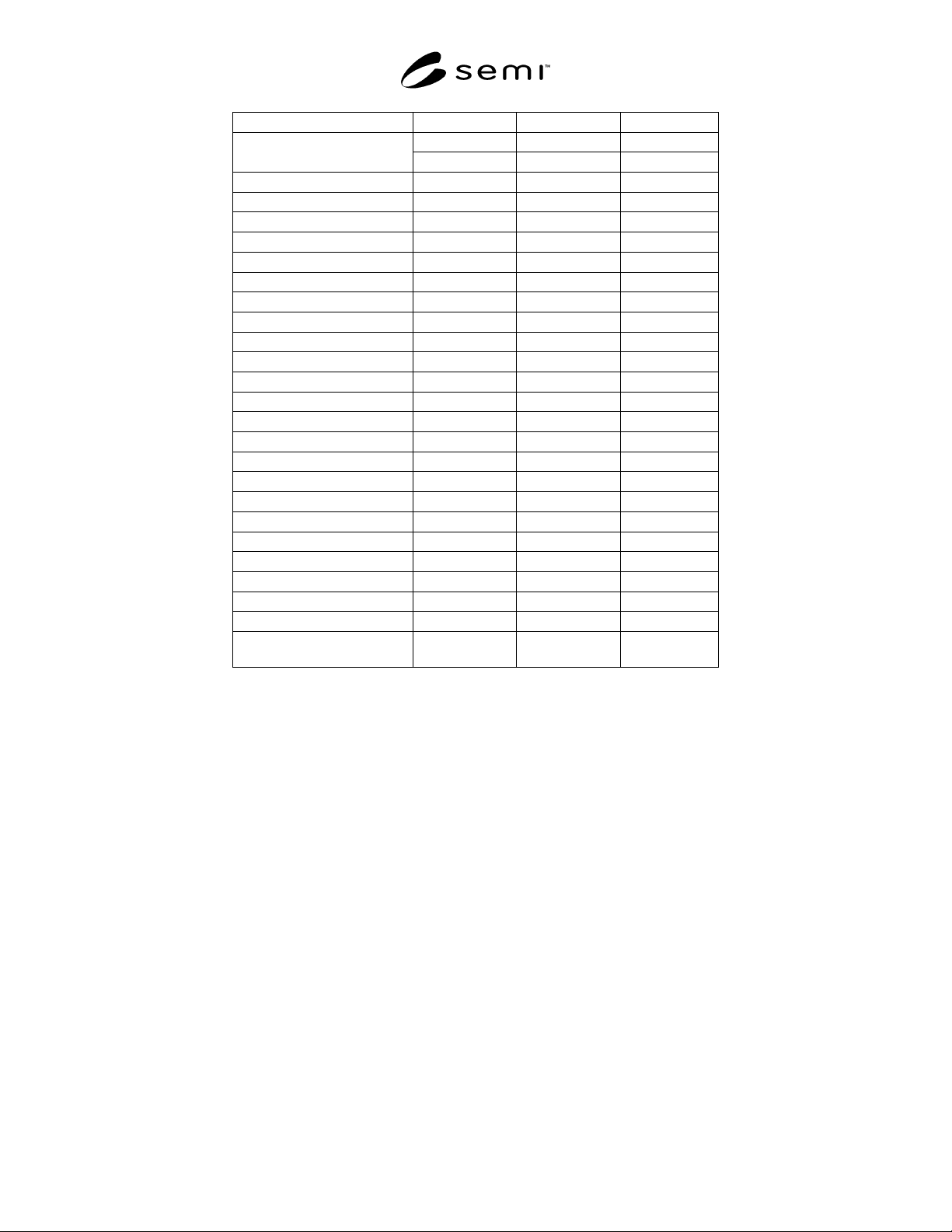
Previous SEMI Reference # C7.4-93 C8.4-0298 C12.3-96
Grade 2 Grade 3 Tier C
(Specification) (Specification) (Guideline)
Copper (Cu) 10 ppb max 1 ppb max 100 ppt max
Gallium (Ga) 10 ppb max -- --
Germanium (Ge) 10 ppb max -- --
Gold (Au) 5 ppb max 1 ppb max 100 ppt max
Iron (Fe) 10 ppb max 1 ppb max 100 ppt max
Lead (Pb) 10 ppb max 1 ppb max 100 ppt max
Lithium (Li) 5 ppb max 1 ppb max --
Magnesium (Mg) 10 ppb max 1 ppb max 100 ppt max
Manganese (Mn) 10 ppb max 1 ppb max 100 ppt max
Molybdenum (Mo) 10 ppb max 1 ppb max --
Nickel (Ni) 10 ppb max 1 ppb max 100 ppt max
Niobium (Nb) 10 ppb max -- --
Potassium (K) 10 ppb max 1 ppb max 100 ppt max
Silver (Ag) 5 ppb max 1 ppb max --
Sodium (Na) 10 ppb max 1 ppb max 100 ppt max
Strontium (Sr) 10 ppb max 1 ppb max --
Tantalum (Ta) 10 ppb max -- --
Thallium (Tl) 10 ppb max -- --
Tin (Sn) 10 ppb max 1 ppb max 100 ppt max
Titanium (Ti) 10 ppb max 1 ppb max 100 ppt max
Vanadium (V) 10 ppb max 1 ppb max --
Zinc (Zn) 10 ppb max 1 ppb max 100 ppt max
Zirconium (Zr) 10 ppb max -- --
Particles in bottles:
size, #/mL
≥ 0.5 µm, 25 max ≥ 0.5 µm, 25 max ≥ 0.2 µm, TBD
NOTICE: SEMI makes no warranties or representations as to the suitability of the standards set forth herein for any
particular application. The determination of the suitability of the standard is solely the responsibility of the user.
Users are cautioned to refer to manufacturer’s instructions, product labels, product data sheets, and other relevant
literature respecting any materials mentioned herein. These standards are subject to change without notice.
The user’s attention is called to the possibility that compliance with this standard may require use of copyrighted
material or of an invention covered by patent rights. By publication of this standard, SEMI takes no position
respecting the validity of any patent rights or copyrights asserted in connection with any item mentioned in this
standard. Users of this standard are expressly advised that determination of any such patent rights or copyrights, and
the risk of infringement of such rights, are entirely their own responsibility.
Copyright by SEMI® (Semiconductor Equipment and Materials
International), 3081 Zanker Road, San Jose, CA 95134. Reproduction o
f
the contents in whole or in part is forbidden without express written
consent of SEMI.
HYDROGEN PEROXIDE SEMI C30-1101 © SEMI 1978, 20011
SEMI C30-1101
SPECIFICATIONS AND GUIDELINES FOR HYDROGEN PEROXIDE
These specifications and guidelines were technically approved by the Global Process Chemicals Committee
and are the direct responsibility of the North American Process Chemicals Committee. Current edition
approved by the North American Regional Standards Committee on August 27, 2001. Initially available at
www.semi.org September 2001; to be published November 2001. This document replaces SEMI C1.9, C7.5,
C8.5, C11.4, and C12.4 in their entirety. Originally published in 1978, 1990, 1992, 1994, and 1995
respectively; previously published March 2001.
1 Purpose
1.1 The purpose of this document is to standardize
requirements for hydrogen peroxide used in the
semiconductor industry and testing procedures to
support those standards. Test methods have been shown
to give statistically valid results. This document also
provides guidelines for grades of hydrogen peroxide for
which a need has been identified. In the case of the
guidelines, the test methods may not have been
statistically validated yet.
2 Scope
2.1 The scope of this document is all grades of
hydrogen peroxide used in the semiconductor industry.
2.2 The VLSI grade purity level is typically required
by semiconductor devices with geometries of 0.8–1.2
microns.
2.3 This standard does not purport to address safety
issues, if any, associated with its use. It is the
responsibility of the users of this standard to establish
appropriate safety and health practices and determine
the applicability of regulatory limitations prior to use.
3 Limitations
3.1 The specification for VLSI grade hydrogen
peroxide is only applicable for materials that remain
below 25°C during transport and storage.
4 Referenced Standards
4.1 SEMI Standards
SEMI C1 — Specifications for Reagents
4.2 ASTM Standards
1
ASTM D 5127 — Standard Guide for Ultra Pure Water
Used in the Electronics and Semiconductor Industry
NOTE 1: Unless otherwise indicated, all documents cited
shall be the latest published versions.
1 American Society for Testing and Materials, 100 Barr Harbor
Drive, West Conshohocken, Pennsylvania 19428-2959, USA.
Telephone: 610.832.9585, Fax: 610.832.9555 Website:
www.astm.org
5 Terminology
5.1 None.
6 Physical Property (for information only)
Density at 25°C
1.11 g/mL
7 Requirements
7.1 The requirements for hydrogen peroxide for Grades
1, 2, 3, 4, 5, and VLSI Grade are listed in Table 1.
8 Grade 1 Procedures
NOTE 2: When hydrogen peroxide is added to water, there is
no spattering. This happens only when the order of addition is
reversed.
NOTE 3: Each laboratory is responsible for verifying the
validity of the method within its own operation.
8.1 Assay — Accurately weigh about 1 mL of sample
in a tared 100 mL volumetric flask, dilute to volume
with water, and mix thoroughly. Transfer exactly 20.0
mL of this solution to a 250 mL conical flask, add 20
mL of dilute sulfuric acid (1 + 15), and titrate with
standardized 0.1 N (0.02 M) potassium permanganate
to a pink color that persists for 15 seconds.
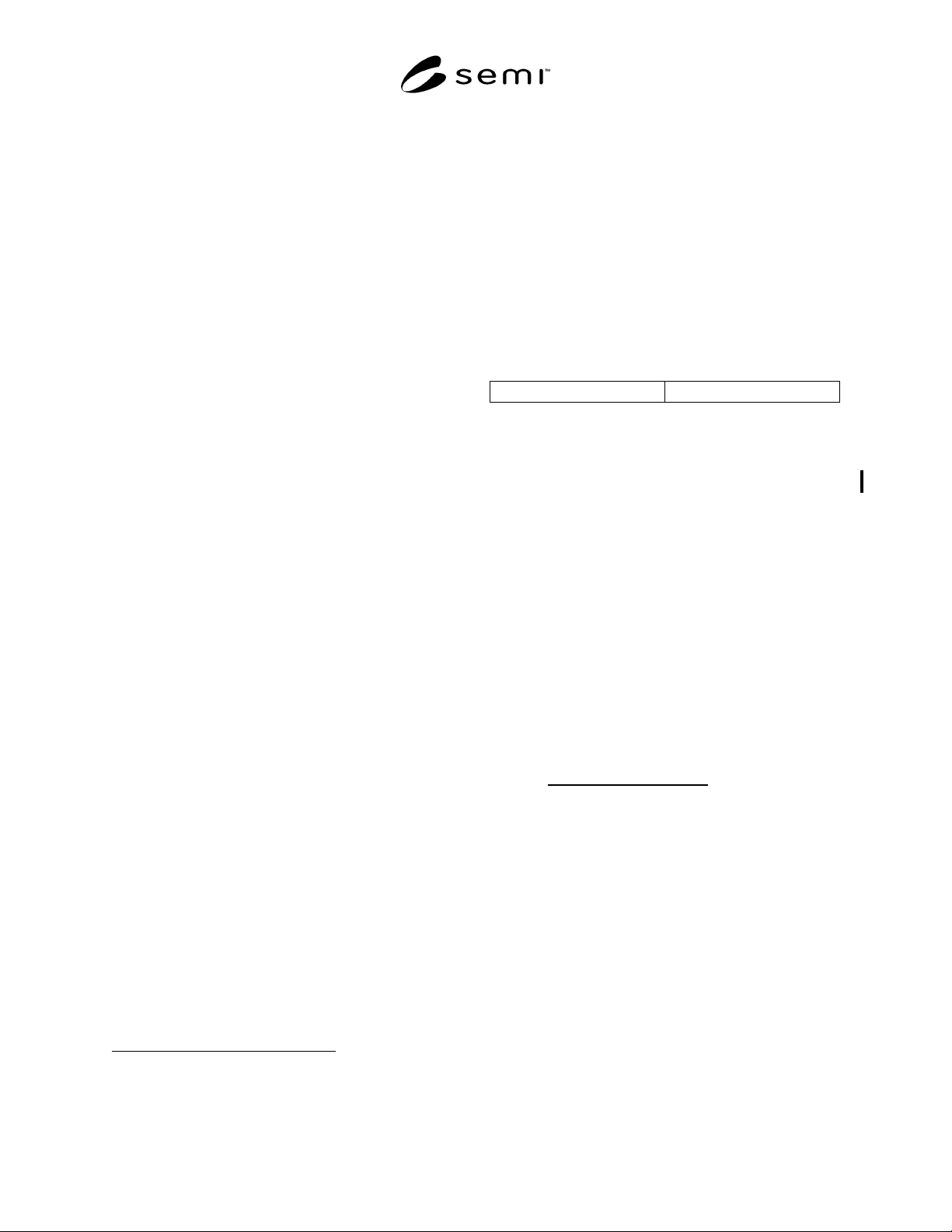
%Assay
=
mL
×
N
of KMnO
4
×
8.500
Weight of sample g
()
8.2 Color — Dilute 2.0 mL of platinum-cobalt stock
solution (APHA No. 500) to 100 mL with water.
Compare this standard (APHA No. 10) with 100 mL of
sample in Nessler tubes. View vertically over a white
background. The sample must be no darker than the
standard.
8.3 Free Acid — Dilute 9 mL (10 g) of sample with 90
mL of freshly boiled and cooled carbon dioxide-free
water. Add 0.15 mL of methyl red indicator solution
and titrate with 0.01 N sodium hydroxide. The volume
of sodium hydroxide solution consumed should not be
more than 0.6 mL greater than the volume required for
a blank test on 90 mL of the water used for dilution.