semi合集-English.pdf - 第1809页
SEMI E42-0704 © SEMI 1995, 2004 78 The delete recipe op eration is invoked with the RMEDelete service. A request to delete a currently selected recipe shall be denied. 11.2.7 Recipe Selection — Recipe selection is the pr…

SEMI E42-0704 © SEMI 1995, 2004 77
"the best version" to be determined by the namespace at
a later stage.
The verify operation is invoked explicitly with the
RMEVerify service. It may also be performed as part of
the download and verify operation as discussed in
Section 11.2.1.
11.2.2.1 Derived Object Form Recipes — For
downloaded recipes that are to be stored, the recipe
executor may wish to re-write or compress a source
form recipe into a derived object form recipe (Section
3.2.2.1.2) as part of the verification process. (The
rewritten form may be of any format and is typically
not a form of "machine-executable code".)
Where downloaded recipes are converted to a derived
object form prior to storage, a method of re-converting
to source form is required. Note that the capability to
retain user comments is desirable, but not required,
where this process is adopted.
The new derived object form recipe inherits the
attributes of the source form recipe with the following
exceptions:
• The class or name of the object form shall be
changed in a systematic and documented manner
that both makes clear the object form derivative
and its heritage from the source form original. For
example, the object form may add an extension to
the name of the original recipe.
• The BodyFormat
attribute shall be changed to
reflect the object form.
• The attributes ExecLength
, ExecChgTime,
BodyLength
, and EditTime shall be updated.
If the attribute ExecChgCtrl
requires the originating
namespace to be notified of changes, then this request
applies to the creation of the derived object form recipe,
and the ChangedBody attribute is set to TRUE until the
recipe has been uploaded successfully by the
namespace manager.
The source form recipe from which the derived object
form was obtained should not be deleted automatically.
11.2.2.2 Verification ID — The attribute
VerificationID
is used for derived object form recipes
and is provided for the recipe executor identification
code. This is a text string containing a unique and
persistent "signature" or identifier for the recipe
executor. This is used to detect derived object form
recipes that were derived by earlier software versions of
the recipe executor, or by versions used by other
agents, that may have obtained different results.
The identifier of the source form recipe of the derived
object form recipe is stored in the attribute SrcRcpID
of
the derived object form recipe.
11.2.3 Recipe Upload — Recipe upload is the
operation that returns an execution recipe from the
recipe executor's storage to the service user. It is
required for recipe executors that are able to originate
or modify recipes. Recipe upload allows recipes to be
managed in a recipe namespace.
The upload recipe operation is invoked with the
RMEUpload service.
11.2.4 Recipe Rename — The recipe rename
operation causes a recipe to be assigned a new
identifier. If the new identifier is already in use by a
pre-existing execution recipe, or if the recipe to be
renamed is currently selected, the request shall be
denied. This is a required operation.
This service is provided to maintain synchronization
between execution recipes and the managed recipes
within an originating namespace.
The rename recipe operation is invoked by the message
service RMERename.
11.2.5 Get Available Storage — The get available
storage operation is used to determine the size of the
remaining recipe storage capacity, in bytes. The value
returned shall exclude any overhead requirements for
storage of one execution recipe. That is, it shall be
assumed that sufficient storage exists for a single recipe
with a combined attribute length and body length less
than or equal to the returned value. This is a required
operation.
The get available storage operation is invoked by the
message service RMESpaceInquire.
11.2.6 Recipe Delete — The recipe delete operation
removes one or more recipes from the execution recipe
storage. Any reusable (rewritable) storage used by a
deleted recipe shall be made available for other recipes,
and the deleted recipe shall be unavailable for all
subsequent operations. This is useful to release storage
for new recipes. This is a required operation.
Recipes stored in non-reusable storage that cannot be
physically deleted shall be made unavailable for
subsequent selection.
If the recipe executor does not have execution recipe
storage (that is, if its sole storage is the recipe
execution area), then the delete operation shall
completely remove the specified recipes from the
recipe execution area.

SEMI E42-0704 © SEMI 1995, 2004 78
The delete recipe operation is invoked with the
RMEDelete service. A request to delete a currently
selected recipe shall be denied.
11.2.7 Recipe Selection — Recipe selection is the
process of locating, validating, and preparing a recipe
for execution within the execution area. Recipe
selection is a required operation of the recipe executor
that allows specification of initial (default) values of
any variable parameters defined by the recipe. Initial
parameter values specified at this time shall override
the corresponding values contained in the Exec-
LinkParam attribute.
It shall be possible to explicitly specify a recipe for
execution. It may also be possible to implicitly select a
recipe, including initial variable parameter values,
through other operations, such as within a higher-order
"process job". Services for implicit methods and for
starting execution itself are beyond the scope of RMS.
If the recipe class is omitted when specifying a recipe
for selection, then the class "/PROCESS/" shall be
assumed.
The request for recipe selection specifies one or more
recipes to be selected. If a recipe cannot be located in
the recipe executor's recipe storage area, then the recipe
executor may optionally attempt to locate and retrieve it
from the originating namespace specified.
Only a linked recipe (with the Linked
attribute set to
TRUE) may be specified by the service user. An
attempt to select an unlinked recipe shall be denied.
Subrecipes that are part of a linked recipe set are
required only to be verified but not linked.
The selection process completes abnormally whenever
an error is detected, including the failure to locate a
specified recipe or to successfully store it, invalid
parameter settings, an attempt to select an unverified
recipe, and other validation errors.
The select recipe operation is invoked with the
RMESelect service.
11.2.7.1 Multiple Selection — Executing agents that
support subclasses of the PROCESS class shall provide
at least one of two methods for the selection of multiple
recipes: (1) they may either allow, or require, that a
request for recipe selection explicitly specify a recipe
from each of certain subclasses, and/or (2) they may
either allow, or require, specification of required
subclasses within a linked set of multi-part recipes.
Such additional permissions and restrictions shall be
included in the recipe management documentation.
For executing agents that support multi-part recipes
(such as described in method 2 above), the recipe
executor is responsible for validating, as a set, the main
recipe and all its subrecipes listed in the LinkList
attribute of the main recipe as a condition of execution.
If the namespace is specified as "Default", the default
namespace is used. The name of this namespace is the
value in the recipe executor attribute DefaultName-
space (see Section 6.4 and 6.7).
All recipes in the linked recipe set are considered to be
selected if the select operation is successful.
11.2.7.2 Validation — Validation consists of type and
range-checking of recipe settings and parameters, and
of confirmation that the recipe is valid for the current
hardware configuration. Validation shall occur as part
of the process of selection. For recipe executors that
require several different classes of recipe, validation
may depend on the recipes that are selected as a set.
For example, a diffusion furnace may have a class of
recipe that is used for the current gas configuration to
map gases to valves. The furnace's normal process
recipe that uses names of gases can only be validated in
combination with the gas configuration table selected at
the same time.
11.2.7.3 Delegation — If delegated recipes are
specified in LinkList
, it is the responsibility of the
recipe executor to ensure that the designated recipe is
accessible to the recipe executor of the component
agent at the time it is selected. Otherwise, the select
request shall be denied.
11.2.7.4 Variable Parameters — For recipes with
variable parameters, new initial values for some or all
of its parameters may be specified as part of the
selection as a parameter name and parameter initial
value pair. Parameter values specified as part of the
selection take precedence over those initial values
defined in the ExecLinkParam
attribute. However,
parameter restrictions may not be changed when
selecting a recipe.
All parameter values that are set either prior to, or
during
12
, the execution of a recipe shall satisfy the
conditions of the parameter restriction. If a parameter
restriction is given in the ExecLinkParam attribute,
then that restriction is used for all occurrences of the
parameter.
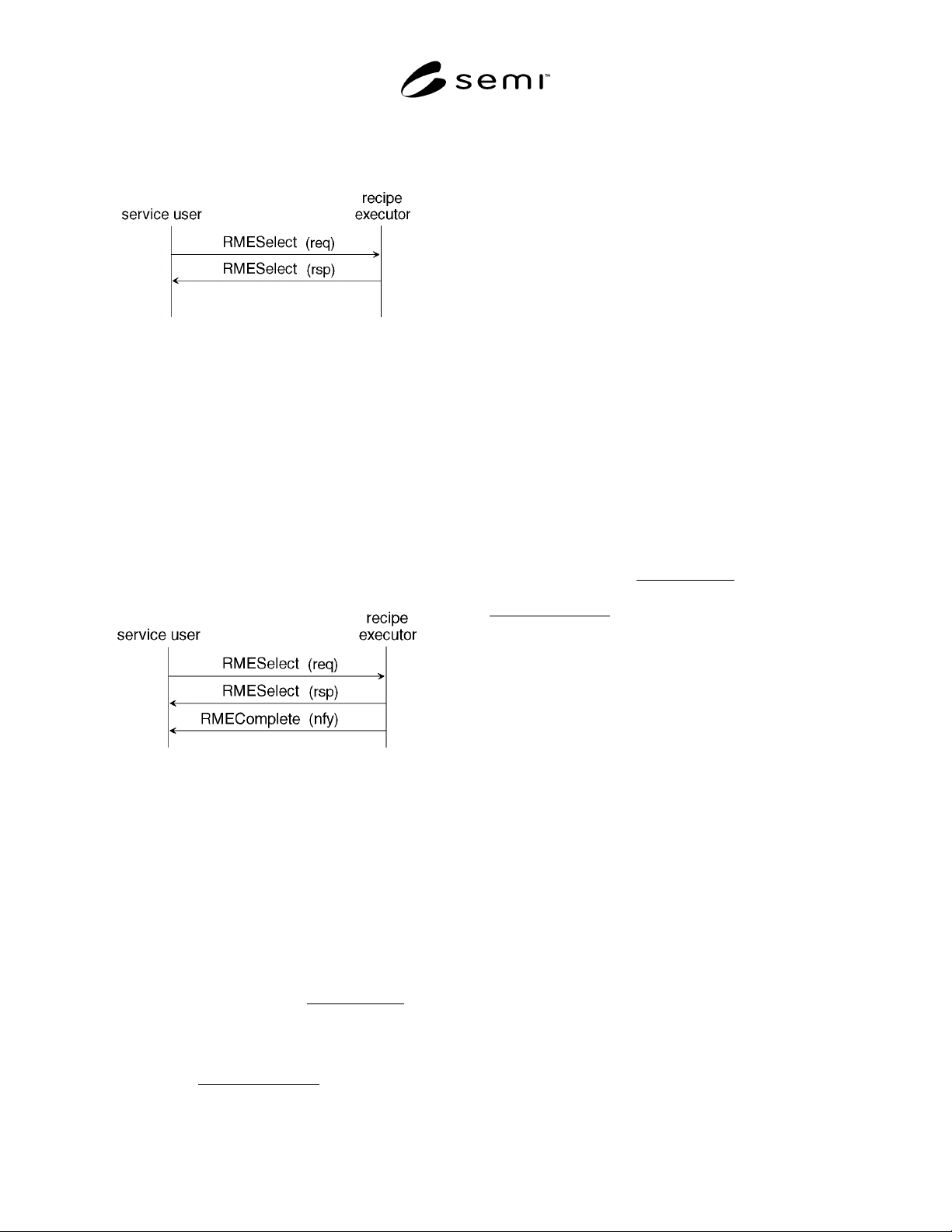
11.2.7.5 Message Scenarios — There are two possible
message flows between the recipe executor and the
service user for the select service.
If the recipe executor is able to locate the recipes in its
local storage, to validate them as a set, and to ready
12 RMS neither defines, nor prohibits, methods for changing
parameter values during the execution process.
SEMI E42-0704 © SEMI 1995, 2004 79
them for execution in a timely manner, then it may
indicate the results of the select operation in the
response message, as illustrated in Figure 11.1.
Figure 11.1
RMESelect Message Flow
Alternatively, the recipe executor may anticipate that
the process of selection will require more time. In this
case, it may send a response indicating the intent to
perform the operation as soon as possible, prior to
starting the operation. The notification message
RMEComplete is sent when all specified recipes are
selected or when a selection failure occurs. Exactly one
notification message is sent, as illustrated in Figure
11.2.
Figure 11.2
RMESelect with RMEComplete Notification
If all recipes are located and in local storage, the recipes
are validated as a set.
11.2.7.6 Selected Recipes — Once a recipe and its
associated subrecipes have been selected, they shall be
fully protected from inadvertent (unintentional) change,
including change through download, overwrite,
deletion, and renaming operations.
The recipe executor attribute RecipeSelectID
shall be
set to the list of currently selected recipes, including all
main recipes specified in the select request and all
subrecipes within a linked recipe set.
The attribute RecipeSelectParam
shall be set to the list
of all variable parameter definitions currently in effect
following selection and prior to the start of actual recipe
execution.
11.2.7.6.1 Select Errors — If the recipe executor is
unable to locate a recipe specified for selection in its
storage, it is responsible for obtaining the recipe from
the designated namespace included in the recipe
specifier.
Possible errors resulting from the select operation
include:
• Failure to specify recipes from each of the
subclasses that it requires,
• Failure to validate a recipe,
• Failure to locate a recipe in a specified namespace,
• Failure to locate a recipe, and
• An attempt by the user to select an unlinked recipe.
The select recipe operation is invoked with the
RMESelect service.
11.2.8 Recipe Deselection — A selected recipe is
deselected by making it unavailable for execution for
the next (subsequent) processing cycle, deleting its
identifier from the RecipeSelectID
attribute, and
deleting its parameter definitions from
RecipeSelectParam
attribute. This is a required
operation.
Only a main recipe that is currently selected may be
specified for deselection. Deselecting a main recipe
shall result in the simultaneous deselection of all of its
subrecipes.
If a recipe is deselected during execution, this shall
have no effect until the current process cycle has
completed.
The recipe executor may have additional restrictions
concerning deselection.
The deselect recipe operation is invoked with the
RMEDeselect service.
11.2.9 Get Execution Recipe Descriptor — The get
execution recipe descriptors operation returns the
descriptors of a specified execution recipe: the
execution attribute descriptor, the generic attribute
descriptor, and the body descriptor, in that order. This
is a required operation.
The execution recipe descriptor may be used to
compare two execution recipes or a managed recipe and
an execution recipe.
The get execution recipe descriptor operation is
invoked with the RMEGetDescriptor service.