semi合集-English.pdf - 第1968页
SEMI E54.4-0704 © SEMI 1997, 2004 3 4 Referenced Standards 4.1 SEMI Standards SEMI E30 — Generi c Model for Com munications and Control of SEMI Equipment (GEM) SEMI E39 — Object Se rvices Standard: Concepts, Behavior, an…
SEMI E54.4-0704 © SEMI 1997, 2004 2
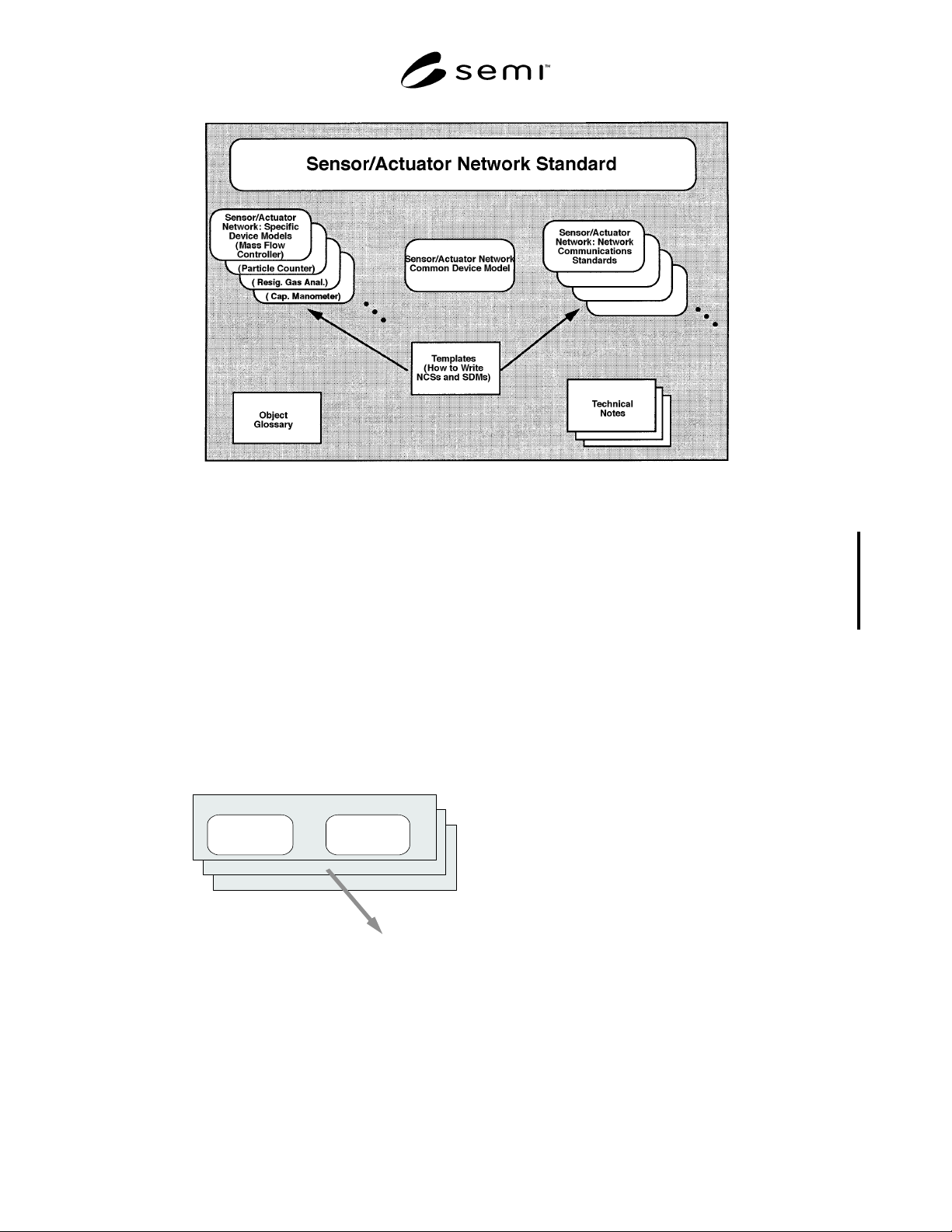
Figure 1
Sensor/Actuator Network Related Documents
2.5 Document Structure — The DeviceNet network
communication standard complies with the SEMI SAN
NCS template document structure; this structure is
shown in Figure 2. The standard document is composed
of two main parts. The first part (Sections 1 through 8)
specifies the SAN enabling protocol as well as the
presentation (i.e., mapping) of CDM object structure
and behavior onto the network (referred to as the
“CDM mapping”). The second part (Section 9)
specifies the presentation (i.e., mapping) of SDM object
structure and behavior onto the network for each SEMI-
specified SDM (referred to as the “SDM mapping”).
CDM
Mapping
(DeviceNet NCS)
SDM
Mappings
(M F C , P article C ounter,
Resig. Gas Anal., etc.)
{
This
Document
•
•
•
(Other NCS
Standards)
Figure 2
DeviceNet NCS Document Structure
2.6 Adding SDM Mappings — SDM mappings added
to part two of this document are considered document
additions and are balloted as such. An SDM mapping
may only be balloted for addition to this document if
the corresponding SEMI SDM has been standardized or
is in the process of being balloted for standardization.
NOTICE: This standard does not purport to address
safety issues, if any, associated with its use. It is the
responsibility of the users of this standard to establish
appropriate safety and health practices and determine
the applicability of regulatory or other limitations prior
to use.
3 Limitations
3.1 This document specifies a semiconductor
equipment SAN based solely on DeviceNet and is a
companion document to the DeviceNet specification;
thus, a complete specification of this standard
necessarily includes the DeviceNet specifications.
There are other semiconductor equipment SAN
communications options. The specifications for these
options are not included here.
3.2 This standard specifies enhancements that provide
additional capabilities over and above those currently
required by DeviceNet. In order to avoid document
consistency problems, information in the DeviceNet
specification that relates to this standard is not repeated
in this document. This document is limited to
describing enhancements or limitations to the
DeviceNet specification that are imposed by this
standard.
3.3 A complete specification of the conformance
testing procedure shall include the DeviceNet protocol
conformance testing specification. Conformance testing
shall also include enhancements and limitations to the
DeviceNet specification required by this standard.
SEMI E54.4-0704 © SEMI 1997, 2004 3
4 Referenced Standards
4.1 SEMI Standards
SEMI E30 — Generic Model for Communications and
Control of SEMI Equipment (GEM)
SEMI E39 — Object Services Standard: Concepts,
Behavior, and Services
SEMI E54.1 — Standard for Sensor/Actuator Network
Common Device Model
4.2 ISO Standards
1
ISO 7498 — Basic Reference Model for Open Systems
Interconnection
ISO 11898 — Road Vehicles — Interchange of Digital
Information — Controller Area Network (CAN) for
High-Speed Communications
4.3 Other Documents
DeviceNet Specification — ODVA
2
Controller Area Network Specification — Version 2, R.
Bosch GmbH, + Postfach 50 D-7000, Stuttgart 1,
Germany, 1991
NOTICE: Unless otherwise indicated, all documents
cited shall be the latest published versions.
5 Terminology
Terminology that is common to all of the documents in
this SAN standard may also be defined in the Sensor
Actuator Network Standard. Terminology may be
reproduced here which is defined in other SEMI
documents.
5.1 Abbreviations & Acronyms
5.1.1 CAN — Controller area network
5.1.2 CDM — Common device model
5.1.3 DM — Device manager (object)
5.1.4 DN — DeviceNet
5.1.5 NCS — Network communication standard
5.1.6 OSI — Open systems interconnect
5.1.7 OSS — Object services standard
5.1.8 SAC — Sensor, actuator, controller (object)
5.1.9 SAN — Sensor/actuator network
1 International Organization for Standardization, ISO Central
Secretariat, 1, rue de Varembé, Case postale 56, CH-1211 Geneva 20,
Switzerland. Telephone: 41.22.749.01.11; Fax: 41.22.733.34.30,
Website: www.iso.ch
2 Open DeviceNet Vendor Association, www.odva.org
5.1.10 SDM — Specific device model
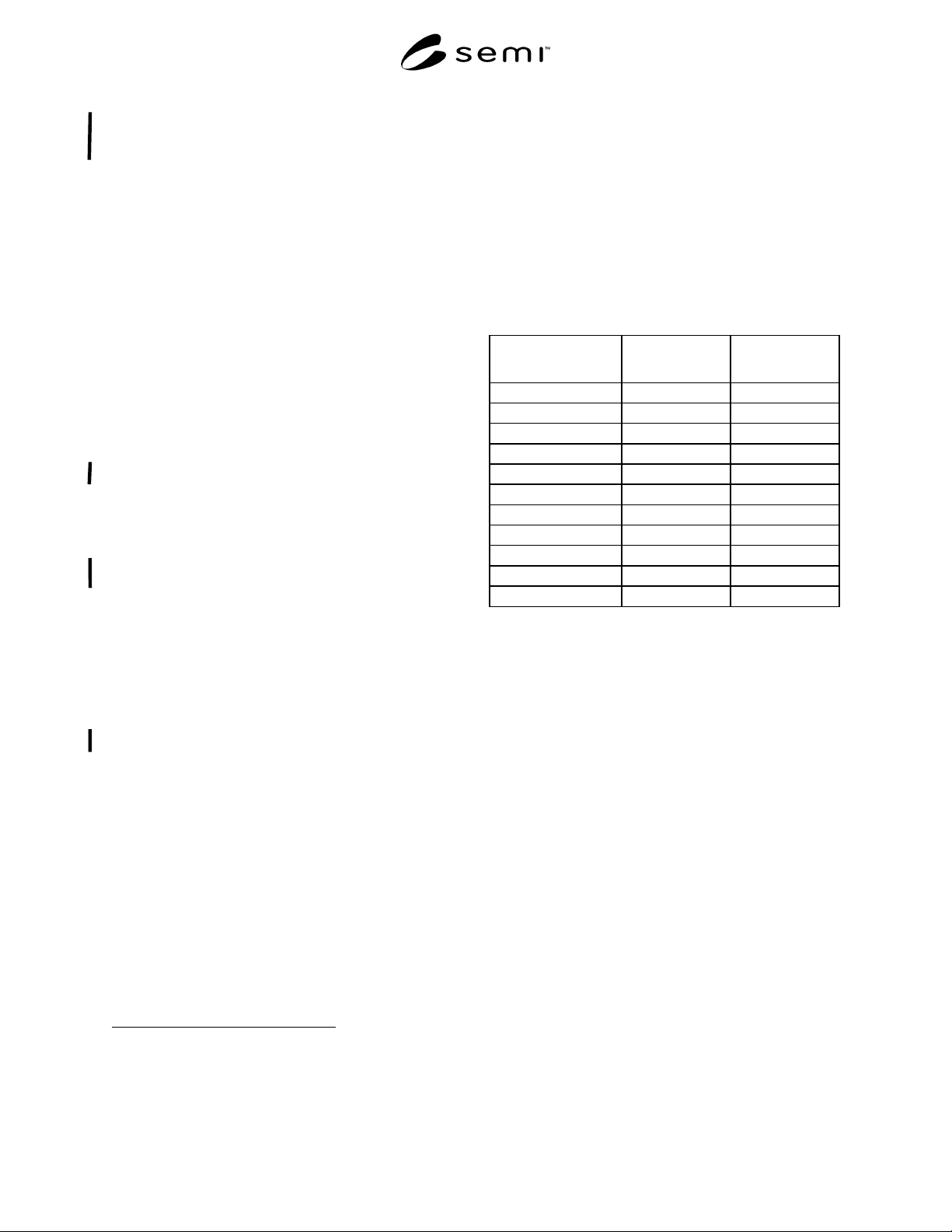
5.2 Device Component Definitions — As this standard
defines the presentation or mapping of CDM data
structure and behavior over a network, it makes use of
many of the terms in the CDM document. Table 1
provides a mapping of fundamental terminology of the
CDM document into this document and the DeviceNet
specification. Note that Column 2 contains an equal
sign “=” if the definition is used exactly as specified in
the CDM specification.
Table 1 Mapping of CDM to NCS Terminology
CDM Term
NCS Equivalent
DeviceNet
Equivalent
Device = =
Device Model = =
Object =, Class =, Class
Instance = =
Attribute = =
Behavior = =
Service = =
State Diagram = =
Byte = =
Nibble = =
Character String = =
5.3 DeviceNet Specific Definitions
5.3.1 class — a set of objects that all represent the
same kind of system component. A class is a
generalization of an object. All objects in a class are
identical in form and behavior, but may contain
different attribute values.
5.3.2 controller area network (CAN) — a protocol
developed by the Bosch corporation for automotive in-
vehicle networking. The CAN specification specifies
OSI reference model layers 1 and 2, specifically the
physical signaling and media access/data link protocols.
5.3.3 device profile — a DeviceNet specification for a
device that contains an object model for the device
type, the I/O data format for the device type, and the
configuration data and the public interface(s) to that
data.
5.3.4 explicit message connections — connections over
a DeviceNet network that provide generic, multi-
purpose communication paths between two devices.
These connections often are referred to as just
messaging connections. Explicit messages provide the
typical request/response - oriented network communi-
cations.
SEMI E54.4-0704 © SEMI 1997, 2004 4
5.3.5 input/output connections — connections over a
DeviceNet network that provide dedicated, special-
purpose communication paths between a producing
application and one or more consuming applications.
Application-specific I/O data moves through these
ports.
6 Communication Protocol High Level
Structure
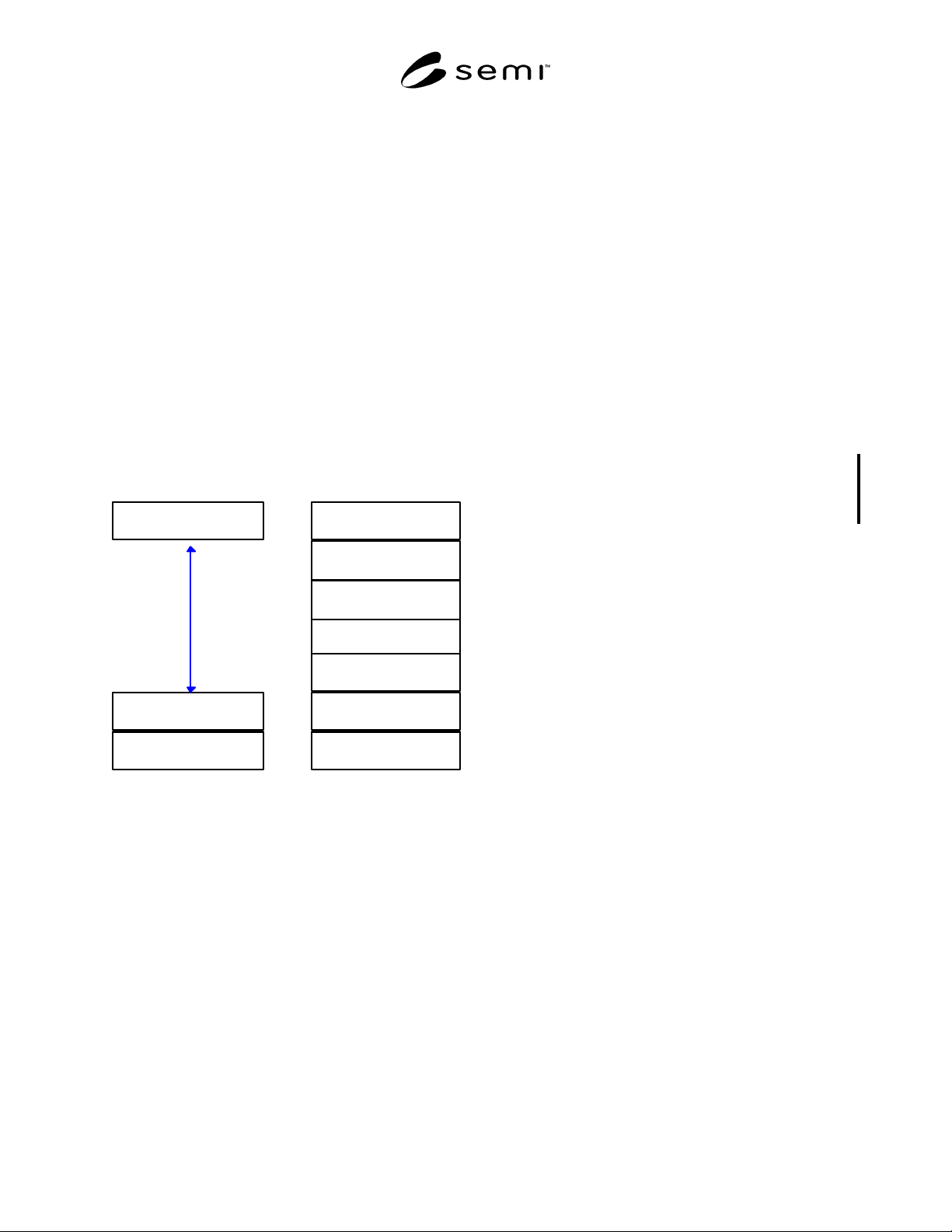
6.1 The DeviceNet protocol is loosely based on a
three-layer architecture. These layers constitute a
collapsed form of the OSI seven-layer architecture,
mapping into the physical, data link, and application
layers of the Reference Model; however, DeviceNet
provides additional functionality (such as connection
support) commonly attributed to other OSI layers. The
high level protocol architecture is shown in Figure 3.
DN Application Layer
CAN Data Link
DN Physical Layer
Layered View of DeviceNet
Application Layer
Presentation Layer
Session Layer
Transport Layer
Network Layer
Data Link Layer
Physical Layer
OSI Reference Model
Figure 3
Layered View of DeviceNet
6.1.1 Note that Figure 3 represents a conceptual view
of the device architecture. Conforming implementations
must implement the services defined in this
specification at each layer and must appear (from the
network) to have implemented this architecture;
however, an internal modular partitioning is not
required. Implementations may sacrifice modularity in
order to achieve high performance.
6.2 The DeviceNet physical layer is fully specified in
Volume 1 of the DN Specification. Features of this
layer include Trunkline - dropline configuration,
simultaneous support for both network-powered and
self-powered devices, and selectable data rates
including at least 125k, 250k, and 500k baud. At the
data link layer, the CAN specification defines a carrier
sense multiple access mechanism for media access
control that avoids collisions and sends frames reliably.
The application layer is specified in Volumes 1 and 2 of
the DN Specification and provides for the definition of
DeviceNet applications as a collection of addressable
objects. Two basic categories of objects exist:
Communication Objects and Application Objects.
Communication Objects manage and provide for the
runtime exchange of messages across DeviceNet.
Application Objects implement product-specific
features and/or provide a logical interface to product-
specific information of devices on a DeviceNet
network.
6.3 In the remainder of this section, the protocol
structure is described in more detail in terms of the OSI
seven layer reference model, the object model
environment, and network management specifications.
6.4 Physical Layer — The device shall comply with the
DeviceNet physical layer specification as well as the
" Interface Guidelines for DeviceNet Devices on
Semiconductor Manufacturing Tools" which is
published as part of the DeviceNet specification. This
includes physical signaling (levels and baud rates -
detailed in the CAN specification), transceivers, node
isolation, media topology, cable specifications, network
connectors and taps, and power considerations (load
limits, system tolerances, and power supply options).
6.4.1 Physical Layer Enhancements — This standard
supports the following physical layer enhancement to
the DeviceNet specifications:
• The transmission media, including both trunk cable
and drop cable, shall be DeviceNet Thin Cable.
Specifications on this cable and its utilization in
DeviceNet systems (e.g., maximum trunk and drop
lengths) are included in the DeviceNet
specification.
6.5 Data Link Layer — The device shall comply with
the DeviceNet Data Link Layer Specifications (i.e.,
Controller Area Network Specification: Version 2).
This includes the media access control mechanism and
the logical link control mechanism. Addressing is
currently limited to 11 bits.
6.6 Network Layer — There is no distinct network
layer.
6.7 Transport Layer — There is no distinct transport
layer. Some of the functionality of this layer is
implemented in the Application Layer. Specific
functions include: segmentation/reassembly for full
message delivery and the establishment of node-to-node
connections.
6.8 Session Layer — There is no distinct session layer.