semi合集-English.pdf - 第7740页
SEMI T12-0305 © SEMI 2004, 2005 19 10 Services for Attachment Tracking 10.1 Services — T his section defines content of service messages p rovided by c lasses in this document. 10.1.1 Format and Pr otocol — The message f…
SEMI T12-0305 © SEMI 2004, 2005 18
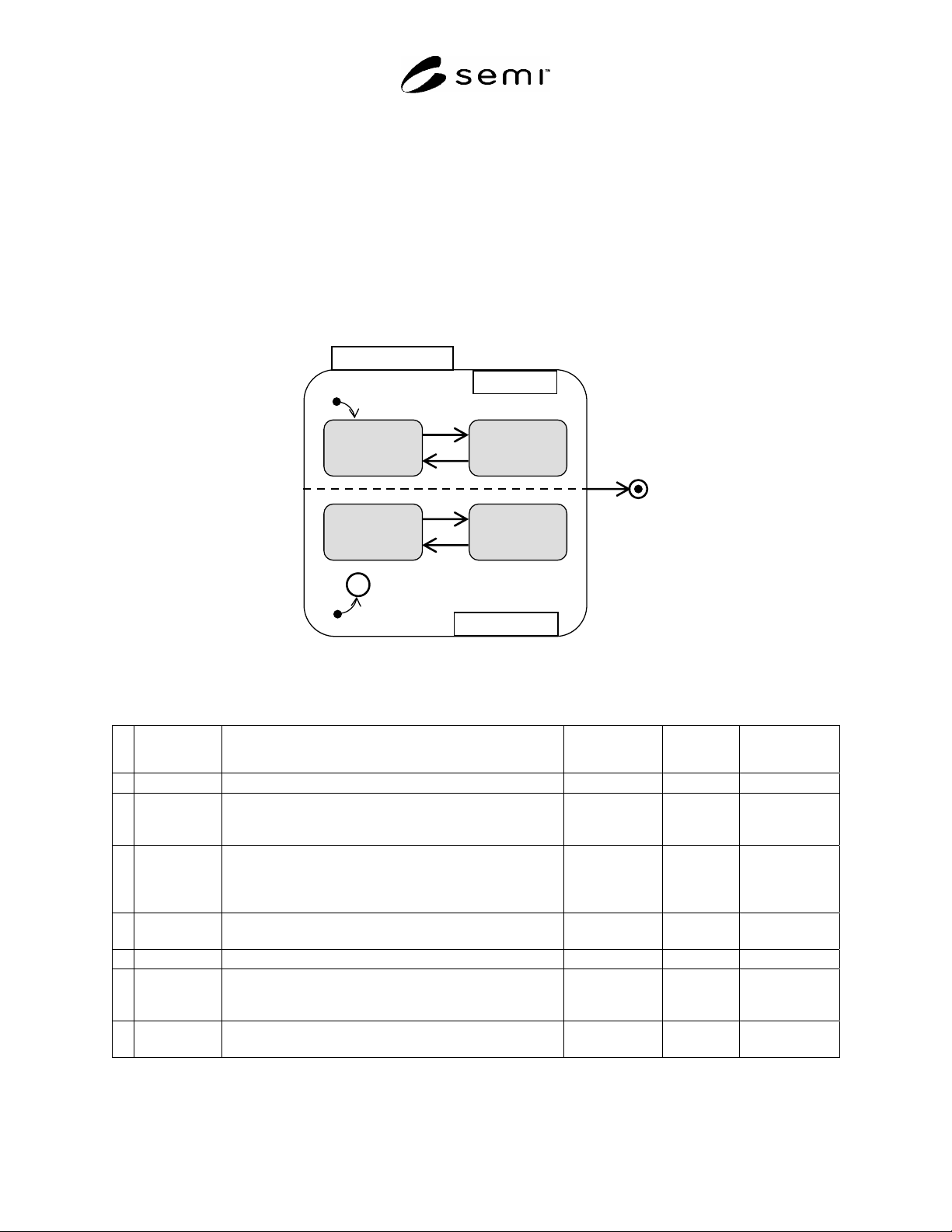
9.13.2.1.3.3 INUSE — One of substates of USING state. Attachment (Secondment) is used for such intension as
process or maintenance right now. It doesn’t matter where it is on equipment but
9.13.2.1.3.4 EXPIRATION — This substate specifies effectiveness of Secondment whether it is expired or not. If
there are more than one expiration condition, more than one EXPIRATION substates could be paralleled but it’s out
of specification of this document. If all the conditions doesn’t fit, it must be EFFEVTIVE and if one of the
conditions fired, it must be EXPIRED.
9.13.2.1.3.5 EFFECTIVE — One of substates of EXPIRATION state. This substate represents that Attachment
(actually Secondment) is not expired and it is no problem to keep using.
9.13.2.1.3.6 NOTUSED — One of substates of EXPIRATION state. This substate represents that Attachment
(actually Secondment) has been expired and it is not recommended to use.
NOTUSED
INUSE
USING
1
2
7
3
EFFECTIVE
EXPIRED
5
6
EXPIRATION
SECONDMENT
4
C
Figure 18
Secondment State
Table 7 Transition Definition Table for JitMachine
#
PREVIOUS
STATE
TRIGGER NEW STATE ACTIONS COMMENTS
1 (No state) Secondment has been created. NOTUSED
2
NOTUSED Secondment has been loaded to certain position for such
intension as process or maintenance, or equipment runs for
above intension with the Secondment.
INUSE
3
INUSE Secondment has been unloaded from certain position for
such intension as process or maintenance, and equipment
stops running for above intension with the Secondment or
still runs but it is not related to the Secondment.
NOTUSED
4
(No state) Secondment has been created. EFFECTIVE
[or] EXPIRED
5 EFFECTIVE One of expiration condition has met. EXPIRED
6
EXPIRED Hitting expiration condition is reconsidered / withdrawn
(destructed), or corresponding Attachment has been
maintained or repaired on site.
EFFECTIVE
7
(any state of
Secondment)
Secondment has been removed. (No state)

SEMI T12-0305 © SEMI 2004, 2005 19
10 Services for Attachment Tracking
10.1 Services — This section defines content of service messages provided by classes in this document.
10.1.1 Format and Protocol — The message format and communication protocol may not be defined here because
they are dependent to specific implementation.
10.1.2 Public Interface — Service definition is a part of definition of public interface. Implementation of services
may not be always required if a set of the message communication between objects or from outside of this system
are not the boarder of deployment unite provided by different suppliers.
10.1.3 Component Based Deployment — However even if they are not, implementing it may help component base
deployment. If it is component based, it is easy to replace, update or improve system by component or such
subcomponent as class.
10.2 Service Definition — Service definitions are given for each class.
10.2.1 Attachment — Following tables defines services of Attachment class.
10.2.1.1 Service List — Attachment class has following services.
Table 8
Operation Description Type Reqd
showId Inquires identification of Attachment. R Y
showName Inquires name of Attachment. R N
changeName Changes name of Attachment. R N
showType Inquires specific type of Attachment. R Y
showHistory Inquires all or a part of Attachment’s history. R Y
updateHistory Adds recent history of Attachment. R Y
10.2.1.2 showId — This service is used to inquire Attachment’s ID. Following table defines its parameters.
Table 9
Parameter Req/Ind Rsp/Conf Description
AttachmentId - M Identification of Attachment.
ServiceStatus - M Result of service request.
10.2.1.3 showName — This service is used to inquire Attachment’s name. Following table defines its parameters.
Table 10
Parameter Req/Ind Rsp/Conf Description
AttachmentName - M Name of Attachment.
ServiceStatus - M Result of service request.
10.2.1.4 changeName — This service is used to change Attachment’s Name. Following table defines its
parameters.
Table 11
Parameter Req/Ind Rsp/Conf Description
AttachmentName M C Name of Attachment.
ServiceStatus - M Result of service request.
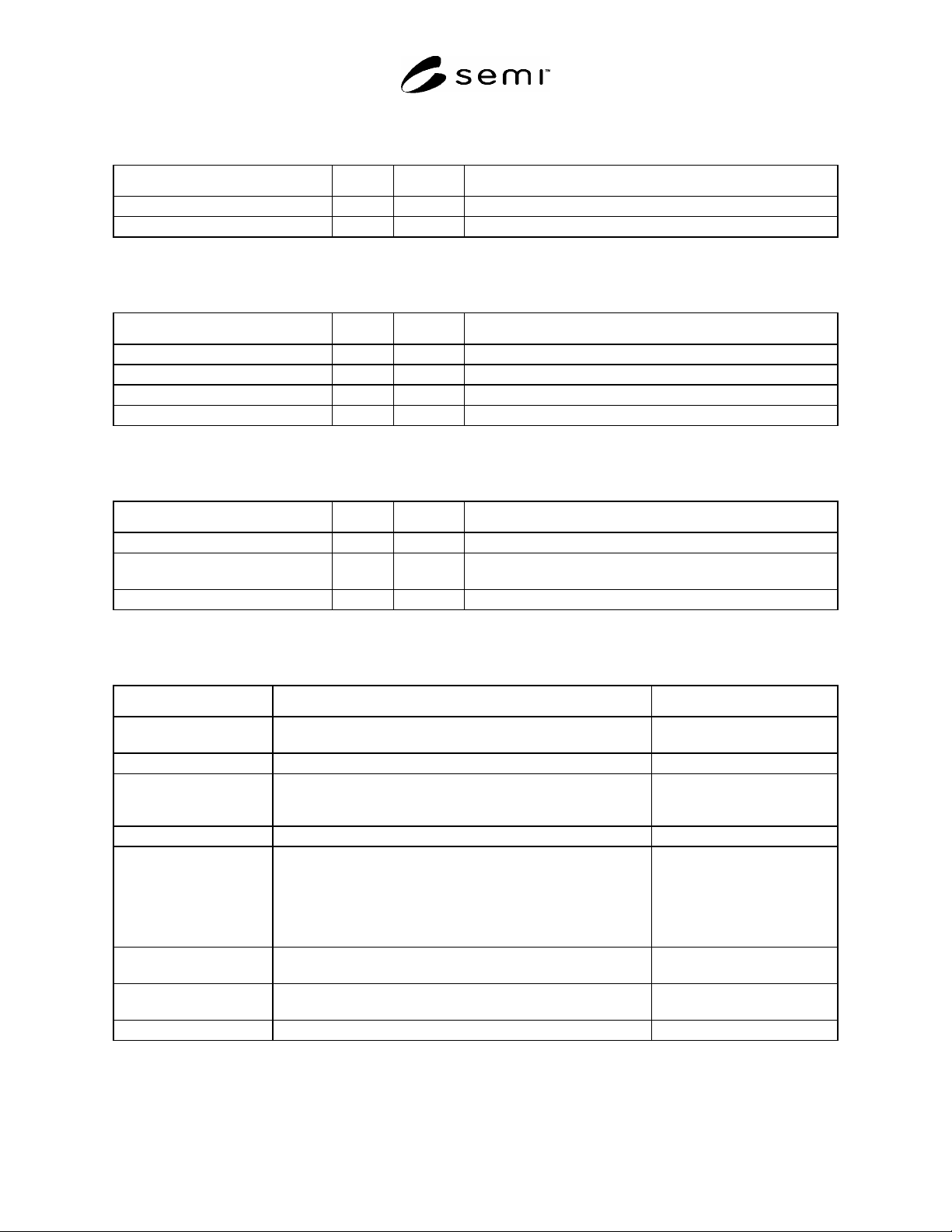
SEMI T12-0305 © SEMI 2004, 2005 20
10.2.1.5 showType — This service is used to inquire Attachment type. Following table defines its parameters.
Table 12
Parameter Req/Ind Rsp/Conf Description
AttachmentType - M Type of Attachment.
ServiceStatus - M Result of service request.
10.2.1.6 showHistory — This service is used to inquire Attachment history. Following table defines its parameters.
Table 13
Parameter Req/Ind Rsp/Conf Description
Items C - Expected Items.
Restriction C - Restriction for items.
History - M Requested attachment’s history.
ServiceStatus - M Result of service request.
10.2.1.7 updateHistory — This service is used to add Attachment history. Following table defines its parameters.
Table 14
Parameter Req/Ind Rsp/Conf Description
Item M - Added Item.
HistoryDifference M - Difference of attachment’s history to be updated. Contents must
be as same as written on equipment.
ServiceStatus - M Result of service request.
10.2.1.8 Parameter List — Above services use following parameters.
Table 15
Parameter Definition Form
AttachmentId Identification of Attachment: usually equivalent to physical ID
maybe tagged on physical attachment.
Text.
AttachmentName Human friendly name assigned on an Attachment. Text.
AttachmentType Type of Attachment: at least jig or implement, and based on
attachments’ compatibility. Further classification is dependent on
manufacturer, attachment, equipment or strategy of its user.
Enumerated.
History Historic record of Attachment. Text.
HistoryDifference Difference of historic record of Attachment from last released
information, including events and difference of fluctuating values.
Fluctuation of such specific values as durations and cycles are
embedded by special events so that they are known as such value
fluctuation. Every event must have ID, code, description and
timestamp.
Text.
Item Category of a historic record: event, exception, critical/affective
process condition, cycles and etc.
Text.
Restriction Screening parameter for history items: e.g., all, latest, summary,
time=0715/300903-1655/311203, time=-100.
Text.
ServiceStatus Result of service to show successful or reason of failure. Text.