semi合集-English.pdf - 第4764页
SEMI C15-95 © SEMI 1995, 2002 1 SEMI C15-95 (Reapproved 1102) TEST METHOD FOR ppm AND ppb HUMIDITY STANDARDS This test method was technically approved by the Global Gases Committee and is the dire ct responsibility of th…
SEMI C14-95 © SEMI 1995, 2002 3
7.4 Break-in Test — Identify the period of time required to obtain 3 consecutive one hour sampling intervals
without detection of particles and the total number of particles recorded during this period.
7.5 Pulse Test — Identify the number of pulses during which particles were detected and the total number of
particle counts.
7.6 Final Purge Test — Identify the average particle concentration at each pressure.
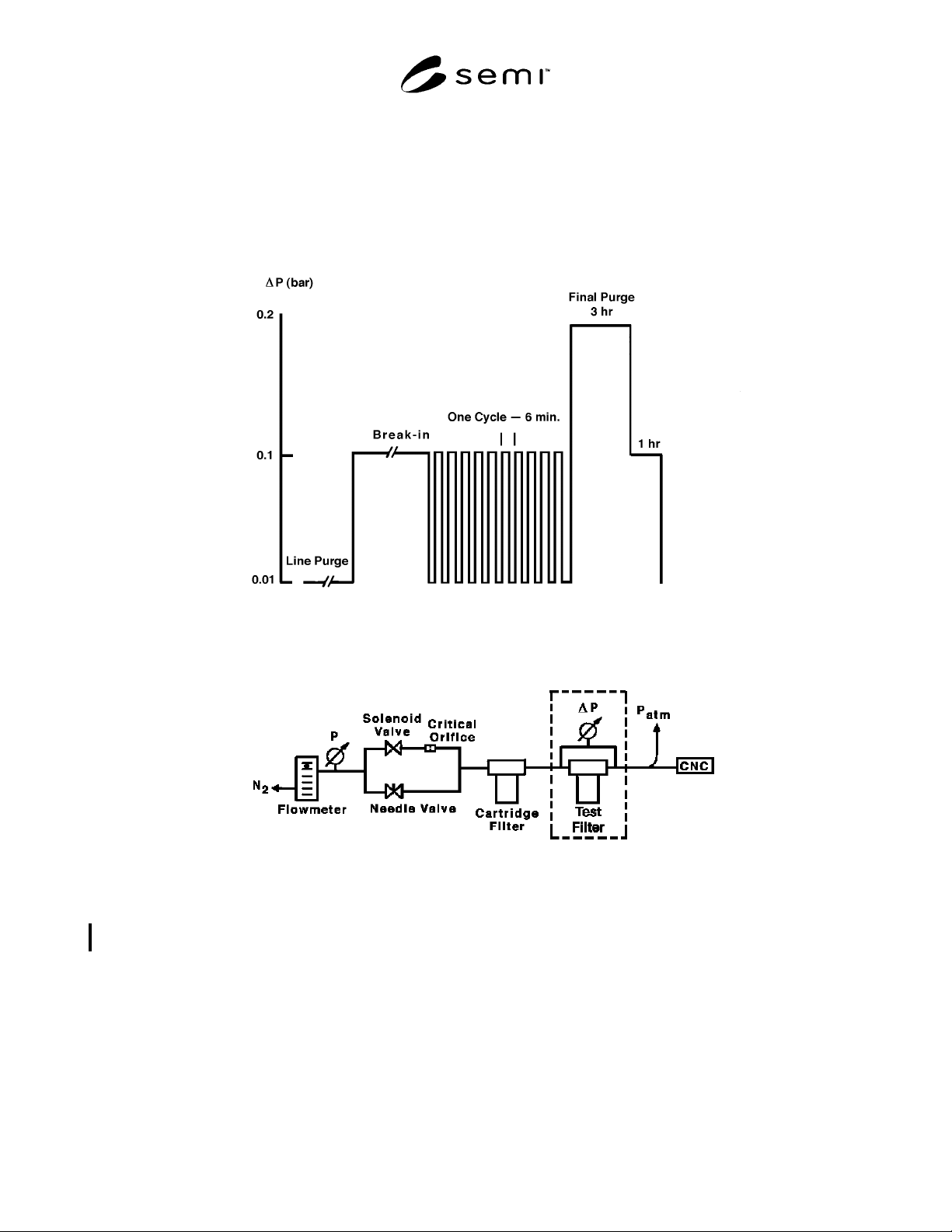
Figure 1
Schematic of a Standard Test Sequence for Evaluating 10-inch Filters
Figure 2
Schematic of the Line Purge Test Setup
NOTICE: SEMI makes no warranties or representations as to the suitability of the standards set forth herein for
any particular application. The determination of the suitability of the standard is solely the responsibility of the user.
Users are cautioned to refer to manufacturer’s instructions, product labels, product data sheets, and other relevant
literature respecting any materials mentioned herein. These standards are subject to change without notice.
The user’s attention is called to the possibility that compliance with this standard may require use of copyrighted
material or of an invention covered by patent rights. By publication of this standard, SEMI takes no position
respecting the validity of any patent rights or copyrights asserted in connection with any item mentioned in this
standard. Users of this standard are expressly advised that determination of any such patent rights or copyrights, and
the risk of infringement of such rights, are entirely their own responsibility.
Copyright by SEMI® (Semiconductor Equipment and Materials
International), 3081 Zanker Road, San Jose, CA 95134. Reproduction o
f
the contents in whole or in part is forbidden without express written
consent of SEMI.

SEMI C15-95 © SEMI 1995, 2002 1
SEMI C15-95 (Reapproved 1102)
TEST METHOD FOR ppm AND ppb HUMIDITY STANDARDS
This test method was technically approved by the Global Gases Committee and is the direct responsibility of
the North American Gases Committee. Current edition approved by the North American Regional Standards
Committee on July 21, 2002. Initially available at www.semi.org October 2002; to be published November
2002. Originally published in 1995.
1 Purpose
1.1 This test will determine whether or not the quantity
of moisture delivered by a gaseous moisture standard is
in agreement with that predicted for the standard on the
basis of physical principles. It is expected that this
method will be used to validate moisture standards
before they are first placed in use, when deviation from
expected performance is likely or suspected, and at
other times as seems necessary.
1.2 The test method assumes the existence of a reliable
moisture analyzer. Although extensive precautions are
described to ensure the validity of the analyzer, it is
always possible that the test could yield a faulty result
through some unforeseen defect in the analytical
equipment.
1.3 Given that moisture generation is subject to many
pitfalls, it will be required that the predicted moisture
concentration delivered by the standard and the
measurement of that level by the analyzer be
independent, and that they agree. The level of
agreement can vary depending on the degree of
precision claimed for the moisture standard, but in any
case the measured and predicted results should be
within 10% over the entire range of the moisture
standard. If not, then the validation should be repeated
after verifying the physical measurement upon which
the prediction is based and any other parameters
deemed suspect.
2 Scope
2.1 This method is intended to be applicable to any
type of gaseous standard delivering a quantity of
moisture in the ppm range or lower, provided the
delivered moisture concentration is predictable on the
basis of fundamental principles of physics. Thus, any
standards which rely solely on characterization by
analysis are specifically excluded.
2.2 As part of this test, a procedure is described for
qualifying certain moisture analyzers considered
suitable for use in qualifying moisture standards.
Moisture analyzers intended for other applications may
need to satisfy different criteria.
2.3 As the most accurate and reliable moisture
analyzers currently available operate primarily in the
ppm range, this test focuses on validation of moisture
standards in this range. The need for ppb moisture
standards is addressed by specifying procedures for
reducing the output of ppm moisture standards to the
ppb range.
2.4 This standard does not purport to address safety
issues, if any, associated with its use. It is the
responsibility of the users of this standard to establish
appropriate safety health practices and determine the
applicability or regulatory limitations prior to use.
3 Limitations
3.1 If no higher level of accuracy is specified by the
user, then a moisture standard shown to be valid by this
method will generate moisture levels which deviate
from the expected values by no more than 20%. The
method leaves open to the user the option of using
sound statistical methods to specify that a given
moisture standard will generate levels showing a closer
agreement with expected values.
3.2 Validation based on this test method is good for a
limited time. The acceptable interval between
validations depends on the nature of the standard and is
not addressed by this method. Thus any citation of
validation results should be accompanied by the date(s)
on which validation was performed.
4 Referenced Documents
This method is based upon principles outlined in F.
Mermoud, M.D. Brandt, and J.J.F. McAndrew, “Low
Level Moisture Generation,” Analytical Chemistry, 63
(2): 198-202 (1991).
5 Device under Test (Test Specimen)
5.1 Definition of a Moisture Standard — A moisture
“standard” is defined to be any device capable of
delivering a flow of humidified gas at controlled
pressure, with no input being provided by the user
except nitrogen of UHP grade (moisture < 1 ppm) or air
of equivalent purity. Any device, such as a permeation
tube, which can provide a predictable amount of
moisture but does not include a means to deliver gas to
and from it, will not be considered a moisture standard
by itself. A device which requires gas of higher purity
than UHP grade will include a purifier capable of
purifying UHP nitrogen to this level.

SEMI C15-95 © SEMI 1995, 2002 2
5.2 Examples of Moisture Standards — Some
examples of moisture standards and the principles upon
which they are based are as follows:
• Permeation and effusion tube standards. These
must include purification means and some means
of regulating the outlet pressure. The moisture
delivery rate can be calculated based on the weight
loss of the tube.
• Cylinder standards. The “standard” will include a
regulator specified for use with the cylinder. The
moisture concentration delivered can be calculated
based on that added to the cylinder in preparation.
A minimum use pressure must be specified.
• Methods based on saturation of gas with water
vapor at a fixed temperature and pressure. The
moisture concentration in the gas may then be
calculated from a knowledge of the saturation
vapor pressure of water over a plane of the pure
phase of ice at the saturation temperature and of the
interaction virial coefficients of the gas-vapor
mixture. The two-pressure and two-temperature
methods are refinements of this approach requiring
additional chambers whose temperature and
pressure must be known.
5.3 Dilution of Standards — For all moisture
generation methods, lower concentrations can be
generated by dynamic dilution (i.e., by combining a
known flow of the standard gas with a known flow of
dilution gas). A diluted standard is acceptable
provided:
• The standard is validated at high concentration
(with the lowest concentration validated being no
more than 10,000 times the use concentration),
• The dilution gas has a moisture level below the
stated precision of the analysis (to be verified using
the same flow path as during the subsequent
analysis, and at the lowest flow rate to be used),
• The absolute accuracies of the dilution system
components are verified by comparison with a
reliable flow standard,
• The linearity of the dilution system can be
demonstrated over the entire range of operation.
The last criterion is particularly important whenever
some portion of the combined flow is discarded, as
mixing problems can easily arise at large dilution
factors.
6 Procedure
6.1 Validation will be performed using a hygrometer
whose output can be directly related to the moisture
concentration on the basis of physical laws or using an
analyzer which has recently been calibrated by
comparison with such an analyzer.
6.2 Hygrometer Qualification
6.2.1 Primary Hygrometers — Hygrometers can be
certified by the National Institute for Standards and
Technology (NIST) in the U.S., and similar certification
is available in other countries, although the lowest
concentration at which certification is available will
vary. Repeated certification at yearly or longer intervals
can be used to establish reliability. A hygrometer which
has been certified by a national standards laboratory to
1 ppm (or lower) moisture in air or nitrogen, and for
which reliability has been established over a period
greater than or equal to that which has elasped since
certification occurred, is acceptable for validation of a
moisture standard and will be referred to as a “primary”
hygrometer.
Because hygrometers which are suitable for use as
primary hygrometers may be less convenient or less
readily available than other hygrometers, the use of
other hygrometers for validation is also acceptable,
provided adequate precautions are taken to ensure that
they are operating correctly. These precautions (to be
described below) require using a moisture source to
compare a secondary hygrometer with the primary
hygrometer. The moisture source need not have been
validated in this case.
6.2.2 Validation of Secondary Hygrometers —
Secondary hygrometers may be validated by comparing
their output with a primary hygrometer when connected
in parallel to the same moisture source. The degree of
agreement required can vary depending upon the
precision to be claimed, but in any case the difference
in reading between the two hygrometers should be no
more than 10% at any point. Comparison should be
made at four moisture concentrations or at two per
decade of proposed operation, whichever is less. Half of
the comparisons should be made while increasing
concentration and half while decreasing, including at
least one comparison at the highest point of the
concentration range. The first and last comparisons
should be at the lowest point of the concentration range.
For example, in order to validate a hygrometer for
operation between 1 and 100 ppm, it would be
acceptable to generate moisture levels at 1, 30, 100, 50,
1 ppm (in that order) and compare the primary with the
secondary hygrometer. Comparison of the measured
level between the two 1 ppm tests provides a ready
indication of hysteresis in the system. If the secondary
hygrometer requires calibration using its own standard,
calibration should be effected before validation.
However, it is acceptable to adjust the calibration in