semi合集-English.pdf - 第2695页
SEMI E97-0200A © SEMI 2000 15 void removeMaterial (in Material aMaterial) raises (Global::FrameworkErrorSignal, MaterialRemovalFailedSignal, Global::NotFoundSignal); /* Remove and return all Material from the MaterialGro…

SEMI E97-0200A © SEMI 2000 14
/* Answers whether the receiver is a member of the material group indicated by the argument. */
boolean isMemberOf (in MaterialGroup aMaterialGroup)
raises (Global::FrameworkErrorSignal);
}; // Material
Dynamic Model: None.
6.5.3 Material Group Interface
Module: AbstractIF
Interface: MaterialGroup
Inherited Interface: NamedEntity
Description: MaterialGroup is the abstract interface for any aggregation of Material.
interface MaterialGroup : NamedEntity {
Exceptions:
/* Signals an attempt to add Material to the MaterialGroup that is already in the group. */
exception DuplicateMaterialSignal {Material aMaterial;};
/* Signals an attempt to add a MaterialGroup to a MaterialGroup that is already in the group. */
exception DuplicateMaterialGroupSignal {Material aMaterialGroup;};
/* Signals an attempt to remove Material that wasn’t found in this MaterialGroup. */
exception MaterialRemovalFailedSignal {Material aMaterial;};
/* Signals an attempt to remove a MaterialGroup that wasn’t found in this MaterialGroup. */
exception MaterialGroupRemovalFailedSignal {MaterialGroup aMaterialGroup;};
Published Events: None.
Provided Services:
/* Set and get the unique identifier for this group. */
string getIdentifier ()
raises (Global::FrameworkErrorSignal);
void setIdentifier (in string identifier)
raises (Global::FrameworkErrorSignal,
Global::DuplicateIdentifierSignal);
/* Adds the argument MaterialSequence to the collection of Matrial held by the receiver. */
void addMaterials (in MaterialSequence aMaterialSequence)
raises (Global::FrameworkErrorSignal,
DuplicateMaterialSignal);
/* Adds the argument Material to the collection of Material held by the receiver. */
void addMaterial (in Material aMaterial)
raises (Global::FrameworkErrorSignal,
DuplicateMaterialSignal);
/* Removes the Material indicated from the MaterialGroup. Throws the exception if not found. */

SEMI E97-0200A © SEMI 200015
void removeMaterial (in Material aMaterial)
raises (Global::FrameworkErrorSignal,
MaterialRemovalFailedSignal,
Global::NotFoundSignal);
/* Remove and return all Material from the MaterialGroup. */
MaterialSequence removeAllMaterials ()
raises (Global::FrameworkErrorSignal);
/* Add the argument MaterialGroup to this MaterialGroup. */
void addMaterialGroup (in MaterialGroup aMaterialGroup)
raises (Global::FrameworkErrorSignal,
DuplicateMaterialGroupSignal);
/* Removes the argument MaterialGroup from this MaterialGroup. */
void removeMaterialGroup (in MaterialGroup aMaterialGroup)
raises (Global::FrameworkErrorSignal,
MaterialGroupRemovalFailedSignal,
Global::NotFoundSignal);
/* Remove and return all MaterialGroups from this MaterialGroup. */
MaterialGroupSequence removeAllMaterialGroups ()
raises (Global::FrameworkErrorSignal);
/* Returns the collection of material in this MaterialGroup. */
MaterialSequence allMaterials ()
raises (Global::FrameworkErrorSignal);
/* Returns all the MaterialGroups in this MaterialGroup. */
MaterialGroupSequence allMaterialGroups ()
raises (Global::FrameworkErrorSignal);
/* Returns the count of the items in the MaterialGroup. */
long count ()
raises (Global::FrameworkErrorSignal);
}; // MaterialGroup
Dynamic Model: None.
6.6 Job Supervision Abstract Interface Group
6.6.1 The Job Supervision Abstract Interface Group provides the abstractions common to creating, executing and
managing a “job,” where a job can be defined as some system level operation which may be requested from the
JobSupervisor. The job often spans a significant amount of time and multiple resources within the system. It is
intended for specialization to provide specific job supervisors and jobs to provide system solutions.
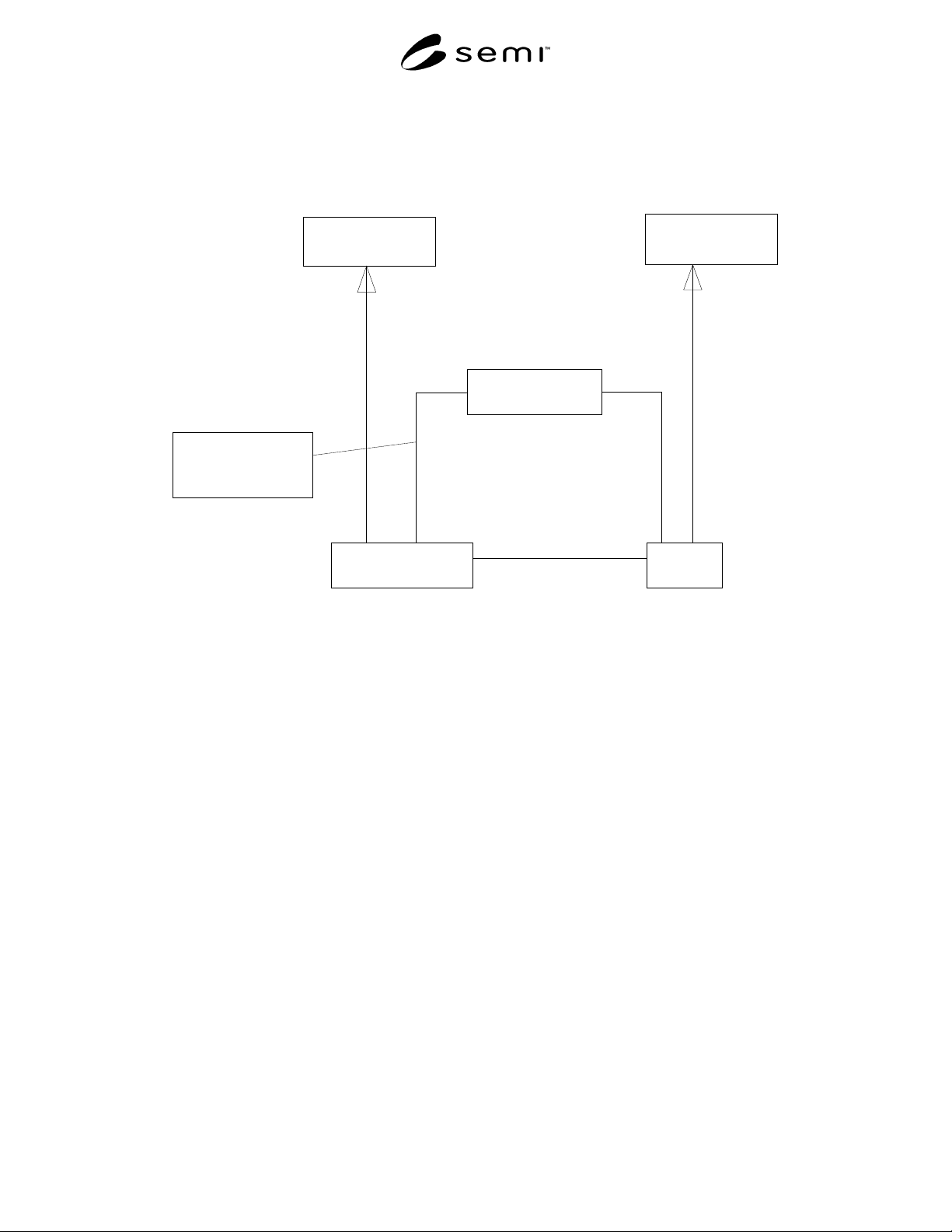
SEMI E97-0200A © SEMI 2000 16
Resource
(from Resource AIG)
OwnedEntity
(from Resource AIG)
Job Supervision Abstract Interface Group
JobSupervisor Job
0..*
1..1
0..*
1..1
supervises
JobRequestor
1..*
0..*
1..*
0..*
contracts
work
from
1..*
1
1..*
1
tracks
progress via
JobSpecification
<<typedef>>
Figure 4
Job Supervision Abstract Interface Group Information Model
6.6.1.1 The basic Job Supervision Abstract Interface Group does not interact with other components, except to the
extent that other components instantiate its interfaces. Figure 4 shows how the interfaces of Job Supervision relate to
one another.
6.6.1.2 A Job Specification is a sequence of properties containing the parameters required to sufficiently define the
work to be done. This sequence is passed by the JobRequestor to the JobSupervisor in the Job request message. See
the JobSupervisor interface for more details.
6.6.1.3 JobSupervision levels are hierarchical. One level may accept a Job and delegate portions of that Job to
lower levels. Jobs, however, are not purely hierarchical. A Job accepted by one JobSupervisor may be broken down,
along with other Jobs of that component and reconstituted as needed to optimize the activities of the factory.
6.6.1.4 For example, a ProductRequest may ask for 15 wafers of a particular product. The ProductRequestManager
may delegate a LotJob to Factory Operations with a Lot containing those 15 wafers and 10 more from a different
ProductRequest. In the factory, this Lot may be split up and processed in smaller groups at various stages or, as
scrap reduces the wafer count, combined with another small lot to create a more optimal process group. The Job
Supervision implementation is allowed great latitude to optimize performance. Its only requirement is to fulfill the
specification of the Job.
6.6.2 JobSupervisor Interface
Module: AbstractIF
Interface: JobSupervisor
Inherited Interface: Resource