semi合集-English.pdf - 第3483页
SEMI E134-0305 © SEMI 2004, 2005 36 12.1.7 DataCollectionPlan Transitio n Table Table 51 DataColle ctionPlan Transition Definit ion Num Previous State Trigger New State Actions 1 (no state) A consumer invokes the DefineP…
SEMI E134-0305 © SEMI 2004, 2005 35
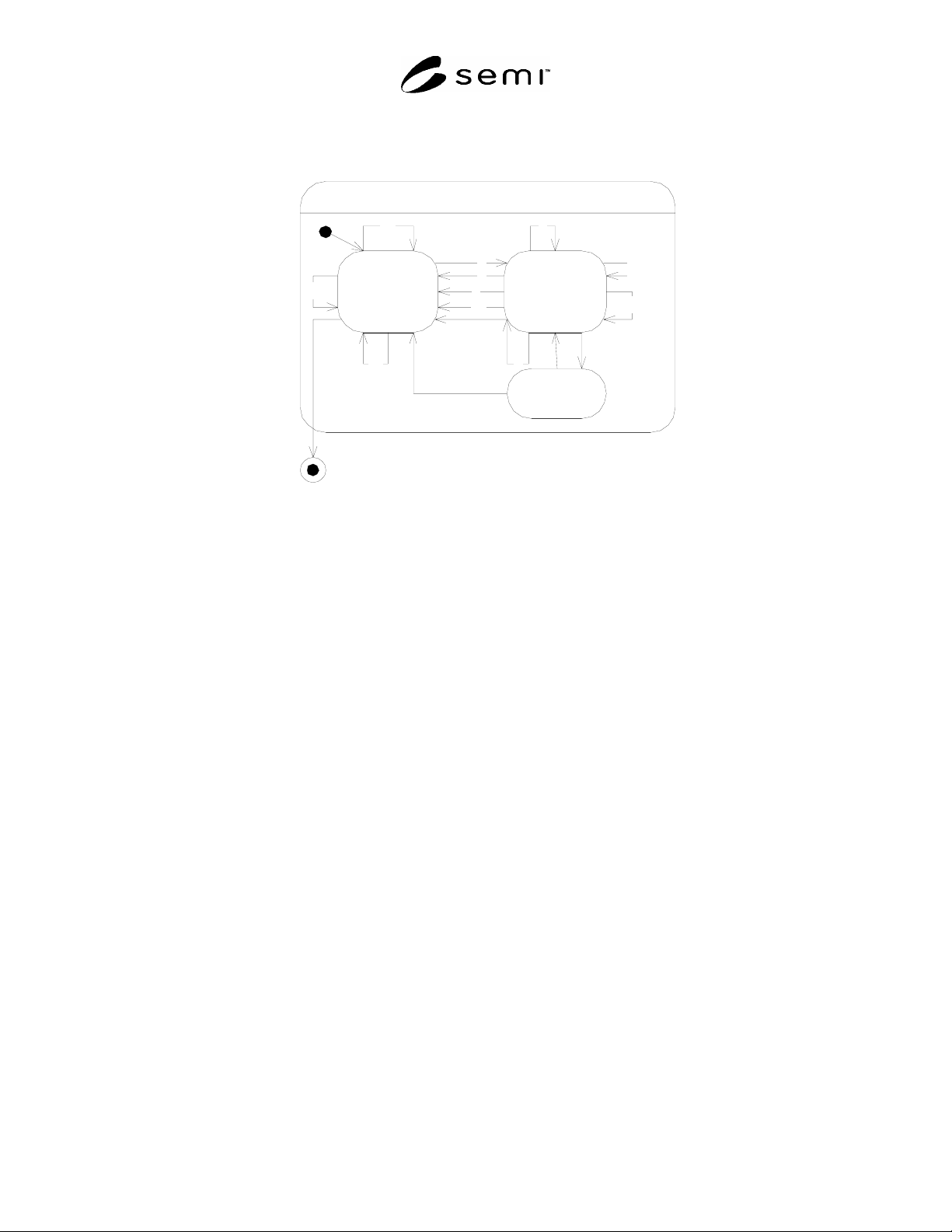
12 Data Collection Plan State Models
12.1 DataCollectionPlan State Model
DataCollectionPlan
ActiveInactive
2
8
4
7
H 1
H Deleted
17
6
10
12
13
Hibernating
1415
16
11
3
5
9
Figure 20
DataCollectionPlan State Model
12.1.1 The purpose of the DataCollectionPlan state model is to define the consumer’s view of the behavior of a
DCP, which includes the consumer’s interactions with the equipment necessary to define, activate, de-activate, and
delete DCPs. Each DCP on the equipment shall execute independently, as described in these state models. The
equipment supplier is not required to provide a direct, literal implementation of these state models. They are
documented here to provide a precise definition of the required behavior for DCPs on the equipment. The
transitions described in these state machines are not to be made available for event data collection.
12.1.1.1 Implementation mappings of this specification may identify additional conditions other than those defined
in this document under which DCP activity should be terminated (that is, cause a transition from the “Active” to the
“Inactive” state). All such conditions, and the details of required equipment behavior under those conditions, shall
be fully specified in any implementation mapping for which this is a consideration.
12.1.2 DataCollectionPlan — The superstate for all DCP states. The equipment has validated the DCP and stored it
in non-volatile memory. The DCP may now be activated and de-activated.
12.1.3 Inactive — The equipment is not sending or buffering any event, exception, or trace reports requested in the
DCP to any consumer. A transition to Active is required for the data defined in this DCP to be reported to a
consumer.
12.1.4 Active — The equipment is sending and/or buffering all event, exception, and trace reports requested in the
DCP to all consumers that have successfully activated the DCP. This state contains substates that are described in
Section.12.2 .
12.1.5 Hibernating — The equipment has paused the sending and buffering of all event, exception, and trace
reports requested in the DCP, because the equipment is entering a state in which it will not be possible to
communicate data to any consumers. The DCP has its ‘isPersistent’ attribute equal to ‘true’.
12.1.6 Deleted — The DCP is no longer stored in non-volatile memory, and can no longer be legally referenced by
any consumer.

SEMI E134-0305 © SEMI 2004, 2005 36
12.1.7 DataCollectionPlan Transition Table
Table 51 DataCollectionPlan Transition Definition
Num Previous State Trigger New State Actions
1 (no state) A consumer invokes the DefinePlan
operation of the DataCollection-
Manager interface. The equipment has
validated its contents.
Inactive The equipment shall store the DCP in non-
volatile memory. The DCP can now be
activated.
2 Inactive A consumer invokes the ActivatePlan
operation of the DataCollection-
Manager interface using the identifier of
this DCP. The consumer has sufficient
privilege for this operation.
Active The equipment shall store the id of the
requesting consumer and the time of the
request. If the DCP is persistent, the
equipment shall store this information in
non-volatile memory. The equipment
shall begin sending and/or buffering all
exception, event, and trace reports
according to the DCP definition, to the
requesting consumer.
3 Inactive A consumer invokes the ActivatePlan
operation of the DataCollection-
Manager interface using the identifier of
this DCP. The equipment has
determined that the DCP is invalid.
Inactive The equipment shall not activate the DCP.
The equipment shall identify all errors in
the DCP, and return this information using
the InvalidPlan error, defined in Section
9.1.2.2.6.
4 Active A consumer invokes the ActivatePlan
operation of the DataCollection-
Manager interface using the identifier of
this DCP. The consumer has sufficient
privilege. The DCP was previously
activated by at least one other consumer.
Active If the requesting consumer had already
previously requested activation of this
DCP, the equipment shall not activate the
DCP again for that consumer (see Section
9.1.2.5.3). Otherwise, the equipment shall
store the id of the requesting consumer and
the time of the request. If the DCP is
persistent, the equipment shall store this
information in non-volatile memory. The
equipment shall begin sending data from
this DCP to the requesting consumer
beginning with the next available
DataCollectionReport (see Section
9.1.2.5).
5 Active A consumer invokes the DeactivatePlan
operation of the DataCollectionManager
interface using the identifier of this
DCP. The consumer has sufficient
privilege. More than one consumer is
currently receiving data from this DCP.
Active The equipment shall stop sending data
from this DCP to the requesting consumer.
The equipment shall delete the activation
information stored (either in volatile, or
non-volatile storage) when the requesting
consumer originally activated the DCP.
The equipment shall continue to
buffer/send data from this DCP to the
remaining consumers.
6 Active A consumer with insufficient privilege
invokes the DeactivatePlan operation of
the DataCollectionManager interface
using the identifier of this DCP.
Active The equipment shall respond to the
consumer with an error stating that the
DCP will not be deactivated because the
consumer does not have sufficient
privilege. See Section 9.1.2.7.
7 Active A consumer invokes the DeletePlan
operation of the DataCollection-
Manager interface using the identifier of
this DCP. At least one consumer is
receiving data from this DCP.
Active The equipment shall respond to the
consumer with an error stating that the
DCP will not be deleted because the DCP
is active (see Section 9.1.2.8).

SEMI E134-0305 © SEMI 2004, 2005 37
Num Previous State Trigger New State Actions
8 Active A consumer invokes the DeactivatePlan
operation of the DataCollection-
Manager interface using the identifier of
this DCP. The consumer has sufficient
privilege, and there are no other
consumers.receiving data from this
DCP.
Inactive The equipment shall delete the activation
information stored (either in volatile, or
non-volatile storage) when the requesting
consumer originally activated the DCP.
The equipment stops sending and
buffering the exception, event, and trace
reports requested in the DCP to the
requesting consumer, discarding any data
buffered at the time of the deactivation.
9 Active A consumer invokes the DeactivatePlan
operation of the DataCollectionManager
interface using the identifier of this
DCP. The consumer has sufficient
privilege and is requesting that the DCP
be terminated (see Section 9.1.2.7.5).
Inactive The equipment shall stop sending and
buffering all data for this DCP to all
consumers that are currently receiving its
data. The equipment shall notify each
consumer of the reason for the de-
activation using the DCPDeactivated class
defined in Section 9.1.2.7.6. The
equipment shall delete the activation
information stored (either in volatile, or
non-volatile storage) when each consumer
originally activated the DCP.
10 Active The equipment is going to enter a state
in which it will not be possible to
communicate data to any consumers
(e.g., equipment shutdown or
emergency power off). The DCP is not
persistent.
Inactive The equipment shall deactivate the DCP
and notify each consumer receiving data
from this DCP (if possible), as described
in Section 15.1.6.2. The equipment stops
sending and buffering the exception, event,
and trace reports requested in the DCP to
the consumer. The equipment shall
discard all data that has been buffered up
to this point. If possible, the equipment
shall delete the activation information
stored when each consumer originally
activated the DCP.
11 Active The equipment determines that
p
erformance conditions require that data
collection activity be terminated (see
Section 13.1.4).
Inactive The equipment terminates all active DCPs,
and notifies each consumer using the
DCPDeactivation notification defined in
Section 15.1.6.2. The equipment shall
delete the activation information stored
(either in volatile, or non-volatile storage)
when each consumer originally activated
the DCP
12 Inactive A consumer with insufficient privilege
invokes the ActivatePlan operation of
the DataCollectionManager interface
using the identifier of this DCP.
Inactive The equipment responds to the consumer
with an error stating that the DCP will not
be activated because the consumer doesn’t
have sufficient privilege (see Section
9.1.2.7).
13 Inactive A consumer with insufficient privilege
invokes the DeletePlan operation of the
DataCollectionManager interface using
the identifier of this DCP.
Inactive The equipment responds to the consumer
with an error stating that the DCP will not
be deleted because the consumer doesn’t
have sufficient privilege (see Section
9.1.2.8).
14 Active The equipment is going to enter a state
in which it will not be possible to
communicate data to any consumers (for
example, as part of an orderly shutdown
or emergency power off). The DCP is
persistent.
Hibernating The equipment shall notify the consumers
(if possible) that the DCP is going into a
Hibernating state, as described in Section
15.1.6.3. The equipment stops reporting
and buffering the exception, event, and
trace reports defined in the DCP to the
consumers. The equipment shall discard
all data that has been buffered up to this
point.