semi合集-English.pdf - 第237页
SEMI E35-0305 © SEMI 1995, 2005 6 5.3 Symb ols 5.3.1 — alpha probability 5.3.2 — beta probability 6 Cost of Ownership Input Unit Cost Input Unit Cost Equipment for Step n+1 Equipment for Step n Recurr ing Co sts …
SEMI E35-0305 © SEMI 1995, 2005 5
5.2.35 process step — the smallest unit of processing activity that can be defined in a process flow (SEMI E81).
5.2.36 product yield (PRY) — the fraction of units that pass through the factory and result in good product. Product
yield for units is the composite of all sources of yield loss.
5.2.37 random variable — a measurable event occurring such that any value from its distribution is equally likely
to take place.
5.2.38 recurring cost — cost that is incurred on an ongoing basis, based on time and/or usage.
5.2.39 repair part — component to service the piece of equipment purchased at the time of repair.
5.2.40 rework — the percentage of units being reprocessed by the piece of equipment because of a fault or defect.
Also called redo.
5.2.41 service contract — an agreement for the supplier to provide equipment service or maintenance under
specified terms and conditions beyond that which is supplied with the piece of equipment.
5.2.42 shadow footprint — the area of the floor space directly under every part of the piece of equipment during its
operation. This area includes any temporary projections from the piece of equipment during loading or processing
(e.g., carriers that stick out from the piece of equipment or equipment load ports that protrude only when the piece of
equipment is being loaded).
5.2.43 spare part — prepurchased inventory of a part maintained to service the piece of equipment.
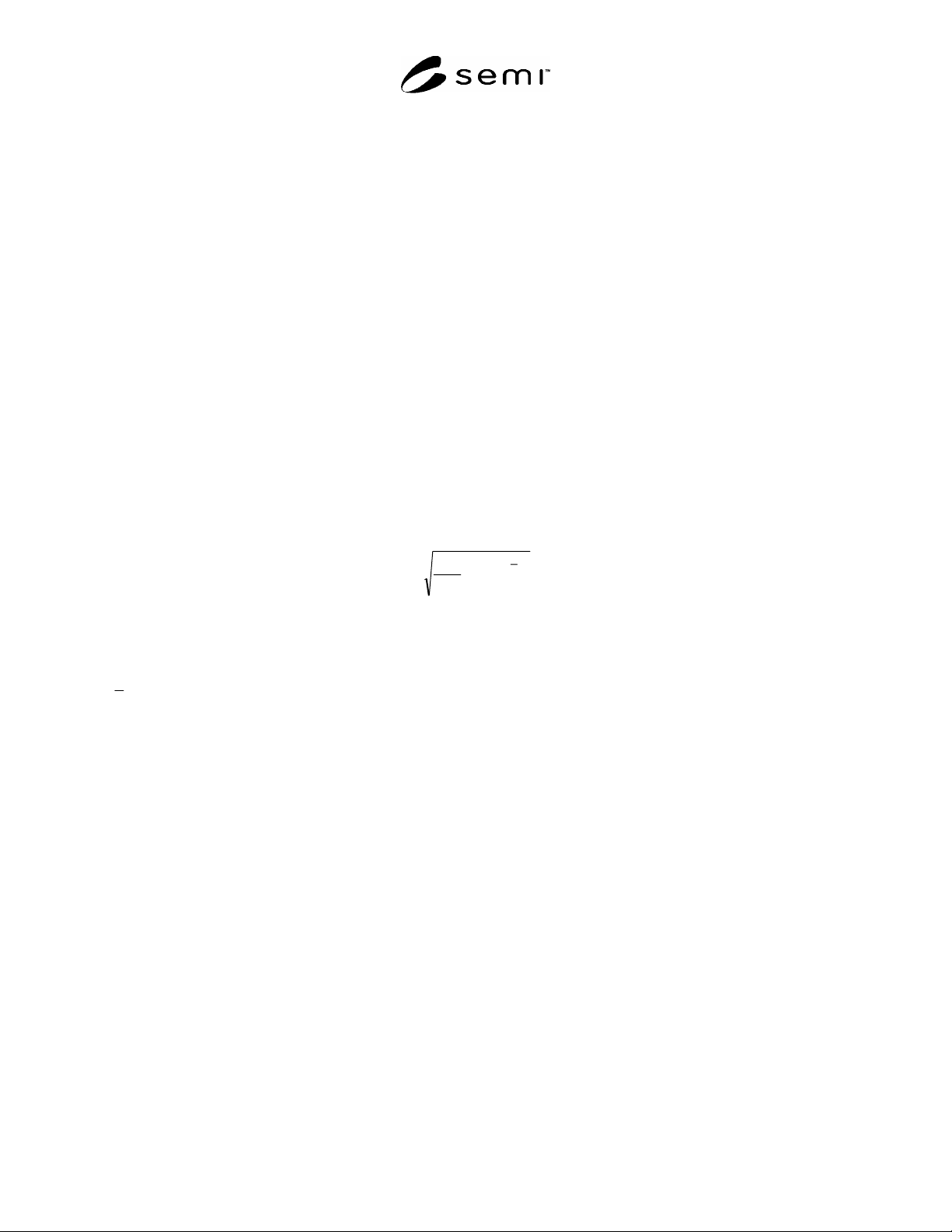
5.2.44 standard deviation,
— the positive square root of the variance.
NOTE 5: The standard deviation of a population may be estimated from experimentally obtained data by the sample standard
deviation (s):
n
i
i
xx
n
s
1
2
)(
1
1
(2)
where:
n = number of data values,
x
i
= value of the i
th
data point, and
x = mean of the data distribution.
5.2.45 step — see process step.
5.2.46 supplier — provider of equipment or services to the unit manufacturer. Also called equipment vendor or
equipment manufacturer.
5.2.47 test unit — see monitor unit.
5.2.48 throughput (TP) — the number of units (e.g., wafers, devices) per hour the piece of equipment delivers to the
factory, including all input, output, and internal overhead operation. TP includes all test or monitor units processed,
since the cost of these non-product units is accounted for directly.
5.2.49 tool — often used synonymously with equipment or system in the silicon wafer processing industry
5.2.50 tooling — fixtures and adaptors required to modify a piece of equipment to the requirements of a specific
unit, test, or operation.
5.2.51 unit — any wafer, die, packaged device, or piece part thereof (includes product and non-product units).
5.2.52 upper specification limit (USL) — value of a characteristic, above which a product is said to be
nonconforming.
5.2.53 variance — a statistical estimator that quantifies spread around the mean of a probability density function.
5.2.54 volume requirement — the number of units required to be processed by the equipment in a specific time
period, normally units per week.
5.2.55 yield — see product yield.
SEMI E35-0305 © SEMI 1995, 2005 6
5.3 Symbols
5.3.1 — alpha probability
5.3.2 — beta probability
6 Cost of Ownership
Input Unit Cost
Input Unit Cost
Equipment
for
Step n+1
Equipment
for
Step n
Recurring Costs
Fixed Costs
Factory Flow
Current Step To Next Step Previous Step
Cost
of
Unit
Cost
of
Unit
$
$
Cost of Ownership = Cost of Equipment Ownership + Cost of Yield Loss
COO = CEO + CYL (3)
Cost of Ownership } $
Cost of Ownership } $
Rework or Redo Test
Rework or Redo Test
Scra
p
Scra
p
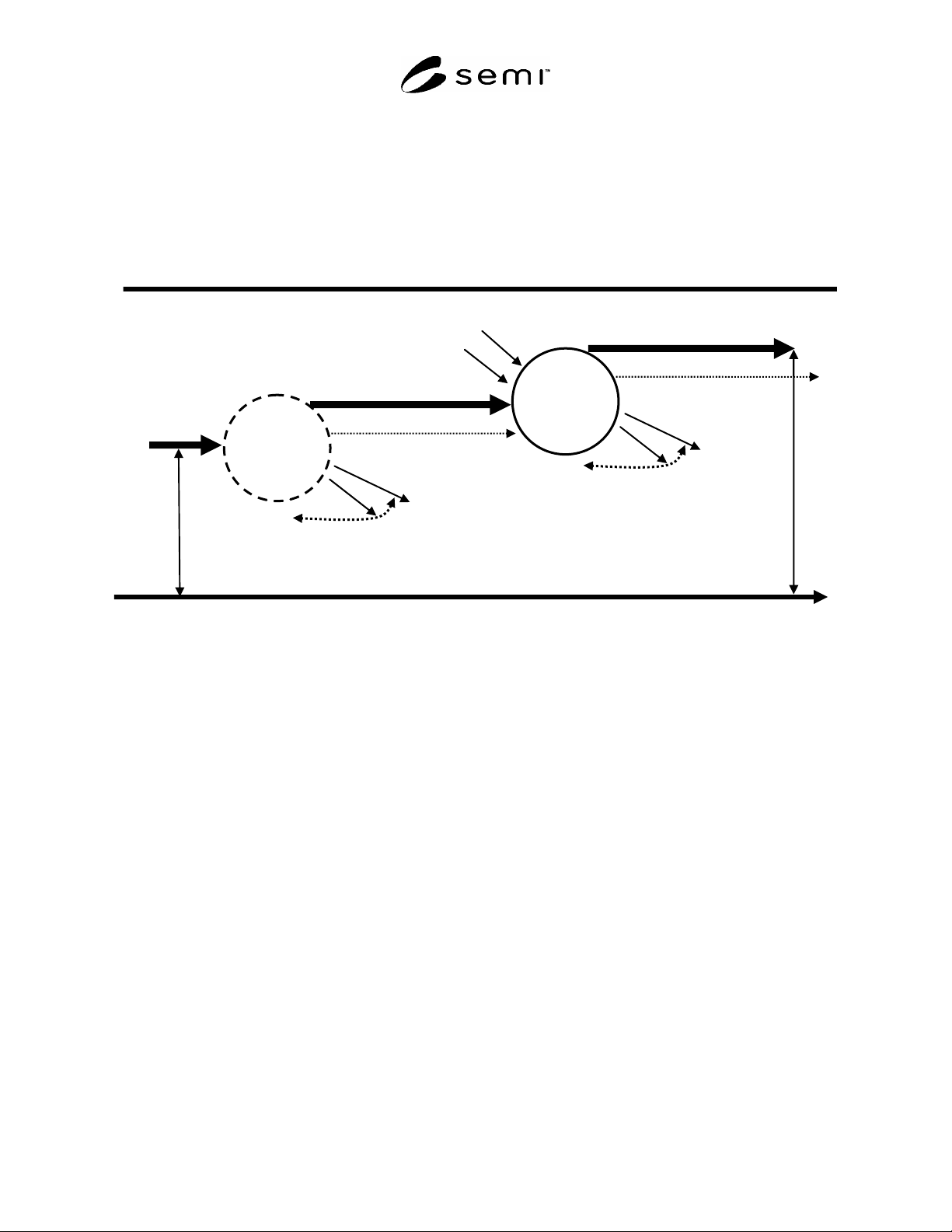
Figure 2
Accumulation of Cost during Factory Flow
6.1 Description of COO
6.1.1 COO is a metric for evaluating the incremental cost added to a unit of good product material flowing through
equipment embedded in a factory environment for a specified lifetime, including the CYL. COO is calculated on an
annualized basis. The metric is expressed as cost per good unit for one pass through the equipment. Figure 2
depicts this accumulation of cost which can be factored into two components, CEO and CYL, as shown in Equation
3.
6.1.2 COO is the full cost of embedding, operating, and decommissioning in a factory environment equipment
needed to accommodate the required volume of product material.
6.1.2.1 COO calculated with no constraints is referred to as comprehensive COO.
6.2 Constrained Versions of COO
6.2.1 A constrained version of COO imposes a set of defined restrictions to facilitate comparisons or to remove
ambiguity. An example is a baseline COO that only includes EY (i.e., DLY and PLY are not included.
6.2.2 Constraints should be predefined by all stakeholders in a specific equipment COO model, prior to estimating
COO, to minimize biasing of the COO estimate.
6.3 Lifetimes
6.3.1 The lifetime of a piece of equipment is the time over which the fixed and recurring costs are considered for
evaluating the annualized COO. The number of years that a piece of equipment is planned to be used in
manufacturing is the piece of equipment’s production lifetime.

SEMI E35-0305 © SEMI 1995, 2005 7
6.3.2 Tax lifetime for depreciation allocation purposes is another measure of the piece of equipment’s lifetime that
is customarily used in evaluating COO. Tax lifetime is based upon local tax or standard accounting practices.
6.3.3 The piece of equipment usually remains in production much longer than the tax lifetime, so it is useful to
consider both lifetimes in evaluating COO.
6.4 CEO: Fixed and Recurring Costs
6.4.1 Determining CEO requires enumerating all of the fixed and recurring costs that are incurred in the life cycle
of the piece of equipment. The calculation is shown in §8.
6.4.2 Fixed costs are those incurred once and are usually associated with the acquisition and incorporation of a
piece of equipment into the factory. End-of-life costs, such as decontamination and removal costs, are also part of
fixed costs.
6.4.3 Recurring costs are those that arise on a regular basis from the operation and maintenance of the piece of
equipment. Some infrequent recurring costs, including the costs of upgrading a piece of equipment to new
technologies may be included in fixed costs if the CEO is being calculated to compare an upgraded existing piece of
equipment with a new acquisition.
6.4.3.1 Costs that are depreciated should be included as fixed costs.
6.5 Yield
6.5.1 Yield is a metric of the percentage of the unit volume that results in good product. Yield affects the COO in a
number of ways.
Volume of units that must be processed for the required product requirements.
Cost of units that do not produce good product.
6.5.2 Product yield (PRY) is the percentage of units that pass through the factory and result in good product.
Product yield for units is the composite yield from all sources of yield loss, as shown in Equation 4. The
components are defined in §5.
ReworkPLYDLYEYPRY
111
(4)
6.5.2.1 Since DLY is generally a wafer-level phenomena, Equation 4 may be simplified for other types of units by
setting DLY = 1. Particle additions are a predictor of defect yield loss at a future step, but not a complete predictor
of all the possible loss since there may be other defects or parametric problems.
6.5.2.2 The P/T ratio of test and measurement equipment also affects PRY. P/T ratio is reflected in Equation 4 by
the inclusion of α and β. The formulas for calculating α and β are provided in Appendix 1.
6.6 Cost of Yields
6.6.1 A unit lost at the end of a given step represents the loss of the starting unit cost and all costs of manufacturing
a unit prior to that step. In addition, units leaving a step with undetected defects may be lost at a later step.
Calculating CYL therefore requires knowing the accumulated costs of manufacturing before the unit is lost.
Therefore, although CYL is a recurring cost, it should be tracked separately. CYL is given in Equation 7 in ¶8.2.
6.7 Volume Requirement
6.7.1 The volume requirement is the number of units to be processed and can be derived from specification of the
product units needed corrected for yield and the number of other units required to be processed by the equipment in
a specific time period such as rework or monitor units. One complication in accurately estimating the volume
requirement is that the volume of units actually reaching the equipment will depend on the equipment yields from all
prior steps.
6.8 Equipment Required
6.8.1 Once the volume of units is specified, the number of pieces of equipment required (ER) is obtained from the
TP and the OU.
ER = Volume Requirement / (TP × OU) (5)