semi合集-English.pdf - 第1629页
SEMI E38-1296 © SEMI 1995 , 1996 18 # Current State Trigger New State Action( s) 11 Tran sfe rring Between Modules Arr ived output CM. Arrive d output CM CM Input/Outp ut Transf er Job. 12 Arrive d output CM Tra nsfer ba…
SEMI E38-1296 © SEMI 1995, 199617
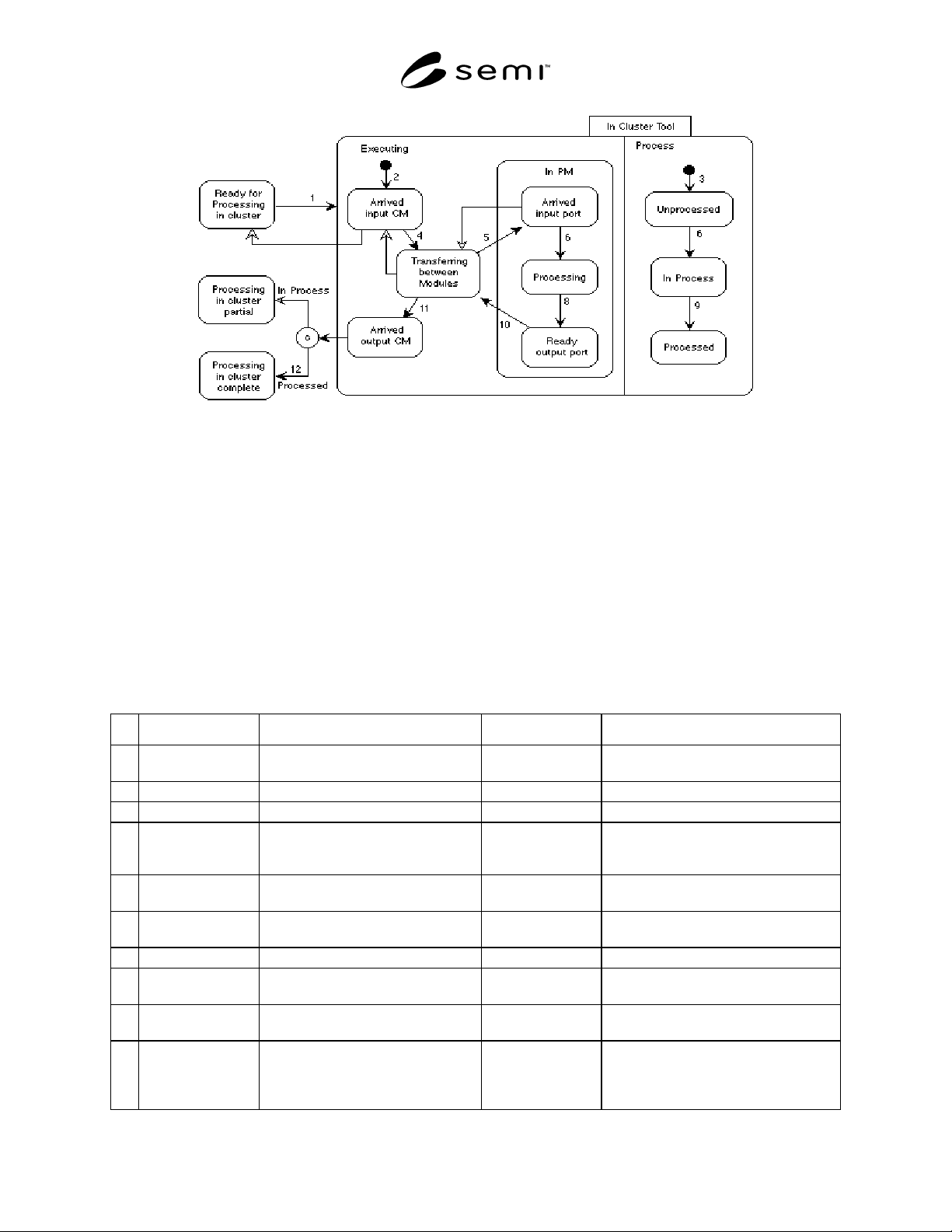
Figure 19
Cluster Tool Material State Model
When ready to be processed in the cluster tool, the material is presented and loaded at the input cassette module
(intertool material transfer). It is usually contained with other single material in a cassette. The material process sub-
state in the scope of this visit to the cluster tool is initially unprocessed. The material is then transferred to the first
process module (intratool material transfer), ready for process. At this point, the material may be returned to the
input cassette module and back to the factory, as the material has not been physically altered.
The material then begins processing in the process module according to the recipe for that process step (process job),
and the process sub-state changes to in-process.
On successful completion of the process step, the material is then ready to be transferred to the next module
(intratool material transfer). This may be another process module for the next process step or to the output cassette
module if processing in the cluster tool is complete, in which case the process sub-state changes to processed. It is
also possible that the next process step be performed in the same process module.
Table 1 Cluster Material State Transition Table
# Current State Trigger New State Action(s)
1 Ready for
Processing in cluster
Material being received at cluster CM. In cluster tool CM Input/Output Transfer Job. CM
Carrier mapping.
2 Not in Cluster tool Material being received at cluster CM. Arrived input CM
3 Not in Cluster tool Material being received at cluster CM. Unprocessed
4 Arrived input CM Initiate material transfer to PM. Transferring
between modules
Initiate PM Process Job. TM Transfer
Job. Source AM Transfer Job (CM send).
Dest. AM Transfer Job (PM receive).
5 Transferring
between Modules
Material arrived in PM. In PM/Arrived input
port
6 In PM/Arrived input
port
Processing initiated on material. In PM/Processing PM Process the material.
7 Unprocessed Processing initiated on material. In Process
8 In PM/Processing PM processing complete. In PM/Ready output
port
9 In Process All required process steps in cluster
completed.
Processed
10 In PM/Ready output
port
Initiate intratool material transfer. Transferring
between modules
Initiate next PM Process Job if material
processing still required. TM Transfer
Job. Source AM Transfer Job (send).
Dest. AM Transfer Job (receive).

SEMI E38-1296 © SEMI 1995, 1996 18
# Current State Trigger New State Action(s)
11 Transferring
Between Modules
Arrived output CM. Arrived output CM CM Input/Output Transfer Job.
12 Arrived output CM Transfer back to factory complete. Processing in cluster
complete
The material is finally unloaded from the output
cassette module to the factory (intertool material
transfer). If all process steps in the cluster tool were
completed and were successful, the processing in the
cluster tool is complete; otherwise, processing in the
cluster tool was only partially accomplished.
Detailed behavioral models are documented in the
individual Cluster-Specific Services and in the
standards which they reference. The Typical Operating
Scenario in the application notes illustrates the
behavioral characteristics of cluster tool control by
showing the detailed messaging among modules and
supervisory controller through the lifecycle of material
as it enters the cluster, is processed, and then leaves the
cluster.
7.4 Cluster Tool Control Topology — The natural
decomposition of a cluster tool is into its modules. The
module controller is the entity which performs internal
control of a module and provides standard services.
Module controllers provide certain application-specific
functions (providers of services and user of services)
and consist of hardware and software components that
interact with the communications and control
environment of the cluster tool.
Traditional definitions of controllers have implied
certain PHYSICAL, hardware control topologies (such
as distributed or centralized processors). These cluster
tool standards specify the communications in terms of
services-providers, enabling the module controllers to
be based on LOGICAL control topologies.
The list of possible physical controllers which could be
used to implement the logical services of the standards
are listed below. It is emphasized, however, that the
standard is not based on any constraint that each of
these physical controllers be present in a cluster control
system, but instead requires that the logical services
(i.e., software functional components) be present
somewhere in the cluster control system.
Possible Controllers:
• Cassette Module Controller
• Process Module Controller
• Transport Module Controller
• Cluster Controller
The logical control topology allows any combination of
module controllers on a single control unit. Standard
communication is not required among them. A common
example is the grouping of transport module and
cassette module control into a single material handler
control unit as shown in Figure 1. For interface
compliance, all communication between a logical
module controller and remote controller or service-user
must be compliant with the standard services.
8 Cluster Tool Module Serv ices
The Cluster Tool control system elements, as
represented in the object information, object
communications, and behavioral models, require
standard services in order to interface with one another.
The objects which are fully standardized (attributes,
behavior, and operations) are only those essential to this
communication, and the services are the interactions
with these standard objects.
The services are grouped into the following functional
areas:
• Object Services
• Processing Management
• Material Movement Management
• Exception Management
• Recipe Management
• Event Reporting
• Clock
The services of each of these groups are described in
detail in this section. The services are defined in terms
of services provided by independent SEMI standards,
specifying their application and limitations with respect
to the fundamental requirements of cluster tool module
communications.
8.1 Object Services — All standardized service object
attribute access across a cluster tool module
communications interface is achieved using object
services. Access may be to read attribute values of
objects, to get a list of objects corresponding to certain
criteria, and to set the values of writable attributes of
objects. The message services provided to accomplish
this are Get and Set.

SEMI E38-1296 © SEMI 1995, 199619
The specific object types, relations, attributes, and
access rules are defined in each specific services group.
The object services are defined in SEMI E39 (Object
Services Standard: Concepts, Behavior, and Services).
Cluster tool module communications require only the
fundamental requirements of that standard except where
stated in a specific services group below.
8.2 Processing Management Services — Processing
management across a cluster tool module communica-
tions interface is achieved using the processing
management services. These services provide the
communications and behavior required of the process-
ing resource by the material processing models through
defining the process job object and its operations.
The processing management services follow SEMI E40
(Standard for Processing Management). Cluster tool
module communications require full compliance with
the information, behavior, and messaging services of
the fundamental requirements of that document.
The process job creation is requested by the cluster
controller using the PRJobCreate service. If the
processing resource accepts the job, it performs the
required processing to completion once the material
arrives. The processing resource shall support the
PRJobCommand Abort service, which ceases any
processing and terminates the job. The processing
resource reports process job milestones achieved to the
cluster controller using the PRJobAlert service.
Process job object attributes required to be accessible
through object services follow:
Attribute Name Description: Requirements
ObjType The object type: process job.
PRJobID Identifier for the process job.
PRMtlType MaterialType.
PRMtlNameList Material identifier: single material only.
PRRecipeMethod Recipe specification type: recipeID
only.
RecID Identifier of the recipe applied.
PRJobStateList All concurrent substates of the process
job.
Processing management messaging services required:
Message Name Description: Requirements
PRJobCreate Create process job: single material,
recipe identifier only, auto-start.
PRJobCommand Command on a process job: abort.
PRJobAlert Notification: setup, processing,
processing complete, complete.
Processing resource capabilities required, but not
already specified above:
• Detect and report success or failure of a process
job.
• Reject incomplete, invalid, and unsupported
requests.
Processing resource capabilities permitted, but not to be
required, by a service-user:
• Pre-conditioning and post-conditioning.
• Stop, Pause, and Resume of a process job.
• Manual process start.
• Process job queuing and queued job Cancel.
• Process tuning.
• Processing of material groups.
• Multiple concurrent process jobs.
• Multiple consecutive process jobs.
• Process job with no material.
• Notification of waiting for material and of process
job state changes.
8.3 Material Movement Services — Each material
movement in a cluster tool involves interaction among
the cluster controller and all of the modules
participating in the transfer. The communications
interfaces and behavior resulting from the material
movement models are defined for each association by
the material movement services.
The material movement services are partitioned into
intratool material movement services, intertool material
movement services, and carrier mapping, as in the
models.
The material movement services follow the Material
Movement Management Standard [SEMI E32] and
Object Services Standard: Concepts, Behavior, and
Services [SEMI E39]. Cluster tool module
communications require full compliance with the
information, behavior, and messaging services of the
fundamental requirements of those standards.
8.3.1 Intratool Material Movement Services — From
the intratool material movement models, an intratool
material transfer — the transfer of material from one
attached module to another through a transport module
— requires the following interactions:
1. The cluster controller decides that material is to be
moved as the result of either arrival of material or
the completion of some processing step on the
material. It determines which material is to be