semi合集-English.pdf - 第1906页
SEMI E54.1-1000 © SEMI 1996, 2000 12 5 NORM AL OPERATING GetA ttribute, SetAttribute , or RestoreDe fault reques t. NORMAL OPERATING Get or Set approp riate attri bute or rest ore def aults. Valid for all substrate s of …
SEMI E54.1-1000 © SEMI 1996, 200011
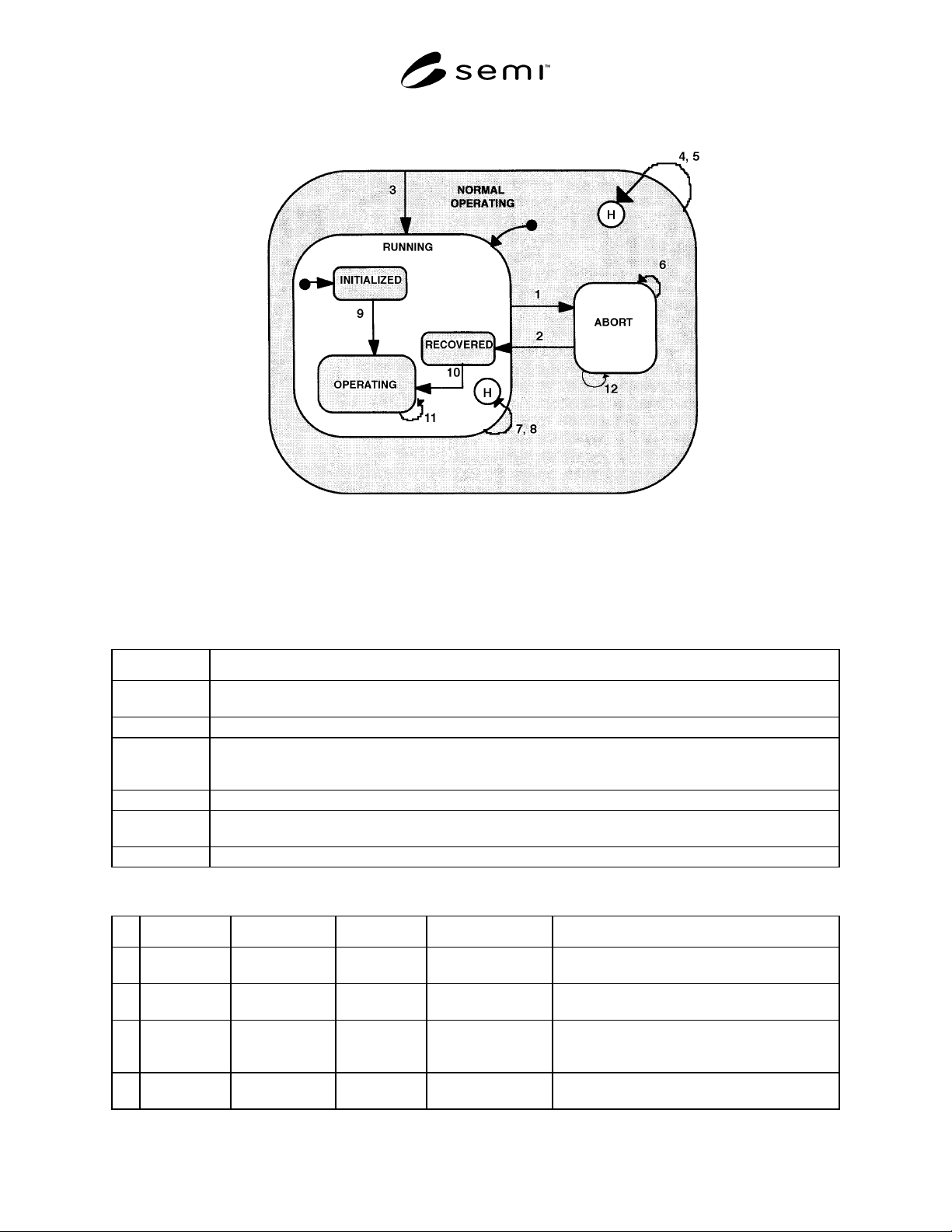
Figure 5
SAC Object Instance Behavior*
NOTE: Only generic behavior is indicated in this chart. A complete state chart necessarily requires the inclusion of device-
specific behavior.
* Transitions 4 through 8, 11, and 12 are recursive (i.e., the New State is the same as the Current State (including all nested sub-states)).
Table 11 SAC Object Instance Behavior State Description
State Description
NORMAL
OPERATING
Object instance exists. Object services can be processed.
RUNNING This is the entry sub-state to NORMAL OPERATING. Object instance is not in its ABORT state.
INITIALIZED This is the entry sub-state to NORMAL OPERATING and RUNNING. Object instance exists and has been
initialized. All attributes set to appropriate initial values (as indicated in an appropriate sensor/actuator network
specific device model specification).
RECOVERED Object instance is in an abort recovered state.
OPERATING This represents the entire collection of sub-states within RUNNING except INITIALIZED and RECOVERED.
The further delineation of this sub-state and transition into this sub-state is outside the scope of this document.
ABORT Object instance is in an aborted state; a detailed description of this state is outside the scope of this document.
Table 12 SAC Object Instance Behavior State Transition Matrix*, **
# Current State Trigger New State Action Comment
1 RUNNING Abort request. ABORT Abort. Abort
response.
ABORT state is device-specific.
2 ABORT Recover request. RECOVERED Recover. Recover
response.
RECOVERED state is device-specific.
3 NORMAL
OPERATING
Reset request. RUNNING Reset. Reset
response.
Valid for all sub-states of
NORMAL OPERATING. Move to
RUNNING/INITIALIZED.
4 NORMAL
OPERATING
Invalid service
request.
NORMAL
OPERATING
Error response. Valid for all substates of
NORMAL OPERATING.
SEMI E54.1-1000 © SEMI 1996, 2000 12
5 NORMAL
OPERATING
GetAttribute,
SetAttribute, or
RestoreDefault
request.
NORMAL
OPERATING
Get or Set
appropriate attribute
or restore defaults.
Valid for all substrates of NORMAL
OPERATING.
6 ABORT Abort request,
Operate request.
ABORT Error response. Invalid request in this state.
7 RUNNING Recover request. RUNNING Error response. Recover service can only be invoked while in
ABORT state.
8 RUNNING PublishAttribute. RUNNING Attribute identified
by attribute ID in
PublishAttribute
service is published.
Notification service.
9 INITIALIZED Operate request
or Device-
specific.
OPERATING Device-specific. Behavior associated with this transition may be
further specified in an appropriate sensor/actuator
network specific device model specification.
10 RECOVERED Operate request
or Device-
specific.
OPERATING Device-specific. Behavior associated with this transition may be
further specified in an appropriate sensor/actuator
network specific device model specification.
11 OPERATING Operate request. OPERATING Error response. Invalid request in OPERATING state.
12 ABORT PublishAttribute. ABORT None. Attributes cannot be published while in ABORT
state.
* Transitions 4 through 8, 11, and 12 are recursive (i.e., the New State is the same as the Current State (including all nested sub-states)).
** Note: Only generic behavior is indicated in this table.
7.2.4 Objects Embedded in SAC Object — The object types that are embedded in the SAC object are listed in Table
3. The structure and behavior of instances of these object types are detailed in the remainder of this section.
7.2.4.1 Assembly Object — Assembly object instances may be used to provide a mechanism for grouping more
than one attribute from one or more object instances in a device into a single data structure for communication over
the network.
7.2.4.1.1 Assembly Object Attributes — All required and “common optional” Assembly object attributes are listed
in Table 13.
Table 13 Assembly Object Attributes
Attribute Name Attribute Identifier Access Network Required Form
Data AsmA1 Context-Specific Yes Context-Specific
7.2.4.1.1.1 Data — An attribute which contains the assembled data. The structure of this data is context-specific.
7.2.4.1.2 Assembly Object Services — The Assembly object instance provides two services: GetAttribute and
SetAttribute.
7.2.4.1.2.1 Get Attribute — This service is used to read the value of an object instance attribute over the network.
Table 14 describes the parameters specified for this service.
Table 14 Assembly Object Get Attribute Parameter Definition
Parameter Request/
Indication
Response/
Confirmation
Form Description
Attribute ID M C Network-Specific Attribute Identifier of the attribute whose value is being
requested.
Attribute Value
—
M Context-Specific Value of the attribute requested.
7.2.4.1.2.2 Set Attribute — This service is used to modify the value of an object instance attribute over the network
which has been identified as modifiable. Table 15 describes the parameters specified for this service.
SEMI E54.1-1000 © SEMI 1996, 200013
Table 15 Assembly Object Set Attribute Parameter Definition
Parameter Request/
Indication
Response/
Confirmation
Form Description
Attribute ID M C, = Network-
Specific
Attribute Identifier of attribute whose value is to be modified.
Inclusion of Attribute in Rsp/Conf. is optional.
Attribute Value
M
C Context-
Specific
Value to which the attribute is to be modified. Inclusion of Attribute
in Rsp/Conf. is optional. Conditions under which the value may
differ from that supplied in the associated Req/Ind. message (e.g.,
negative response) are not defined in this document.
Additional services and/or service parameters may be provided by an Assembly object instance that are device-
specific and/or implementation-specific. These services may be Notification or Request type services (see Section
6.4.1). A complete definition of additional services and service parameters that are device-specific may be found in
an appropriate sensor/actuator network specific device model specification.
7.2.4.1.3 Assembly Object Behavior — The behavior exhibited by the Assembly object instance is in support of the
GetAttribute and SetAttribute services. That is, when a GetAttribute service request is received for the attribute
“Data”, the response contains the “Data” attribute value. Similarly, when a SetAttribute service request is received
for the attribute “Data”, the value of “Data” is modified, if indeed the attribute is modifiable, and a successful
service response is returned; otherwise, a service not successful is returned.
7.2.4.2 Local Link Object — Local Link object instances may be used to “link” an attribute of one object instance
to an attribute of another object instance.
7.2.4.2.1 Local Link Object Attributes — All required and “common optional” Local Link object attributes are
listed in Table 16.
Table 16 Local Link Object Attributes
Attribute Name Attribute Identifier Access Network Required Form
Source Object Class LnkA1 Context-Specific N Context-Specific
Source Object Instance LnkA2 Context-Specific N Context-Specific
Source Object Attribute LnkA3 Context-Specific Y Context-Specific
Destination Object Class LnkA4 Context-Specific N Context-Specific
Destination Object Instance LnkA5 Context-Specific N Context-Specific
Destination Object Attribute LnkA6 Context-Specific Y Context-Specific
Commit LnkA7 Context-Specific N Boolean
7.2.4.2.1.1 Source Object Class — Where applicable, the class of the object instance from which the source
attribute is to be linked.
7.2.4.2.1.2 Source Object Instance — The instance number of the object from which the source attribute is to be
linked.
7.2.4.2.1.3 Source Object Attribute — The attribute ID of the source attribute to be linked.
7.2.4.2.1.4 Destination Object Class — Where applicable, the class of the object instance to which the destination
attribute is to be linked.
7.2.4.2.1.5 Destination Object Instance — The instance number of the object to which the destination attribute is to
be linked.
7.2.4.2.1.6 Destination Object Attribute — The attribute ID of the destination attribute to be linked.
7.2.4.2.1.7 Commit — An attribute that indicates whether the Link object will perform the link function (the link
function is described in Section 7.2.4.2.3). When this attribute is FALSE, the object cannot perform the link
function.