semi合集-English.pdf - 第4582页
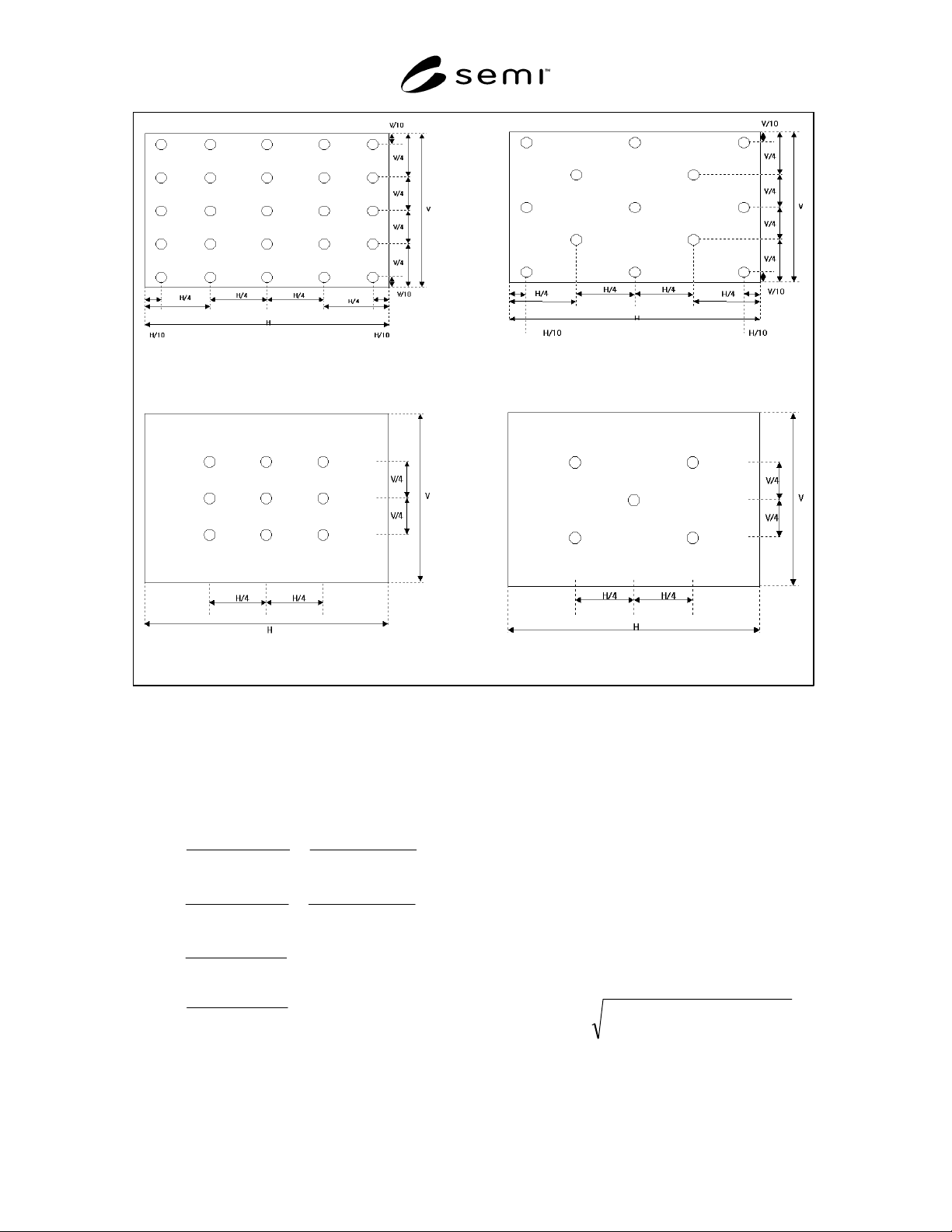
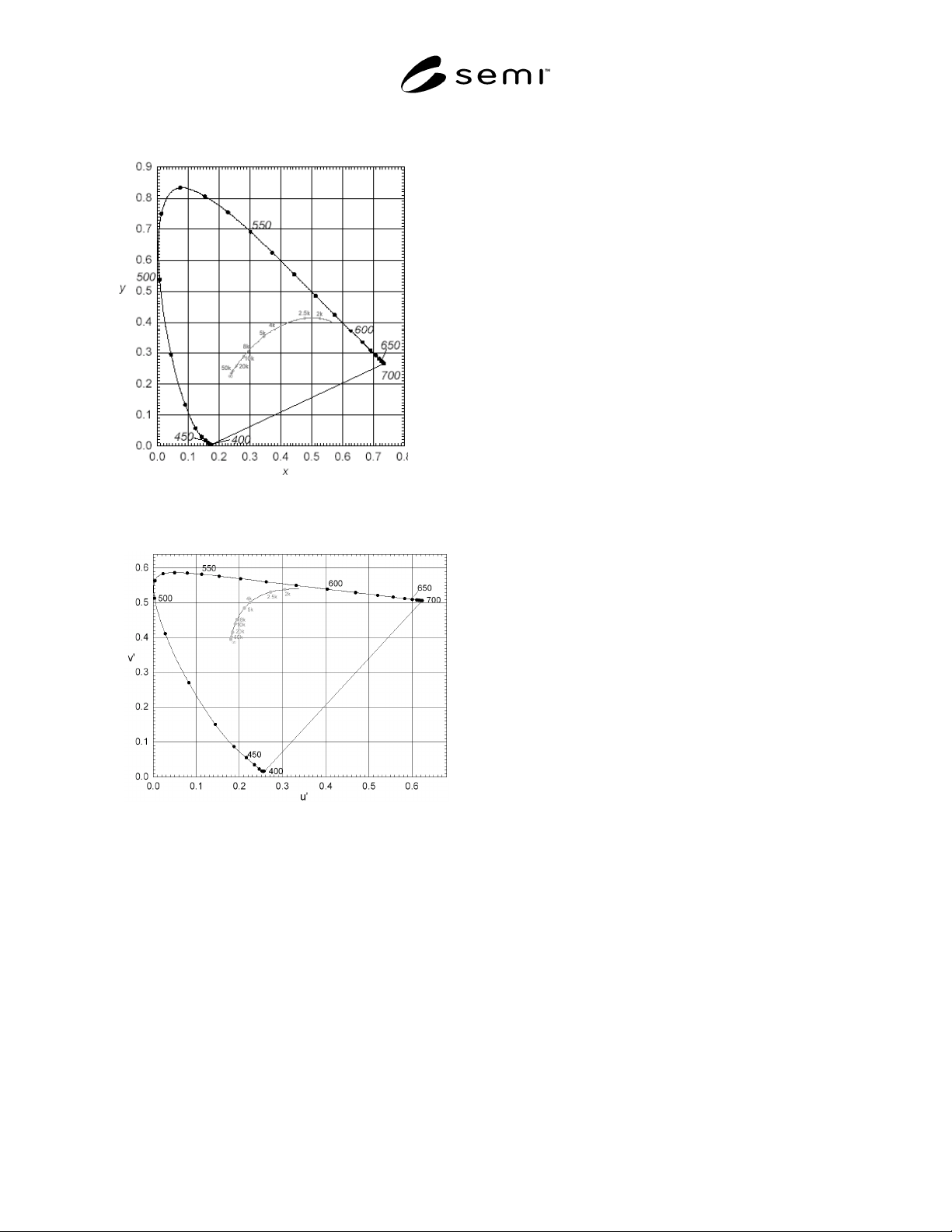
SEMI D33-0703 © SEMI 2003 4 uniform ity, but in this standa rd, five poi nt color uniform ity is recommended. (Confe r with Figure 3d .) Figure 4 The 1931 CIE Coordinates (x,y) Figure 5 The 1976 CIE Coor dinates (u’,v’) …
SEMI D33-0703 © SEMI 2003 3
Figure 3b
13 measuring points
Figure 3a
25 measuring points
Figure 3c
9 measuring points
Figure 3d
5 measuring points
6.3.4 Color
6.3.4.1 In this standard, color coordinate systems are
the 1931 or 1976 CIE systems. CIE1931 use the ‘x’ and
‘y’ coordination and CIE1976 use u’ and v’
coordination. The relation between CIE1931 to
CIE1976 is below:
36'48'18
'12
36'48'18
'27
3122
9
315
9
'
3122
4
315
4
'
+−
=
+−
=
++−
=
++
=
++−
=
++
=
vu
v
y
vu
u
x
yx
y
ZYX
Y
v
yx
x
ZYX
X
u
6.3.4.2 Generally, because the light source of BLU is a
discontinue wavelength, color should be measured by
spectroradiometer. It is more accurate than filter
colorimeter for color measuring. In this standard, the
measuring distance and viewing direction are the same
with the luminance testing method.
6.3.5 Color Uniformity
6.3.5.1 Color Uniformity is a same meaning with the
Color difference in this standard. It means how the
displays have the consistent chromaticity. In case of the
color uniformity, we use the u’ and v’ coordinates from
CIE1976. The reference point is center position. It is
referenced the ∆u’v’ formula.
The formula is below:
)()(
'
2
'
1
'
2
'
1
''
22
vvuu
vu
−−
+=∆
6.3.5.2 There are some positioning methods for color
uniformity test. It is the same point with luminance
SEMI D33-0703 © SEMI 2003 4
uniformity, but in this standard, five point color
uniformity is recommended. (Confer with Figure 3d.)
Figure 4
The 1931 CIE Coordinates (x,y)
Figure 5
The 1976 CIE Coordinates (u’,v’)
NOTICE: SEMI makes no warranties or
representations as to the suitability of the standards set
forth herein for any particular application. The
determination of the suitability of the standard is solely
the responsibility of the user. Users are cautioned to
refer to manufacturer's instructions, product labels,
product data sheets, and other relevant literature,
respecting any materials or equipment mentioned
herein. These standards are subject to change without
notice.
By publication of this standard, Semiconductor
Equipment and Materials International (SEMI) takes no
position respecting the validity of any patent rights or
copyrights asserted in connection with any items
mentioned in this standard. Users of this standard are
expressly advised that determination of any such patent
rights or copyrights, and the risk of infringement of
such rights are entirely their own responsibility.
Copyright by SEMI® (Semiconductor Equipment and Materials
International), 3081 Zanker Road, San Jose, CA 95134. Reproduction o
f
the contents in whole or in part is forbidden without express written
consent of SEMI.
SEMI D34-0703 © SEMI 2003 1
SEMI D34-0703
TEST METHOD FOR MEASUREMENT OF FPD POLARIZING FILMS
This test method was technically approved by the Global Flat Panel Display Committee and is the direct
responsibility of the Japanese FPD Materials and Components Committee. Current edition approved by the
Japanese Regional Standards Committee on April 28, 2003. Initially available at www.semi.org May 2003;
to be published July 2003.
1 Purpose
1.1 This standard establishes implementation
guidelines for the measurement of visual appearance,
thickness, and optical characteristics of FPD Polarizing
Films. These methods can be applied in manufacturing,
quality control, and research and development.
2 Scope
2.1 This document specifies measurement methods.
2.2 Specifies measurement methods for visual
appearance (dot defects, line defects, visual exclusion
area), thickness, optical characteristics (single
transmittance, parallel transmittance, cross
transmittance, UV cut performance, polarization
efficiency, hue a, b and hue a*, b* and haze) of
polarizing films.
NOTICE: This standard does not purport to address
safety issues, if any, associated with its use. It is the
responsibility of the users of this standard to establish
appropriate safety and health practices and determine
the applicability of regulatory or other limitations prior
to use.
3 Referenced Standards
3.1 Japan Industry Standards (JIS)
1
JIS K7105
2
— Testing methods for optical
characteristics of plastics
JIS Z8701
3
— Colour specification -- The CIE 1931
standard colorimetric system and the CIE 1964
supplementary standard colorimetric system
JIS Z8720
4
— Standard Illuminants and sources for
colorimetry
1 Japan Standards Association(JSA) 4-1-24 Akasaka, Minato-ku,
Tokyo, 107-8440 Japan. Tel: +81-3-3583-8000, E-mail:
webmaster@jsa.or.jp, http://www.jsa.or.jp
2 English version available.
3 Related International Standards: CIE 15.2, ISO/CIE 10526: CIE
standard colorimetric illuminants, ISO/CIE 10527: CIE standard
colorimetric observers; Commission Internationale de l’Eclairage,
Kegelgasse 27, A-1030 Vienna, Austria. Tel: +43-1-714-31-87-0;
International Organization for Standards(ISO), 1, rue de Varembe,
Case, postale 56 CH-1211 Geneva 20, Switzerland. Tel: +41-22-749-
01-11, E-mail: central@iso.ch, http://www.iso.ch
JIS Z8723
5
— Methods for visual comparison of
surface colours
JIS Z8729
6
— Colour specification -- CIE LAB and
CIE LUV colour spaces
NOTICE: Unless otherwise indicated, all documents
cited shall be the latest published versions.
4 Terminology
None.
5 Definitions of Measured Object and
Summary of Measurement Methods
5.1 Visual Appearance of Polarizing Film (Dot
Defects)
5.1.1 Definition of Defect Size
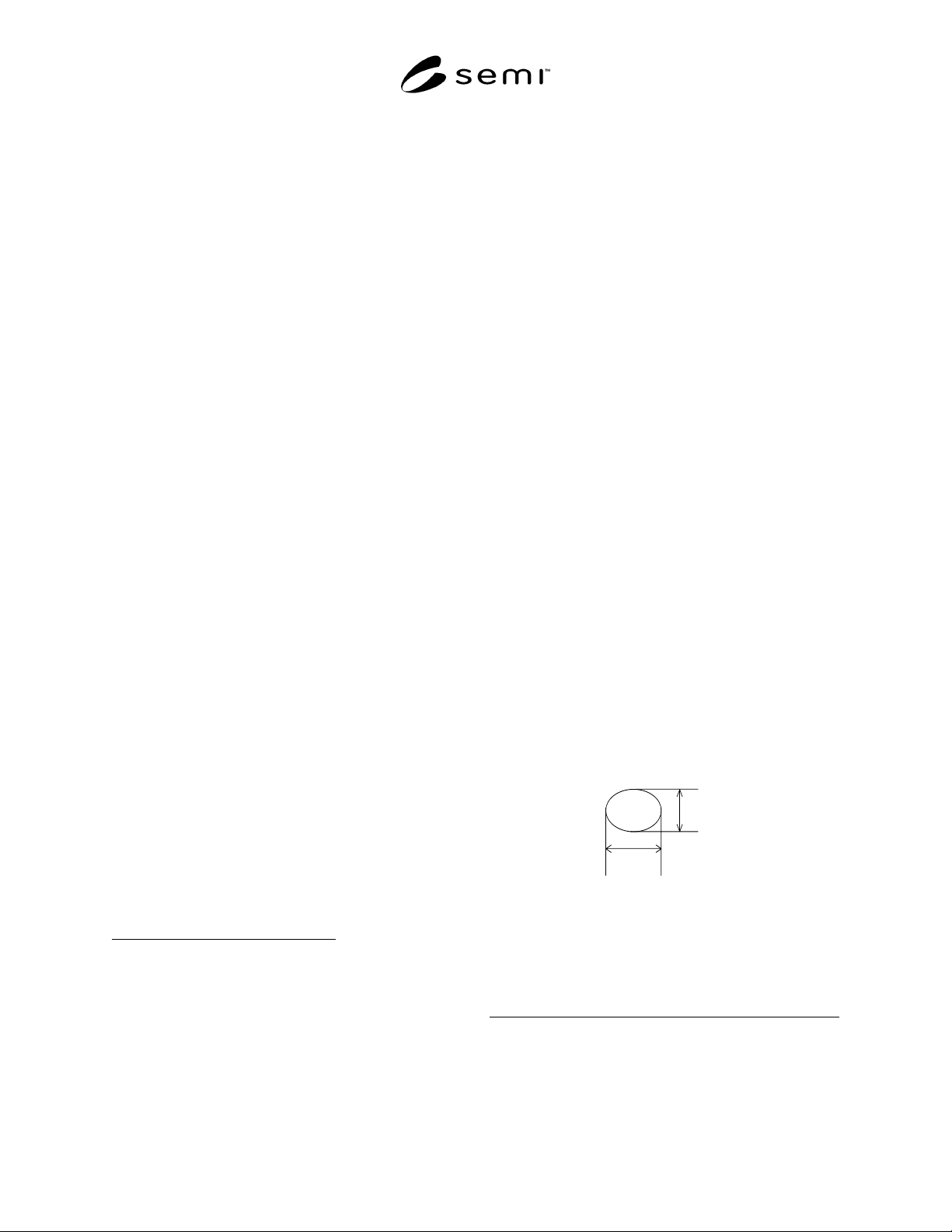
5.1.1.1 Non-White Spot — Points that can be verified
visually during reflection inspection and transmission
inspection. Size is defined by measuring the long side
and short side of the core section and taking their mean
value (Φ).
5.1.1.2 White Spot — Points that can be verified
visually during Cross-Nicol transmission inspection.
Size is defined by measuring the long side and short
side of the core section and taking their mean value
(Ф).
A
B
φ
=
(
A+
B
)/2
Figure 1
Definition of Defect Size (Dot Defect)
4 Related International Standards: ISO/CIE 10526: CIE standard
colorimetric illuminants
5 Related International Standards: ISO/DIS 3668: Paints and
varnishes – Visual comparison of the colour of paints
6 Related International Standards: Not Applicable; English version
not available.