semi合集-English.pdf - 第1069页
SEMI E5-1104 © SEMI 1982, 2004 11 Name Format Description Values Where Used ACKC15 10 Return code for secondary messages, 1 by te 0 = Accepted 1 = command will be performed with completion signaled later 2 = DSNAME not f…
SEMI E5-1104 © SEMI 1982, 2004 10
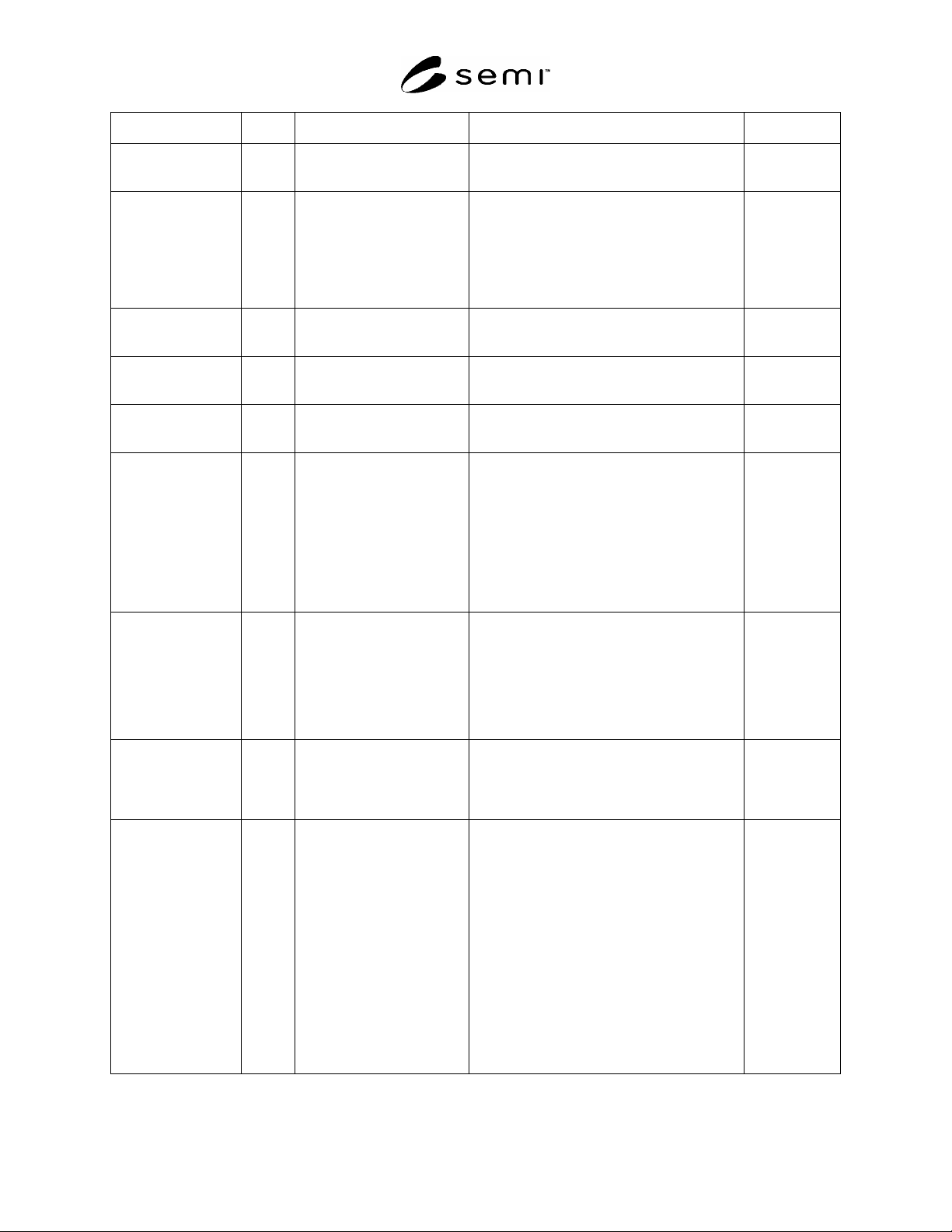
Name Format Description Values Where Used
ACDS 32, 52 After Command Codes
Vector of all command codes
which defined command must
succeed within the same block.
S7F22
ACKA 11 Indicates success of a request:
TRUE is successful else FALSE
S5F14, F15,
F18;
S16F2, F4, F6,
F12, F14, F16,
F18, F24, F26,
F28, F30;
S17F4, F8, F14
ACKC3 10 Acknowledge code, 1 byte
0 = Accepted
>0 = Error, not accepted
1-63 Reserved
S3F6, F8, F10
ACKC5 10 Acknowledge code, 1 byte
0 = Accepted
>0 = Error, not accepted
1-63 Reserved
S5F2, F4
ACKC6 10 Acknowledge code, 1 byte
0 = Accepted
>0 = Error, not accepted
1-63 Reserved
S6F2, F4, F10,
F12, F14
ACKC7 10 Acknowledge code, 1 byte
0 = Accepted
1 = Permission not granted
2 = Length error
3 = Matrix overflow
4 = PPID not found
5 = Mode unsupported
6 = Command will be performed
with completion signaled later
>6 = Other error
7-63 Reserved
S7F4, F12, F14,
F16, F18, F24,
F32, S7F38,
F40, F42, F44
ACKC7A 31, 51 Acknowledge Code, 1 byte
0 = Accepted
1 = MDLN is inconsistent
2 = SOFTREV is inconsistent
3 = Invalid CCODE
4 = Invalid PPARM value
5 = Other error (described by
ERRW7)
6-63 Reserved
S7F27
ACKC10 10 Acknowledge Code, 1 byte
0 = Accepted for display
1 = Message will not be
displayed
2 = Terminal not available
3-63 Reserved
S10F2, F4, F6,
F10
ACKC13 10 Return code for secondary
messages 1 byte
0 = O.K.
1 = ERROR: Try Later
2 = ERROR: Unknown Data Set
name
3 = ERROR: Illegal Checkpoint
value
4 = ERROR: Too many open Data
Sets
5 = ERROR: Data set open too
many times
6 = ERROR: No open Data Set
7 = ERROR: Cannot continue
8 = ERROR: End of Data
9 = ERROR: Handle in Use
>10 = ERROR: Pending Transaction
11-127 Reserved
S13F2, F4, F6,
F8
SEMI E5-1104 © SEMI 1982, 2004 11
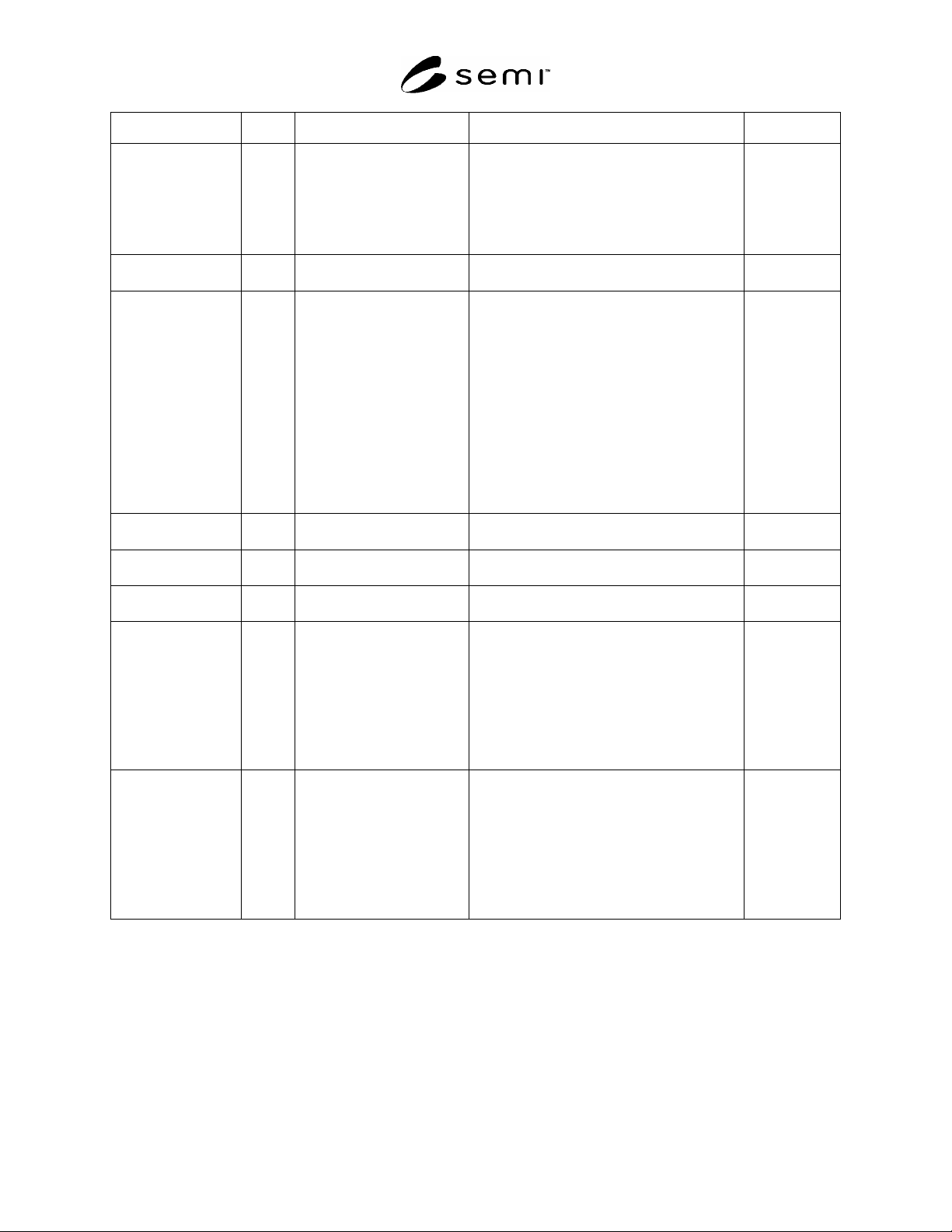
Name Format Description Values Where Used
ACKC15 10 Return code for secondary
messages, 1 byte
0 = Accepted
1 = command will be performed
with completion signaled later
2 = DSNAME not found
3 = Permission not granted
4 = other error
5-63 Reserved
S15F50,F52
AGENT 20
S15F11, F12,
F21, F22, F25
ALCD 10 Alarm code byte
bit 8 = 1 means alarm set
bit 8 = 0 means alarm cleared
bit 7-1 is alarm category
0 = Not used
1 = Personal safety
2 = Equipment safety
3 = Parameter control warning
4 = Parameter control error
5 = Irrecoverable error
6 = Equipment status warning
7 = Attention flags
8 = Data integrity
>8 = Other categories
9-63 Reserved
S5F1, F6
ALED 10 Alarm enable/disable code, 1
byte
bit 8 = 1 means enable alarm
bit 8 = 0 means disable alarm
S5F3
ALID 3(), 5() Alarm identification
S5F1, F3, F5,
F6
ALTX 20 Alarm text limited to 40
characters
S5F1, F6
ATTRDATA 0, 10,
20, 3(),
4(), 5(),
11
Contains a specific attribute
value for a specific object
S1F20;
S3F17, F18;
S13F14, F16;
S14F1, F2, F3,
F4, F9, F10,
F11, F12, F13,
F14, F15, F16,
F17, F18;
S18F2, F3
ATTRID 20, 5() Identifier for an attribute for a
specific type of object
S1F19;
S3F17, F18;
S13F14, F16;
S14F1, F2, F3,
F4, F8, F9, F10,
F11, F12, F13,
F14, F15, F16,
F17, F18;
S18F1, F3
SEMI E5-1104 © SEMI 1982, 2004 12
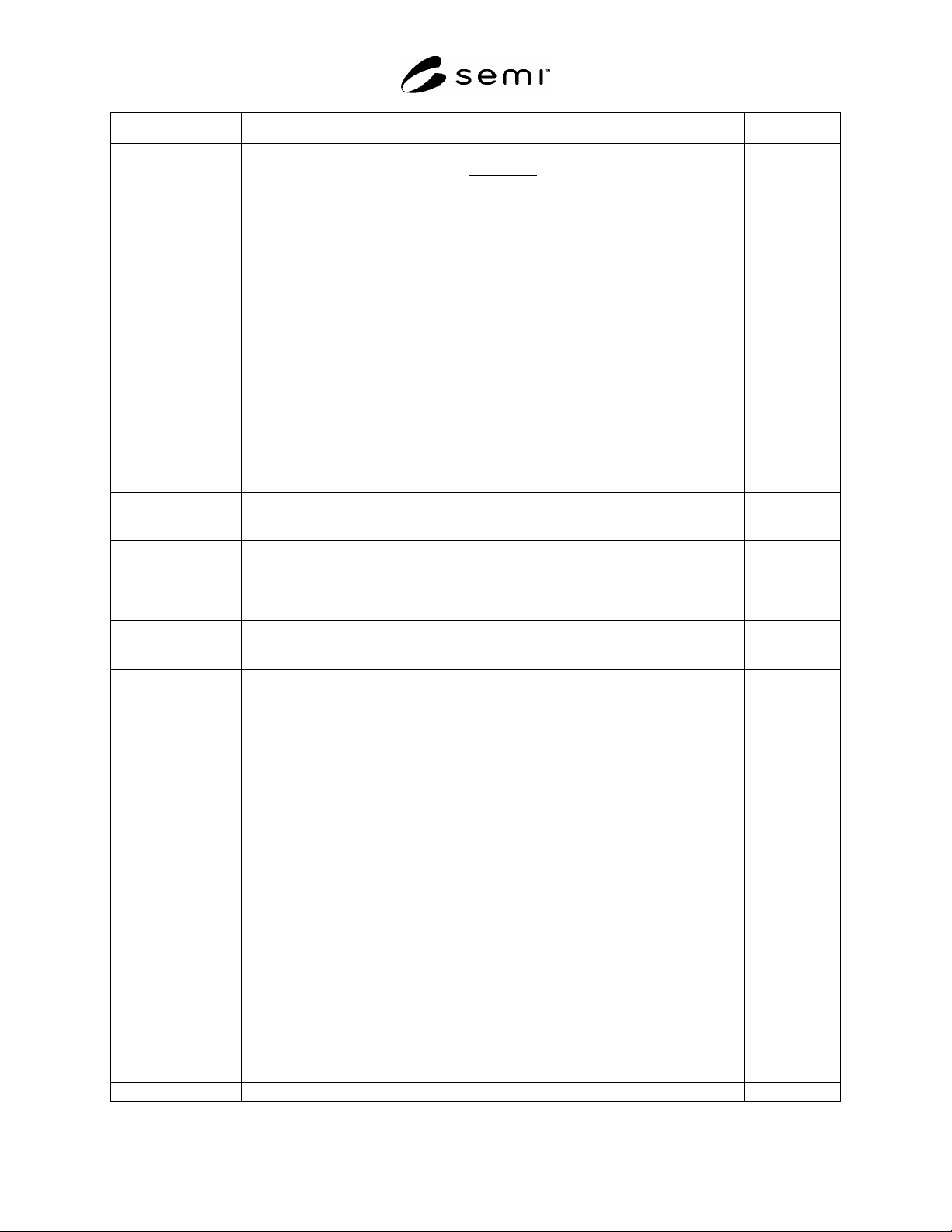
Name Format Description Values Where Used
ATTRRELN 51 The relationship that a
specified qualifying value has
to the value of an attribute of
an object instance (the value
of interest):
0 = The qualifying value is
equal to
the value of interest,
1 = The qualifying value is not
equal to the value of interest,
2 = The qualifying value is
less than the value of interest,
3 = The qualifying value is
less than or equal to the value
of interest,
4 = The qualifying value is
greater than the value of
interest,
5 = The qualifying value is
greater than or equal to the
value of interest,
6 = The qualifying value is
present (contained in the set
of) the value of interest,
7 = The qualifying value is
absent (not contained in the set
of) the value of interest,
>7 = Reserved.
S14F1
BCDS 32, 52 Before Command Codes
Vector of all command codes
which defined command must
precede within the same block.
S7F22
BCEQU 20, 51 Bin code equivalents
Array of all codes that are to
be processed. Must be the same
format as BINLT and NULBC. Zero
length indicates all codes be
sent.
S12F3, F4
BINLT 20, 51 The Bin List
Is an array of bin values.
Format must be the same as used
in NULBC and BCEQU.
S12F7, F9, F11,
F14, F16, F18
BLKDEF 31, 51 Block Definition
Blocks define the range for
before/after code checking
(specified by BCDS, IBCDS,
NBCDS, ACDS, IACDS, and NACDS).
BLKDEF specifies whether the
command being defined starts a
block (+1), terminates a block
(-1), or is within the body of a
block (0). All other values are
invalid. The outermost block of
a process program is implicit,
and is bounded by the first and
last command of the process
program. Before/after checks
for a particular command are
performed with all other
commands in the same block and
at the same nesting level. For
the purpose of before/after
checking, a set of commands
making up a block is considered
to be a single body command of
its containing block. This
command has the before/after
restrictions of the start block
command which begins the block.
S7F22
BPD 10 Boot program Data
S8F2